Quick Answer
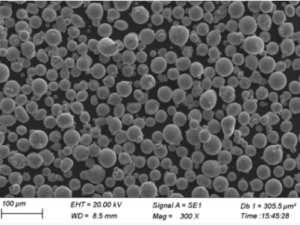
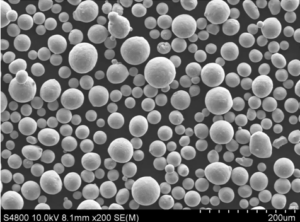
4340 alloy steel powder is a spherical Ni-Cr-Mo low alloy steel feedstock (nominal 0.40% C, 1.8% Ni, 0.8% Cr, 0.25% Mo, balance Fe) used in laser powder bed fusion, directed energy deposition, binder jetting, and powder metallurgy to produce ultra-high-strength structural parts. In powder bed fusion systems it performs well but demands respect for its hardenability: the same chemistry that delivers quenched-and-tempered tensile strength of 1,000-1,900 MPa also makes the as-printed structure prone to martensitic transformation stresses and cracking, so successful LPBF practice uses build plate preheat of 100-200 deg C, conservative scan parameters around 250-350 W and 800-1200 mm/s, layer thickness of 30-50 microns, and immediate post-build stress relief. Powder quality prerequisites are a 15-53 micron PSD for LPBF (45-106 microns for DED), sphericity above 93%, oxygen below 0.05 wt%, and Hall flow under 20 s/50 g. After quenching and tempering, printed 4340 parts reach hardness of 28-50 HRC depending on tempering temperature, with fatigue and fracture toughness suitable for gears, shafts, and aerospace fittings. Buyers should request batch certificates covering chemistry, oxygen, PSD, and flow, and should plan the heat treatment cycle as part of the process design, not as an afterthought.
What Is 4340 Alloy Steel Powder and Its Industrial Relevance
4340 alloy steel powder is the particulate form of AISI/SAE 4340, one of the most important ultra-high-strength steels in mechanical engineering. The grade belongs to the nickel-chromium-molybdenum family of low alloy steels, standardized as AISI 4340, UNS G43400, and closely related to European grades 34CrNiMo6 (1.6582) and 36CrNiMo4. In wrought form it has served for nearly a century in aircraft landing gear, crankshafts, gears, and ordnance components, anywhere that section sizes are large, loads are extreme, and toughness cannot be sacrificed for hardness.
Within the family of low alloy steel powders available for additive manufacturing and powder metallurgy, 4340 occupies the high-strength end of the spectrum. Tool steels such as H13 exceed its hot hardness and maraging steels exceed its strength-to-toughness ratio, but neither matches 4340’s combination of deep hardenability, through-section strength, and cost. The nickel content gives the alloy its signature hardenability: even heavy sections transform to martensite uniformly during quenching, which in powder metallurgy terms means consistently high strength across parts of varying wall thickness.
The industrial relevance of 4340 powder rests on several characteristics:
- Ultra-high strength capability: quenched and tempered tensile strength from 1,000 MPa up to roughly 1,900 MPa at low tempering temperatures.
- Excellent hardenability: uniform hardness through thick sections, critical for DED-repaired and large-format printed parts.
- Good toughness for its strength class: Charpy impact values remain useful even at high hardness levels.
- Fatigue resistance: a long track record in rotating and oscillating loaded components such as shafts and gears.
- Wear performance: high-temper variants serve in dies, tooling inserts, and abrasion-exposed components.
In powder bed fusion, 4340 is best understood as a high-performance material for users who have already mastered easier steels. Its carbon content and hardenability mean the printing process must be engineered around residual stress management, but the reward is printed parts with mechanical properties that approach or match wrought 4340 after proper heat treatment.
Chemical Composition Overview With Element Function Reference
The chemistry of 4340 is deliberately balanced: enough carbon for high hardness, enough nickel for hardenability and toughness, and chromium plus molybdenum to deepen the quench response and resist temper embrittlement. Powder grades follow AISI 4340 limits with additional controls on oxygen and nitrogen introduced during atomization.
Chemical Composition of 4340 Alloy Steel
| Element | Min (%) | Max (%) | Role |
|---|---|---|---|
| Carbon (C) | 0.38 | 0.43 | Primary hardening element; controls as-quenched hardness and strength |
| Nickel (Ni) | 1.65 | 2.00 | Deep hardenability; improves toughness and low-temperature impact strength |
| Chromium (Cr) | 0.70 | 0.90 | Hardenability, wear resistance, and tempering resistance |
| Molybdenum (Mo) | 0.20 | 0.30 | Suppresses temper embrittlement; raises hardenability and hot strength |
| Manganese (Mn) | 0.60 | 0.80 | Deoxidizer; hardenability and hot workability |
| Silicon (Si) | 0.15 | 0.35 | Deoxidizer; solid solution strengthening |
| Phosphorus (P) | – | 0.035 | Impurity; embrittles grain boundaries |
| Sulfur (S) | – | 0.040 | Impurity; forms MnS inclusions that reduce toughness |
| Oxygen (O, powder) | – | 0.05 | Powder interstitial; affects ductility, fatigue, and inclusion content |
| Iron (Fe) | Balance | Balance | Base matrix |
Carbon at 0.38-0.43% defines the alloy’s personality. It is high enough to deliver as-quenched hardness above 50 HRC, which is why printed 4340 cannot be treated like 316L or maraging steel: as the printed layers cool, the austenite transforms to hard, brittle martensite, generating transformation stresses that drive cracking if thermal gradients are not controlled. This single fact explains most of the process discipline discussed in the parameter guidance above.
Nickel is the hardenability anchor and the toughness guarantor. Its 1.65-2.00% addition lowers the martensite start temperature moderately while dramatically slowing the bainite and pearlite transformations, so parts harden deeply and uniformly. Nickel is also the element most responsible for 4340’s useful toughness at high strength levels where plain carbon steels become glass-brittle.
Chromium and molybdenum work as a pair. Chromium adds hardenability, wear resistance, and resistance to softening during tempering; molybdenum, though present at only 0.20-0.30%, plays the outsized role of suppressing temper embrittlement, the loss of toughness that Ni-Cr steels suffer when held or slowly cooled through the 350-550 deg C range. This is why 4340 tempers cleanly where simpler Ni-Cr steels do not.
For powder buyers, oxygen deserves the same scrutiny as the alloying elements. Atomization and powder reuse build oxide content, and oxygen above roughly 0.05 wt% raises inclusion density, directly reducing ductility and fatigue life in a material whose entire value proposition is fatigue-critical structural service.
Physical and Mechanical Properties for Engineering Design Use
Design values for 4340 depend decisively on heat treatment condition, so the data below distinguishes the annealed baseline from the quenched-and-tempered states relevant to service. Values apply to room temperature testing of wrought-equivalent material; well-processed LPBF and HIPed powder metallurgy parts achieve the same ranges.
Key Properties
| Property | Value | Unit |
|---|---|---|
| Density | 7.85 | g/cm3 |
| Melting range | 1427-1500 | deg C |
| Thermal conductivity | 44-46 | W/m*K |
| Coefficient of thermal expansion | 12.3 | um/m*K |
| Elastic modulus | 205 | GPa |
| Tensile strength (annealed) | 745 | MPa |
| Yield strength (annealed) | 470 | MPa |
| Tensile strength (Q&T, 200 deg C temper) | 1860-1930 | MPa |
| Yield strength (Q&T, 200 deg C temper) | 1640-1700 | MPa |
| Elongation (Q&T, high strength) | 10-12 | % |
| Hardness range (Q&T) | 28-50 | HRC |
| Charpy V-notch (Q&T, 28-32 HRC) | 60-80 | J |
The strength spectrum is the design headline. Tempering at around 200 deg C preserves near-maximum hardness (~48-50 HRC) and tensile strength approaching 1,900 MPa for wear and tooling duty; tempering at 425-650 deg C trades strength for toughness, landing at 1,000-1,200 MPa with 28-34 HRC and the best impact and fatigue performance, which is where most structural and rotating parts operate. This tunability across a 900 MPa strength band from a single powder chemistry is a genuine supply chain advantage.
The elastic modulus of 205 GPa and density of 7.85 g/cm3 mean 4340 parts are stiff and heavy; lightweighting arguments for printed 4340 rest on topology optimization and part consolidation rather than material substitution. Thermal conductivity around 45 W/m*K is modest, roughly one-quarter that of aluminium alloys, so printed 4340 tooling with conformal cooling channels gains real cycle-time value over conventionally drilled tools.
For LPBF designers, the critical property is not in the table: hardenability itself. Because air cooling alone can partially harden thin sections, as-printed 4340 contains hard martensitic regions locked in residual tension. Standard practice is stress relief at 550-650 deg C immediately after build, before support removal, followed by the full austenitize-quench-temper cycle (austenitizing around 845 deg C, oil or polymer quench, temper to target hardness). Skipping the stress relief is the single most common cause of cracked parts and distorted geometries.
Fatigue performance in powder-bed parts depends on porosity and surface condition. Hot isostatic pressing (HIP) closes internal pores and roughly doubles fatigue strength at 10^7 cycles compared with as-built surfaces, while machined or polished surfaces close most of the remaining gap to wrought data.
Available Grades Particle Distribution and Tolerance Standards
4340 powder is commercially available in cuts matched to each consolidation process, with LPBF grades carrying the tightest morphology and interstitial requirements.
Available Specifications
| Parameter | Standard/Value |
|---|---|
| PSD for LPBF / SLM | 15-53 um (D10 ~22, D50 ~36, D90 ~55) |
| PSD for DED | 45-106 um or 53-150 um |
| PSD for binder jetting | 15-45 um |
| PSD for MIM | 0-22 um or 0-38 um |
| PSD for press-and-sinter PM | 45-150 um |
| Sphericity | >= 93% |
| Hall flow rate | <= 20 s/50 g |
| Apparent density | >= 4.3 g/cm3 |
| Tap density | >= 4.9 g/cm3 |
| Oxygen content | <= 0.05 wt% (premium <= 0.03 wt%) |
| Chemistry reference | AISI/SAE 4340, UNS G43400 |
| Packaging | Vacuum-sealed or argon-filled, 25-50 kg drums |
The 15-53 micron LPBF cut is the default for powder bed fusion, with the fines fraction below 15 microns held under 10% to protect flowability. Steel powders of this density flow more readily than aluminium at the same cut, so 4340 layers spread uniformly even on machines with basic recoater systems, one reason it is a popular first “difficult” material for shops moving up from 316L.
DED and laser cladding grades use the coarser 45-106 or 53-150 micron cuts, which flow reliably through gravity and carrier-gas powder feeders. In directed energy deposition, 4340’s hardenability is an asset for repair work: clad layers harden consistently without preheat cracking in most geometries, provided interpass temperatures are managed.
Binder jetting and MIM consume the finest fractions. Binder jetting’s 15-45 micron cut sinters to 97-99% density with subsequent HIP closing the remainder, while MIM’s sub-38 micron powder feeds high-volume small parts such as firearm components and power tool parts. For these sintered routes, oxygen specification becomes the controlling quality variable, since sintering cannot remove oxygen dissolved in the powder itself.
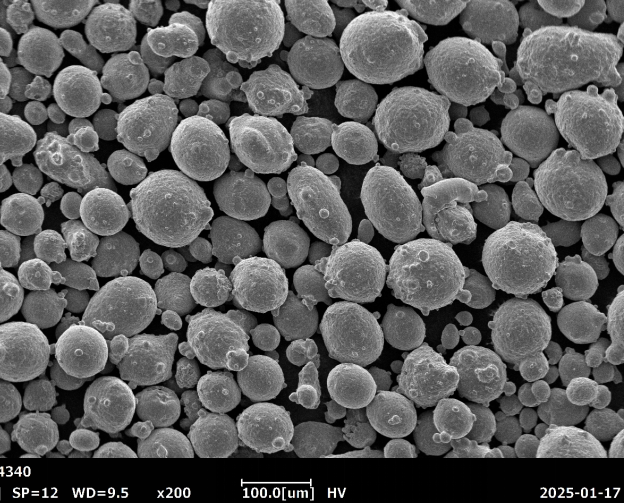
Certification and traceability expectations mirror aerospace practice: laser diffraction PSD per ISO 13320, full chemistry by OES or ICP, oxygen-nitrogen by inert gas fusion, Hall flow per ASTM B213, and SEM morphology verification per batch. Because 4340’s mechanical properties depend on heat treatment executed by the parts manufacturer, powder certificates document input quality while coupon testing after the customer’s own Q&T cycle verifies final performance. Serious suppliers support this with atomization heat traceability from melt to drum.
Manufacturing Steps From Melting to Final Powder Product Form
4340 powder is produced by inert gas atomization as the industrial standard, with the process chain engineered to hold carbon within its narrow 0.38-0.43% window and keep oxygen out.
Melting begins with low-residual scrap, iron, and ferroalloy additions (FeNi, FeCr, FeMo, FeMn) charged into a vacuum or inert-atmosphere induction furnace. Carbon control is the central melt discipline: induction melting on basic linings tends to lose carbon to oxidation and pick it up from refractories unpredictably, so experienced producers use covered melts, late carbon additions, and pre-pour analysis with corrective trim additions to land the narrow specification band.
Gas atomization (GA) converts the melt to powder. The 4340 melt, superheated to roughly 1600-1650 deg C, pours through a refractory nozzle into converging high-pressure argon or nitrogen jets that disintegrate the stream into droplets. The droplets spheroidize and solidify during free fall in the tower. Nitrogen atomization is common and economical for steel; argon is specified for premium LPBF grades where minimal nitrogen pickup and lowest satellite content are required. Well-run campaigns achieve sphericity above 93% with oxygen of 0.02-0.04 wt%.
Classification follows, using multi-deck sieving and air classification to cut the as-atomized distribution into the commercial ranges listed above. Steel powder classification is less hazardous than aluminium (no combustible dust concern at steel’s ignition energies), allowing higher-throughput conventional equipment.
Quality control and packaging complete the chain:
- Lot sampling for chemistry, oxygen-nitrogen, PSD, flow rate, and apparent and tap density.
- SEM morphology inspection for sphericity, satellites, and hollow particles.
- Blending to homogenize chemistry and PSD across the campaign.
- Packaging in sealed, desiccated, argon-backfilled or vacuum containers, since even steel powder surface-oxidizes and picks up moisture during humid storage, degrading flow and printability.
For users of premium grades, secondary processing options include plasma spheroidization to round irregular particles and classification to custom narrow distributions for specific machine platforms. Suppliers with integrated melt-atomize-classify operations, and in-house equipment depth through PREP powder making technology for coarse speciality fractions, can tune these steps to a customer’s process rather than offering only catalog cuts.
Applications by Industry Structural Thermal and Wear Components
4340 powder applications concentrate where high static strength, fatigue resistance, and wear performance converge. Representative uses are summarized below and on the supplier’s applications page.
Typical Applications by Industry
| Industry | Representative Parts | Why 4340 Powder |
|---|---|---|
| Aerospace | Landing gear fittings, actuator lugs, structural pins | Ultra-high strength, deep hardenability |
| Automotive and motorsport | Gears, shafts, driveline components, suspension nodes | Fatigue strength, wear resistance |
| Oil and gas | Downhole tool bodies, valve components, connectors | Strength in heavy sections, toughness |
| Tooling and dies | Die inserts, punches, wear plates, conformal-cooled molds | High-temper hardness 45-50 HRC |
| Defense and firearms | Breech components, small arms parts via MIM | Proven ordnance heritage, MIM economics |
| Industrial machinery | Hydraulic components, coupling parts, repair claddings | DED repair of worn shafts and surfaces |
Aerospace remains the qualification benchmark. Printed and DED-repaired 4340 fittings, lugs, and pins exploit the alloy’s ability to hold 1,500+ MPa strength with useful toughness, and the wrought material’s century of service data shortens certification arguments. DED repair of landing gear and actuator components is an established maintenance application, where 4340 clad layers restore worn bores and journals.
Automotive and motorsport use powder routes for gears, shafts, and driveline components where printed near-net shapes eliminate machining of high-hardness material, and where consolidated assemblies reduce mass in reciprocating systems. MIM-produced 4340 parts serve volume applications from power tools to transmission components.
Oil and gas values through-section strength: downhole tool bodies and high-pressure valve components see combined pressure, torsion, and impact loading in sections too thick for case-hardening grades to respond. Printed 4340 with HIP and Q&T delivers uniform properties through wall thicknesses that defeat carburizing steels.
Tooling and wear components exploit the high-temper condition. Die inserts, punches, and wear plates printed with conformal cooling channels, then tempered to 45-50 HRC, combine 4340’s abrasion resistance with thermal management impossible in drilled tools. This is one of the fastest-growing segments for the grade.
Defense and firearms applications lean on MIM: small arms components, sights, and mechanism parts are produced in volume from fine 4340 cuts, building on the alloy’s long ordnance heritage.
Across these sectors, the sourcing logic is consistent: engineers choose 4340 powder when the design needs genuine ultra-high strength with toughness, in geometries that printing or MIM produces more economically than machining from bar and forging.
Performance Comparison Against Alternative Material Grade Options
Selecting a high-strength steel powder means weighing 4340 against stainless, tool steel, and maraging alternatives, each optimized for a different balance of strength, toughness, corrosion resistance, and process ease.
4340 vs Alternative Steel AM Grades
| Property | 4340 | 17-4PH Stainless | H13 Tool Steel | 18Ni Maraging 300 |
|---|---|---|---|---|
| Alloy family | Ni-Cr-Mo low alloy | Precipitation-hardening stainless | Cr-Mo-V hot work tool steel | Ni-Co-Mo maraging |
| Tensile strength (peak, MPa) | 1860-1930 | 1170-1310 | 1600-1800 | 1930-2050 |
| Toughness at high strength | Good | Moderate | Moderate | Excellent |
| Corrosion resistance | Poor (requires coating) | Good | Poor | Poor |
| LPBF process difficulty | Moderate-high (preheat needed) | Easy | Moderate | Easy-moderate |
| Max service temperature | ~400 deg C | ~300 deg C | ~550 deg C | ~400 deg C |
| Heat treatment complexity | Austenitize + quench + temper | Single aging step | Austenitize + double temper | Single aging step |
| Relative powder cost | Low | Medium | Medium | High |
17-4PH stainless is the easy alternative: it prints almost as readily as 316L, needs only a single-step aging treatment, and resists corrosion. Its ceiling around 1,300 MPa, however, is a full 600 MPa below peak 4340, so it serves where moderate strength plus corrosion resistance suffices and process simplicity matters.
H13 tool steel competes in tooling applications, offering superior hot hardness and tempering resistance for dies that run hot, and it is the correct choice for aluminum die-casting tooling and extrusion dies. For room-temperature wear and structural duty, 4340 matches its strength at lower cost with easier heat treatment.
18Ni maraging 300 is the performance ceiling: similar peak strength to 4340 with dramatically better toughness and a forgiving single-step aging treatment that avoids quench distortion entirely. The penalty is cost, maraging powder runs several times the price of 4340, plus cobalt and nickel supply exposure. Aerospace programs justify it for the most demanding fittings; cost-sensitive structural applications default to 4340.
The selection rule compresses cleanly: choose 17-4PH for corrosion-resistant moderate strength, H13 for hot tooling, maraging for maximum toughness at maximum strength, and 4340 when the design needs 1,500-1,900 MPa class strength with good toughness at the lowest material cost, accepting the heat treatment discipline that comes with it.
Our Company
Shanghai Truer Technology Co., Ltd is a China-based additive manufacturing supplier integrating PREP powder making equipment and high-quality spherical metal powders. Established in 2009, the company offers both gas atomization (GA) and PREP manufacturing capabilities across nickel alloys, titanium alloys, aluminium alloys, stainless steels, cobalt alloys, copper alloys, low alloy steels, high-entropy alloys, and specialty materials.
For low alloy steel feedstock, Truer supplies 4340, 4140, and related grades in LPBF, DED, binder jetting, and MIM particle size cuts, with argon-atomized premium options for oxygen- and nitrogen-sensitive structural applications. Every batch ships with a certificate of analysis covering full chemistry against AISI limits, oxygen-nitrogen content, PSD by laser diffraction, Hall flow, apparent density, and SEM morphology on request, providing the batch consistency that heat-treat-qualified processes require.
The company also supports custom alloy development, small-batch prototyping quantities, and scale production for aerospace, automotive, oil and gas, tooling, and industrial customers. A joint innovation center for metal 3D printing, operated with leading research institutions, assists customers with parameter development and post-process heat treatment optimization for hardenable steels such as 4340.
For inquiries about 4340 alloy steel powder specifications, sampling, or custom chemistry windows, contact the team with your target PSD, oxygen limit, and annual volume estimate.
FAQ
Q1: What is the typical particle size distribution for 4340 alloy steel powder? A: The standard LPBF cut is 15-53 microns, with 45-106 or 53-150 microns for DED and cladding. Fine cuts of 0-22 or 0-38 microns serve MIM, and 15-45 microns is typical for binder jetting.
Q2: Can 4340 powder be used in both SLM and DED systems? A: Yes, with the PSD matched to the process: 15-53 microns for SLM/LPBF and coarser cuts for DED. Both processes require attention to the alloy’s hardenability, using preheat and immediate post-build stress relief to prevent martensitic cracking.
Q3: What certifications does 4340 powder come with? A: Standard supply includes a certificate of analysis with full chemistry against AISI 4340 limits, oxygen-nitrogen content, PSD by laser diffraction, Hall flow rate, and apparent density. SEM morphology reports and atomization heat traceability are available for aerospace and defense programs.
Q4: What is the MOQ for ordering 4340 powder? A: Sample quantities of 10-20 kg are available for parameter development and heat treatment qualification. Production orders typically start at 50 kg, with volume pricing at 200 kg and above.
Q5: Can the composition of 4340 powder be customized? A: Yes. Carbon can be targeted within the 0.38-0.43% band, low-phosphorus and low-sulfur premium melts are available, and related grades such as 4140 or 300M variants can be produced on the same atomization platform with a minimum campaign quantity.
Q6: What is the typical lead time for 4340 powder orders? A: Standard cuts are usually available from stock or within 1-2 weeks. Custom chemistries, argon-atomized premium grades, and large campaign quantities typically require 3-6 weeks depending on melting and atomization scheduling.