Quick Answer
AlZn10 cladding powder is a spherical aluminium-zinc alloy feedstock containing approximately 10% zinc with the balance aluminium, used primarily in thermal spraying (arc, flame, and atmospheric plasma spray) and laser cladding to deposit sacrificial corrosion-protection coatings on steel structures and to clad or repair high-strength aluminium components. Its engineering value rests on electrochemistry: the 10% zinc addition shifts the alloy’s corrosion potential roughly 100-200 mV more negative than pure aluminium, so the coating acts as a sacrificial anode, protecting underlying steel cathodically even at scratches and cut edges, while aluminium in the matrix forms a stable, slow-corroding barrier layer that dramatically extends coating life compared with pure zinc. Typical commercial powder is supplied at 15-45 or 20-53 microns for thermal spray and 45-106 microns for laser cladding, with sphericity above 90%, oxygen below 0.10 wt%, and Hall flow under 50 s/50 g. Applied coatings reach thicknesses of 100-500 microns per pass sequence, bond strengths above 10-20 MPa on grit-blasted steel, and service lives measured in decades for marine and atmospheric exposure. Buyers should verify batch certificates for zinc content (9-11%), oxygen, PSD by laser diffraction, and flow rate, and should match the powder cut to the spray or cladding process being qualified.
What Is AIZn10 Cladding Powder and Its Benefits for Industrial Use
AlZn10 cladding powder is an aluminium-zinc alloy powder engineered for surface engineering rather than bulk part production: its purpose is to be melted, propelled, or fused onto a substrate so that the coated surface gains corrosion protection, wear support, or restored dimensions that the substrate material cannot provide on its own. The nominal composition, 10% zinc in aluminium, places the alloy in a deliberately chosen electrochemical window: zinc-rich enough to protect steel sacrificially, aluminium-rich enough to corrode slowly and form adherent protective oxide products.
Within the family of aluminium alloy powders supplied for thermal spray, cladding, and additive processes, AlZn10 fills the anticorrosion cladding niche. Structural aluminium powders such as AlSi7Mg and AlSi10Mg are optimized for building parts; AlZn10 is optimized for protecting them, and for protecting the far larger tonnage of steel infrastructure that cannot practically be galvanized or painted to multi-decade service.
The benefits that drive industrial specification of AlZn10 cladding powder include:
- Dual corrosion protection mechanism: the coating works simultaneously as a barrier layer and as a sacrificial anode, so damage sites, edges, and welds remain protected where pure barrier coatings fail.
- Long service life in marine and atmospheric exposure: Al-Zn thermal spray coatings routinely deliver 20-40 years to first maintenance in offshore and coastal environments, outperforming pure zinc in salt-laden atmospheres.
- No heat-affected distortion of the substrate: thermal spray and cladding deposit at substrate temperatures that do not alter the metallurgy of the base steel or aluminium structure.
- Excellent paint and sealer compatibility: the sprayed surface profile accepts sealers and duplex paint systems that extend life further in immersed service.
- Repair and dimensional restoration capability: worn shafts, housings, and machined surfaces can be rebuilt with the same powder used for corrosion protection.
For buyers, the practical consequence is a single feedstock serving offshore wind, bridge, marine, and general industrial maintenance markets, with qualification anchored in long-established thermal spray standards for zinc and aluminium coatings.
Chemical Composition Analysis and Key Element Role Breakdown
AlZn10’s chemistry is deliberately simple: the performance lives in the zinc level and in the exclusion of elements that disturb the coating’s electrochemical behavior. Powder specifications hold zinc in a tight window because both corrosion potential and coating integrity depend on it.
Chemical Composition of AlZn10
| Element | Min (%) | Max (%) | Role |
|---|---|---|---|
| Zinc (Zn) | 9.0 | 11.0 | Shifts corrosion potential negative; provides sacrificial protection to steel |
| Aluminium (Al) | Balance | Balance | Barrier matrix; forms stable protective oxide; slows coating consumption |
| Iron (Fe) | – | 0.50 | Impurity; limited to avoid galvanic sites and brittle intermetallics |
| Silicon (Si) | – | 0.40 | Impurity from melt practice; excess reduces coating ductility |
| Copper (Cu) | – | 0.10 | Impurity; strongly nobler than matrix, promotes localized corrosion |
| Lead (Pb) | – | 0.05 | Impurity; restricted for environmental and performance reasons |
| Cadmium (Cd) | – | 0.01 | Restricted impurity under environmental regulations |
| Oxygen (O, powder) | – | 0.10 | Powder interstitial from atomization; affects coating cohesion |
Zinc at 9-11% is the functional element. Pure aluminium coatings on steel provide excellent barrier protection but limited sacrificial action in atmospheric exposure, because aluminium’s passive film raises its potential close to steel’s; pure zinc coatings protect sacrificially but dissolve quickly in marine atmospheres. The 10% zinc addition threads the needle: it depresses the alloy’s free corrosion potential enough (typically to around -1.0 V versus saturated calomel electrode in seawater) to drive cathodic protection of exposed steel at defects, while the aluminium matrix keeps the coating’s own consumption rate low. Below 9% zinc the sacrificial drive weakens; above 11% the coating consumption rate rises and spray behavior coarsens, which is why the window is narrow and why buyers should read the zinc value on every certificate.
Aluminium as the balance provides the barrier function and the spray-friendly melting behavior. Its oxide film stabilizes the coating surface, and corrosion products of the Al-Zn system are dense and adherent, tending to seal pores in the as-sprayed lamellar structure over the first months of exposure, a self-healing characteristic documented in long-term marine exposure programs.
Iron, silicon, and copper are the controlled impurities. Copper is the most dangerous in service: nobler than the matrix, even small amounts create galvanic micro-couples that pit the coating. Oxygen matters at the powder stage: atomization forms surface oxides that carry into the coating as oxide stringers between lamellae, and excessive oxygen above 0.10 wt% measurably reduces coating cohesion and bond strength.
For cladding of aluminium substrates, the same chemistry serves a different purpose: Zn-bearing aluminium cladding alloys provide sacrificial protection to high-strength 7xxx-series structures, extending the logic that wrought producers use with clad sheet into repair and additive cladding applications.
Physical and Mechanical Properties Density Strength Hardness
AlZn10’s datasheet divides into bulk alloy constants and applied-coating properties, and buyers need both: the former for process design, the latter for performance specification. Values below reflect the alloy and arc-sprayed or plasma-sprayed coatings at room temperature.
Key Properties
| Property | Value | Unit |
|---|---|---|
| Density (alloy) | 2.85-2.90 | g/cm3 |
| Melting range | 590-645 | deg C |
| Corrosion potential (seawater, vs SCE) | approx. -1.0 | V |
| Thermal conductivity (alloy) | 120-140 | W/m*K |
| Electrical conductivity | 30-35 | % IACS |
| Coating hardness (as-sprayed) | 60-90 | HV |
| Bond strength on grit-blasted steel | 10-20+ | MPa |
| Coating porosity (as-sprayed) | 3-8 | % |
| Typical coating thickness | 100-500 | um |
| Coating tensile strength (free-standing) | 120-180 | MPa |
The density of 2.85-2.90 g/cm3 sits between aluminium and zinc, close enough to aluminium that powder handling, feeder calibration, and spray gun settings transfer directly from pure aluminium practice, a small but real operational advantage for shops running both materials.
The melting range of 590-645 deg C defines the thermal window for all deposition processes. In arc and flame spraying, wire or powder feedstock melts fully and atomizes into droplets that flatten and freeze on impact in microseconds, building the lamellar coating structure; in laser cladding, the low melting range relative to steel substrates allows full fusion of the clad layer with minimal substrate dilution when energy input is controlled. The zinc fraction introduces one process caution: zinc boils at 907 deg C, so excessive superheat in plasma or laser processing vaporizes zinc preferentially, shifting coating chemistry and generating fume; disciplined parameter windows keep the deposited composition within specification.
Coating hardness of 60-90 HV and free-standing tensile strength of 120-180 MPa describe a soft, ductile coating by design. AlZn10 coatings are not wear surfaces; they deform rather than crack under substrate flexing and thermal cycling, and their mechanical compliance is part of why they survive decades on bridges and offshore structures that expand, contract, and vibrate. Where wear resistance is also required, the AlZn10 layer serves as the corrosion base under harder topcoats.
Bond strength above 10-20 MPa on properly grit-blasted steel exceeds the cohesive strength of most paint systems severalfold, and porosity of 3-8% in the as-sprayed state is managed, not eliminated: interconnected porosity is sealed by corrosion products in service and by organic sealers in duplex systems, which is standard practice for immersed applications.
Grade Specifications Size Ranges and Quality Control Standards
AlZn10 cladding powder is supplied in cuts matched to the major spray and cladding processes, with quality documentation following thermal spray industry convention.
Available Specifications
| Parameter | Standard/Value |
|---|---|
| PSD for thermal spray (flame/plasma) | 15-45 um or 20-53 um |
| PSD for laser cladding / DED | 45-106 um |
| PSD for cold spray | 15-53 um (tight distribution) |
| Sphericity | >= 90% |
| Hall flow rate | <= 50 s/50 g |
| Apparent density | >= 1.30 g/cm3 |
| Oxygen content | <= 0.10 wt% (premium <= 0.06 wt%) |
| Moisture | <= 0.05 wt% |
| Chemistry | Zn 9-11%, balance Al |
| Packaging | Vacuum-sealed or argon-filled, 10-25 kg containers |
Thermal spray cuts of 15-45 and 20-53 microns feed flame and plasma spray powder guns, where distribution width directly affects melting consistency: oversized particles arrive at the substrate semi-molten and reduce cohesion, while excessive fines overheat, oxidize, and vaporize zinc. Tight, certified distributions with D10/D50/D90 reported are therefore not paperwork but process control. For plasma spraying of corrosion coatings, a D50 around 30-35 microns with narrow span is the common qualification target.
Laser cladding cuts of 45-106 microns flow reliably through carrier-gas powder feeders and suit the larger melt pools of laser overlay work on shafts, flanges, and structural repair. Cold spray, an emerging route for aluminium-based anticorrosion coatings that avoids zinc vaporization entirely, uses tight 15-53 micron distributions with high sphericity, since cold spray deposition efficiency depends critically on particle velocity and morphology.
Quality control standards for each batch should include:
- Zinc and impurity chemistry by ICP-OES or XRF, with zinc reported to two decimals.
- Oxygen by inert gas fusion.
- PSD by laser diffraction per ISO 13320.
- Hall flow per ASTM B213 and apparent density per ASTM B212.
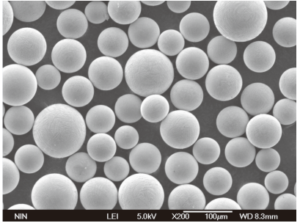
- SEM morphology imaging verifying sphericity and satellite content.
- Batch traceability from atomization heat number to packaged lot.
For infrastructure and offshore qualification programs, coating-level validation matters more than powder data alone: spray trials from the qualification lot, tested for bond strength per ASTM C633, porosity by metallography, and corrosion performance per salt spray or cyclic exposure standards, close the loop between powder quality and coating performance. Serious suppliers support this with retained batch samples and stable atomization practice across reorders.
Manufacturing Steps From Melting to Final Powder Product Form
AlZn10 cladding powder is produced by gas atomization as the standard industrial route, with the process chain designed around zinc’s volatility and aluminium’s oxidation sensitivity.
Melting begins with primary aluminium ingot (99.7%+) and high-purity zinc (99.99% SHG grade) charged into induction or resistance furnaces under cover gas. Because zinc vaporizes aggressively at aluminium melting temperatures, furnace practice minimizes superheat time and uses late zinc addition with gentle stirring, followed by pre-pour analysis to confirm the 9-11% zinc window before tapping. Impurity control, especially copper and iron, is enforced at charge selection since neither can be removed downstream.
Gas atomization (GA) converts the melt to spherical powder: the melt pours through a refractory nozzle into converging high-pressure nitrogen or argon jets that disintegrate the stream into droplets, which spheroidize under surface tension and freeze during free fall in the sealed tower. Nitrogen atomization is standard for aluminium cladding grades and economically preferred; argon serves premium low-oxygen lots. The sealed, inert tower environment is doubly important for this alloy: aluminium powder is combustible as a fine dust, and zinc vapor recondensing in the system must be managed to prevent composition drift between the melt and the collected powder. Well-run campaigns hold oxygen at 0.04-0.08 wt% with sphericity of 90-94%.
Classification cuts the as-atomized distribution into commercial ranges using multi-deck sieving and air classification. Aluminium-alloy classification operates under inert atmosphere with explosion-rated equipment, a capital discipline that distinguishes serious producers, because the fines removed in this step are exactly the combustible fraction.
Quality control and packaging complete the chain:
- Lot sampling for chemistry, oxygen, PSD, flow rate, and apparent density.
- SEM morphology inspection for sphericity, satellites, and hollow particles.
- Blending to homogenize zinc content and distribution across the campaign.
- Packaging in vacuum-sealed or argon-backfilled moisture-barrier containers with desiccant, since aluminium powder’s hygroscopic surface oxide degrades flow and spray consistency in humid storage.
Suppliers with integrated melting, atomization, and classification, and with process depth through in-house PREP powder making technology for speciality alloy fractions, can tune PSD and chemistry to a customer’s specific spray or cladding qualification rather than supplying catalog material alone.
Applications by Industry Medical Aerospace and Power Generation
AlZn10 cladding powder applications concentrate in corrosion protection of large structures, with secondary uses in repair and component cladding. Representative uses are summarized below and on the supplier’s applications page.
Typical Applications by Industry
| Industry | Representative Uses | Why AlZn10 Powder |
|---|---|---|
| Offshore and marine | Platform structures, wind turbine towers, ship hulls and decks | Sacrificial plus barrier protection in salt atmospheres |
| Infrastructure | Bridges, lock gates, port cranes, water treatment structures | 20-40 year maintenance-free coating life |
| Power generation | Transmission towers, substation structures, hydro penstocks | Atmospheric corrosion protection, electrical conductivity |
| Oil and gas | Tank externals, flare booms, coastal pipeline supports | CUI resistance and marine exposure durability |
| Aerospace | Cladding and repair of high-strength aluminium structures | Sacrificial Al-Zn layer protects 7xxx substrates |
| Industrial maintenance | Shaft and housing rebuilds, dimensional restoration | Repair geometry plus corrosion protection in one step |
Offshore and marine is the anchor market. Thermal-sprayed Al-Zn coatings on offshore wind turbine foundations, platform jackets, and ship structures provide decades of splash-zone and atmospheric protection, and the sacrificial mechanism keeps protecting at welds, edges, and mechanical damage sites where paint systems initiate underfilm corrosion. Duplex systems, AlZn10 coating plus sealer, are standard specification for immersed and splash-zone service.
Infrastructure follows the same logic at even larger scale: bridges, hydraulic steel structures, and port equipment specified for 50-100 year design lives use thermal spray Al-Zn as the primary corrosion system, with documented performance in long-term exposure programs supporting life-cycle cost arguments that paint cannot match.
Power generation and transmission apply the coatings to lattice towers, substation steel, and hydroelectric penstocks, where the coating’s electrical conductivity is an incidental benefit on grounding-relevant structures and its durability eliminates recoating outages.
Aerospace and high-strength aluminium applications use the alloy’s other face: laser-clad Al-Zn layers on 7xxx-series structures restore corrosion protection on repaired or blended areas, extending the clad-sheet principle into maintenance and additive repair.
Industrial maintenance consumes growing volumes for shaft, bore, and housing rebuilds, where a single powder deposit restores dimension and leaves a corrosion-protected surface.
Across these sectors the sourcing logic is consistent: where steel or high-strength aluminium must survive decades outdoors, in salt air, or in immersion, and where maintenance access is expensive, AlZn10 cladding converts corrosion protection from a recurring maintenance cost into a one-time capital decision.
Performance Comparison Against Alternative Material Grade Options
Anticorrosion coating selection weighs AlZn10 against the pure metals it blends and the richer zinc alloy it competes with.
AlZn10 vs Alternative Thermal Spray Coating Materials
| Property | AlZn10 | Pure Zn | Pure Al | Zn-15Al |
|---|---|---|---|---|
| Nominal composition | Al-10% Zn | Zn >99.9% | Al >99.5% | Zn-15% Al |
| Protection mechanism | Barrier + sacrificial | Sacrificial | Barrier (+mild sacrificial) | Barrier + strong sacrificial |
| Coating consumption rate (marine) | Low | High | Very low | Moderate |
| Sacrificial drive to steel | Good | Strong | Weak | Strong |
| Service life (marine atmospheric) | 20-40 years | 10-20 years | 20-40 years | 15-30 years |
| Immersed seawater suitability | Good (with sealer) | Moderate | Good (with sealer) | Good |
| Spray process compatibility | Flame, plasma, arc, laser, cold spray | Flame, arc | Flame, arc, cold spray | Flame, arc |
| Relative material cost | Medium | Low | Low-medium | Low-medium |
Pure zinc is the historical standard for steel protection and remains cheapest per kilogram, but its high consumption rate in marine atmospheres limits service life, and its corrosion products are voluminous in salt environments. Zinc still wins for short-to-medium design lives and for galvanized-equivalent atmospheric duty where cost dominates.
Pure aluminium coats slowly and lasts long in marine exposure, but its passive film weakens sacrificial action at defects in atmospheric service, leaving cut edges and scratches vulnerable. It excels in high-temperature oxidation service (to ~500 deg C) where zinc-bearing coatings cannot operate, a clear dividing line: above 300-350 deg C service temperature, specify aluminium, not AlZn10.
Zn-15Al approaches the same compromise from the zinc-rich side, offering stronger sacrificial drive with better life than pure zinc, but its zinc-rich matrix still consumes faster than AlZn10 in marine atmospheres. The two pseudo-alloys bracket the design space: Zn-15Al where sacrificial strength matters most, AlZn10 where coating longevity and aluminium-rich barrier behavior lead.
The selection rule: pure zinc for economical short-life protection, Zn-15Al for maximum sacrificial drive, pure aluminium for high-temperature or immersion-optimized duty, and AlZn10 as the balanced default for marine and atmospheric structures specified at 20 years and beyond, with pure metal powders covering the single-element alternatives where the design calls for them.
Our Company
Shanghai Truer Technology Co., Ltd is a China-based additive manufacturing supplier integrating PREP powder making equipment and high-quality spherical metal powders. Established in 2009, the company offers both gas atomization (GA) and PREP manufacturing capabilities across nickel alloys, titanium alloys, aluminium alloys, stainless steels, cobalt alloys, copper alloys, high-entropy alloys, and specialty materials.
For thermal spray and cladding feedstock, Truer supplies AlZn10 and related aluminium-zinc compositions alongside pure aluminium, zinc-aluminium pseudo-alloys, and structural aluminium grades, in particle size cuts matched to flame spray, plasma spray, laser cladding, DED, and cold spray processes. Every batch ships with a certificate of analysis covering zinc content to two decimals, oxygen by inert gas fusion, PSD by laser diffraction, Hall flow, apparent density, and SEM morphology on request, supporting coating qualification programs and production reorder consistency.
The company also provides custom alloy development, including zinc content adjustment within and beyond the 9-11% window, plus small-batch prototyping quantities and scale production for offshore, infrastructure, energy, and industrial maintenance customers. A joint innovation center for metal 3D printing, operated with leading research institutions, supports customers developing laser cladding and cold spray parameters for aluminium-based coating systems.
For inquiries about AlZn10 cladding powder specifications, sampling, or custom compositions, contact the team with your spray or cladding process, target PSD, and annual volume estimate.
FAQ
Q1: What is the typical particle size distribution for AlZn10 cladding powder? A: Thermal spray grades are supplied at 15-45 or 20-53 microns, laser cladding and DED at 45-106 microns, and cold spray at tight 15-53 micron distributions. Custom cuts can be classified to match specific gun and feeder requirements.
Q2: Can AlZn10 powder be used in both thermal spray and laser cladding systems? A: Yes, with the PSD matched to the process: finer cuts for flame and plasma spray, coarser 45-106 micron fractions for laser cladding. Laser processing requires controlled energy input to limit zinc vaporization and keep the deposited coating chemistry within specification.
Q3: What certifications does AlZn10 powder come with? A: Standard supply includes a certificate of analysis with zinc content reported to two decimals plus impurity chemistry, oxygen by inert gas fusion, PSD by laser diffraction, Hall flow rate, and apparent density. SEM morphology reports and atomization heat traceability are available for infrastructure and offshore qualification programs.
Q4: What is the MOQ for ordering AlZn10 powder? A: Sample quantities of 10-20 kg are available for spray trials and coating qualification. Production orders typically start at 50 kg, with volume pricing above 200 kg for ongoing spray programs.
Q5: Can the composition of AlZn10 powder be customized? A: Yes. Zinc content can be adjusted within or beyond the 9-11% window, and related Al-Zn compositions can be produced on the same atomization platform. Custom compositions require a minimum atomization campaign quantity and a short development cycle.
Q6: What is the typical lead time for AlZn10 powder orders? A: Standard thermal spray cuts are usually available from stock or within 1-2 weeks. Custom compositions and large campaign quantities typically require 3-6 weeks depending on melting and atomization scheduling.