Quick Answer
Hastelloy C276 welding powder is a spherical Ni-Mo-Cr alloy feedstock (UNS N10276, nominal 57% Ni, 16% Mo, 15.5% Cr, 4% W, 5% Fe) used for plasma transferred arc (PTA) cladding, laser cladding, directed energy deposition (DED), and increasingly laser powder bed fusion of corrosion-resistant components. Seven properties define its engineering value: outstanding resistance to pitting and crevice corrosion in chloride media (PREN around 68); tolerance of both oxidizing and reducing acids, a rare dual capability; very low carbon and silicon content that keeps welds and overlays free of grain boundary precipitation, so no post-weld heat treatment is required; excellent resistance to stress corrosion cracking in hot chloride service; good mechanical strength (790 MPa tensile, 355 MPa yield annealed) with 40-60% elongation; proven weldability across PTA, laser, and wire-arc processes; and service capability from cryogenic temperatures up to about 1040 deg C in oxidizing atmospheres. For powder procurement, standard welding cuts are 45-106 and 53-150 microns for PTA and laser cladding, with 15-53 microns for LPBF, sphericity above 93%, oxygen below 0.05 wt%, and Hall flow under 18 s/50 g. Every batch should ship with full chemistry against ASTM B574/B575 limits, oxygen-nitrogen analysis, PSD by laser diffraction, and flow certification.
What Is Hastelloy C276 Welding Powder and Its Material Benefits
Hastelloy C276 welding powder is the powder form of the most widely specified corrosion-resistant nickel alloy in the chemical process industry. Developed by Haynes International and standardized as UNS N10276 under ASTM B574 (bar), B575 (plate and sheet), and B622 (pipe), C276 belongs to the Ni-Cr-Mo “C family” of alloys engineered to survive environments that destroy stainless steels in days: hot contaminated mineral acids, wet chlorine, hypochlorite, chloride-bearing process streams, and sour gas.
Within the family of nickel alloy powders available for welding, cladding, and additive manufacturing, C276 holds a unique position as the universal corrosion solution. Inconel 625 offers higher strength and better fabricability for structural work, and C22 edges ahead in strongly oxidizing media, but C276 remains the default answer when a process stream mixes oxidizing and reducing chemistry or when chloride pitting is the failure mode. As a welding and cladding powder, its role is often economical rather than structural: a 2-3 mm C276 overlay on a carbon steel or low alloy steel substrate delivers full corrosion performance at a fraction of solid-alloy cost, which is why weld overlay of flanges, valve seats, pressure vessel nozzles, and pipe internals consumes the majority of C276 powder tonnage.
The material benefits that drive specification of C276 powder include:
- Broad-spectrum corrosion resistance: one of very few alloys resistant to both oxidizing and reducing acids, including sulfuric, hydrochloric, phosphoric, and acetic acid across wide concentration and temperature ranges.
- Exceptional chloride pitting and crevice corrosion resistance: PREN around 68, far above any stainless steel, suiting seawater, brine, and chloride process service.
- As-welded corrosion performance: ultra-low carbon (0.01% max) and silicon suppress grain boundary carbide precipitation in the heat-affected zone, so overlays and printed parts perform in the as-deposited condition without solution annealing.
- Stress corrosion cracking immunity: effectively immune to chloride SCC that plagues austenitic stainless steels above 60 deg C.
- Excellent weldability: low susceptibility to hot cracking, compatible with dissimilar welding to steel substrates for overlay work.
In powder form, these benefits extend to additive manufacturing: printed C276 valve internals, pump components, and heat exchanger parts combine the alloy’s corrosion pedigree with geometries impossible to machine, while selective laser melting (SLM) parameter sets for C276 are now mature enough for production qualification.
Chemical Composition Analysis and Key Element Role Breakdown
C276’s corrosion performance is written in its chemistry: very high molybdenum for reducing acids and chloride pitting, substantial chromium for oxidizing media, tungsten as a strengthening supplement, and deliberately starved carbon and silicon to protect weldability. Powder grades hold the full wrought specification with added controls on oxygen and nitrogen from atomization.
Chemical Composition of Hastelloy C276
| Element | Min (%) | Max (%) | Role |
|---|---|---|---|
| Nickel (Ni) | Balance | Balance | Base matrix; inherent resistance to reducing acids and chloride SCC |
| Molybdenum (Mo) | 15.0 | 17.0 | Resistance to reducing acids, pitting, and crevice corrosion |
| Chromium (Cr) | 14.5 | 16.5 | Resistance to oxidizing media; passive film formation |
| Tungsten (W) | 3.0 | 4.5 | Solid solution strengthening; supplements Mo in localized corrosion resistance |
| Iron (Fe) | 4.0 | 7.0 | Cost-reducing addition; controlled to preserve corrosion performance |
| Cobalt (Co) | – | 2.5 | Residual element with defined limit |
| Manganese (Mn) | – | 1.0 | Deoxidizer and melting residual |
| Vanadium (V) | – | 0.35 | Residual element |
| Silicon (Si) | – | 0.08 | Kept ultra-low to prevent HAZ precipitation and hot cracking |
| Carbon (C) | – | 0.01 | Kept ultra-low to prevent grain boundary carbide precipitation |
| Oxygen (O, powder) | – | 0.05 | Powder interstitial; affects ductility and overlay integrity |
Molybdenum at 15-17% is the alloy’s workhorse element. It drives resistance to hydrochloric and sulfuric acid (reducing conditions where chromium-rich alloys fail), and it is the dominant contributor to pitting and crevice corrosion resistance in chlorides, the property that matters most in seawater, brines, and bleaching plant service. In the PREN formula (Cr + 3.3 x Mo), molybdenum’s 16 points contribute over 50 of C276’s roughly 68 total.
Chromium at 14.5-16.5% covers the other half of the chemical spectrum: oxidizing media such as nitric acid, ferric and cupric salts, and wet chlorine, where a stable chromium-rich passive film protects the surface. The Mo-Cr balance is what makes C276 the safe default when process chemistry varies or is poorly characterized.
Tungsten at 3-4.5% reinforces molybdenum’s localized corrosion resistance and adds solid solution strength, while iron at 4-7% is a deliberate economizing addition held within limits that do not compromise performance.
Carbon and silicon, capped at 0.01% and 0.08% respectively, define the alloy’s welding personality. During welding, cladding, or the repeated thermal cycles of LPBF, ordinary Ni-Mo-Cr alloys precipitate grain boundary carbides and intermetallic phases that create corrosion attack paths; C276’s starved interstitials prevent this, which is why it performs in the as-welded condition where predecessors like Alloy C required solution annealing after welding. For powder buyers, this chemistry logic extends to oxygen: gas atomization introduces surface oxides, and keeping total oxygen below 0.05 wt% preserves the ductility and deposit integrity that overlay and AM applications demand.
Physical and Mechanical Properties Reference Data for Design
C276 is a solution-strengthened alloy: it does not age harden, so properties are stable and predictable from welding and additive thermal cycles. Values below reflect the annealed condition at room temperature unless noted.
Key Properties
| Property | Value | Unit |
|---|---|---|
| Density | 8.89 | g/cm3 |
| Melting range | 1323-1371 | deg C |
| Thermal conductivity (RT) | 9.8-10.2 | W/m*K |
| Electrical resistivity | 1.30 | uOhm*m |
| Coefficient of thermal expansion (20-200 deg C) | 11.2 | um/m*K |
| Elastic modulus | 205 | GPa |
| Tensile strength (annealed) | 790-830 | MPa |
| Yield strength (annealed) | 355-400 | MPa |
| Elongation | 40-60 | % |
| Hardness (annealed) | 87-95 | HRB |
| PREN (pitting resistance equivalent) | ~68 | – |
| Max service temp (oxidizing) | ~1040 | deg C |
The mechanical profile, 790 MPa tensile with 40-60% elongation, describes a tough, ductile alloy rather than a high-strength one. C276 parts yield gradually and deform substantially before failure, a valuable safety characteristic in pressure equipment. Strength rises significantly with cold work (to 1,200+ MPa in heavily worked condition), which matters for machined overlay surfaces and for printed parts where rapid solidification produces a modest strength increase over wrought annealed values.
Thermal conductivity around 10 W/m*K, roughly one-fifteenth that of copper and one-quarter that of carbon steel, has two practical consequences. In cladding and DED, heat concentrates at the deposition zone, so interpass temperature control (typically below 100-150 deg C) prevents excessive dilution and residual stress; in LPBF, the low conductivity supports fine feature resolution but requires scan strategy management on thin walls to avoid heat accumulation and distortion.
The PREN value near 68 is the single number that explains most C276 specifications: super duplex stainless steels reach 40-45, 6% Mo super austenitics reach 43-48, and only the most highly alloyed nickel grades exceed C276’s localized corrosion resistance. Combined with effective immunity to chloride stress corrosion cracking, a failure mode that eliminates austenitic stainless steels from hot chloride service entirely, the alloy covers the great majority of severe chemical environments with a single material selection.
For additive and overlay designers, the absence of precipitation hardening simplifies post-processing: printed or clad C276 needs no aging treatment, and solution annealing at 1120-1175 deg C followed by rapid cooling is required only when maximum corrosion performance or full stress relief is specified. As-deposited overlays routinely pass standard corrosion testing (ASTM G28, G48) without any heat treatment, which is precisely the property that made C276 the world’s default weld overlay alloy.
Powder Specifications Size Distribution and Grade Availability
C276 powder is supplied in cuts matched to each deposition and consolidation process, with welding and cladding grades dominating commercial volumes.
Available Specifications
| Parameter | Standard/Value |
|---|---|
| PSD for PTA welding | 45-106 um or 53-150 um |
| PSD for laser cladding / DED | 45-106 um |
| PSD for LPBF / SLM | 15-53 um (D10 ~22, D50 ~35, D90 ~54) |
| PSD for thermal spray | 15-45 um or 20-53 um |
| Sphericity | >= 93% |
| Hall flow rate | <= 18 s/50 g |
| Apparent density | >= 4.6 g/cm3 |
| Tap density | >= 5.2 g/cm3 |
| Oxygen content | <= 0.05 wt% (premium <= 0.03 wt%) |
| Nitrogen content | <= 0.05 wt% |
| Chemistry reference | UNS N10276, ASTM B574/B575, AWS A5.14 ERNiCrMo-4 equivalent |
| Packaging | Vacuum-sealed or argon-filled, 25-50 kg drums |
PTA and laser cladding cuts of 45-106 and 53-150 microns are the workhorse welding grades, engineered for reliable feeding through gravity and carrier-gas powder systems. The high density of C276 (8.89 g/cm3) gives its powder excellent flow and feeding stability, and gas-atomized sphericity above 93% ensures consistent delivery rates, critical for overlay dilution control, where feeding variation translates directly into iron dilution from the substrate and degraded corrosion performance in the first cladding layer.
LPBF cuts of 15-53 microns serve the growing additive manufacturing segment: printed valve internals, pump impellers, and instrument components for chemical service. Distribution discipline matters here; fines below 15 microns are held under 10% to preserve flowability, and oxygen specification becomes tighter (0.03% premium) because printed thin walls have less tolerance for oxide-related lack-of-fusion defects than bulk overlays.
Grade availability spans standard gas-atomized material for general cladding through premium argon-atomized, low-oxygen lots for aerospace-adjacent and nuclear applications. Buyers should verify that certificates report the full UNS N10276 element set, including the trace elements (V, Co, Mn, Si, C) that cheap certificates omit, since silicon and carbon excursions directly compromise the as-welded corrosion performance that justifies the alloy’s price.
Batch certification should include chemistry by ICP-OES, oxygen-nitrogen by inert gas fusion, PSD by laser diffraction per ISO 13320, Hall flow per ASTM B213, and SEM morphology imaging, with atomization heat traceability from melt to drum. For cladding qualification programs, suppliers should additionally support deposit-level corrosion testing on overlays produced from qualification lots.
Manufacturing Process Gas Atomization and Quality Screening Steps
C276 welding powder is produced by inert gas atomization as the universal industrial route, with water atomization unsuitable for quality welding grades due to its irregular morphology and high oxygen pickup.
Melting uses vacuum induction or AOD-refined practice with high-purity nickel, molybdenum, chromium, and tungsten charges. The melt discipline centers on holding carbon and silicon at their ultra-low specification limits, because every downstream property, as-welded corrosion resistance, hot cracking resistance, overlay integrity, depends on them. Pre-pour analysis confirms the full chemistry before tapping.
Gas atomization (GA) converts the melt at roughly 1500-1550 deg C into spherical powder using argon or nitrogen jets. Argon atomization is preferred for premium LPBF and low-oxygen cladding grades; nitrogen atomization serves standard PTA welding grades economically, with nitrogen pickup held within specification. Droplets spheroidize during free fall and solidify in the sealed tower, with oxygen typically held at 0.02-0.05 wt% depending on grade.
Screening and classification cut the as-atomized distribution into the commercial ranges through multi-deck ultrasonic sieving and air classification. Quality welding grades demand tight oversize control, particles above the cut maximum jam PTA torch feed lines and create unmelted defects in overlays, so premium producers sieve conservatively and verify the D90 ceiling on every lot.
Quality screening before release covers:
- Full chemistry verification against UNS N10276 with all trace elements reported.
- Oxygen and nitrogen by inert gas fusion.
- PSD by laser diffraction with D10/D50/D90 reporting and fines fraction documentation.
- Hall flow and apparent density measurement.
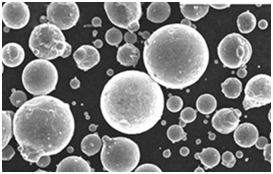
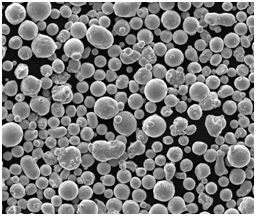
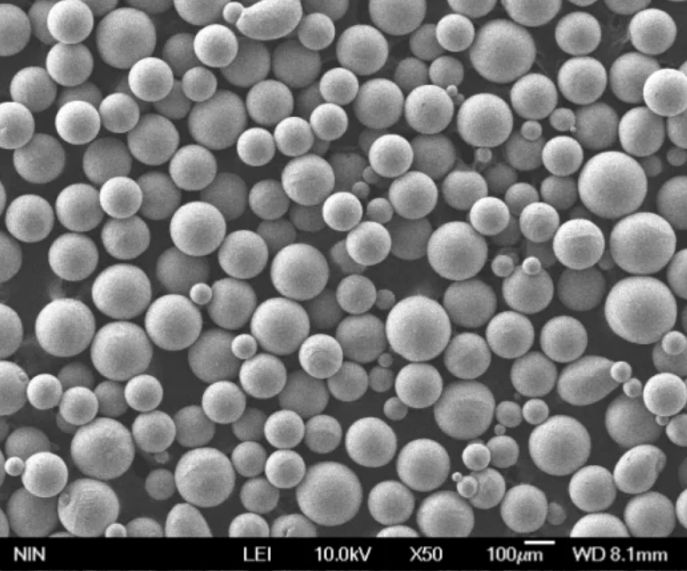
- SEM morphology inspection for sphericity, satellites, and hollow particles.
- Blending to homogenize the lot, then packaging in sealed, argon-backfilled or vacuum containers with desiccant.
For buyers running qualification programs, the meaningful extension of this chain is deposit-level validation: cladding coupons or printed test bars produced from the actual lot, tested for dilution, hardness, and corrosion performance per ASTM G48 pitting tests. Suppliers with integrated melting, atomization, and classification, and with process depth through in-house PREP powder making technology for speciality fractions, can align powder production with these downstream validation requirements rather than shipping catalog material against a data sheet alone.
Applications by Industry Additive Manufacturing End Use Markets
C276 powder applications follow the alloy’s corrosion pedigree across chemical processing, oil and gas, and environmental equipment, with additive manufacturing expanding the geometry envelope in each sector. Representative uses are summarized below and on the supplier’s applications page.
Typical Applications by Industry
| Industry | Representative Parts | Why C276 Powder |
|---|---|---|
| Chemical processing | Valve overlays, pump internals, reactor internals, agitator parts | Broad acid resistance, as-welded performance |
| Oil and gas | Downhole tool overlays, wellhead components, sour service trim | H2S and chloride resistance, NACE compliance |
| Flue gas desulfurization | Scrubber internals, duct overlays, damper components | Resists hot acidic condensate and chlorides |
| Pulp and paper | Bleach plant components, digester overlays | Wet chlorine and hypochlorite resistance |
| Waste treatment | Incinerator components, scrubber systems | Mixed oxidizing/reducing flue chemistry |
| Pharmaceutical | Reactor overlays, process vessel internals | Purity, cleanability, corrosion resistance |
| Marine and seawater | Seawater valve trim, heat exchanger components | Pitting and crevice corrosion immunity |
Chemical processing is the anchor market. PTA and laser-clad C276 overlays on valve seats, gates, and stems deliver corrosion performance on carbon steel bodies at a fraction of solid-alloy cost, and printed C276 valve cages, trim, and pump impellers now serve corrosive duties where cast geometry limited design. The alloy’s as-welded corrosion performance is the decisive property: overlays go into service without heat treatment.
Oil and gas, particularly sour service, specifies C276 for downhole tool overlays, wellhead valve trim, and Christmas tree components where H2S, chlorides, and CO2 combine. The alloy’s compliance with NACE MR0175/ISO 15156 for sour environments, combined with overlay economics, drives steady cladding powder demand, and DED repair of high-value corrosion-damaged components is a growing segment.
Flue gas desulfurization and waste incineration plants operate in exactly the mixed-chemistry regime where C276 outperforms alternatives: scrubber outlet ducts, dampers, and stack linings see hot acidic condensate with chlorides and fluctuating oxidizing potential. Weld overlay of these large steel structures consumes substantial C276 powder tonnage worldwide.
Pulp and paper bleach plants were an early adoption driver, wet chlorine and hypochlorite destroy stainless rapidly, and the installed base continues to demand overlay repair and replacement components. Pharmaceutical and fine chemical reactors specify C276 overlays for product purity and cleanability. Seawater systems use printed and clad C276 for valve trim and exchanger components where 6% Mo stainless reaches its limits.
Across these markets, additive manufacturing is shifting the mix: printed C276 parts with optimized internal geometry increasingly replace assemblies of machined and welded wrought pieces, while cladding continues to dominate by tonnage.
Comparison With Alternative Materials and Performance Data Table
Corrosion alloy selection weighs C276 against its C-family sibling, the workhorse Inconel 625, and the far cheaper stainless baseline.
Hastelloy C276 vs Alternative Corrosion-Resistant Alloys
| Property | Hastelloy C276 | Hastelloy C22 | Inconel 625 | 316L Stainless |
|---|---|---|---|---|
| Base system | Ni-Mo-Cr-W | Ni-Cr-Mo-W | Ni-Cr-Mo-Nb | Fe-Cr-Ni-Mo |
| PREN | ~68 | ~65 | ~51 | ~25 |
| Reducing acid resistance | Excellent | Good | Moderate | Poor |
| Oxidizing acid resistance | Very good | Excellent | Good | Moderate |
| Chloride SCC resistance | Immune | Immune | Excellent | Poor above 60 deg C |
| Tensile strength (annealed, MPa) | 790-830 | 790-860 | 900-930 | 515-560 |
| Yield strength (annealed, MPa) | 355-400 | 365-410 | 460-500 | 205-220 |
| As-welded corrosion performance | Excellent | Excellent | Very good | Limited (L grade) |
| LPBF printability | Good | Good | Excellent | Excellent |
| Relative material cost | High | High | Medium-high | Low |
Hastelloy C22 is the closest rival, trading some of C276’s reducing-acid performance for superior oxidizing-media resistance thanks to its higher chromium (20-22.5%). In mixed or variable chemistry, the choice is genuinely difficult and often made on specific exposure data; C276 holds the larger installed base and specification heritage, and remains the better choice where hydrochloric and sulfuric acid dominate.
Inconel 625 competes on strength and fabricability rather than ultimate corrosion resistance. It is roughly 100 MPa stronger, prints more easily in LPBF, and costs less, making it the structural choice for marine and aerospace components. In severe chemical service, its lower molybdenum (8-10%) shows: pitting resistance and reducing-acid performance fall well short of C276.
316L stainless anchors the cost baseline, perfectly adequate for mild chemical and food service, but its PREN around 25 and chloride SCC susceptibility disqualify it from the environments where C276 operates. The economic logic of C276 cladding exists precisely to bridge this gap: stainless or carbon steel structure, C276 corrosion surface.
The selection rule: 316L for mild duty, 625 for strength-driven marine and structural work, C22 when oxidizing chemistry dominates, and C276 as the default for severe, mixed, or uncertain corrosive environments, in solid form where geometry demands it, and as a powder overlay where economics demand it.
Our Company
Shanghai Truer Technology Co., Ltd is a China-based additive manufacturing supplier integrating PREP powder making equipment and high-quality spherical metal powders. Established in 2009, the company offers both gas atomization (GA) and PREP manufacturing capabilities across nickel alloys, cobalt alloys, titanium alloys, aluminium alloys, stainless steels, copper alloys, high-entropy alloys, and specialty materials.
For corrosion-resistant nickel feedstock, Truer supplies Hastelloy C276, C22, Inconel 625, 718, and related grades in PTA welding, laser cladding, DED, thermal spray, and LPBF particle size cuts. Powders are gas atomized with full trace element reporting against UNS specifications, and every batch ships with a certificate of analysis covering chemistry, oxygen-nitrogen content, PSD by laser diffraction, Hall flow, apparent density, and SEM morphology on request, supporting both cladding qualification and AM production programs.
The company also provides custom alloy development, small-batch prototyping quantities, and scale production for chemical processing, oil and gas, environmental, and marine customers. A joint innovation center for metal 3D printing, operated with leading research institutions, supports parameter development and corrosion validation testing for nickel alloy overlays and printed components.
For inquiries about Hastelloy C276 welding powder specifications, sampling, or custom PSD requirements, contact the team with your deposition process, target PSD, and annual volume estimate.
FAQ
Q1: What is the typical particle size distribution for Hastelloy C276 welding powder? A: PTA and laser cladding grades are supplied at 45-106 or 53-150 microns, while LPBF applications use the 15-53 micron cut. Thermal spray grades are available at 15-45 or 20-53 microns, and custom distributions can be classified to order.
Q2: Can C276 powder be used in both cladding and SLM systems? A: Yes, with the PSD matched to the process: coarser 45-106 micron cuts for PTA and laser cladding, and 15-53 microns for SLM/LPBF. The alloy’s low carbon and silicon chemistry gives it excellent behavior in both processes, with overlays and printed parts performing in the as-deposited condition without post-weld heat treatment.
Q3: What certifications does C276 powder come with? A: Standard supply includes a certificate of analysis with full chemistry against UNS N10276 including all trace elements, oxygen-nitrogen content by inert gas fusion, PSD by laser diffraction, Hall flow rate, and apparent density. SEM morphology reports and atomization heat traceability are available for qualification programs.
Q4: What is the MOQ for ordering Hastelloy C276 powder? A: Sample quantities of 10-20 kg are available for cladding procedure qualification and AM parameter development. Production orders typically start at 50 kg, with volume pricing above 200 kg.
Q5: Can the composition of C276 powder be customized? A: Yes. Molybdenum and chromium can be positioned within specification for specific corrosion duties, ultra-low carbon melts are available for critical welding applications, and related C-family grades can be produced on the same atomization platform with a minimum campaign quantity.
Q6: What is the typical lead time for C276 powder orders? A: Standard cladding and LPBF cuts are usually available from stock or within 1-2 weeks. Custom chemistries and large campaign quantities typically require 3-6 weeks depending on melting and atomization scheduling.