Quick Answer
AISi7Mg LPBF powder is a spherical Al-Si-Mg casting-type alloy feedstock (6.5-7.5% Si, 0.45-0.7% Mg, balance Al) engineered for laser powder bed fusion, offering a forgiving process window, near-full density at standard parameters, and T6-age-hardenable strength around 300 MPa. Optimizing processing parameters starts with the powder itself: specify a 15-53 micron PSD (D50 around 33-36 microns), sphericity above 92%, oxygen below 0.08 wt%, and Hall flow under 60 s/50 g, because layer uniformity determines melt pool stability more than any single machine setting. On typical 400 W LPBF platforms, AlSi7Mg reaches >99.5% density with laser power of 300-370 W, scan speed of 1200-1500 mm/s, hatch spacing of 0.10-0.17 mm, and layer thickness of 30-60 microns, targeting a volumetric energy density of roughly 40-65 J/mm3. A build plate preheat of 150-200 deg C reduces thermal gradients and residual stress, and rotating scan vectors 67 degrees between layers minimizes directional porosity. Post-processing follows the classic route: stress relief, solution treatment around 530-540 deg C, quench, and artificial aging at 155-165 deg C to T6. Buyers should confirm each powder batch ships with chemistry, oxygen, PSD, and flow certification, since drifting fines content and oxygen pickup across reuse cycles are the most common hidden causes of parameter instability.
What Is AISi7Mg LPBF Powder and Its Benefits for Industrial Use
AISi7Mg LPBF powder is the additive manufacturing form of the Al-Si-Mg near-eutectic casting alloy family, chemically equivalent to grades such as A357 and EN AC-42000, refined for laser powder bed fusion feedstock. The designation breaks down simply: aluminium base, approximately 7% silicon, and a magnesium addition below 1% that enables precipitation hardening. Where AlSi10Mg dominates general-purpose metal 3D printing by volume, AlSi7Mg occupies the premium structural niche: its lower silicon content delivers higher ductility and toughness after heat treatment, which is why it is the default aluminium powder for flight-critical castings adapted to AM.
Within the family of aluminium alloy powders offered for additive manufacturing, AlSi7Mg sits between the ultra-printable AlSi10Mg and the high-strength wrought-derived grades like 6061 and 7075. Its silicon level of 6.5-7.5% remains high enough to suppress the solidification cracking that plagues wrought compositions under rapid cooling, so it prints almost as easily as AlSi10Mg, while its reduced eutectic fraction leaves more of the matrix available for ductile deformation and Mg2Si precipitation strengthening.
The practical benefits for industrial users include:
- Wide process window: full density is achievable across a broad range of laser power and scan speed combinations, simplifying qualification and multi-machine production.
- Superior ductility and fatigue performance: elongation of 6-12% and improved fracture toughness versus AlSi10Mg in T6 condition.
- Excellent surface finish capability: fine, uniform melt pools produce as-built surfaces of Ra 6-12 microns on up-skin faces.
- Thin-wall and lattice capability: stable melt pool behavior supports walls down to 0.3-0.4 mm and fine lattice struts for lightweight structures.
- Established heritage data: decades of A357 premium casting data ease certification arguments in aerospace programs.
These characteristics make AlSi7Mg the reference material when a printed aluminium part must carry structural loads, not just fill space.
Chemical Composition Table With Each Element Function Explained
The chemistry of LPBF-grade AlSi7Mg is tighter than the foundry specification for A357 castings. Iron, in particular, is held far below casting limits because Fe-bearing intermetallics embrittle thin printed walls and seed fatigue cracks.
Chemical Composition of AlSi7Mg (LPBF Grade)
| Element | Min (%) | Max (%) | Role |
|---|---|---|---|
| Silicon (Si) | 6.5 | 7.5 | Lowers melting range; ensures crack-free solidification and fluidity |
| Magnesium (Mg) | 0.45 | 0.70 | Forms Mg2Si precipitates; enables T6 age hardening |
| Titanium (Ti) | 0.08 | 0.25 | Grain refiner; promotes fine equiaxed solidification structure |
| Iron (Fe) | – | 0.15 | Impurity; limited to avoid brittle AlFeSi platelets |
| Copper (Cu) | – | 0.05 | Impurity; capped to preserve corrosion resistance |
| Manganese (Mn) | – | 0.10 | Impurity control; modifies Fe phases at trace levels |
| Zinc (Zn) | – | 0.07 | Impurity from recycled feedstock |
| Oxygen (O, powder) | – | 0.08 | Powder interstitial from atomization; affects ductility and fatigue |
| Aluminium (Al) | Balance | Balance | Base matrix; low density and corrosion-resistant oxide film |
Silicon defines the alloy’s processing character. At around 7%, the composition sits close enough to the Al-Si eutectic (12.6%) to gain most of its solidification benefits, a narrow freezing range, good melt fluidity, and strong resistance to hot tearing, while keeping enough primary aluminium dendrites in the microstructure to preserve ductility. Dropping silicon below 6.5% measurably widens the cracking-prone process window; this is why the LPBF grade enforces the full 6.5-7.5% band.
Magnesium is the strengthening element. During solution treatment it dissolves into the aluminium matrix, and during artificial aging it precipitates as fine Mg2Si phases that raise yield strength from roughly 110 MPa as-built to 240-270 MPa in T6. Magnesium is also the element most affected by processing: its high vapor pressure causes selective evaporation from the melt pool surface, so printed parts typically run 0.03-0.08% lower in Mg than the feed powder, a shift that must be accounted for in qualification.
Titanium, added at 0.08-0.25%, acts as a grain refiner through Al3Ti nucleation sites, promoting the fine equiaxed grain structure that improves both crack resistance and isotropy of mechanical properties.
Iron and oxygen are the two numbers buyers should scrutinize on every certificate of analysis. Iron above 0.15% forms needle-like beta-AlFeSi phases that sharply reduce elongation, and oxygen, introduced as surface oxide during atomization and powder reuse, degrades fatigue life and increases melt pool spatter. Premium LPBF grades hold iron at 0.10% or below and oxygen under 0.08 wt%.
Physical and Mechanical Properties at Standard Test Temperature
AlSi7Mg’s property profile explains its aerospace popularity: near-AlSi10Mg strength with substantially better ductility, plus thermal conductivity useful for integrated heat management. Values below reflect room-temperature (20-25 deg C) testing of LPBF material.
Key Properties
| Property | Value | Unit |
|---|---|---|
| Density | 2.68 | g/cm3 |
| Melting range | 557-613 | deg C |
| Thermal conductivity (T6) | 150-170 | W/m*K |
| Electrical conductivity | 35-40 | % IACS |
| Coefficient of thermal expansion | 21.5-22.5 | um/m*K |
| Elastic modulus | 70-72 | GPa |
| Tensile strength (T6) | 290-320 | MPa |
| Yield strength (T6) | 240-270 | MPa |
| Elongation at break (T6) | 6-12 | % |
| Hardness (T6) | 105-120 | HB |
| Fatigue strength (10^7 cycles, HIP + T6) | 110-130 | MPa |
The density of 2.68 g/cm3 delivers the fundamental lightweighting argument: at T6 yield strength near 250 MPa, specific strength exceeds that of structural steels by a factor of three, which is why topology-optimized AlSi7Mg brackets routinely achieve 40-60% mass reduction against machined aluminium and even more against steel.
The melting range of 557-613 deg C defines both the process window and the heat treatment schedule. Solution treatment at 530-540 deg C sits just 15-20 degrees below the solidus, close enough that furnace temperature uniformity matters; overshoot risks incipient melting of eutectic silicon, visible as rounded Si particles and porosity at grain boundaries. Well-controlled LPBF practice uses stepped solution cycles or tight +/-3 deg C furnaces.
Mechanically, the as-built condition already delivers 380-430 MPa tensile strength thanks to the supersaturated, fine cellular structure from rapid solidification, but with only 3-6% elongation and significant anisotropy. The T6 cycle trades a little peak strength for the ductility, toughness, and fatigue resistance that structural applications require, and it homogenizes properties between build orientations. For fatigue-critical parts, hot isostatic pressing (HIP) at around 500 deg C and 100 MPa argon closes internal porosity before aging, typically doubling fatigue life at 10^7 cycles.
Thermal conductivity of 150-170 W/m*K in T6 condition is a genuine differentiator: it exceeds AlSi10Mg as-built values and approaches that of 6061, supporting combined structural-thermal parts such as cooled avionics chassis and motor housings with integrated cooling jackets.
Specifications and Grades for Additive Manufacturing Processes
AlSi7Mg powder is supplied in process-specific cuts, with LPBF grades subject to the tightest controls on morphology and interstitials.
Available Specifications
| Parameter | Standard/Value |
|---|---|
| PSD for LPBF / SLM | 15-53 um (D10 ~20, D50 ~34, D90 ~54) |
| Alternative LPBF fine cut | 10-45 um |
| PSD for DED | 45-106 um |
| Sphericity | >= 92% |
| Hall flow rate | <= 60 s/50 g |
| Apparent density | >= 1.30 g/cm3 |
| Tap density | >= 1.55 g/cm3 |
| Oxygen content | <= 0.08 wt% (premium <= 0.05 wt%) |
| Moisture | <= 0.05 wt% |
| Chemistry reference | A357 / EN AC-42000 type, tightened for AM |
| Packaging | Vacuum-sealed or argon-filled, 5-25 kg |
The 15-53 micron cut is the LPBF industry default, compatible with standard recoater blades and 30-60 micron layer thicknesses. Distribution shape matters as much as the nominal range: a narrow, Gaussian distribution with limited fines below 15 microns (typically under 10 vol%) flows predictably and packs to higher bed density, directly improving melt pool stability. The fine 10-45 micron cut suits machines with optimized recoater dynamics and delivers better surface finish on cosmetic parts, at the cost of tighter handling discipline because fine aluminium powder is more oxidation-sensitive and more flow-limited.
Powder reuse is where specifications meet economics. LPBF users typically sieve used powder at 63-80 microns and refresh with 30-50% virgin material per cycle. Each cycle slightly raises oxygen content and shifts the PSD as satellites and spatter are removed, so disciplined operations track oxygen and D50 trend lines per lot rather than treating powder as an infinite consumable. Most quality standards, including emerging AMS specifications for aluminium AM feedstock, cap reuse by measured oxygen and flow performance rather than by cycle count.
Batch certification should include laser diffraction PSD per ISO 13320, full chemistry by ICP-OES, oxygen/nitrogen/hydrogen by inert gas fusion, Hall flow per ASTM B213, and SEM morphology imaging. For aerospace qualification programs, suppliers should additionally provide atomization heat traceability and, where required, coupon test data printed from the actual batch. These documents are the raw material of any parameter qualification exercise, since parameters qualified on one batch only transfer to another batch of demonstrably equivalent powder.
Manufacturing Process From Raw Material to Spherical Powder Form
AlSi7Mg LPBF powder is produced almost exclusively by inert gas atomization, the only route that economically combines the required sphericity, chemistry control, and fine particle cuts.
The process begins with charge preparation: primary aluminium ingot (99.7%+ purity), crystalline silicon, and Al-Mg and Al-Ti master alloys are weighed to hit the target chemistry with compensation for magnesium losses during melting. Low-iron practice is enforced from the start, since iron cannot be removed downstream; it can only be excluded from the charge.
Gas atomization (GA) proper takes place in a sealed tower. The charge is induction or resistance melted under inert cover gas, superheated to roughly 750-850 deg C, and poured through a refractory nozzle into the path of high-velocity argon or nitrogen jets. The gas stream shreds the molten stream into droplets that spheroidize under surface tension and freeze during free fall. Argon atomization is preferred for premium LPBF grades because it eliminates nitrogen pickup and typically achieves lower satellite content; nitrogen atomization offers cost advantages for standard grades where the slightly higher gas content is acceptable.
Classification converts the broad as-atomized distribution into commercial cuts. Multi-deck ultrasonic sieving removes oversize particles, while cyclone and air classifiers strip the sub-15-micron fines that would otherwise destroy flowability. For aluminium powders this step carries safety requirements as well: fine aluminium dust is combustible, so classification lines operate under inert atmosphere with explosion-rated equipment, a capital discipline that separates serious producers from marginal ones.
Quality control and packaging close the chain:
- Representative sampling of each blended lot for chemistry, oxygen, PSD, flow, and morphology.
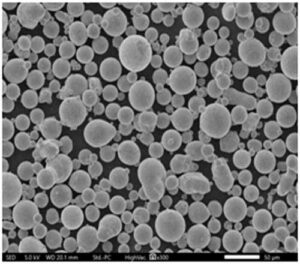
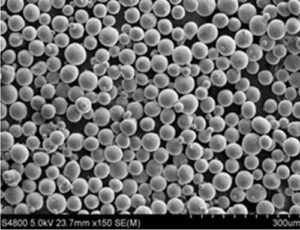
- SEM imaging to verify sphericity above 92% and satellite content within specification.
- Vacuum sealing or argon backfilling in moisture-barrier containers with desiccant, because aluminium powder’s hygroscopic surface oxide degrades both flow and printability if exposed to humid air.
For premium structural applications, some buyers also specify plasma-based spheroidization as a secondary treatment, passing gas-atomized powder through a plasma torch to round irregular particles and burn off satellites. The step adds cost but can push sphericity above 97% and improve flow measurably. Suppliers with integrated atomization and classification, including those also operating PREP powder making equipment for coarser speciality alloys, bring the process depth needed to tune these steps to a customer’s machine platform.
Applications by Industry Automotive Electronics and Aviation
AlSi7Mg LPBF parts cluster in applications where structural integrity justifies the alloy’s modest premium over AlSi10Mg. Representative uses are summarized below and on the supplier’s applications page.
Typical Applications by Industry
| Industry | Representative Parts | Why AlSi7Mg LPBF |
|---|---|---|
| Aerospace and aviation | Brackets, hinges, ducting, avionics chassis | Ductility, fatigue life, A357 heritage data |
| Space | Satellite structural panels, antenna mounts | Stiffness-to-weight, thermal stability |
| Automotive and motorsport | Suspension uprights, pedal boxes, cooling manifolds | Crash-relevant ductility, rapid iteration |
| Electronics | Heat sink chassis, RF enclosures, cold plates | Thermal conductivity 150-170 W/m*K |
| Energy | Heat exchangers, turbine sensor housings | Corrosion resistance, complex internal channels |
| Industrial robotics | End effectors, lightweight arm segments | Stiffness at minimum moving mass |
Aviation and aerospace is the anchor industry. AlSi7Mg’s combination of T6 strength near 300 MPa, 6-12% elongation, and documented A357 casting heritage makes it the default choice for printed secondary and tertiary structure: seat track fittings, avionics racks, environmental control ducting, and bracket families consolidated from multi-piece assemblies. Certification authorities respond well to the alloy precisely because its wrought and cast behavior is so thoroughly documented, shortening the data package needed for printed parts.
Space applications exploit stiffness-to-weight and dimensional stability across thermal cycles. Printed satellite panels with isogrid or lattice cores, optical bench structures, and antenna feed supports benefit from the alloy’s low thermal expansion and its ability to hold tight as-built tolerances on large, thin-walled geometries.
Automotive and motorsport value the ductility argument: suspension and structural nodes see impact and fatigue loading where AlSi10Mg’s brittleness is a liability. AlSi7Mg uprights, roll hoop fairings, and cooling system manifolds appear regularly in formula student through top-tier racing, and the same parts migrate into low-volume performance road cars.
Electronics and thermal management leverage conductivity. Printed cold plates with internal microchannels, RF filter housings, and chassis that must simultaneously carry load and move heat exploit the alloy’s 150-170 W/m*K T6 conductivity, roughly 20-30% above as-built AlSi10Mg.
Energy and industrial users print heat exchangers, valve bodies, and robotic end effectors where corrosion resistance and complex internal geometry matter more than maximum strength. Across all these sectors, the alloy’s forgiving process window translates directly into production economics: higher first-pass yield, less parameter development time, and easier transfer between machines and sites.
Comparison With Competing Materials for Similar Use Case Scenarios
Choosing among printable aluminium alloys comes down to balancing printability, strength, ductility, and conductivity against cost. The table below positions AlSi7Mg against its three most common alternatives.
AlSi7Mg vs Alternative Aluminium AM Alloys
| Property | AlSi7Mg | AlSi10Mg | Al 6061 | Scalmalloy |
|---|---|---|---|---|
| Main alloying elements | Si 7%, Mg | Si 10%, Mg | Mg, Si, Cu | Mg, Sc, Zr |
| LPBF printability | Very good | Excellent | Moderate (crack-prone) | Good |
| Tensile strength (T6/aged, MPa) | 290-320 | 320-340 | ~310 | 480-520 |
| Elongation (T6, %) | 6-12 | 4-7 | 8-12 | 10-14 |
| Thermal conductivity (W/m*K) | 150-170 | 120-150 (T6) | ~167 | 130-150 |
| Fatigue performance | High | Moderate | Moderate | Very high |
| Heritage/qualification data | Extensive (A357) | Extensive (AM) | Extensive (wrought) | Growing |
| Relative powder cost | Medium | Low | Low | Very high |
AlSi10Mg remains the volume default. It prints marginally more easily, costs less, and its as-built strength is actually higher. Buyers step up to AlSi7Mg when the part needs elongation above 6%, fatigue performance, or premium-casting-grade fracture behavior, which is exactly the profile of structural and safety-relevant parts.
Al 6061 competes on conductivity and weld compatibility with wrought assemblies, but its low silicon content makes it significantly harder to print, requiring tighter parameter control and accepting lower first-pass yield. For parts that must be welded to 6061 structure, it wins; for free-standing printed parts, AlSi7Mg is the more productive choice.
Scalmalloy (Al-Mg-Sc) outperforms AlSi7Mg on every mechanical axis, strength, ductility, fatigue, and corrosion, but at several times the powder price and with scandium supply constraints. It is reserved for parts where its performance premium translates into system-level value, typically aerospace primary structure and top-end motorsport.
The practical rule: default to AlSi10Mg for geometry-driven parts, AlSi7Mg for load-bearing structural parts, 6061 for weld-integrated or conductivity-critical assemblies, and Scalmalloy only where the performance budget allows it.
Our Company
Shanghai Truer Technology Co., Ltd is a China-based additive manufacturing supplier integrating PREP powder making equipment and high-quality spherical metal powders. Established in 2009, the company offers both gas atomization (GA) and PREP manufacturing capabilities across nickel alloys, titanium alloys, aluminium alloys, stainless steels, cobalt alloys, copper alloys, high-entropy alloys, and specialty materials.
For aluminium LPBF feedstock, Truer supplies AlSi7Mg, AlSi10Mg, AlSi12, 6061, 7075, and related grades in standard 15-53 micron and 10-45 micron cuts, with argon-atomized premium options for oxygen-critical structural applications. Every batch ships with a certificate of analysis covering chemistry, oxygen and interstitial content, PSD, Hall flow, apparent density, and SEM morphology on request, giving customers the batch-to-batch consistency that parameter qualification depends on.
The company also provides custom alloy development, small-batch prototyping quantities, and scale production for aerospace, automotive, electronics, medical, and energy customers. A joint innovation center for metal 3D printing, operated with leading research institutions, supports parameter development and process transfer projects for alloys where the process window matters as much as the chemistry.
For inquiries about AISi7Mg LPBF powder specifications, sampling, or argon-atomized premium grades, contact the team with your target PSD, oxygen limit, and annual volume estimate.
FAQ
Q1: What is the typical particle size distribution for AISi7Mg LPBF powder? A: The standard LPBF cut is 15-53 microns with a D50 around 33-36 microns, and a fine 10-45 micron cut is available for improved surface finish. Coarser 45-106 micron fractions serve DED processes.
Q2: Can AISi7Mg powder be used in both SLM and EBM systems? A: AlSi7Mg is optimized for SLM/LPBF platforms, where it prints readily at 300-400 W laser power. EBM use is less common for aluminium alloys due to magnesium evaporation under vacuum, but coarser cuts can be supplied for DED and experimental EBM work.
Q3: What certifications does AISi7Mg powder come with? A: Standard supply includes a certificate of analysis with full chemistry against A357-type limits, oxygen-nitrogen-hydrogen content, PSD by laser diffraction, Hall flow rate, and apparent density. SEM morphology reports and batch traceability documentation are available for aerospace qualification programs.
Q4: What is the MOQ for ordering AISi7Mg LPBF powder? A: Sample quantities of 5-10 kg are available for parameter development and machine qualification. Production orders typically start at 25-50 kg per batch, with volume pricing above 100 kg.
Q5: Can the composition of AISi7Mg powder be customized? A: Yes. Silicon and magnesium levels can be tuned within specification, titanium grain refiner content can be adjusted, and low-iron premium melts are available on request. Custom compositions require a minimum atomization campaign quantity.
Q6: What is the typical lead time for AISi7Mg powder orders? A: Standard argon or nitrogen-atomized cuts are usually available from stock or within 1-2 weeks. Custom compositions and large campaign quantities typically require 3-6 weeks depending on atomization scheduling and certification scope.