Quick Answer
C18150 copper chromium zirconium powder is a spherical Cu-Cr-Zr precipitation-hardening alloy feedstock (UNS C18150, nominal 0.5-1.5% Cr, 0.05-0.25% Zr, balance Cu) used in laser powder bed fusion, directed energy deposition, and powder metallurgy to produce components that must combine high electrical and thermal conductivity with useful strength at elevated temperature. After solution treatment and aging, the alloy delivers 75-85% IACS electrical conductivity, thermal conductivity of 320-330 W/m*K, tensile strength of 450-540 MPa, and softening resistance to approximately 500 deg C, a combination no pure copper or brass can approach. Buyers sourcing for industrial AM should prioritize four quality factors: chemistry held within the narrow Cr and Zr windows (both elements directly control aged strength and conductivity), low oxygen content below 0.05 wt% (critical because oxide films degrade both conductivity and LPBF fusion), high sphericity above 92% with tight PSD control (copper’s high reflectivity and thermal conductivity already make melt pools unstable, so powder consistency matters more than for steel), and batch certificates reporting all alloying elements plus oxygen. Standard cuts are 15-53 microns for LPBF and 45-106 microns for DED, with gas atomization under inert gas as the production standard. Expect printed parts to require solution annealing at 950-1000 deg C followed by aging at 450-500 deg C to develop final properties.
What Is C18150 Copper Chromium Zirconium Powder for Industry
C18150 copper chromium zirconium powder is the additive manufacturing and powder metallurgy form of one of the most successful high-conductivity copper alloys ever developed. Standardized as UNS C18150 and widely known as CuCrZr or CuCr1Zr, the alloy belongs to the precipitation-hardening copper family: a nearly pure copper matrix carrying a small, carefully controlled addition of chromium and zirconium that forms fine precipitates during aging, raising strength and heat resistance while sacrificing only a modest fraction of copper’s conductivity. In wrought form it has served for decades in resistance welding electrodes, induction heating coils, continuous casting molds, and, in its most demanding role, liquid rocket engine combustion chamber liners.
Within the family of copper alloy powders available for additive manufacturing, C18150 occupies the high-conductivity structural position. Pure copper powders offer maximum conductivity but almost no strength or softening resistance; brasses and bronzes offer strength at a fraction of copper’s conductivity; GRCop alloys push temperature capability higher at significant cost. C18150 threads the middle: the best available balance of conductivity, strength, thermal fatigue resistance, and processability, which is why it has become the default copper alloy for industrial metal AM.
The material benefits driving industrial demand for C18150 powder include:
- High conductivity with real strength: 75-85% IACS electrical conductivity at 450-540 MPa tensile strength, versus 100% IACS at only 220-250 MPa for pure copper.
- Excellent softening resistance: properties hold to roughly 500 deg C, far above pure copper’s useful limit, enabling brazing, coating, and hot-service operations without property collapse.
- Outstanding thermal fatigue performance: the combination of high conductivity and elevated-temperature strength resists the cyclic heat flux of rocket chambers, welding electrodes, and induction coils.
- Good LPBF processability: unlike pure copper, whose reflectivity and conductivity make laser melting marginal at conventional laser powers, C18150’s alloying slightly improves laser absorption, and commercial 400-500 W selective laser melting (SLM) platforms now process it routinely.
- Established qualification heritage: decades of wrought service data in aerospace and welding applications shorten certification arguments for printed parts.
In powder form, these benefits unlock the geometries that make copper AM compelling: conformal cooling channels, integrated heat exchanger passages, and combustion chamber regenerative cooling circuits that machining cannot produce.
Chemical Composition Analysis and Key Element Role Breakdown
C18150’s chemistry is minimal by design: the entire performance package rests on less than 2% total alloying, held in narrow windows because the precipitate population, and therefore the strength-conductivity balance, is set by exactly how much chromium and zirconium the matrix contains.
Chemical Composition of C18150
| Element | Min (%) | Max (%) | Role |
|---|---|---|---|
| Chromium (Cr) | 0.5 | 1.5 | Primary precipitation strengthener; forms fine Cr precipitates during aging |
| Zirconium (Zr) | 0.05 | 0.25 | Secondary strengthener; refines precipitates, raises softening temperature |
| Copper (Cu) | Balance | Balance | High-conductivity matrix |
| Iron (Fe) | – | 0.08 | Impurity; degrades conductivity if in solution |
| Lead (Pb) | – | 0.05 | Impurity; restricted, harms hot workability |
| Oxygen (O, powder) | – | 0.05 | Powder interstitial; degrades conductivity, ductility, and LPBF fusion |
| Others (total) | – | 0.20 | Controlled residual elements |
Chromium at 0.5-1.5% is the workhorse. In solution-treated condition it dissolves in the copper matrix; during aging at 450-500 deg C it precipitates as nanoscale chromium-rich particles that impede dislocation motion, roughly doubling yield strength over pure copper. The conductivity cost is modest because precipitation removes chromium from solid solution, it is solute atoms, not precipitates, that scatter electrons most strongly, so a properly aged C18150 recovers most of pure copper’s conductivity while keeping its strength. This precipitation-recovery mechanism is the alloy’s central trick, and it makes heat treatment execution as important as chemistry.
Zirconium at 0.05-0.25% is small in quantity but decisive in function. Zirconium forms Cu3Zr-type precipitates and modifies the chromium precipitate distribution, refining particle size, slowing precipitate coarsening at temperature, and thereby raising the alloy’s softening temperature from roughly 400 deg C (binary Cu-Cr) to about 500 deg C. That 100-degree margin is what qualifies CuCrZr, and disqualifies simpler CuCr, for rocket engine liners, resistance welding electrodes, and any application with sustained hot exposure. Buyers should treat the Zr value on the certificate as a first-order quality parameter, not a trace footnote.
Copper purity of the balance determines the conductivity ceiling. Every impurity atom in solid solution costs conductivity, so melt practice uses high-purity cathode copper feedstock, and the iron and residual limits exist specifically to protect it.
Oxygen deserves special attention in powder form for two reasons. First, oxygen-bearing copper (tough pitch behavior) suffers hydrogen embrittlement during the solution anneal in hydrogen-containing atmospheres; low-oxygen powder avoids this. Second, surface oxide films on powder particles impede laser absorption uniformity and inter-layer fusion in LPBF, showing up as lack-of-fusion porosity that directly cuts conductivity and fatigue life. Premium C18150 powder holds oxygen below 0.05 wt%, with best practice at 0.02-0.03%.
Physical and Mechanical Properties Reference Data for Design
C18150’s design value lies in property combinations, so the datasheet should be read in pairs: conductivity with strength, strength with temperature capability. Values below reflect the solution-treated and aged (peak) condition at room temperature unless noted, achievable in well-processed LPBF material after full heat treatment.
Key Properties
| Property | Value | Unit |
|---|---|---|
| Density | 8.89 | g/cm3 |
| Melting range | 1070-1080 | deg C |
| Electrical conductivity (aged) | 75-85 | % IACS |
| Thermal conductivity (aged) | 320-330 | W/m*K |
| Coefficient of thermal expansion | 17.0 | um/m*K |
| Elastic modulus | 128 | GPa |
| Tensile strength (aged) | 450-540 | MPa |
| Yield strength (aged) | 380-480 | MPa |
| Elongation (aged) | 10-20 | % |
| Hardness (aged) | 130-160 | HV |
| Softening temperature | ~500 | deg C |
The conductivity-strength pair is the headline. At 80% IACS and roughly 500 MPa tensile, C18150 offers four-fifths of pure copper’s electrical performance with more than double its strength, the exchange that makes compact, high-current components possible: smaller electrode holders, thinner induction coil sections, and lighter power electronics cold plates that carry mechanical load as well as heat.
Thermal conductivity of 320-330 W/m*K in aged condition places the alloy second only to pure copper among printable metals and roughly twice that of aluminium alloys, which is why printed C18150 heat exchangers and cooling components outperform aluminium designs wherever volume and heat flux density matter more than weight.
The softening temperature near 500 deg C defines the alloy’s service and processing envelope. Below this threshold, aged properties are essentially stable; above it, precipitates coarsen and strength declines. Practically, this means printed C18150 parts tolerate brazing cycles, coating processes, and hot service that would fully anneal pure copper, but designers should not specify the alloy for sustained service beyond 500-550 deg C, where GRCop-type alloys take over.
For LPBF designers, three property notes matter. First, the elastic modulus of 128 GPa and high ductility of copper systems mean thin walls survive the thermal stresses of printing better than brittle materials, but support removal from copper is laborious and should be designed around. Second, as-printed material is in a supersaturated, partially solutionized state; the full solution-and-age cycle is mandatory for specification properties, solution at 950-1000 deg C, water quench, age at 450-500 deg C for 1-4 hours. Third, residual porosity costs conductivity disproportionately: each percent of porosity removes several percent of conductivity, so density above 99.5% is the practical qualification threshold for thermal and electrical applications.
Available Grades Particle Distribution and Tolerance Standards
C18150 powder is supplied in process-matched cuts with controls reflecting copper’s particular handling sensitivities.
Available Specifications
| Parameter | Standard/Value |
|---|---|
| PSD for LPBF / SLM | 15-53 um (D10 ~22, D50 ~35, D90 ~54) |
| PSD for DED / laser cladding | 45-106 um |
| PSD for press-and-sinter PM | 45-150 um |
| Sphericity | >= 92% |
| Hall flow rate | <= 20 s/50 g |
| Apparent density | >= 4.5 g/cm3 |
| Tap density | >= 5.0 g/cm3 |
| Oxygen content | <= 0.05 wt% (premium <= 0.03 wt%) |
| Chemistry reference | UNS C18150, CuCr1Zr |
| Packaging | Vacuum-sealed or argon-filled, 10-25 kg |
The 15-53 micron LPBF cut is the industry default, with two copper-specific qualifications. First, fines below 15 microns carry disproportionate surface oxide area, and since oxide control is existential for conductivity, premium producers limit fines more strictly for copper alloys than for steels, typically under 8%. Second, powder reuse discipline matters more than for most alloys: each LPBF cycle adds oxygen pickup and copper alloy powders are more oxidation-prone than nickel or steel at equivalent handling, so operations should track oxygen trend per lot and refresh with 40-50% virgin powder per cycle for conductivity-critical parts.
DED and laser cladding cuts of 45-106 microns serve deposition of copper alloy features on combustion chambers, mold surfaces, and electrode substrates, where C18150’s thermal conductivity and bondability make it the standard repair and functional-layer material.
Press-and-sinter grades at 45-150 microns feed the traditional powder metallurgy route for welding electrode blanks and electrical contacts, a substantial tonnage market where gas-atomized spherical powder improves green density and sintered conductivity over water-atomized alternatives.
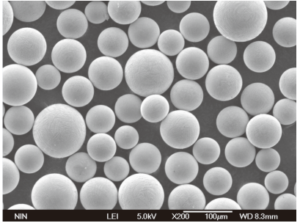
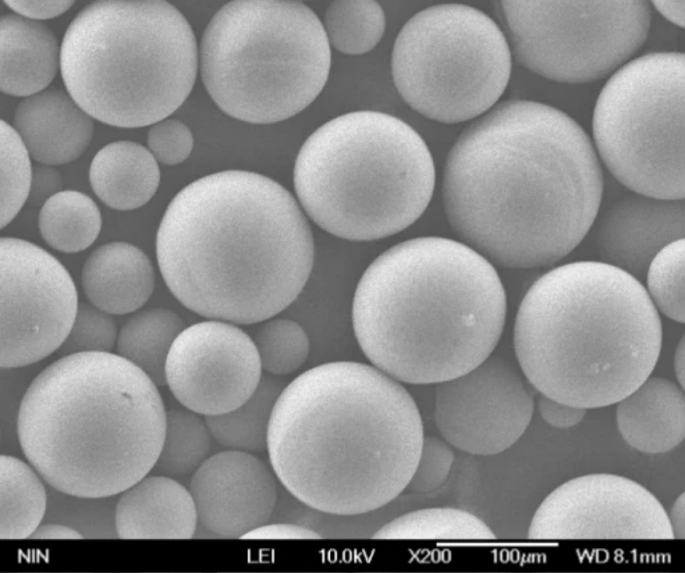
Batch certification should include full chemistry by ICP-OES with chromium and zirconium reported to two decimals, oxygen and nitrogen by inert gas fusion, PSD by laser diffraction per ISO 13320, Hall flow per ASTM B213, and SEM morphology imaging. For conductivity-critical qualification programs, the decisive document is a printed or sintered test bar measurement: conductivity by eddy current per ASTM E1004 and tensile testing after the customer’s own heat treatment cycle, since final properties depend on heat treatment execution as much as on powder quality.
Manufacturing Process From Alloy to Spherical Powder Product
C18150 powder is produced by inert gas atomization, with process design focused on two copper-specific challenges: zirconium’s reactivity and copper’s oxidation sensitivity.
Melting uses vacuum or inert-atmosphere induction furnaces with high-purity cathode copper, master alloy additions of Cu-Cr and Cu-Zr. Zirconium oxidizes aggressively in contact with air or refractory oxides, so melt practice adds it late under full inert cover with minimal hold time before pouring, and pre-pour analysis verifies both Cr and Zr recovery against the narrow specification windows. Manganese-free, low-oxygen practice is standard, and furnace lining selection matters because zirconium reduces many refractory oxides, contaminating the melt.
Gas atomization (GA) converts the melt, superheated to roughly 1200-1300 deg C, into spherical powder using nitrogen or argon jets. Nitrogen atomization is standard and economical for copper alloys; argon serves premium low-oxygen LPBF grades. Droplets spheroidize and freeze in the sealed tower, with the inert environment holding oxygen at 0.02-0.05 wt% in well-run campaigns. Copper’s high thermal conductivity makes droplet solidification fast, which helps sphericity but demands disciplined nozzle and gas-pressure design to avoid coarse, irregular fractions.
Classification cuts the as-atomized distribution into commercial ranges using multi-deck ultrasonic sieving and air classification under inert blanketing. Copper powder classification carries less explosion risk than aluminium but requires the same moisture discipline, since surface oxidation accelerates in humid air.
Quality control and packaging complete the chain:
- Lot sampling for chemistry with Cr and Zr to two decimals, oxygen-nitrogen, PSD, flow, and density.
- SEM morphology inspection for sphericity, satellites, and hollow particles.
- Blending to homogenize the campaign.
- Packaging in vacuum-sealed or argon-backfilled containers with desiccant, with short recommended shelf-life discipline for opened containers.
Suppliers with integrated melting, atomization, and classification, and with equipment depth through in-house PREP powder making technology for premium coarse fractions of specialty alloys, can tune chemistry windows and PSD to a customer’s specific machine platform and heat treatment cycle, the level of alignment that conductivity-critical AM production requires.
Applications by Industry Automotive Electronics and Aviation
C18150 powder applications cluster wherever high current density or high heat flux meets mechanical load, exactly the components where pure copper fails mechanically and structural metals fail thermally. Representative uses are summarized below and on the supplier’s applications page.
Typical Applications by Industry
| Industry | Representative Parts | Why C18150 Powder |
|---|---|---|
| Aerospace propulsion | Rocket engine combustion chamber liners, injector heads | Thermal fatigue resistance, conductivity, 500 deg C capability |
| Automotive and EV | Motor winding components, charging connectors, power electronics cold plates | Conductivity with structural strength |
| Electronics | Heat sinks, vapor chambers, RF components | 320-330 W/m*K in printable geometries |
| Welding industry | Resistance welding electrodes, seam welding wheels | Softening resistance, conductivity, wear life |
| Power and energy | Induction coils, busbar components, switchgear parts | Current density plus mechanical integrity |
| Industrial tooling | Injection mold inserts with conformal cooling | Conductivity for cycle-time reduction |
Aerospace propulsion is the flagship application. Liquid rocket engine combustion chambers operate under extreme heat flux with cryogenic fuel on one side and combustion gas above 3000 deg C on the other; regeneratively cooled liners need copper’s conductivity to move heat, alloy strength to contain pressure, and softening resistance to survive repeated firings. C18150 has become the workhorse printed-chamber material for launch and space propulsion programs, with LPBF producing the integral cooling channel geometries that define modern chamber design, a role it shares with the higher-temperature GRCop family at the extreme end.
Automotive electrification is the fastest-growing volume opportunity. EV motor components, high-current charging connectors, and power electronics cold plates all exploit the conductivity-strength combination, and printed C18150 cold plates with internal microchannel geometries move heat that die-cast and skived aluminium solutions cannot, at power densities that keep rising with each semiconductor generation.
Electronics thermal management uses printed C18150 heat sinks and vapor chamber structures where space-constrained, high-flux cooling justifies AM cost, from data center cold plates to RF amplifier thermal bases.
Welding and power industries remain the traditional base: resistance welding electrodes and seam wheels exploit softening resistance and conductivity in the industry’s longest-established CuCrZr application, while induction coils, printed with integrated cooling passages, extend service life in hardening and melting installations. Tooling rounds out demand, with conformal-cooled injection mold inserts cutting cycle times 20-40% versus drilled tools.
Across these markets, the selection logic is consistent: engineers reach for C18150 when the component must move electricity or heat like copper and carry load like a structural metal, and AM or PM delivers the geometry more economically than machining wrought bar.
Performance Comparison Against Alternative Material Grade Options
High-conductivity copper alloy selection weighs C18150 against pure copper, the simpler Cu-Cr grade, and the premium GRCop family.
C18150 vs Alternative High-Conductivity Copper Materials
| Property | C18150 (CuCrZr) | C18200 (CuCr) | OFHC Pure Cu | GRCop42 |
|---|---|---|---|---|
| Alloying system | Cu-Cr-Zr | Cu-Cr | 99.95%+ Cu | Cu-Cr-Nb |
| Electrical conductivity (% IACS) | 75-85 | 75-85 | 100-102 | 75-85 |
| Tensile strength (MPa) | 450-540 | 400-480 | 220-250 | 480-560 |
| Softening temperature | ~500 deg C | ~400 deg C | ~200-250 deg C | ~600-700 deg C |
| Thermal fatigue resistance | Very good | Good | Moderate | Excellent |
| LPBF processability | Good | Good | Difficult (high laser power/green laser) | Moderate |
| Heat treatment | Solution + age | Solution + age | None (annealed) | None required |
| Relative material cost | Medium | Medium | Low-medium | High |
C18200 (binary Cu-Cr) is the direct predecessor: nearly identical room-temperature conductivity and slightly lower strength, but its 100-degree softening disadvantage excludes it from rocket chambers, high-duty welding electrodes, and any sustained hot service. Where temperatures stay moderate, it remains a marginally cheaper alternative with essentially interchangeable printing behavior.
OFHC pure copper wins on conductivity alone, 100% IACS versus 80%, but loses everywhere else: half the strength, softening above 250 deg C, and notoriously difficult LPBF behavior due to reflectivity and conductivity, typically requiring 1 kW lasers or green laser systems. For printed parts, C18150’s slightly lower conductivity is usually the price of printability itself.
GRCop42 (Cu-4Cr-2Nb) is the premium step: Cr2Nb intermetallic strengthening pushes softening resistance to 600-700 deg C with superior thermal fatigue life and no heat treatment requirement, making it the choice for the most extreme chamber duty cycles. Its penalty is cost, niobium content and specialized processing run material cost well above C18150, plus narrower supplier availability. Most industrial applications below 500 deg C cannot justify the premium.
The selection rule: OFHC copper where conductivity is the only metric and laser capability exists, C18200 for moderate-temperature economy, C18150 as the default for any printed copper component with mechanical load and hot service to 500 deg C, and GRCop42 for the extreme thermal fatigue frontier.
Our Company
Shanghai Truer Technology Co., Ltd is a China-based additive manufacturing supplier integrating PREP powder making equipment and high-quality spherical metal powders. Established in 2009, the company offers both gas atomization (GA) and PREP manufacturing capabilities across nickel alloys, titanium alloys, aluminium alloys, stainless steels, cobalt alloys, copper alloys, high-entropy alloys, and specialty materials.
For high-conductivity copper feedstock, Truer supplies C18150 CuCrZr, C18200, GRCop42, CuSn10, and OFHC pure copper powders in LPBF, DED, and press-and-sinter cuts, with chromium and zirconium chemistry held to tight windows and oxygen controlled at premium levels for conductivity-critical applications. Every batch ships with a certificate of analysis covering full chemistry to two decimals, oxygen-nitrogen content, PSD by laser diffraction, Hall flow, apparent density, and SEM morphology on request, and retained samples support customer conductivity qualification testing.
The company also provides custom alloy development, small-batch prototyping quantities, and scale production for aerospace propulsion, automotive electrification, electronics, and welding industry customers. A joint innovation center for metal 3D printing, operated with leading research institutions, supports LPBF parameter development and solution-and-aging heat treatment optimization for copper alloy powders.
For inquiries about C18150 copper chromium zirconium powder specifications, sampling, or premium low-oxygen grades, contact the team with your target PSD, oxygen limit, and annual volume estimate.
FAQ
Q1: What is the typical particle size distribution for C18150 powder? A: The standard LPBF cut is 15-53 microns with fines below 15 microns limited to under 8% for oxidation control. DED and laser cladding use 45-106 microns, and press-and-sinter grades are available at 45-150 microns.
Q2: Can C18150 powder be used in both SLM and DED systems? A: Yes, with the PSD matched to the process. LPBF of CuCrZr is now routine on 400-500 W platforms thanks to the alloy’s improved laser absorption over pure copper, while DED and laser cladding use the coarser cuts for chamber liner and mold surface deposition.
Q3: What certifications does C18150 powder come with? A: Standard supply includes a certificate of analysis with chromium and zirconium reported to two decimals against UNS C18150, oxygen-nitrogen by inert gas fusion, PSD by laser diffraction, Hall flow, and apparent density. SEM morphology reports and retained samples for conductivity qualification are available for critical programs.
Q4: What is the MOQ for ordering C18150 powder? A: Sample quantities of 5-10 kg are available for parameter development and conductivity qualification. Production orders typically start at 25-50 kg, with volume pricing above 100 kg.
Q5: Can the composition of C18150 powder be customized? A: Yes. Chromium and zirconium can be positioned within specification to bias toward conductivity or strength, ultra-low-oxygen premium melts are available, and related grades such as C18200 or customer-specified Cu-Cr-Zr variants can be produced with a minimum campaign quantity.
Q6: What is the typical lead time for C18150 powder orders? A: Standard cuts are usually available from stock or within 1-2 weeks. Custom chemistries, argon-atomized premium grades, and large campaign quantities typically require 3-6 weeks depending on melting and atomization scheduling.