Quick Answer
Aluminium 1350 powder is the spherical powder form of AA1350, the 99.5 percent pure electrical-conductor grade of aluminium, produced by gas atomization in 15-45 um cuts for LPBF and 20-63 um or coarser fractions for cold spray and DED. With electrical conductivity of 61.8 percent IACS, thermal conductivity around 230 W/m.K, and density of 2.70 g/cm3, the alloy is the default feedstock when a printed or sprayed component must carry current or move heat rather than bear load. Additive manufacturing and cold spray with 1350 powder produce complex-geometry conductors, bus bars, heat exchangers, and cold-sprayed copper-replacement coatings that wrought processing cannot form, while the alloy’s single-phase, crack-free metallurgy makes it one of the most forgiving aluminium powders to process.
| Property | Value |
|---|---|
| Alloy System | 99.5% pure aluminium (AA1350, EC grade) |
| Density | 2.70 g/cm3 |
| Electrical Conductivity | 61.8% IACS |
| Thermal Conductivity | ~230 W/m.K |
| Typical Powder Size (LPBF) | 15-45 um |
| Typical Powder Size (cold spray) | 20-63 um |
| Tensile Strength (annealed) | 60-100 MPa |
| Key Advantage | Highest conductivity of any AM aluminium feedstock, in printable form |
What Is Aluminium 1350 Powder and Its Benefits for Industrial Use
Aluminium 1350 powder belongs to the aluminium-based alloy powder family and replicates the chemistry of AA1350, the grade the electrical industry has used for wire, bus bar, and conductor strip for a century. The 99.5 percent minimum purity is not an arbitrary figure: each tenth of a percent of dissolved impurity costs measurable conductivity, and 1350 represents the practical ceiling of conductivity available at commodity aluminium pricing.
Converting this conductor grade to spherical powder unlocks benefits that sheet, wire, and extrusion cannot deliver:
- Complex-geometry conductors. LPBF and DED produce bus bars with conformal cooling channels, three-dimensional current collectors, and integrated connector geometries that eliminate bolted joints and their contact resistance.
- Cold-spray copper replacement. Cold-sprayed 1350 coatings deposit pure aluminium conductors and corrosion-protection layers onto steel, copper, and composite substrates at a fraction of copper’s material cost and weight.
- Crack-free printability. With no significant alloying elements, the alloy solidifies without the hot-cracking tendency of high-strength aluminium grades, giving wide parameter windows and high first-pass yield.
- Thermal management performance. Thermal conductivity near 230 W/m.K exceeds every structural aluminium alloy, so printed heat sinks, cold plates, and heat exchangers in 1350 outperform alloyed alternatives where strength is not the constraint.
- Corrosion resistance and reflectivity. Commercial-purity aluminium offers excellent atmospheric corrosion resistance and high surface reflectivity, useful in lighting and thermal-radiation applications.
The designation follows the Aluminum Association system, where the leading 1 identifies the commercially pure series and the trailing 50 marks this specific purity and impurity-control level. Buyers will encounter the same grade as EC grade aluminium, Al99.5, or 1E50 in various registers, and conductor-industry specifications frequently quote it against IEC or national conductor standards rather than the AA sheet. Powder orders should reference the AA1350 chemistry window explicitly, since generic pure aluminium powder does not guarantee the transition-metal limits that conductor duty requires.
The trade-off defines the application boundary: at 60-100 MPa tensile strength, the alloy carries essentially no structural load, and any design requiring mechanical strength belongs to the alloyed grades. Selecting 1350 is a deliberate decision to optimize conductivity over strength, and the component design must respect that choice.
Chemical Composition Analysis and Key Element Role Breakdown
The composition of AA1350 is defined less by what is present than by what is excluded, because conductivity in aluminium is destroyed by dissolved impurities, particularly transition metals.
Chemical Composition of AA1350
| Element | Min (wt%) | Max (wt%) | Role |
|---|---|---|---|
| Al | 99.50 | – | Conductive base; purity level defines the grade |
| Si | – | 0.10 | Impurity limit; moderate conductivity effect |
| Fe | – | 0.40 | Impurity limit; controlled against intermetallic formation |
| Cu | – | 0.05 | Impurity limit; strong conductivity penalty per unit content |
| Mn | – | 0.01 | Strict limit; severe conductivity degradation |
| Cr | – | 0.01 | Strict limit; severe conductivity degradation |
| V + Ti | – | 0.02 | Strict combined limit; the classic conductivity killers in conductor grades |
| Zn | – | 0.05 | Impurity limit |
| Others (each/total) | – | 0.03 / 0.10 | Aggregate purity control across minor elements |
| O | – | 0.08 | Powder-quality limit; surface oxide affects layer bonding |
The element limits tell a story learned over decades of conductor production: vanadium, titanium, chromium, and manganese in solution are the most damaging impurities per atom, which is why the grade controls them in hundredths of a percent rather than tenths. Boron treatment in primary metal production ties these elements up as harmless borides, and the effectiveness of that treatment is a large part of what distinguishes true 1350 conductor stock from ordinary commercial purity aluminium.
For specification writing, the practical approach is to quote the AA1350 window in full on the purchase order rather than a simplified purity statement, and to require per-lot certification of the V+Ti combined figure specifically. These two provisions cost nothing and eliminate the most common source of dispute in conductor-grade powder procurement, namely powder that meets a headline 99.5 percent purity while carrying transition-metal levels that cost one or two percent of conductivity.
For powder buyers, the oxygen limit carries the same weight as the metallic limits. The native oxide on aluminium powder is unavoidable and even beneficial to handling safety, but excessive oxide thickness degrades interlayer bonding in LPBF and particle bonding in cold spray, so lot certificates should report oxygen and the powder should be stored sealed and dry.
Physical and Mechanical Properties at Standard Test Temperature
The data below reflect annealed reference material at standard test temperature (23 +/- 5 C), with cold-sprayed and as-built values varying with processing route.
Key Properties
| Property | Value | Unit |
|---|---|---|
| Density | 2.70 | g/cm3 |
| Melting Point | ~660 | C |
| Electrical Conductivity | 61.8 | % IACS |
| Electrical Resistivity | 0.0279 | uOhm.m |
| Thermal Conductivity | ~230 | W/m.K |
| Coefficient of Thermal Expansion | 23.6 x 10⁻⁶ | /K |
| Young’s Modulus | 68-70 | GPa |
| Yield Strength (annealed) | 20-35 | MPa |
| Tensile Strength (annealed) | 60-100 | MPa |
| Elongation (annealed) | 30-45 | % |
| Hardness (annealed) | 20-30 | HV |
| Specific Heat | ~900 | J/kg.K |
The conductivity figures are the product’s reason to exist. At 61.8 percent IACS, 1350 carries roughly 61 percent of the current that the same cross-section of copper carries, at 30 percent of the weight and a fraction of the cost, which is why overhead power lines and bus systems standardized on it. In thermal duty, 230 W/m.K exceeds even high-conductivity aluminium casting alloys by 30-50 percent, and printed 1350 heat exchangers exploit that margin in geometries that maximize surface area.
Mechanically, the alloy is very soft and extremely ductile, which has two practical consequences. First, cold spray deposition works well because the soft particles deform and bond readily at achievable gas temperatures. Second, printed and sprayed components need mechanical support or integration into a stronger structure, and designs typically treat the 1350 element as a functional insert, a conductor or heat path, carried by a structural frame of another material.
Work hardening offers a partial escape from the strength limitation where the design allows it. The annealed figures quoted here roughly double under heavy cold deformation, and cold-sprayed deposits, which are severely work-hardened by the deposition process itself, show as-sprayed tensile values of 100-150 MPa with correspondingly reduced ductility. Subsequent annealing restores full ductility and conductivity, and the choice between as-sprayed and annealed condition is made per component based on whether marginal strength or marginal conductivity matters more.
Specifications and Grades for Additive Manufacturing Processes
1350 aluminium powder is supplied as gas-atomized spherical product in fractions matched to LPBF, DED, and cold spray.
Available Specifications
| Parameter | Standard/Value |
|---|---|
| Particle Size Distribution (LPBF) | 15-45 um, 15-53 um |
| Particle Size Distribution (DED) | 45-106 um |
| Particle Size Distribution (cold spray) | 20-63 um |
| Sphericity | >= 0.85 for GA product |
| Apparent Density | >= 1.2 g/cm3 typical |
| Tap Density | >= 1.5 g/cm3 typical |
| Hall Flow Rate | <= 28 s/50g for conditioned powder |
| Oxygen Content | <= 800 ppm per lot |
| Moisture Content | <= 0.05 wt% per lot |
| Purity Basis | Al >= 99.50% with V+Ti and Cr/Mn limits certified per AA1350 |
| PSD Tolerance | D10/D50/D90 certified on every lot |
| Packaging | Vacuum-sealed, argon-flushed, 1-25 kg per container |
Cold spray is the route where this powder sees the most industrial tonnage, and its powder requirements differ subtly from LPBF: the 20-63 um cut with high purity and low oxide deposits most efficiently, because softer, cleaner particles reach the critical bonding velocity at lower gas temperature and pressure. LPBF cuts in 15-45 um print readily, with the alloy’s low reflectivity threshold relative to copper making it the easiest conductor metal to laser-process.
Safety handling applies as to all fine aluminium powders: fractions below 45 um are combustible, and storage, conveying, and reclamation should use inert conditions and appropriately rated equipment, with safety data sheets accompanying every shipment. Reuse practice in LPBF follows standard aluminium conventions, with recycled powder refreshed by 30-50 percent virgin material per cycle and oxygen re-verified periodically, since oxide accumulation affects both spreadability and the conductivity of the finished part.
Manufacturing Process Gas Atomization and Quality Screening Steps
Production begins with electrical-conductor-grade aluminium feedstock, verified against the AA1350 impurity limits before melting, because the atomization process cannot remove dissolved impurities and the powder can only be as pure as its charge. The melt is converted by gas atomization (GA) under argon, which avoids the nitrogen porosity that nitrogen atomization can introduce in pure aluminium and keeps oxygen pickup low.
The soft, low-melting metal atomizes readily, and the quality-critical work is in classification and handling:
- Classification by sieving and air separation isolates the specified size fractions, with fines below 10-15 um removed for both flowability and combustible-dust safety.
- Surface conditioning adjusts the flow behavior for recoater-based systems where specified.
- Flow and density verification confirms Hall or Carney flow rate, apparent density, and tap density values.
- Chemical analysis by ICP-OES certifies the full impurity window including the critical V+Ti combined limit, with oxygen and moisture content reported per lot.
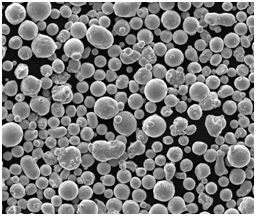
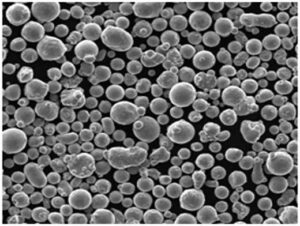
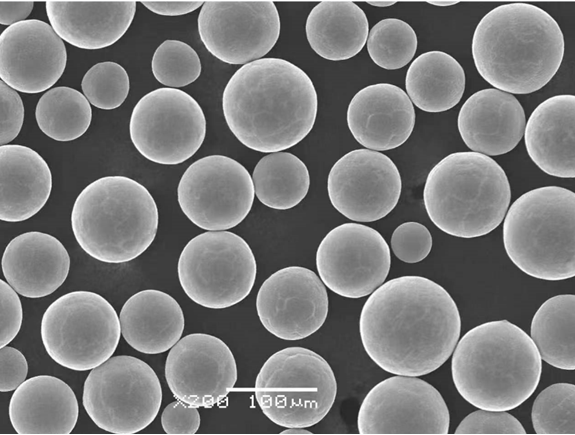
- Morphology inspection by SEM verifies sphericity, satellite content, and overall surface condition.
- Inert packaging in argon-flushed, vacuum-sealed containers with desiccant protects the powder against hydration of the surface oxide during long-term storage and international transport.
The certification point that distinguishes this product from generic pure aluminium powder is the conductor-grade impurity panel: a certificate listing only aluminium content without the vanadium, titanium, chromium, and manganese limits does not confirm AA1350, and buyers should insist on the full element window that the grade designation implies.
Applications by Industry Medical Aerospace and Power Generation
1350 powder serves industries where conductivity and geometry freedom intersect. Sector context is available on the applications page.
Power generation and distribution. The core market. Cold-sprayed aluminium conductor coatings repair corroded bus bars and substation connectors in the field, and LPBF-produced three-dimensional bus bars integrate cooling channels and connection features for compact power electronics and battery-pack interconnects. Weight-sensitive transmission and distribution hardware benefits directly from aluminium-over-copper substitution in printable geometries, and grid-modernization programs are evaluating printed sensor-integrated conductor components for smart substations.
Aerospace and aviation. Electrical system components, lightweight current-return paths, and thermal management hardware use printed 1350 where every gram matters and copper’s density penalizes the design. Satellite thermal doublers and radiators in pure aluminium exploit the alloy’s conductivity and low outgassing, and cold-spray repair of aluminium airframe and avionics-housing surfaces uses matched-purity feedstock.
Electric vehicles and automotive. Battery-pack bus bars, motor cooling jackets, and power-module base plates are active qualification areas, with AM enabling the conformal cooling and integrated busbar geometries that improve pack energy density. Cold-sprayed 1350 coatings also serve as corrosion protection on magnesium and mixed-metal assemblies, a growing use as multi-material vehicle bodies proliferate.
Electronics and thermal management. Printed heat sinks, cold plates, and vapor-chamber-adjacent structures exploit the alloy’s 230 W/m.K conductivity in geometries optimized by thermal simulation, outperforming alloyed-aluminium equivalents where mechanical strength is provided by the surrounding assembly. Data-center power and cooling hardware is an emerging volume opportunity as rack power densities climb.
Medical and analytical equipment. Non-structural thermal and electrical components in imaging and diagnostic equipment use the alloy’s conductivity, non-magnetic character, and cleanliness, with powder routes serving the low-volume, geometry-specific parts this sector demands.
Across these industries, the qualification logic is simpler than for structural alloys: the functional requirement is conductivity, which is verified by resistivity measurement on printed or sprayed coupons rather than by lengthy mechanical test programs. This shortens adoption cycles considerably, and most programs move from coupon to prototype component within a single development phase, with lot-level purity certification providing the continuity that production requires.
Comparison With Competing Materials for Similar Use Case Scenarios
Selection around 1350 powder typically benchmarks it against pure copper powders such as OFHC pure Cu, against AlSi casting alloys for general AM, and against AA1100 as the lower-purity commercial alternative.
Aluminium 1350 vs Alternative Conductor and General AM Materials
| Property | AA1350 | OFHC Pure Cu | AlSi10Mg | AA1100 |
|---|---|---|---|---|
| Density (g/cm3) | 2.70 | 8.96 | 2.67 | 2.71 |
| Electrical Conductivity (% IACS) | 61.8 | 100-102 | 30-36 | 59-61 |
| Thermal Conductivity (W/m.K) | ~230 | ~390 | 150-170 | ~220 |
| Tensile Strength (MPa, reference) | 60-100 | 200-250 | 350-400 | 90-130 |
| LPBF Processability | Good | Difficult (reflectivity) | Excellent | Good |
| Cold Spray Suitability | Excellent | Excellent | Moderate | Excellent |
| Relative Material Cost | Low | High | Low-Medium | Low |
Against OFHC copper, 1350 concedes absolute conductivity but wins on weight, cost, and LPBF processability, since copper’s infrared reflectivity makes laser melting far harder. Against AlSi10Mg, it wins conductivity by roughly 40 percent while conceding all structural capability, so the two serve functional and structural duty respectively. Against AA1100, it offers a small but real conductivity advantage with stricter impurity control, and the choice usually follows availability and the criticality of the last conductivity percent.
The selection rule is direct: choose 1350 powder when the component’s function is to conduct electricity or heat in a geometry that wrought processing cannot produce; choose copper only when maximum conductivity in minimum volume justifies its weight, cost, and processing difficulty; and choose alloyed aluminium whenever the part must also carry load. Hybrid designs increasingly combine the two philosophies, printing a structural AlSi10Mg frame and cold-spraying 1350 conductive paths onto or into it, which captures the strengths of both material classes in a single assembly.
Our Company
Shanghai Truer Technology Co., Ltd is a China-based additive manufacturing supplier integrating PREP powder making equipment and high-quality spherical metal powders. Established in 2009, the company offers both gas atomization (GA) and PREP manufacturing capabilities across nickel alloys, titanium alloys, aluminum alloys, stainless steels, cobalt alloys, copper alloys, high-entropy alloys, and specialty materials.
Truer provides custom alloy development, small-batch prototyping, and scale production services for industries including aerospace, medical implants, oil and gas, and automotive. The company operates a joint innovation center for metal 3D printing in collaboration with top research institutions.
For inquiries about aluminium 1350 powder or other metal powder requirements, contact the team.
FAQ
Q1: What is the typical particle size distribution for aluminium 1350 powder? A: LPBF uses 15-45 um or 15-53 um cuts, DED uses 45-106 um, and cold spray uses 20-63 um. Every production lot ships with certified D10, D50, and D90 data, and cold-spray grades are optimized for deposition efficiency at practical gas temperatures and pressures.
Q2: Can aluminium 1350 powder be used in LPBF systems? A: Yes, and it is one of the easiest aluminium powders to print because the single-phase, low-alloy composition eliminates hot-cracking risk and parameter windows are wide. Its conductivity function, not structural performance, should drive the decision to print it, since mechanical properties are those of annealed pure aluminium.
Q3: What certifications does aluminium 1350 powder come with? A: Every lot ships with a certificate of analysis covering the full AA1350 impurity window including the critical V+Ti combined limit, oxygen and moisture content, PSD data, flow rate, and apparent density. Safety data sheets accompany all shipments as standard documentation.
Q4: What is the MOQ for ordering aluminium 1350 powder? A: Development quantities of 1-5 kg are available for LPBF parameter work and cold-spray trials, which typically covers initial conductivity characterization as well. Production volumes ship in 10-25 kg argon-flushed, vacuum-sealed containers, with pricing scaled to quantity and purity grade.
Q5: Can the composition or particle size be customized? A: Yes. Size cuts can be tailored within the atomization capability, and closely related conductor-grade compositions can be produced on request. The 99.5 percent purity floor and the transition-metal limits are normally maintained throughout, since they define the conductivity the grade is purchased for.
Q6: What is the typical lead time for aluminium 1350 powder orders? A: Standard fractions usually ship within one to two weeks of order confirmation. Custom cuts and high-volume cold-spray supply typically require four to six weeks including atomization scheduling, classification, and the full certification package.