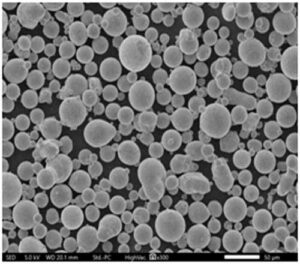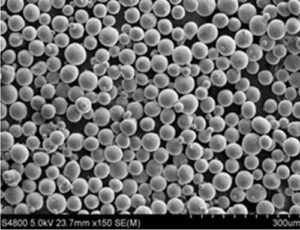
Quick Answer
7050 aluminium powder is the powder-metallurgy form of the aerospace workhorse AA7050, an Al-Zn-Mg-Cu alloy prized for the best combination of high strength, fracture toughness, and stress-corrosion resistance in the 7xxx series. Gas-atomized spherical powder is supplied in 15-45 um cuts for LPBF and 20-63 um or coarser fractions for DED, cold spray, and HIP, with oxygen typically below 800 ppm and sphericity above 0.85. Because the alloy’s wide freezing range makes it hot-crack sensitive, commercial AM use usually involves Zr/Sc grain-refinement modification or tightly controlled parameter windows, and the powder’s fastest-growing 2026 applications are cold-spray repair, DED structural builds, and qualification programs for wing-box and fuselage-relevant components.
| Property | Value |
|---|---|
| Alloy System | Al-Zn-Mg-Cu (7xxx series, AA7050) |
| Density | 2.83 g/cm3 |
| Typical Powder Size (LPBF) | 15-45 um |
| Typical Powder Size (DED/cold spray) | 20-63 um, 45-106 um |
| Sphericity (GA) | >= 0.85 |
| Oxygen Content | <= 800 ppm |
| Wrought T7451 Tensile Strength | ~510 MPa |
| Key Advantage | High strength with superior toughness and SCC resistance |
What Is 7050 Aluminium Powder and Its Benefits for Industrial Use
7050 aluminium powder belongs to the aluminium-based alloy powder family and replicates the chemistry of AA7050, the alloy that succeeded 7075 in primary aircraft structures because it offered equivalent strength with markedly better resistance to stress-corrosion cracking and exfoliation, plus higher fracture toughness in thick sections. In powder form, that same chemistry opens the alloy to additive manufacturing, cold spray repair, and powder metallurgy consolidation routes that forging and plate processing cannot reach.
The industrial case for 7050 powder rests on several benefits:
- High specific strength. Peak-aged 7050 delivers strength comparable to many steels at roughly one-third of the density, which translates directly into payload and fuel-burn advantages in weight-critical structures.
- Best-in-class SCC resistance for its strength level. The T74-type overaged tempers that made wrought 7050 the standard for wing skins and spars give it far better stress-corrosion performance than 7075-T6, a distinction that carries over into consolidated powder product.
- Thick-section toughness. Reduced quench sensitivity relative to 7075 means properties hold up in heavy cross-sections, relevant to HIP-consolidated and DED-built components.
- Repair compatibility. Chemistry-matched 7050 powder enables cold-spray and DED restoration of worn or corroded airframe components, a fast-growing maintenance, repair, and overhaul application.
- Powder metallurgy flexibility. The same qualified chemistry can move between AM prototyping and HIP or extrusion-based powder metallurgy for production volumes.
The designation follows the Aluminum Association four-digit system, where the leading 7 identifies the Al-Zn-Mg-Cu series and the trailing digits distinguish this grade from siblings such as 7055, 7068, and 7150. Buyers will encounter the same material written as AA7050, AlZn6CuMgZr (EN designation), or simply 7050 aluminium alloy powder, and quotations should always reference the governing specification, since chemistry windows differ slightly between AA and EN registers.
One candid caveat governs all of the above: AA7050 in its standard composition is difficult to process by laser powder bed fusion. The nearly 100 K freezing range and volatile zinc and magnesium content promote hot tearing and keyhole porosity during rapid solidification. Industrial LPBF adoption therefore relies on modified compositions with zirconium or scandium grain refiners, while the unmodified powder performs robustly in DED, cold spray, and HIP. Buyers should state their process route when requesting quotations, because the correct powder variant depends on it.
Chemical Composition Details and Alloying Element Contributions
The AA7050 composition is a refinement of the 7075 baseline: zinc and magnesium provide the precipitation system, copper raises strength and modifies corrosion behavior, and zirconium replaces chromium as the grain-structure control element, which reduces quench sensitivity and improves toughness.
Chemical Composition of AA7050 Powder
| Element | Min (wt%) | Max (wt%) | Role |
|---|---|---|---|
| Al | Balance | Balance | FCC matrix hosting the MgZn2 precipitation system |
| Zn | 5.7 | 6.7 | Primary strengthening element; forms MgZn2 (eta) precipitates |
| Mg | 1.9 | 2.6 | Partners with Zn in precipitation; raises strength and hardening response |
| Cu | 2.0 | 2.6 | Increases peak strength; improves SCC resistance in overaged tempers |
| Zr | 0.08 | 0.15 | Grain-structure control via Al3Zr dispersoids; reduces quench sensitivity |
| Fe | – | 0.15 | Impurity limit; excess Fe forms brittle constituent particles |
| Si | – | 0.12 | Impurity limit; kept low to protect toughness |
| Mn | – | 0.10 | Minor dispersoid former; limited in this grade |
| Cr | – | 0.04 | Deliberately low; distinguishes 7050 from 7075 |
| Ti | – | 0.06 | Grain refinement residual from ingot practice |
| O | – | 0.08 | Powder-quality limit; surface oxide affects interlayer bonding |
The precipitation sequence that delivers strength runs from GP zones through metastable eta-prime to equilibrium eta (MgZn2), and the overaged T74-type practice coarsens these precipitates deliberately to trade a small amount of strength for a large gain in stress-corrosion resistance. Copper’s presence above 2 percent is central to that trade and is one reason 7050 displaced 7075 in damage-tolerant airframe design.
For powder buyers, two compositional points deserve attention. First, zinc and magnesium losses during atomization and laser processing shift the measured chemistry slightly from the wrought specification, so lot certificates should be checked against target ranges rather than assumed. Second, zirconium at specification level already provides partial grain refinement in AM, but modified powder variants raise Zr content or add scandium to push as-built grain structure fully equiaxed and suppress hot cracking in LPBF.
Physical and Mechanical Properties at Standard Test Temperature
The table below consolidates typical data at standard test temperature (23 +/- 5 C). Wrought T7451 reference values represent the alloy’s qualification baseline; as-built and heat-treated AM values vary with process route and are shown as typical ranges.
Key Properties
| Property | Value | Unit |
|---|---|---|
| Density | 2.83 | g/cm3 |
| Melting Range | 490-635 | C |
| Thermal Conductivity (RT) | 150-160 | W/m.K |
| Coefficient of Thermal Expansion | 23.5 x 10⁻⁶ | /K |
| Young’s Modulus | 70-72 | GPa |
| Yield Strength (wrought T7451) | 440-455 | MPa |
| Tensile Strength (wrought T7451) | 505-525 | MPa |
| Elongation (wrought T7451) | 10-12 | % |
| Tensile Strength (AM + aged, modified) | 400-500 | MPa |
| Elongation (AM + aged, modified) | 6-12 | % |
| Fracture Toughness K1c (wrought) | 29-33 | MPa.m1/2 |
| Hardness (peak aged) | 150-170 | HV |
| Fatigue Performance | High for wrought class; defect-sensitive in AM builds | – |
Two characteristics stand out in this property set. First, the specific strength is exceptional: at a density of 2.83 g/cm3, peak-aged tensile strength above 500 MPa gives a strength-to-weight ratio few structural metals approach. Second, fracture toughness near 30 MPa.m1/2 at this strength level is the property that originally won AA7050 its airframe position, and recovering that toughness in consolidated powder product is a primary objective of HIP and heat-treatment development.
Temper designation matters as much as chemistry when interpreting these figures. The T7451 reference temper is stress-relieved by stretching and overaged specifically for stress-corrosion resistance; a T6-type peak-aged treatment of the same alloy raises tensile strength toward 570 MPa but sacrifices the SCC resistance that defines the grade. Powder-consolidated product is almost always supplied in T74-type condition to preserve the alloy’s signature advantage.
AM-specific values depend heavily on route. Cold-spray deposits reach near-wrought strength after aging but with limited ductility in the as-sprayed state; DED material with proper thermal management approaches wrought properties after T74-type treatment; LPBF with modified chemistry now reaches 450-500 MPa with acceptable ductility. Unmodified LPBF builds, by contrast, remain vulnerable to hot cracking and are not recommended for structural qualification.
Specifications PSD Tolerances and Available Grade Options List
7050 aluminium powder is supplied as gas-atomized spherical powder in fractions matched to each consolidation process, with PSD tolerances typically held to D10, D50, and D90 values certified on every lot.
Available Specifications
| Parameter | Standard/Value |
|---|---|
| Particle Size Distribution (LPBF) | 15-45 um, 15-53 um |
| Particle Size Distribution (DED) | 45-106 um |
| Particle Size Distribution (cold spray) | 20-63 um |
| Particle Size Distribution (MIM/press-sinter) | 0-45 um |
| Sphericity | >= 0.85 (GA), higher on request |
| Apparent Density | >= 1.3 g/cm3 |
| Tap Density | >= 1.6 g/cm3 |
| Hall Flow Rate | <= 25 s/50g (coated/conditioned) |
| Oxygen Content | <= 800 ppm |
| Moisture Content | <= 0.05 wt% |
| PSD Tolerance | D10/D50/D90 certified per lot |
| Grade Options | Standard AA7050; Zr/Sc-modified LPBF grade; high-purity cold-spray grade |
| Packaging | Vacuum-sealed, argon-flushed, 1-25 kg |
| Custom Composition | Available on request |
Aluminium powders flow less freely than denser alloy powders, and the Hall flow figure depends strongly on surface conditioning and moisture control, so conditioned powder with certified flow data is advisable for recoater-based LPBF systems. Cold-spray grades prioritize a slightly coarser, more angular-tolerant distribution and the highest purity, since deposition efficiency and bond strength depend on particle velocity and surface cleanliness.
All lots ship with full chemistry, PSD, and morphology certification, and modified LPBF grades include the grain-refiner addition documented on the certificate of analysis. Reuse guidance follows standard aluminium practice: LPBF users typically top up recycled powder with 30-50 percent virgin material per cycle and monitor oxygen and fine-fraction drift, since aluminium oxide buildup degrades both spreadability and as-built density over repeated cycles.
Manufacturing Process From Raw Material to Spherical Powder Form
Production begins with wrought-specification AA7050 feedstock, vacuum- or inert-atmosphere induction melted and then converted by gas atomization (GA), in which high-pressure argon jets disintegrate the melt stream into droplets that spheroidize and solidify in flight. The entire sequence from melt preparation to packaging is completed under controlled atmosphere, because even brief humid-air exposure of fresh powder surfaces raises moisture pickup measurably. Argon is preferred over nitrogen for aluminium alloys to avoid nitride formation and to keep oxygen pickup low, since aluminium’s native oxide reforms instantly on any exposed surface.
The volatility of zinc and magnesium requires careful melt superheat and atomization gas control: excessive superheat preferentially evaporates these elements and shifts the powder chemistry away from the target window, while insufficient superheat raises the satellite and irregular-particle fraction. Qualified producers hold the melt practice within a narrow window and verify final chemistry by ICP-OES on every lot rather than assuming feedstock equivalence.
Post-atomization conditioning follows a controlled sequence:
- Classification by sieving and air separation isolates the specified fractions and removes fines below 10-15 um, which are both a flowability and a safety concern.
- Surface conditioning adjusts the native oxide and applies flow aids where specified for recoater-based systems.
- Flow and density testing verifies Hall or Carney flow rate, apparent density, and tap density values.
- Chemical analysis confirms the full specification window plus oxygen, moisture, and trace impurities.
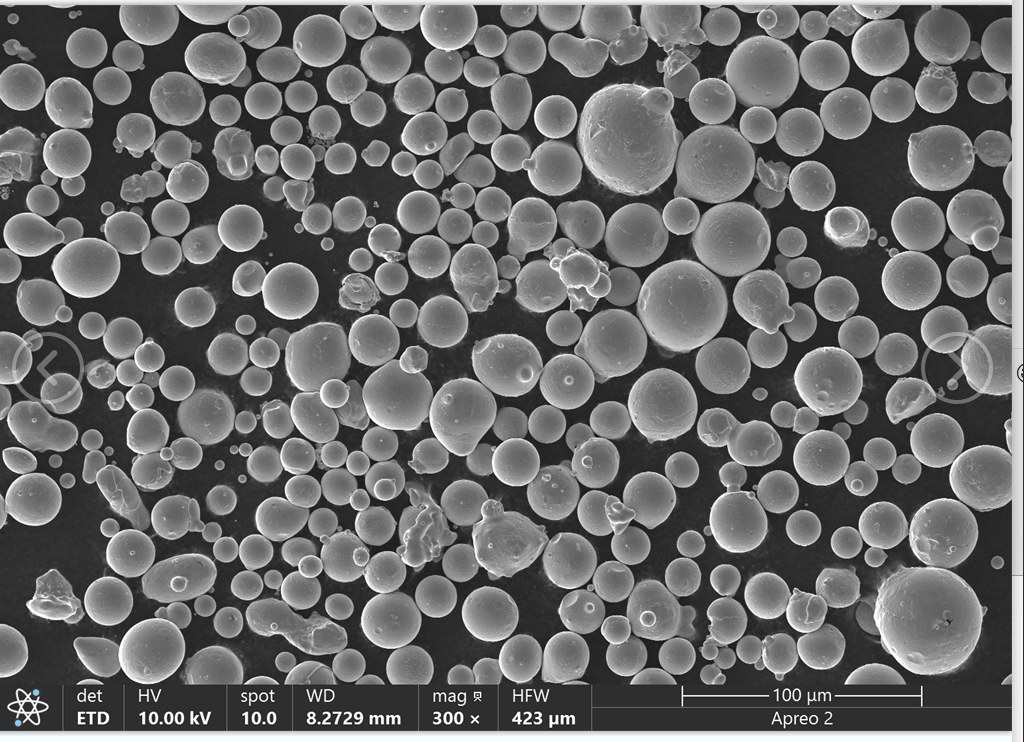
- Morphology inspection by SEM verifies sphericity, satellite content, and surface oxide condition.
- Inert packaging in argon-flushed, vacuum-sealed containers with desiccant protects against hydration of the oxide layer during storage and international transport.
Safety handling deserves explicit mention: fine aluminium powder is combustible, and fractions below 45 um should be stored, conveyed, and reclaimed under inert conditions with appropriate ATEX-rated equipment. Suppliers should provide safety data sheets and handling guidance with every shipment.
Applications by Industry Medical Aerospace and Power Generation
7050 aluminium powder serves industries where the alloy’s strength-to-weight and damage-tolerance record justifies its processing complexity. Sector context is available on the applications page.
Aerospace structures and MRO. This is the core market. Cold-spray deposition of 7050 powder repairs corrosion damage, worn fastener holes, and fretting damage on wing and fuselage components, restoring geometry with chemistry-matched material and minimal heat input. DED programs are qualifying larger structural rebuilds, and LPBF with modified powder targets brackets, fittings, and interior structures where buy-to-fly ratios favor additive. Space-launch hardware is an adjacent growth area, with propellant-system and structural components under evaluation.
Defense and rotorcraft. Military airframe sustainment programs were early adopters of cold-spray repair with high-strength aluminium powders, and 7050 is a standard feedstock for restoring magnesium-restricted and corrosion-prone areas on helicopters and transport aircraft. Portable cold-spray systems using this powder now support field-level repair, shortening aircraft downtime from weeks to days for corrosion-blend restoration.
Power generation and energy. Wind-turbine yaw and pitch system components, hydroelectric fittings, and lightweight structural elements in power electronics enclosures use high-strength aluminium, and powder routes serve low-volume, geometry-complex parts where tooling cost rules out forging. The alloy’s corrosion resistance in overaged condition suits outdoor and marine-adjacent energy installations.
Medical and precision equipment. While not an implant material, 7050 powder serves medical-sector applications such as imaging-system frames, robotic surgical equipment structures, and portable device housings where stiffness-to-weight and machinability matter. HIP-consolidated billet machined to final form is the typical route for these high-integrity, low-volume parts.
Research and qualification. As one of the highest-strength aluminium alloys under active AM development, 7050 powder is widely ordered by universities and aerospace primes for grain-refinement, hot-cracking-mitigation, and heat-treatment studies, making it a reference material in the high-strength printable aluminium literature. Published parameter sets for modified 7050 now cover LPBF, DED, and cold-spray routes, giving new adopters a usable starting point for their own qualification campaigns.
Comparison With Alternative Powders and Key Performance Metrics
Material selection around 7050 powder typically benchmarks it against 7075, against the weldable AlSi10Mg and AlSi7Mg casting alloys, and against scandium-modified systems such as Scalmalloy.
7050 Powder vs Alternative Aluminium Alloys
| Property | AA7050 | AA7075 | AlSi10Mg | Scalmalloy |
|---|---|---|---|---|
| Density (g/cm3) | 2.83 | 2.81 | 2.67 | 2.67 |
| Peak Tensile (MPa, reference) | 510 (T7451) | 570 (T6) | 350-400 (AM aged) | 500-530 (AM aged) |
| SCC Resistance | Excellent (T74) | Poor (T6) | Good | Good |
| Fracture Toughness | High | Moderate | Moderate | High |
| LPBF Printability | Difficult (modified OK) | Difficult (modified OK) | Excellent | Excellent |
| Cold Spray Suitability | Excellent | Excellent | Good | Moderate |
| Max Service Temp (C) | ~120 | ~120 | ~150 | ~150 |
| Relative Powder Cost | Medium-High | Medium-High | Low | Very high |
Against 7075, 7050 trades a small margin of peak strength for a large gain in stress-corrosion resistance, toughness, and thick-section property retention, which is why it is the preferred structural grade and the more common choice for repair feedstock. Against AlSi7Mg and AlSi10Mg-class casting alloys, it offers roughly 30-50 percent higher strength but demands far more process discipline in LPBF. Against Scalmalloy, it achieves similar strength at a fraction of the powder cost, though Scalmalloy prints more forgivingly and offers superior as-built ductility.
The selection rule is practical: choose 7050 powder for cold-spray repair, DED structural work, and HIP consolidation where its wrought-equivalent properties are the draw; choose AlSi10Mg or Scalmalloy when LPBF printability and geometric freedom are the priority. In sustainment and repair programs specifically, chemistry matching to the parent structure usually makes the decision automatically, and 7050 is the mandated feedstock wherever the original component was built from the wrought alloy.
Our Company
Shanghai Truer Technology Co., Ltd is a China-based additive manufacturing supplier integrating PREP powder making equipment and high-quality spherical metal powders. Established in 2009, the company offers both gas atomization (GA) and PREP manufacturing capabilities across nickel alloys, titanium alloys, aluminum alloys, stainless steels, cobalt alloys, copper alloys, high-entropy alloys, and specialty materials.
Truer provides custom alloy development, small-batch prototyping, and scale production services for industries including aerospace, medical implants, oil and gas, and automotive. The company operates a joint innovation center for metal 3D printing in collaboration with top research institutions.
For inquiries about 7050 aluminium powder or other metal powder requirements, contact the team.
FAQ
Q1: What is the typical particle size distribution for 7050 aluminium powder? A: LPBF uses 15-45 um or 15-53 um fractions, DED uses 45-106 um, and cold spray typically uses 20-63 um. Each lot is certified with D10, D50, and D90 values, and custom cuts are available on request.
Q2: Can 7050 aluminium powder be used in LPBF systems? A: Standard AA7050 is hot-crack sensitive in LPBF due to its wide freezing range, so it is generally processed by DED, cold spray, or HIP instead. Zr- or Sc-modified variants have been developed specifically for LPBF and achieve 450-500 MPa after aging with acceptable ductility.
Q3: What certifications does 7050 aluminium powder come with? A: Every lot ships with a certificate of analysis covering full elemental chemistry, oxygen and moisture content, PSD data, flow rate, and apparent and tap density. SEM morphology reports and safety data sheets are available as standard documentation.
Q4: What is the MOQ for ordering 7050 aluminium powder? A: Development quantities of 1-5 kg are available for parameter work and cold-spray trials. Production volumes are supplied in 10-25 kg argon-flushed, vacuum-sealed containers, with pricing scaled to quantity and grade.
Q5: Can the composition of 7050 aluminium powder be customized? A: Yes. Zirconium and scandium additions for grain refinement are the most common customization, and zinc-magnesium balance can be adjusted within the specification window for specific heat-treatment responses. Custom variants are produced through the supplier’s alloy development service with trial batches first.
Q6: What is the typical lead time for 7050 aluminium powder orders? A: Standard grades in stock sizes usually ship within one to two weeks. Modified LPBF compositions and high-purity cold-spray grades typically require four to six weeks including atomization scheduling, classification, conditioning, and the full certification package.