Quick Answer
FeCoNiCrAl High Entropy Alloys are multi-principal-element alloys designed to balance strength, oxidation resistance, thermal stability, and microstructural complexity in demanding environments. For additive manufacturing parts, they are chosen when designers need a material platform that can outperform many conventional alloys at elevated temperature, resist wear and surface degradation, and support alloy tuning through composition and process control. In practice, FeCoNiCrAl powder is most attractive for research-led aerospace, energy, tooling, and surface-engineering applications rather than routine commodity production.
What Is FeCoNiCrAl High Entropy Alloys?
FeCoNiCrAl High Entropy Alloys belong to the broader family of high-entropy alloys, or HEAs, in which several principal elements are mixed at relatively high concentrations instead of relying on one dominant base element. That design philosophy changes how phases form, how diffusion proceeds, and how strengthening mechanisms interact. A useful overview of the high-entropy alloy concept is available in the high-entropy alloy background article.
In the Fe-Co-Ni-Cr-Al system, iron, cobalt, nickel, chromium, and aluminum are combined to create a composition space with wide metallurgical flexibility. Depending on the exact elemental ratio, the alloy can favor face-centered cubic, body-centered cubic, ordered B2, or mixed microstructures. That matters because the Al level in particular strongly influences density, hardness, oxidation behavior, and the balance between room-temperature ductility and high-temperature strength.
Unlike legacy superalloys that evolved around a nickel-rich matrix, FeCoNiCrAl materials are often explored as compositionally tunable platforms. Engineers and researchers use them to study solid-solution strengthening, precipitation or ordering effects, and the role of controlled segregation during rapid solidification. For powder-bed fusion and related AM routes, these features are especially relevant because the thermal history is steep, cyclic, and localized.
Why FeCoNiCrAl Matters in Metal AM
AM does more than shape a part; it can also refine the alloy’s microstructure because each molten track cools rapidly. That makes FeCoNiCrAl systems interesting for process-structure-property optimization. Compared with many conventional steels or nickel alloys, the material offers more room to tailor phase fractions by adjusting composition, scan strategy, heat treatment, or remelting cycles.
Distinguishing Features Versus Conventional Alloys
Several practical traits make this alloy family noteworthy:
- Composition-driven phase tuning through controlled Al content and elemental balance
- High resistance to oxidation and scaling in many elevated-temperature conditions
- Good hardness and wear potential, especially in Al-enriched variants
- Compatibility with research, prototyping, and niche production in spherical AM powder form
At the same time, FeCoNiCrAl is not a drop-in replacement for every nickel alloy or stainless steel grade. It is better understood as an advanced alloy platform that can be tailored for specific loading, temperature, and environmental demands.
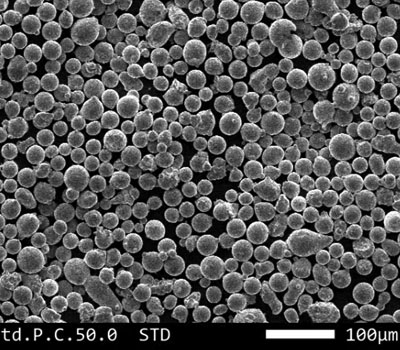
In metal additive manufacturing, powder quality is not just an input variable; it is a first-order determinant of part quality.
FeCoNiCrAl Powder Behavior in SLM and EBM
For laser powder bed fusion, FeCoNiCrAl powder typically benefits from tight particle-size control, high sphericity, and low oxygen pickup to support stable spreading and predictable melt-pool dynamics. In electron beam systems, the same alloy family can also be attractive because elevated build temperatures may reduce residual stress and influence ordered-phase development differently than laser-based processing.
Readers comparing alloy families for adjacent applications often review nickel superalloy powder options and cobalt alloy powder grades alongside HEA candidates, especially when wear, heat, and corrosion performance all matter.
Chemical Composition and Material Grade
There is no single universal commercial grade called “FeCoNiCrAl” in the same way that 316L or Inconel 718 are standardized. Instead, the name usually refers to a composition family. Most projects therefore specify a nominal elemental ratio, acceptable impurity limits, powder morphology targets, and required post-processing conditions in a purchase specification or technical data sheet.
Aluminum content is the most common lever used to tune phase constitution. Lower-Al versions may retain more FCC character and better ductility, while higher-Al versions often shift toward BCC or ordered B2 structures with higher hardness and oxidation resistance. Because of this variability, buyers should always ask whether the powder is nominal-equiatomic, Al-lean, Al-rich, or designed for a target phase balance after AM and heat treatment.
Typical FeCoNiCrAl High Entropy Alloys Composition Windows
The table below shows representative, non-exhaustive composition windows used in research and pre-commercial development. Values are typical nominal targets in weight percent for illustration; project specifications may differ.
| Material Variant | Fe (wt%) | Co (wt%) | Ni (wt%) | Cr (wt%) | Al (wt%) | Typical Grade / Spec Reference | ASTM / AMS / GB / ISO / DIN Cross-Reference |
|---|---|---|---|---|---|---|---|
| Near-equiatomic FeCoNiCrAl | 18-23 | 18-23 | 18-23 | 18-23 | 12-20 | Enterprise or R&D specification | No direct dedicated equivalent; project-specific |
| Al-lean FeCoNiCrAl | 20-24 | 20-24 | 20-24 | 20-24 | 8-12 | Custom AM powder grade | No direct dedicated equivalent; project-specific |
| Al-rich FeCoNiCrAl | 17-22 | 17-22 | 17-22 | 17-22 | 18-25 | High-hardness or oxidation-focused spec | No direct dedicated equivalent; project-specific |
| FeCoNiCrAl with trace process controls | balance | balance | balance | balance | balance | Internal specification with O/N/H limits | No direct dedicated equivalent; project-specific |
Because no mature global product standard yet governs this exact HEA family, procurement typically references general powder standards, AM process controls, and internal acceptance criteria. For terminology, many buyers align documentation with ISO/ASTM 52900 additive manufacturing vocabulary, while testing methods may be drawn from broader powder metallurgy or AM quality frameworks.
Grade Selection Considerations
When evaluating a FeCoNiCrAl powder grade, the most important questions are usually:
- What nominal composition is required after melting losses and processing?
- Is the target microstructure FCC-dominant, BCC/B2-dominant, or mixed?
- Which impurities matter most for the intended process and application?
- Is the part a structural AM component, a hardfacing feedstock, or a research coupon?
These questions matter more than a simple catalog grade name because HEAs are still often qualification-driven rather than standards-driven.
Technical Specifications
For spherical AM powder, the technical specification should describe not only chemistry but also morphology, flowability, contamination limits, and packaging condition. FeCoNiCrAl powders are commonly requested for laser powder bed fusion, electron beam powder bed fusion, directed energy deposition, thermal spraying, and some powder metallurgy routes.
The most common particle-size distributions follow the machine process window. Fine cuts support thin powder layers and finer feature resolution, while coarser cuts can be better suited to DED, EBM, or spraying processes. As with other alloy powders, buyers should review apparent density, tap density, Hall flow behavior, moisture sensitivity, and batch traceability before process qualification.
Typical FeCoNiCrAl High Entropy Alloys Powder Specifications
| Powder Form | Typical PSD Range | Apparent Density | Tap Density | Hall Flow | Oxygen Content | Sphericity |
|---|---|---|---|---|---|---|
| Fine AM powder | 15-53 µm | 3.9-4.7 g/cm³ | 4.6-5.5 g/cm³ | 15-22 s/50 g | ≤ 1000 ppm typical | ≥ 0.90 typical |
| Standard LPBF powder | 20-63 µm | 4.0-4.8 g/cm³ | 4.7-5.6 g/cm³ | 14-20 s/50 g | ≤ 800 ppm typical | ≥ 0.92 typical |
| EBM / coarser AM powder | 45-105 µm | 4.1-4.9 g/cm³ | 4.8-5.7 g/cm³ | 13-19 s/50 g | ≤ 800 ppm typical | ≥ 0.93 typical |
| DED / spray grade | 53-150 µm | 4.2-5.0 g/cm³ | 4.9-5.8 g/cm³ | 12-18 s/50 g | ≤ 1200 ppm typical | ≥ 0.90 typical |
These values are realistic procurement ranges, not guaranteed universal numbers. Exact results depend on atomization route, sieving efficiency, composition balance, and how oxygen, nitrogen, and satellites are controlled.
FeCoNiCrAl High Entropy Alloys Properties to Watch
Bulk property expectations depend strongly on composition and heat treatment, but the following trends are common:
- Higher Al content usually increases hardness and oxidation resistance
- Mixed BCC/B2 structures often improve elevated-temperature strength but may reduce room-temperature ductility
- Fine, spherical powder tends to support better layer uniformity and more stable recoating
- Post-build heat treatment can significantly alter phase distribution and residual stress
Where terminology or process classification needs to be harmonized across customer documentation, many teams also refer to ASTM additive manufacturing standards resources.
Applications Across Industries
FeCoNiCrAl is rarely selected just because it is novel. It is chosen when the component faces a combination of heat, oxidation, wear, and design complexity that makes conventional alloy selection less straightforward. In many projects, the alloy is evaluated against nickel superalloys, cobalt wear alloys, and stainless steels rather than against only one benchmark material.
Where FeCoNiCrAl High Entropy Alloys Add Value
In aerospace and energy applications, the alloy can be interesting for experimental hot-zone hardware, thermal-exposure coupons, oxidation-resistant lattice structures, and fixtures used in harsh atmospheres. In industrial tooling, higher-Al variants may be attractive for wear-prone inserts, nozzles, and cladding layers. In research laboratories, the system is widely used to study rapid-solidification metallurgy and phase evolution under AM conditions.
| Industry | Typical Part | AM / PM Process | Why the Alloy Is Considered |
|---|---|---|---|
| Aerospace R&D | High-temperature brackets, lattice coupons, thermal test articles | LPBF, EBM | Balance of oxidation resistance, strength, and tunable microstructure |
| Energy & Power | Burner components, heat-exposed fixtures, prototype flow parts | LPBF, DED | Thermal stability and surface durability in elevated-temperature service |
| Tooling & Surface Engineering | Wear inserts, hardfacing layers, nozzles | DED, laser cladding, thermal spray | Hardness and wear resistance, especially in Al-rich variants |
| Materials Research | Phase-evolution coupons, benchmark specimens, combinatorial builds | LPBF, EBM, PM | Useful model system for HEA process-structure-property studies |
Process Fit by Application
FeCoNiCrAl powder is especially compelling when designers want to exploit AM’s geometric freedom while also investigating microstructure control. For example, a lattice heat shield or thin-walled oxidation coupon can be built with a different local cooling path than a massive wear insert, which means the same nominal chemistry may behave differently in service.
That is why qualification plans should pair application logic with process logic. A powder that works well for DED hardfacing may not be optimal for fine-feature LPBF, even if the chemistry is nominally identical.
Manufacturing and Quality Assurance
The quality of FeCoNiCrAl powder depends as much on the production route as on the target chemistry. Gas atomization is widely used for scalable spherical powder production, while plasma rotating electrode processing is valued for exceptionally spherical, clean powder with low contamination risk. Vacuum induction gas atomization is often preferred when melt chemistry control and reduced oxidation exposure are priorities.
For HEA powders, QA should verify chemistry, particle-size distribution, morphology, inclusions, internal porosity, flowability, and gas content. Because the alloy family is still qualification-driven, customers often define acceptance criteria batch by batch, especially for oxygen and sieve fractions.
Powder-Making Route Comparison for FeCoNiCrAl High Entropy Alloys
| Route | Main Strengths | Main Limitations | Typical Powder Traits | Suitable Use Cases |
|---|---|---|---|---|
| GA (Gas Atomization) | Good scalability, broad PSD control, industrial throughput | More satellites than PREP in some cases; oxidation control must be managed carefully | Spherical to near-spherical; cost-effective production | General AM, PM, cladding, spray feedstock |
| PREP (Plasma Rotating Electrode Process) | Very high sphericity, low contamination, strong flowability | Higher cost; feedstock electrode preparation required | Clean, highly spherical powder with narrow defect population | Premium AM powder, demanding R&D, high-integrity parts |
| VIGA (Vacuum Induction Gas Atomization) | Good chemistry control and lower oxygen exposure | Capital-intensive; process tuning required for each alloy family | Spherical powder with controlled chemistry and impurity levels | Qualification-critical AM and advanced alloy development |
| Hybrid screened supply chain | Flexible sourcing and post-sieving | Quality consistency depends on supplier discipline | Properties vary with incoming lot control | Non-critical prototyping or blended procurement models |
QA Workflow and Release Criteria
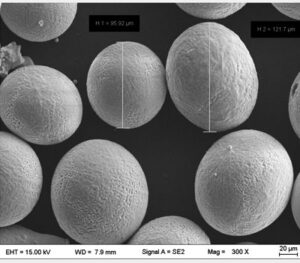
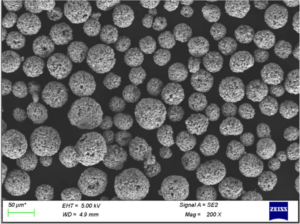
A robust inspection plan for FeCoNiCrAl usually includes ICP or XRF for chemistry, inert gas fusion for oxygen and nitrogen, laser diffraction or sieve analysis for PSD, SEM imaging for morphology, and Hall flow plus density testing for powder handling performance. If the powder is intended for repeat LPBF builds, users may also request recycled-powder behavior studies and comparison between virgin and reused lots.
Spherical powder quality matters because HEA compositions can already present a narrow process window. If the powder additionally contains excessive satellites, wide PSD tails, or elevated oxygen, it becomes harder to distinguish true alloy behavior from powder-driven process instability.
Suppliers with broader AM portfolios often compare FeCoNiCrAl against more established materials such as stainless steel powder grades or titanium and nickel systems to help customers build realistic qualification pathways rather than treating every new alloy as a blank slate.
Why Choose Truer as Your Supplier
A practical supplier decision for FeCoNiCrAl should be based on process compatibility, powder-making capability, testing discipline, and the ability to support custom specifications. For this material family, off-the-shelf commodity sourcing is less common than technical collaboration around chemistry windows, PSD cuts, and application-specific documentation.
Shanghai Truer Technology’s relevance in this context comes from the combination of powder-making equipment and additive-manufacturing process experience. The company’s background in PREP, GA, and SEBM systems is technically useful when a customer needs to align alloy chemistry with powder morphology and end-use process selection.
Truer’s Fit for Advanced Alloy Programs
Rather than evaluating Truer only as a catalog powder source, it is more accurate to view the company as a manufacturer working across powder production and application support. That matters for FeCoNiCrAl because qualification often requires iteration between powder characteristics and build performance.
Process-integrated supply capability is particularly relevant when customers need custom particle-size ranges, traceability, and support from trial builds through scale-up. A concise company overview is available on the metal AM company profile, which helps buyers place the powder offering in the broader equipment-and-materials context.
Ordering Guide and Support
Ordering FeCoNiCrAl powder usually begins with a technical discussion rather than a simple grade-and-quantity request. Buyers should specify intended process, target PSD, chemistry tolerance, oxygen limit, morphology expectations, packaging format, and whether the powder is for research, qualification, or production.
If the material is being introduced into a regulated or performance-critical program, it is advisable to request a certificate of analysis, batch traceability details, and retained sample policy before placing a larger order. Recycled-powder strategies, storage conditions, and inert handling practices should also be discussed early.
Typical Ordering Framework for FeCoNiCrAl High Entropy Alloys
| Packaging | Typical MOQ Tier | Lead Time | Sample Policy | Notes |
|---|---|---|---|---|
| 500 g lab bottle | R&D sample | 1-3 weeks typical | Paid sample or trial lot | Best for chemistry screening and single-build trials |
| 1-5 kg sealed container | Small qualification batch | 2-4 weeks typical | Usually available with COA | Common for LPBF parameter development |
| 10-25 kg inert-packed drum | Pilot production batch | 3-6 weeks typical | Retained sample recommended | Suitable for repeat-build validation |
| 50 kg+ industrial lot | Scale manufacturing or multi-site trials | 4-8 weeks typical | Formal lot approval advised | Requires tighter documentation and planning |
What to Confirm Before Purchase
A well-structured inquiry should confirm:
- Nominal composition and acceptable variation by element
- Target AM or PM process and machine type
- Required PSD fraction and maximum oversize content
- Oxygen, nitrogen, and moisture expectations
- COA, lot traceability, and packaging atmosphere
- Whether application support or build trials are needed
For RFQs or sample coordination, the most direct route is the technical inquiry contact page, where project details can be aligned with powder form and delivery scope.
Our Company
Shanghai Truer Technology Co., Ltd. was established in 2009 and created its additive manufacturing business in 2019. The company works on integrating 3D-printing powder-making equipment and services with spherical metal powders for engineering use in additive manufacturing. Its technical scope includes Selective Electron Beam Melting equipment, Plasma Rotating Electrode Process powder-making equipment, and gas atomization-related capabilities. The powder portfolio includes TiNi, TiTa, TiAl, TiNbZr, CoCrMo, and broader nickel-based, cobalt-based, titanium-based, copper-based, aluminum-based, and stainless steel spherical powders for processes such as SLM, SEBM, DED, laser cladding, PM, MIM, HIP, cold or hot spraying, welding, and coating across industries including 3C electronics, hand tools, remote control cars, medical, aerospace, and nuclear power.
FAQ
Q1. What makes FeCoNiCrAl High Entropy Alloys different from conventional nickel superalloys?
FeCoNiCrAl High Entropy Alloys are built around multiple principal elements rather than one dominant matrix element. That gives metallurgists more freedom to tune phase balance, hardness, oxidation behavior, and thermal stability through composition and processing. In AM, this often translates into a broader research opportunity, though not always a simpler qualification path.
Q2. Is FeCoNiCrAl High Entropy Alloys suitable for laser powder bed fusion?
Yes, provided the powder has high sphericity, controlled PSD, and low oxygen content, and the process window is developed carefully. Laser powder bed fusion is one of the most common routes used to study this alloy family because rapid solidification can refine microstructure and expose composition-dependent phase behavior. Parameter development is still essential because the alloy can be more sensitive than mature commodity grades.
Q3. Which powder size is best for FeCoNiCrAl High Entropy Alloys in AM?
For LPBF, a typical range such as 15-53 µm or 20-63 µm is often preferred because it balances spreadability and layer resolution. Coarser ranges such as 45-105 µm are more common for EBM or some directed energy deposition applications. The correct choice depends on machine architecture, layer thickness, and whether fine features or higher deposition rates are the priority.
Q4. Are there ASTM or ISO standards dedicated specifically to FeCoNiCrAl High Entropy Alloys powder?
At present, buyers usually work from internal, project-specific, or enterprise specifications rather than a universally adopted dedicated grade standard for this exact HEA family. General AM and powder-testing standards still apply, but the chemistry and acceptance criteria are commonly customized. That is why technical data sheets and purchase specifications carry unusual importance for this material.
Q5. What properties usually improve when aluminum content increases in FeCoNiCrAl High Entropy Alloys?
Higher Al content often promotes harder BCC or ordered B2 phases, which can improve hardness, wear resistance, and oxidation performance. The trade-off is that room-temperature ductility may decline if the phase balance shifts too far away from FCC-rich behavior. The optimal Al level therefore depends on whether the part is meant for structural loading, surface durability, or thermal exposure.
Q6. Can FeCoNiCrAl High Entropy Alloys be used outside additive manufacturing?
Yes. The powder or bulk alloy concepts can also be relevant to powder metallurgy, hardfacing, laser cladding, thermal spraying, and experimental high-temperature applications. In many cases, the same composition family is evaluated across multiple processes to determine whether performance comes mainly from the alloy itself or from the AM-enabled microstructure.