Quick Answer
high-sphericity IN738LC powder is a nickel-based superalloy feedstock tailored for additive manufacturing of parts that must retain strength, oxidation resistance, and creep performance at elevated temperature. It is chosen for 3D printing because highly spherical particles generally flow better, pack more uniformly, and support more stable layer deposition than irregular powder. For laser and electron-beam systems, that usually means more consistent recoating, better powder-bed density, and a lower risk of porosity or process variability in turbine-class and other high-heat components.
What Is high-sphericity IN738LC powder?
IN738LC is a low-carbon version of the well-known IN738 nickel-base superalloy family. The alloy was originally developed for severe hot-section duty, especially where components face sustained thermal exposure, oxidizing atmospheres, and mechanical stress at the same time. In powder form, it is used in additive manufacturing, repair, cladding, and selected powder metallurgy routes when a design needs more temperature capability than common stainless steels or easier-to-process nickel grades can provide.
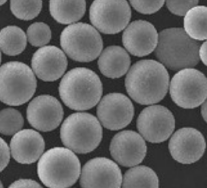
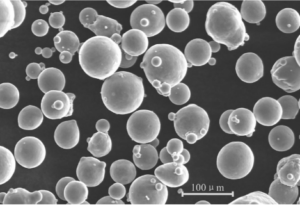
The phrase “high-sphericity” refers to particle morphology rather than nominal chemistry. A highly spherical powder contains a large fraction of round particles with limited elongation, a controlled level of satellites, and a narrow amount of shape-related irregularity. In additive manufacturing, that matters because particle shape influences flowability, apparent density, spreading uniformity, and the way powder layers respond to laser or electron-beam energy.
From a metallurgical standpoint, IN738LC is a precipitation-hardened alloy. Its strength comes from a gamma nickel matrix reinforced by gamma-prime precipitates formed mainly through aluminum and titanium additions. Chromium supports oxidation and hot-corrosion resistance, while cobalt, tungsten, tantalum, molybdenum, niobium, boron, and zirconium help stabilize the microstructure and improve creep behavior at high temperature.
Compared with more forgiving AM grades such as 718 or 625, IN738LC sits further toward the performance end of the spectrum and closer to the processing edge. It offers stronger high-temperature capability, but it is also more sensitive to thermal stress, cracking, and build parameter control. That is why users who specify this alloy typically pay close attention not only to chemistry, but also to powder morphology, gas content, size distribution, and post-build heat treatment strategy.
In practice, high sphericity is valuable because it improves the way a difficult superalloy enters the machine. A powder with high particle roundness tends to spread more evenly across the build plane, reducing local variation in bed thickness and helping the process operate within a narrower parameter window. For IN738LC, where printing latitude is already limited, that is a meaningful advantage rather than a cosmetic quality metric.
A broader nickel alloy powder portfolio often includes easier grades for general corrosion or mid-temperature parts, but IN738LC is selected when designers need more hot-strength margin. In adjacent applications, cobalt-based alloy powders may be preferred for wear, galling, or specific corrosion conditions, yet they are not direct substitutes for every turbine-oriented nickel superalloy requirement.
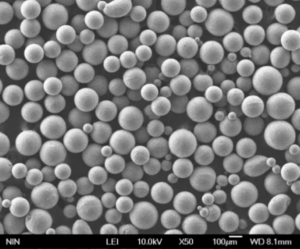
In advanced metal AM, powder shape influences process repeatability long before the first scan track is melted.
Chemical Composition and Material Grade
IN738LC chemistry is designed around a nickel-rich matrix with carefully balanced additions for precipitation strengthening and environmental resistance. Like many turbine superalloys, it is not simply “nickel plus chromium”; its performance depends on a multi-element chemistry that must stay within narrow limits if the user expects stable phase formation and reliable heat-treatment response.
Typical Chemical Composition of IN738LC Powder
| Element / Grade Item | Typical wt.% | Function / Cross-Reference Note |
|---|---|---|
| Nickel (Ni) | Balance | Base matrix element |
| Chromium (Cr) | 15.7–16.3 | Oxidation and hot-corrosion resistance |
| Cobalt (Co) | 8.0–9.0 | Strengthening and phase stability |
| Tungsten (W) | 2.4–2.8 | Solid-solution strengthening |
| Molybdenum (Mo) | 1.6–1.9 | High-temperature strength contribution |
| Tantalum (Ta) | 1.5–2.0 | Gamma-prime support and creep resistance |
| Niobium (Nb) | 0.7–1.1 | Secondary strengthening effect |
| Aluminum (Al) | 3.2–3.7 | Primary gamma-prime former |
| Titanium (Ti) | 3.2–3.7 | Primary gamma-prime former |
| Carbon (C) | 0.08–0.13 | Controlled carbide formation; LC indicates lower carbon than older variants |
| Boron (B) | 0.005–0.015 | Grain-boundary strengthening |
| Zirconium (Zr) | 0.03–0.10 | Grain-boundary support |
| Iron (Fe) | ≤ 0.50 typical | Residual control |
| Silicon (Si) | ≤ 0.30 typical | Residual control |
| Manganese (Mn) | ≤ 0.20 typical | Residual control |
| ASTM status | No single widely used dedicated ASTM AM powder designation | Usually ordered to supplier chemistry plus QA data |
| AMS status | No universal AMS powder code routinely used in AM trade | Customer drawing or purchase spec normally governs |
| GB status | Often supplied against enterprise or project specification | Cross-reference depends on purchaser requirement |
| ISO status | No direct one-code ISO material designation for this powder | AM process standards exist separately from alloy purchase specs |
| DIN / EN status | No exact one-to-one DIN equivalent commonly used for AM powder procurement | Chemistry-based equivalence is more common than formal code mapping |
Although the alloy name is widely recognized, buyers should not assume that every market uses one harmonized standard code for powder. Many IN738LC powder orders are placed against supplier specifications that define chemistry, size distribution, oxygen limits, morphology, and inspection methods in the same document. That is common for high-performance AM feedstock because conventional cast-alloy references do not fully describe powder behavior.
The low-carbon designation matters because carbides influence grain boundaries, creep response, and cracking behavior. Lower carbon than earlier variants helps optimize hot-work and service performance, though final results still depend on the full chemistry balance and the thermal history of the printed part. For this reason, alloy certification and powder qualification should be considered together rather than as separate tasks.
When engineers compare IN738LC to nearby superalloys, the key distinction is its emphasis on hot-section capability. It is not the easiest nickel alloy to print, but it can outperform more forgiving grades in oxidation and creep-limited conditions. The value of the powder therefore comes from the interaction of composition, morphology, process control, and heat treatment rather than from chemistry alone.
Technical Specifications
Powder specification for additive manufacturing must connect directly to machine behavior. A certificate that lists only chemistry is incomplete if it says nothing about particle size, density, flow, oxygen, or sphericity. For IN738LC, those secondary parameters are especially important because the alloy leaves less room for inconsistency during building.
Typical Technical Specification for high-sphericity IN738LC powder
| Parameter | 15–53 µm | 45–105 µm | 53–150 µm | Typical Note |
|---|---|---|---|---|
| Main process fit | Fine L-PBF / SLM | EBM, coarse L-PBF, DED | DED, cladding, spray-related use | Application dependent |
| D10 | 15–20 µm | 45–55 µm | 53–65 µm | Typical laser diffraction result |
| D50 | 28–35 µm | 70–80 µm | 90–105 µm | Typical median range |
| D90 | 48–53 µm | 100–105 µm | 145–150 µm | Typical upper cut |
| Apparent density | 4.6–5.1 g/cm³ | 4.7–5.2 g/cm³ | 4.8–5.3 g/cm³ | Depends on morphology and fines |
| Tap density | 5.0–5.6 g/cm³ | 5.2–5.8 g/cm³ | 5.3–5.9 g/cm³ | Typical range |
| Hall flow rate | 14–20 s/50 g | 12–18 s/50 g | 11–17 s/50 g | Spherical powder typically flows faster |
| Oxygen content | ≤ 0.03 wt.% typical target | ≤ 0.03 wt.% typical target | ≤ 0.04 wt.% typical target | Final limit by order |
| Nitrogen content | Low, often ≤ 0.02 wt.% | Low, often ≤ 0.02 wt.% | Low, often ≤ 0.02 wt.% | Supplier-controlled |
| Sphericity | typically ≥ 0.95 | typically ≥ 0.95 | typically ≥ 0.95 | Image-analysis basis, typical |
| Satellite content | low | low | low | Qualitative or image-based acceptance |
| Moisture / packaging condition | dry, sealed | dry, sealed | dry, sealed | Required for shipping and storage |
The fine 15–53 µm cut is commonly used for laser powder bed fusion because it supports thin layers and detailed features. Coarser ranges such as 45–105 µm or 53–150 µm are often better matched to electron-beam systems, directed energy deposition, or cladding, where thicker feedstock and different melt-pool dynamics are expected.
Why spherical powder matters in AM processing
Highly spherical powder promotes more predictable spreading. In a recoater-driven process, smooth particle motion helps create a flatter layer and lowers the chance that agglomerates or irregular grains disturb local bed thickness. That improves powder-bed consistency, which can be especially important when processing a crack-sensitive nickel superalloy.
Sphericity also influences bulk density and packing. Densely packed layers can respond more consistently to energy input because void distribution in the unmelted powder bed is less erratic. While this does not guarantee defect-free parts, it supports a more stable starting condition for parameter optimization.
Interpreting specification values realistically
No single number determines whether a powder is “good.” A very fine powder may show strong packing behavior but create handling challenges or oxygen pickup risk. A coarser powder may flow well but produce thicker layers and lower resolution. The correct technical specification must therefore match the machine, process window, and final part geometry.
It is also important to treat reported values as part of a batch history rather than an isolated snapshot. A lot that meets nominal flow, density, and PSD requirements can still behave differently if the morphology distribution shifts between campaigns. That is why experienced users focus on trend control, not just pass/fail certificates.
Applications Across Industries
IN738LC powder is not a general-purpose metal powder. It is used when service conditions justify a superalloy designed for heat, stress, and oxidation resistance. In additive manufacturing, the main advantage is the ability to produce geometries or restore features that would otherwise be difficult, time-consuming, or uneconomical through casting and machining alone.
Typical uses for high-sphericity IN738LC powder
| Industry | Typical Part | AM / PM Process | Main Technical Driver |
|---|---|---|---|
| Aerospace | Turbine blades, vanes, shrouds | L-PBF, EBM, DED repair | High-temperature strength and oxidation resistance |
| Power Generation | Gas turbine combustor hardware, nozzle components | DED, cladding, PM routes | Creep and thermal-fatigue performance |
| Industrial Turbomachinery | Seal segments, hot-zone inserts, replacement parts | L-PBF, DED | Complex geometry and spare-part flexibility |
| Repair and MRO | Edge restoration, tip repair, surface build-up | DED, laser cladding | Life extension of expensive superalloy hardware |
| Motorsport / Performance Systems | Hot-side turbo and exhaust-adjacent parts | L-PBF | Elevated-temperature stability |
| Process Heating Equipment | Burner hardware, thermal shields, heat-resistant fixtures | PM, DED, cladding | Oxidation and cyclic thermal durability |
Aerospace remains the most visible application because turbine hardware often pushes materials into temperature ranges where ordinary alloys lose mechanical margin. The ability to print internal passages, prototype design changes quickly, or repair localized wear makes powder-based manufacturing attractive even when qualification is demanding.
Power-generation users face a similar challenge. Many gas-turbine parts operate for long intervals under load and are expensive to replace through conventional supply chains. Additive routes can shorten response time for low-volume or legacy geometries, especially when the part needs feature restoration rather than complete recasting.
Repair is another important use case. When the goal is to rebuild a worn edge or damaged zone, powder quality directly affects feeding stability, dilution control, and deposit integrity. In those conditions, a high-sphericity feedstock is not merely easier to handle; it can materially influence the repeatability of the restoration process.
Material selection versus alternative AM powders
IN738LC is one option within a larger engineering toolkit. For lightweight designs, a titanium alloy powder portfolio will often be more suitable. For corrosion-driven industrial parts, some stainless or cobalt systems may be better choices, and for thermal conductivity needs, copper alloys can outperform nickel superalloys entirely.
What keeps IN738LC relevant is its hot-strength profile. When the limiting factor is sustained elevated-temperature performance rather than simple corrosion resistance or ease of printing, designers often accept a more difficult manufacturing path in exchange for higher service capability. That tradeoff is exactly where this alloy tends to earn its place.
Manufacturing and Quality Assurance
Powder quality starts with how the alloy is melted and atomized. The route used to create IN738LC powder influences particle shape, satellite formation, internal porosity, chemistry retention, and contamination exposure. For a demanding superalloy, the difference between a merely acceptable powder and a robust AM feedstock often begins upstream in the powder plant.
Production routes for spherical IN738LC powder
Gas atomization is widely used for nickel-based powders because it is scalable and adaptable to many alloy systems. Under controlled conditions, molten metal is broken into droplets by high-velocity gas, then rapidly solidified into mostly spherical particles. Vacuum induction gas atomization improves environmental control and can help reduce contamination, which is especially useful for reactive or tightly specified superalloys.
PREP, or plasma rotating electrode process, is associated with premium spherical powder and very low contamination. In this route, a rotating electrode melts at the tip and centrifugal force creates droplets that solidify into highly round particles. PREP often produces excellent morphology, although throughput, size distribution, and cost structure differ from gas atomization.
For some customers, the practical question is not which route is universally better, but which route produces the most reliable powder for their machine and qualification path. Truer’s technical background spans SEBM equipment and PREP powder-making equipment, with gas atomization also relevant in powder production discussions. That kind of process context is useful when an application requires matching powder characteristics to a specific AM platform.
Typical QA controls for high-sphericity IN738LC powder
| QA Check | Typical Method / Instrument | What It Evaluates | Typical Acceptance Direction |
|---|---|---|---|
| Chemical composition | ICP-OES, combustion analysis | Confirms alloy chemistry | Within agreed purchase limits |
| Particle size distribution | Laser diffraction, sieve analysis | Confirms PSD window | Inside ordered size range |
| Particle morphology | SEM, optical image analysis | Roundness, satellites, surface condition | Predominantly spherical particles |
| Apparent density | Hall or Scott volumeter | Packing behavior | Stable within qualified range |
| Tap density | Tap density tester | Compaction behavior | Stable within qualified range |
| Flowability | Hall flowmeter or equivalent | Recoating / feed performance | Stable, process-suitable flow |
| Oxygen and nitrogen | Inert gas fusion | Cleanliness and contamination control | At or below defined maximum |
| Internal porosity check | Polished cross-section, micro-CT where specified | Hollow-particle frequency | Low and controlled fraction |
| Packaging integrity | Sealed container and dryness check | Storage and transport condition | Dry, intact, traceable |
The best powder QA programs do more than show one batch certificate. They establish repeatability over time, document retained samples, and connect inspection data to actual machine performance. For users of IN738LC, lot-to-lot reproducibility matters because small shifts in powder condition can produce larger downstream effects than they would in a more forgiving alloy.
External technical frameworks are helpful for terminology and process alignment even when they do not define every purchase parameter. The ISO standards organization and ASTM International standards platform are often consulted for process language, testing methods, and specification structure. For broader metallurgy background, many engineers also use ASM International resources when evaluating superalloy behavior and heat-treatment implications.
Reuse, handling, and traceability
Powder does not remain unchanged after exposure to the build chamber. Returned powder may collect fines, absorb oxygen or moisture, and experience morphology shifts after repeated thermal cycling and sieving. A strong virgin powder is important, but so is a defined reuse policy that sets limits for blend ratio, recycling count, and requalification checks.
Traceability is equally important. For critical parts, users should know the lot number, size cut, packaging date, test record, and any blend history tied to the powder in a specific build. This is one reason why many aerospace and energy users treat powder management as part of the manufacturing process rather than as a warehouse function.
Why Choose Truer as Your Supplier
The main supplier-selection issue for IN738LC powder is not broad catalog size alone; it is whether the supplier understands how powder-making parameters and AM process demands interact. With a crack-sensitive, high-temperature alloy, buyers usually need evidence of control over chemistry, morphology, and application support, not just access to nominal material.
Truer’s relevance comes from its participation in powder-making equipment, additive manufacturing systems, and downstream application contexts. That includes SEBM equipment, PREP powder-making equipment, and metal powder supply across multiple alloy families. A supplier working across materials and end processes can often help an engineering team compare whether IN738LC is the correct choice or whether another powder family is more suitable.
The company also operates within an ecosystem that includes a joint innovation center for metal 3D printing with labs and technical experts. In practical terms, that matters because qualification programs for IN738LC often require coordinated work between powder supply, process setup, and finished-part evaluation. Buyers reviewing a supplier profile can use the company background overview to understand that operating context more clearly.
From a procurement standpoint, the most useful supplier is one that can discuss the powder as a process input rather than a commodity. For IN738LC, that means defining morphology targets, documentation scope, recommended particle-size windows, and packaging controls before qualification begins. That approach supports process-specific qualification, which is generally the safest path for a superalloy with a narrow AM process window.
Ordering Guide and Support
Ordering high-sphericity IN738LC powder starts with a technical definition, not a product code alone. The purchaser should specify the target process, particle-size range, chemistry limits, oxygen ceiling, preferred atomization route if relevant, packaging format, and documentation package. If the powder is intended for qualification rather than routine production, the order should also state whether retained samples, micrographs, or internal-porosity evaluations are required.
Typical ordering framework for IN738LC powder
| Packaging Format | MOQ Tier | Typical Lead Time | Sample Policy |
|---|---|---|---|
| 500 g sealed bottle | Laboratory screening | 1–2 weeks if available from sample stock | Paid sample commonly possible |
| 1 kg bottle | Early R&D | 1–3 weeks typical | Basic COA often included |
| 5 kg canister | Parameter development | 2–4 weeks typical | Sample from same lot may be offered |
| 10 kg drum | Pilot production | 3–5 weeks typical | Additional QA items by request |
| 25 kg drum | Standard production | 3–6 weeks typical | Qualification documents defined in PO |
| Custom inert-sealed pack | Project-specific or export | By agreement | Tailored for long transport or controlled storage |
Sample orders are valuable because they reveal how the powder behaves in the real machine environment. A small batch can be used to check recoating, density, surface finish, crack tendency, and post-heat-treatment response before a production quantity is purchased. For IN738LC, that step is often essential because machine settings that work for one nickel alloy may not transfer cleanly to another.
Commercial terms should also reflect the qualification plan. If a customer approves a given lot for a demanding application, future replenishment may need to stay within the same PSD and gas-content envelope. That is why many engineering teams prefer to align purchasing, process development, and quality documentation from the start through the technical contact and quotation page.
Our Company
Shanghai Truer Technology Co., Ltd. was established in 2009 and created its additive manufacturing business in 2019. The company focuses on integrating 3D-printing powder-making equipment and services with metal powders for engineering applications of additive manufacturing. Its core technologies include Selective Electron Beam Melting equipment and Plasma Rotating Electrode Process powder-making equipment, with gas atomization also relevant to powder production. The product portfolio includes TiNi, TiTa, TiAl, TiNbZr, CoCrMo, plus spherical nickel-based, cobalt-based, titanium-based, copper-based, aluminum-based, and stainless-steel powders. The company serves processes including SLM, SEBM, DED, laser cladding, PM, MIM, HIP, cold or hot spraying, and welding or coating, with end-use industries that include 3C electronics, hand tools, remote-control cars, medical, aerospace, and nuclear power.
FAQ
Q1. Is high-sphericity IN738LC powder better than standard IN738LC powder for additive manufacturing?
In many AM applications, yes, because improved particle roundness usually supports better flow and more even layer deposition. That said, higher sphericity does not replace the need for correct chemistry, low oxygen, controlled PSD, and a validated machine parameter set.
Q2. What sphericity level is considered good for IN738LC powder?
Many suppliers describe premium AM powder as having typical sphericity at or above about 0.95 by image-analysis methods, but the exact number depends on how it is measured. Buyers should always ask which method was used, what sample size was tested, and whether satellite content was evaluated separately.
Q3. Which 3D-printing processes use high-sphericity IN738LC powder most often?
Laser powder bed fusion and electron-beam melting are the most common additive routes, while directed energy deposition and laser cladding use coarser fractions for build-up or repair. The chosen size range should match the process rather than be selected as a generic “best” option.
Q4. Why is IN738LC harder to print than Inconel 718 or 625?
IN738LC is a more strongly precipitation-hardened, hot-section-oriented alloy with greater sensitivity to thermal stress and cracking. As a result, it usually requires tighter control of preheat, energy density, support strategy, and post-build heat treatment than more forgiving nickel alloys.
Q5. How should high-sphericity IN738LC powder be stored after delivery?
It should be kept sealed, dry, clearly labeled, and protected from unnecessary exposure to air during handling. If powder is opened for production use, the user should control humidity, track reuse cycles, and prevent cross-contamination with other metal powders.
Q6. What should buyers request on the certificate for high-sphericity IN738LC powder?
At minimum, the buyer should request chemistry, PSD, apparent density, tap density, Hall flow, oxygen content, and morphology information. For critical projects, it is also sensible to request internal-porosity checks, packaging details, retained-sample practice, and lot traceability.