Quick Answer
FeNi42 soft magnetic powder is a spherical iron-nickel alloy feedstock containing approximately 42% nickel with the balance iron, combining useful soft magnetic behavior with the exceptionally low, controlled thermal expansion that defines the classic Alloy 42 (1.3917 / Nilo 42) wrought grade. Buyers sourcing this powder for additive manufacturing, powder metallurgy, or metal injection molding should evaluate three critical factors: first, chemistry purity, especially oxygen below 0.05 wt% and tightly controlled nickel content (41.5-42.5%), because interstitials and composition drift directly degrade permeability and coercivity; second, particle size distribution matched to the process, typically 15-53 microns for laser powder bed fusion and 45-106 microns for EBM and DED; and third, documented magnetic performance after heat treatment, since final permeability and coercive force only develop after a high-temperature anneal in dry hydrogen or vacuum. Saturation flux density is around 1.4-1.5 T, Curie temperature approximately 420 deg C, and coefficient of thermal expansion roughly 4.5-5.0 x 10⁻⁶/K between 20 and 300 deg C, which is why FeNi42 dominates glass-to-metal sealing and hermetic packaging applications. Always request a certificate of analysis covering chemistry, oxygen, PSD, flow rate, and sphericity before qualifying a new supplier.
What Is FeNi42 Soft Magnetic Powder and Its Material Benefits
FeNi42 soft magnetic powder belongs to the iron-nickel family of soft magnetic and controlled-expansion alloys, a group that also includes FeNi50 and the high-permeability permalloy grades around 78-80% nickel. The “42” in the designation refers to the nominal nickel content of 42 weight percent, with iron making up essentially all of the balance. In wrought form, this composition is standardized internationally as Alloy 42, UNS K94100, DIN 1.3917, and under trade names such as Nilo 42, and it has been the default material for glass-to-metal seals, ceramic package lead frames, and semiconductor hermetic enclosures for decades.
Within the broader range of soft magnetic powders available for additive manufacturing and powder metallurgy, FeNi42 occupies a distinctive middle position. Alloys with higher nickel content, such as FeNi50 and permalloy, deliver higher maximum permeability and lower coercive force, but their thermal expansion rises with nickel content and their saturation flux density falls. FeNi42 trades a modest amount of magnetic performance for two decisive benefits: a saturation flux density of approximately 1.4-1.5 T, which exceeds that of high-nickel permalloys, and a near-constant, low coefficient of thermal expansion that closely matches alumina ceramics and sealing glasses up to about 400 deg C.
The key material benefits that drive demand for FeNi42 powder include:
- Controlled low thermal expansion: roughly 4.5-5.0 x 10⁻⁶/K from 20 to 300 deg C, enabling dimensionally stable assemblies with glass and ceramic.
- Good soft magnetic response: initial permeability in the thousands and coercive force below 20 A/m after proper annealing, suitable for low-frequency cores, shielding, and sensor components.
- High saturation flux density for its class: about 1.4-1.5 T, roughly double that of 80% nickel permalloy.
- Moderate electrical resistivity: approximately 0.70 uOhm*m, higher than pure iron, which helps limit eddy current losses in AC applications.
- Excellent processability: the single-phase austenitic (fcc) structure is ductile, non-hardening, and welds and sinters cleanly.
In powder form, these characteristics open applications that wrought processing cannot reach: geometrically complex magnetic cores, integrated shielding structures, printed hermetic package components, and net-shape parts for metal injection molding (MIM) at production volumes.
Chemical Composition Data and Performance Element Correlation
The performance of FeNi42 depends on nickel content more sensitively than almost any other commercial alloy, because both the magnetic transition behavior and the thermal expansion minimum of the Fe-Ni system sit near this composition. A shift of even one percent nickel moves the Curie point, the expansion curve, and the permeability, which is why reputable powder suppliers hold nickel within half a percent of nominal.
Chemical Composition of FeNi42
| Element | Min (%) | Max (%) | Role |
|---|---|---|---|
| Nickel (Ni) | 41.5 | 42.5 | Defines fcc structure, Curie point, permeability, and expansion coefficient |
| Iron (Fe) | Balance | Balance | Ferromagnetic base; provides saturation flux density |
| Manganese (Mn) | – | 0.50 | Deoxidizer in melt practice; improves hot workability |
| Silicon (Si) | – | 0.30 | Deoxidizer; raises electrical resistivity slightly |
| Carbon (C) | – | 0.05 | Impurity; degrades permeability and increases coercivity |
| Phosphorus (P) | – | 0.025 | Impurity; embrittles grain boundaries |
| Sulfur (S) | – | 0.025 | Impurity; forms inclusions that pin domain walls |
| Oxygen (O, powder) | – | 0.05 | Powder interstitial; must stay low for magnetic softness |
Nickel is the controlling element. At 42%, the alloy sits just below the composition of minimum thermal expansion in the Fe-Ni system (the invar region near 36% Ni) while retaining full ferromagnetism with a Curie temperature around 420 deg C. Higher nickel shifts the alloy toward the permalloy regime with higher permeability but lower saturation; lower nickel raises saturation flux density but destroys the expansion matching that makes the alloy valuable in sealed packages.
Iron supplies the ferromagnetic matrix. Its high magnetic moment per atom is why FeNi42 saturates near 1.4-1.5 T, well above the 0.75-0.8 T typical of 80% nickel permalloys. For powder buyers, the iron-to-nickel ratio reported on the certificate of analysis is the first number to verify.
Carbon, sulfur, and phosphorus are magnetic poisons in soft magnetic alloys. Carbon interstitials and sulfide or phosphide inclusions pin magnetic domain walls, directly raising coercive force and hysteresis loss. In powder production, the dominant interstitial concern is oxygen: every particle carries a surface oxide layer from atomization, and total oxygen above roughly 0.05 wt% measurably degrades permeability after sintering or printing. This is why inert gas atomization with high-purity argon, followed by sealed handling and packaging, is the accepted production standard for this grade.
Manganese and silicon appear in small residual amounts from melt deoxidation practice and are harmless at specification limits; silicon even contributes a small beneficial increase in electrical resistivity. Buyers should treat the certificate of analysis as a performance document, not a formality: in soft magnetic alloys, chemistry is performance.
Physical and Mechanical Properties Overview and Data Summary
FeNi42 is specified for its physical constants as much as for its strength, so a complete data sheet should cover magnetic, thermal, and mechanical properties together. Values below reflect the alloy in the annealed condition, which is the state relevant to magnetic service.
Key Properties
| Property | Value | Unit |
|---|---|---|
| Density | 8.11 | g/cm3 |
| Melting point | 1430-1450 | deg C |
| Curie temperature | ~420 | deg C |
| Saturation flux density (Bs) | 1.4-1.5 | T |
| Coercive force (annealed) | < 20 | A/m |
| Initial permeability | 2000-5000 | – |
| Electrical resistivity | 0.70 | uOhm*m |
| CTE (20-300 deg C) | 4.5-5.0 | x10-6/K |
| Thermal conductivity | 15-17 | W/m*K |
| Elastic modulus | 145 | GPa |
| Tensile strength (annealed) | 570-620 | MPa |
| Yield strength (annealed) | 280-320 | MPa |
| Elongation | 30 | % |
| Hardness (annealed) | 150-160 | HV |
The thermal expansion behavior is the alloy’s signature property. Between room temperature and about 300 deg C, the mean expansion coefficient stays near 4.7 x 10⁻⁶/K, closely tracking sealing glasses and alumina ceramics. Above the inflection temperature the coefficient rises sharply, so design engineers should always match the expansion curve, not just a single room-temperature number, when qualifying sealed assemblies.
The magnetic properties require correct interpretation. FeNi42 is genuinely soft magnetic, but it is not a record-permeability alloy: initial permeability of 2000-5000 and coercive force below 20 A/m are typical after annealing, respectable values that suit shielding, low-frequency cores, and sensor yokes, but well below the 100,000+ permeability of supermalloy. Its advantage lies in the combination: no high-permeability alloy matches its expansion control, and no low-expansion alloy (invar, Kovar) matches its magnetic softness at useful flux densities. Saturation near 1.5 T also exceeds every nickel-rich permalloy, making FeNi42 the better choice when induction levels matter more than ultimate permeability.
Mechanically, the annealed alloy is soft, ductile, and non-hardening by heat treatment, since the fcc structure has no phase transformation below the melting point. Strength comes only from cold work, which conversely damages magnetic softness, so finished magnetic parts are always used in the fully annealed condition. For additively manufactured parts, this means the post-process anneal serves double duty: it relieves residual stress and develops final magnetic performance. Density of 8.11 g/cm3 also matters for powder buyers converting between mass and powder bed volume when quoting builds.
Available Grades Particle Distribution and Tolerance Standards
Commercial FeNi42 powder is supplied in several particle size cuts matched to the major consolidation processes, each with defined tolerances on distribution width, morphology, and interstitial content.
Available Specifications
| Parameter | Standard/Value |
|---|---|
| PSD for LPBF / SLM | 15-53 um (D10 ~20, D50 ~33, D90 ~52) |
| PSD for EBM / DED | 45-106 um |
| PSD for MIM | 0-25 um or 0-38 um (fine cut) |
| PSD for press-and-sinter PM | 45-150 um |
| Sphericity | >= 92% (gas atomized) |
| Hall flow rate | <= 20 s/50 g |
| Apparent density | >= 4.3 g/cm3 |
| Tap density | >= 5.0 g/cm3 |
| Oxygen content | <= 0.05 wt% (premium grades <= 0.03 wt%) |
| Chemistry | Ni 41.5-42.5%, per ASTM F30 / DIN 1.3917 |
| Packaging | Vacuum-sealed or argon-filled, moisture-barrier drums |
For selective laser melting (SLM) platforms, the 15-53 micron cut is standard, with the fines fraction below 15 microns held under 10% to preserve flowability. Because FeNi42 flows better than aluminium powders of the same cut (its higher density improves layer spreading), some LPBF users run slightly finer distributions, down to 10-45 microns, to improve surface finish on intricate magnetic core geometries.
For electron beam melting (EBM) and directed energy deposition, the coarser 45-106 micron cut provides stable flow at elevated preheat temperatures and reduces powder charging in the electron beam environment. The EBM process’s vacuum atmosphere is actually advantageous for this grade, since it suppresses further oxidation during the build.
MIM and press-and-sinter grades use the finest and coarsest cuts respectively, and here oxygen specification becomes the dominant quality variable: sintered magnetic parts achieve final properties only if the powder sinters to near-full density and the subsequent hydrogen anneal can reduce surface oxides.
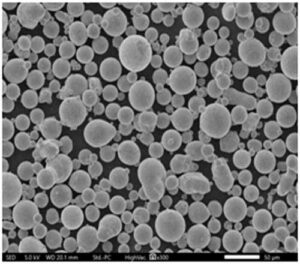
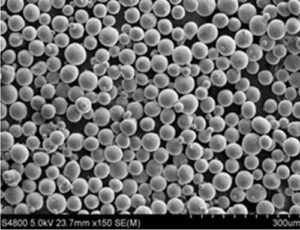
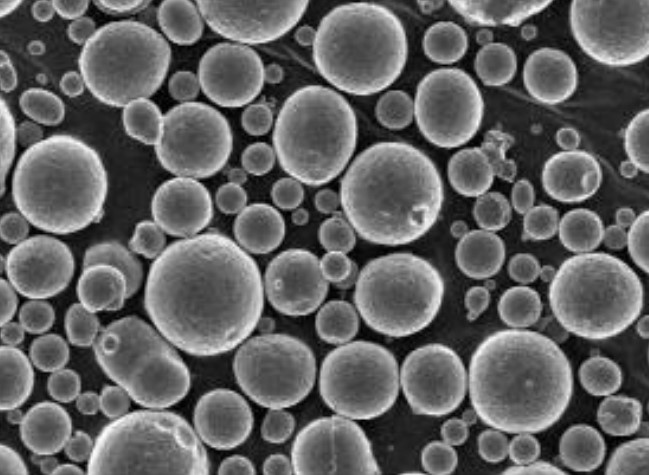
Batch certification should include laser diffraction PSD per ISO 13320, nickel and impurity chemistry by ICP-OES or XRF, oxygen/nitrogen by inert gas fusion, Hall flow per ASTM B213, and SEM morphology imaging. Because magnetic performance cannot be measured on loose powder, qualification lots for critical applications often include a sintered or printed test bar whose permeability and coercive force are measured after the standard anneal, a practice worth requesting from any serious supplier.
Manufacturing Process Melting Atomization and Classification Steps
FeNi42 soft magnetic powder is produced by inert gas atomization as the standard industrial route, with centrifugal processes such as PREP available for premium coarse fractions. The process chain is designed around one overriding goal: keeping oxygen and magnetic impurities out of the final powder.
Gas atomization (GA) begins with vacuum induction melting of electrolytic iron and high-purity nickel (typically 99.9%+ cathode nickel) under strict charge control, because the nickel content must land within a half-percent window and carbon pickup from crucibles must be suppressed. The melt is superheated, then poured through a ceramic nozzle and disintegrated by high-purity argon jets. Argon is strongly preferred over nitrogen for soft magnetic grades: nitrogen can dissolve into Fe-Ni melts and form nitrides that pin domain walls, while argon is fully inert. Droplets spheroidize and solidify in the atomization tower, and the closed system keeps oxygen pickup to a minimum, routinely achieving 0.02-0.04 wt% total oxygen in well-run campaigns.
Plasma rotating electrode process (PREP) offers an alternative for the coarsest, highest-quality fractions. A wrought FeNi42 electrode rod rotates at high speed while a plasma torch melts its tip; centrifugal force ejects droplets that solidify into near-perfectly spherical particles with virtually no satellites and no ceramic nozzle contact. PREP powder commands a premium and starts at coarser sizes (typically 45 microns and up), making it well suited to EBM, DED, and hot isostatic pressing (HIP) feedstock rather than fine LPBF cuts.
Post-atomization, the powder passes through controlled classification steps:
- Screening and air classification: the atomized distribution is split into commercial cuts (0-25, 15-53, 45-106, 45-150 microns) using multi-deck sieving and cyclone classifiers under inert gas blanketing.
- Blending and homogenization: classified lots are blended to normalize chemistry and PSD across the campaign.
- Quality sampling: each lot is sampled for chemistry, oxygen, PSD, flow, and morphology before release.
- Packaging: powder is vacuum-sealed or argon-backfilled in moisture-barrier containers with desiccant, because surface moisture accelerates oxidation and degrades flow.
One process step happens not at the powder producer but at the parts manufacturer, and buyers should plan for it: the final anneal. Whether the part is printed, molded, or pressed, full magnetic softness requires annealing at 900-1100 deg C in dry hydrogen or high vacuum, followed by controlled cooling through the ordering temperature range. Powder suppliers who understand this step can advise on oxygen limits and particle cleanliness that make the anneal effective.
Applications by Industry Medical Aerospace and Power Generation
FeNi42 powder serves applications that sit at the intersection of magnetic function and thermal expansion matching, a combination no competing alloy family reproduces. Demand concentrates in electronics packaging, sensors, and electromagnetic components, with additive manufacturing opening new geometries in each sector. Representative uses are summarized below and on the supplier’s applications page.
Typical Applications by Industry
| Industry | Representative Parts | Why FeNi42 Powder |
|---|---|---|
| Electronics packaging | Hermetic package bases, lead frames, seal rings | CTE match to glass/ceramic |
| Aerospace | Sensor housings, avionics shielding, sealed connectors | Expansion stability plus shielding |
| Medical | Implantable device enclosures, imaging sensor components | Hermetic sealing, biocompatible nickel alloys family |
| Power generation | Relay cores, solenoid yokes, instrument transformer parts | Bs ~1.5 T, low hysteresis loss |
| Automotive electronics | Sensor cores, actuator armatures, EMI shielding | Net-shape complexity via MIM/AM |
| Scientific instruments | Cryostat feedthroughs, vacuum chamber seals | Low CTE across temperature cycles |
Electronics and semiconductor packaging is the historical heartland of this alloy. Glass-to-metal and ceramic-to-metal seals rely on FeNi42’s expansion curve tracking that of sealing glass through the sealing and cooling cycle, preventing stress cracks in hermetic enclosures for oscillators, sensors, and optoelectronic devices. Powder routes now produce net-shape seal rings and package bases by MIM, cutting machining waste on small high-volume parts, while binder jetting and LPBF serve prototype package geometries.
Aerospace and defense applications exploit the dual property set: avionics enclosures and connector shells must survive wide temperature swings without dimensional drift, and the same material provides magnetic shielding for sensitive instrumentation. Additively manufactured shielding structures with conformal, weight-optimized shapes are an active development area, because printing allows shield walls to follow the electronics they protect rather than forcing box geometries.
Medical devices use FeNi42 where hermetic feedthroughs and sealed sensor housings contact implanted electronics. The alloy’s expansion stability keeps ceramic insulator seals intact through sterilization cycles, and powder metallurgy routes produce small, intricate enclosure components economically at scale.
Power generation, relays, and industrial electronics value the magnetic side: with saturation near 1.5 T and low hysteresis loss after annealing, FeNi42 serves in relay cores, solenoid yokes, and instrument transformer components where flux density matters and the operating frequency is low enough that its moderate resistivity is acceptable. Printed cores with shaped pole faces and integrated flux paths are replacing laminated assemblies in specialty low-volume applications.
Automotive electronics and sensors round out the demand picture, particularly through MIM, which produces millions of small soft magnetic sensor cores and actuator armatures annually. The trend toward electrified vehicles is expanding this segment, as position, current, and speed sensors multiply per vehicle.
Across these industries, the sourcing logic is consistent: engineers reach for FeNi42 when a part must hold dimensions against glass or ceramic across temperature and simultaneously carry or shield magnetic flux, and powder metallurgy or printing delivers the geometry more economically than machining wrought bar.
Comparison With Other Grades and Alternative Alloy System Options
Soft magnetic alloy selection is always a compromise among saturation flux density, permeability, resistivity, cost, and, in FeNi42’s case, thermal expansion. The table below compares FeNi42 with the grades buyers most often weigh against it.
FeNi42 vs Alternative Soft Magnetic Alloys
| Property | FeNi42 | FeNi50 | FeNi80 (Permalloy) | FeCo50 | FeSi (6.5%) |
|---|---|---|---|---|---|
| Saturation flux density (T) | 1.4-1.5 | 1.5-1.6 | 0.75-0.8 | 2.3-2.4 | 1.8 |
| Initial permeability | 2000-5000 | 4000-10000 | 50000-100000+ | 1000-3000 | 2000-6000 |
| Coercive force (A/m) | < 20 | < 10 | < 2 | 40-80 | < 20 |
| Electrical resistivity (uOhm*m) | 0.70 | 0.50 | 0.55 | 0.25 | 0.80 |
| CTE 20-300 deg C (x10-6/K) | 4.5-5.0 | 8-9 | 12-13 | 10-11 | 11-12 |
| Curie temperature (deg C) | ~420 | ~500 | ~450 | ~980 | ~700 |
| Glass/ceramic sealing | Excellent | No | No | No | No |
| Relative material cost | Medium | Medium | High | Very high | Low |
FeNi50 is the nearest sibling, offering slightly higher saturation and permeability with lower coercive force, but its expansion coefficient roughly doubles, eliminating it from sealing applications. Where the design is purely magnetic, a shielding can or a relay core with no expansion constraint, FeNi50 is often the better magnetic performer per dollar.
FeNi80 permalloy dominates where ultimate permeability and minimal coercive force are decisive, such as high-sensitivity shielding and precision current transformers. Its saturation below 0.8 T limits it to low-induction duty, and its expansion is ordinary, so it competes with FeNi42 only in shielding applications, and only when induction levels are low.
FeCo50 is the saturation champion at 2.3-2.4 T, used in aircraft generators and high-performance motors where weight and size justify cobalt’s very high cost and the alloy’s brittleness in processing. It cannot seal to glass and costs several times more per kilogram than FeNi42.
FeSi alloys, including silicon steel powder, offer low cost and high resistivity for laminated-style AC cores, but their permeability is modest, they are brittle in powder form, and they lack any expansion matching capability.
The selection logic compresses to a few rules. If the part must seal to glass or ceramic, FeNi42 is essentially the only soft magnetic option. If the part is purely magnetic, choose by induction level and frequency: FeCo50 for maximum flux, FeNi50 or permalloy for maximum permeability, FeSi for cheap AC cores, and FeNi42 when moderate magnetic performance must come with expansion stability.
Our Company
Shanghai Truer Technology Co., Ltd is a China-based additive manufacturing supplier integrating PREP powder making equipment and high-quality spherical metal powders. Established in 2009, the company offers both gas atomization (GA) and PREP manufacturing capabilities across nickel alloys, titanium alloys, aluminium alloys, stainless steels, cobalt alloys, copper alloys, high-entropy alloys, and specialty materials.
In the soft magnetic category, Truer supplies FeNi42, FeNi50, FeCo50, permalloy, and related compositions as spherical powders with particle size distributions matched to LPBF, EBM, DED, MIM, and press-and-sinter processes. Soft magnetic grades are atomized under high-purity argon with controlled oxygen levels, and every batch ships with a certificate of analysis covering chemistry, oxygen and interstitial content, PSD, flow rate, apparent density, and SEM morphology on request.
Beyond standard grades, the company provides custom alloy development, small-batch prototyping quantities, and scale production services for industries including aerospace, medical devices, electronics packaging, oil and gas, and automotive. A joint innovation center for metal 3D printing, operated in collaboration with leading research institutions, supports customers developing printed magnetic components or qualifying new powder grades for production.
For inquiries about FeNi42 soft magnetic powder specifications, sampling, or custom nickel content windows, contact the team with your target PSD, oxygen limit, and annual volume estimate.
FAQ
Q1: What is the typical particle size distribution for FeNi42 soft magnetic powder? A: The standard LPBF cut is 15-53 microns, with 45-106 microns supplied for EBM and DED. Fine cuts of 0-25 or 0-38 microns are available for MIM, and coarser 45-150 micron fractions serve press-and-sinter applications.
Q2: Can FeNi42 powder be used in both SLM and EBM systems? A: Yes, provided the PSD matches the platform: 15-53 microns for SLM/LPBF and 45-106 microns for EBM. EBM’s vacuum atmosphere is actually beneficial for this grade because it limits oxidation during the build, though parts from either process require a final anneal to develop full magnetic properties.
Q3: What certifications does FeNi42 powder come with? A: Standard supply includes a certificate of analysis with nickel and impurity chemistry per ASTM F30 / DIN 1.3917, oxygen-nitrogen content by inert gas fusion, PSD by laser diffraction, Hall flow rate, and apparent density. SEM morphology reports and qualification test bar data are available for regulated applications.
Q4: What is the MOQ for ordering FeNi42 powder? A: Sample quantities of 5-10 kg are typically available for process development and magnetic qualification. Production orders generally start at 25-50 kg, with better pricing at volumes above 100 kg.
Q5: Can the composition of FeNi42 powder be customized? A: Yes. The nickel window can be narrowed or shifted within the Fe-Ni system, and related grades such as FeNi46 or FeNi50 can be produced on the same atomization platform. Custom compositions require a minimum campaign quantity and a short development cycle.
Q6: What is the typical lead time for FeNi42 powder orders? A: Standard cuts are usually available from stock or within 1-2 weeks. Custom compositions, PREP-produced coarse fractions, or large campaign quantities typically require 3-6 weeks depending on melting and atomization scheduling.