Kurzantwort
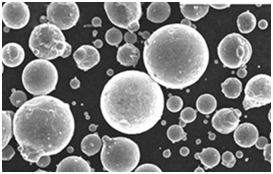
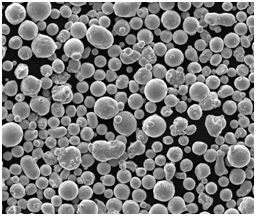
Spherical copper powder is a high-conductivity metal powder engineered with near-round particles for additive manufacturing, powder metallurgy, and thermal spray processes. It is chosen for metal 3D printing when a component must combine complex geometry with strong electrical and thermal performance. In practical terms, spherical copper powder is most valuable for heat exchangers, cooling inserts, electrodes, inductive parts, and electronic hardware where conductivity, powder flow, and dense part formation matter more than maximum structural strength.
What Is spherical copper powder?
Spherical copper powder is a particulate copper material produced so that most particles are close to round rather than angular, dendritic, or irregular. In powder-based manufacturing, that shape is not merely aesthetic. It changes how the material flows through hoppers, spreads across powder beds, packs under vibration, and behaves during melting or sintering. For that reason, spherical copper powder occupies a distinct place within the broader copper powder family.
The term sits at the intersection of metallurgy and process engineering. “Copper powder” identifies the base material, which may be commercially pure copper or a copper-based alloy. “Spherical” defines the morphology that supports more consistent handling and more predictable consolidation. In advanced manufacturing, engineers often care as much about morphology as they do about nominal chemistry, because a chemically correct powder can still fail if it feeds poorly or forms unstable powder layers.
Historically, copper has been one of the most important engineering metals because of its excellent electrical conductivity, thermal conductivity, ductility, and corrosion behavior in many service environments. Traditional copper processing routes such as rolling, extrusion, machining, and casting remain dominant for bulk production, but they become limiting when the desired geometry includes internal channels, thin lattice features, or integrated conductive pathways. Spherical copper powder exists largely to close that gap between copper’s intrinsic properties and modern shape complexity.
Within metal additive manufacturing, copper is both attractive and difficult. It is attractive because few engineering metals can match its conductivity profile. It is difficult because copper reflects a significant portion of incident laser energy and draws heat rapidly away from the melt pool, making energy coupling more demanding than with many steels or nickel alloys. That challenge is one reason the industry places such emphasis on powder quality when discussing copper AM feedstock.
It is also important to distinguish spherical copper powder from related materials. Electrolytic copper powder is often more irregular and may be preferred in some conventional powder metallurgy applications. Water-atomized copper powder can offer economic advantages, but it typically has lower sphericity than gas-atomized feedstock. Copper alloys such as CuCrZr, bronze, brass, or CuNi systems solve different engineering problems by trading some conductivity for better strength, hardness, or wear resistance.
In standards language, the material is best understood through both powder terminology and alloy terminology. Process definitions published in ISO/ASTM 52900 additive manufacturing terminology help explain where copper powder fits within additive manufacturing categories, while broader metallurgical references such as ASM International materials guidance clarify how copper and its alloys are selected in industrial practice. Together, these frameworks help buyers avoid specifying “copper powder” too loosely when the actual requirement is a narrowly controlled spherical AM feedstock.
Chemical Composition and Material Grade
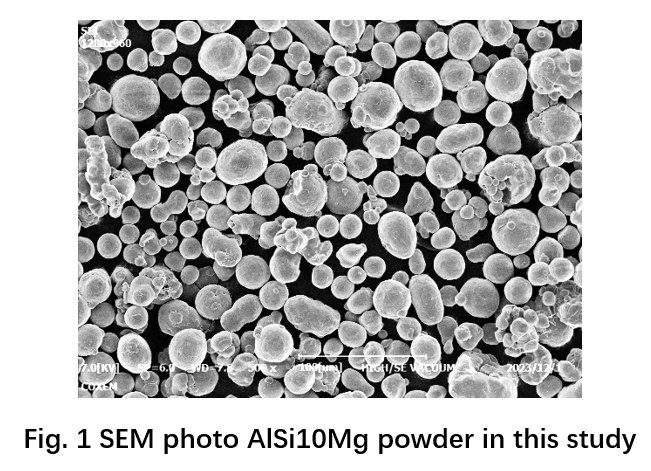
Chemistry is the first technical filter for spherical copper powder, but it is not the last one. Buyers often start with purity because they want the conductivity associated with copper, yet conductivity-sensitive applications depend on more than total Cu content alone. Residual oxygen, sulfur, iron, lead, bismuth, and phosphorus can influence oxide formation, melt behavior, sintering response, and final electrical performance.
In practice, spherical copper powder may be supplied as commercially pure copper or as a copper-based alloy tailored to a defined use case. For purely conductive applications, the focus usually remains on high-purity copper with low and controlled residuals. For applications that need a better balance between conductivity and mechanical performance, the specification may move into alloy territory instead of staying with unalloyed copper.
Copper Purity and Residual Elements
Commercial powder specifications often describe copper as at least 99.5 wt% or higher, while premium AM grades may be tighter depending on the process route and end use. Oxygen is frequently monitored because oxide films can affect both the powder surface and the built part’s conductivity. Small residual quantities of iron, sulfur, or lead may still fall within commercial limits, but advanced users often request narrower limits if the powder is intended for high-performance electronics or thermal management components.
Grade Naming for Spherical Copper Powder
Unlike aerospace titanium or stainless grades, pure copper powder is not always purchased by a single universally recognized AM-specific grade designation. Suppliers therefore cross-reference chemistry families, wrought-material naming conventions, and internal powder specifications. This means the purchaser should confirm whether the quoted grade reflects only chemistry, or chemistry plus powder-form physical-property controls.
Why Cross-Reference Standards Carefully
ASTM, AMS, GB, ISO, and DIN naming systems can provide useful orientation, but many were originally built around wrought, cast, or general industrial copper rather than narrowly qualified spherical AM feedstock. A chemistry family reference is helpful, but it does not replace lot-specific powder data. The most robust purchasing specifications combine a copper material family reference with explicit limits for PSD, oxygen, morphology, and powder condition.
| Element / Grade Item | Typical Composition or Reference | ASTM Context | AMS Context | GB Context | ISO / DIN Context |
|---|---|---|---|---|---|
| Kupfer (Cu) | ≥ 99.5 wt% typical; higher purity lots available | Commercially pure copper family reference | Order-specific documentation when requested | Pure copper designation practice | Comparable Cu family naming context |
| Sauerstoff (O) | Low, controlled, application-dependent | Powder-specific reporting preferred | Often customer-defined | Often customer-defined | Important for conductivity and oxide control |
| Silber (Ag) | Trace residual typical | Minor residual element | Same | Same | Usually included in trace analysis |
| Eisen (Fe) | Low residual typical | Conductivity-sensitive impurity | Same | Same | Usually controlled in supplier certificate |
| Schwefel (S) | Very low residual typical | Cleanliness-related impurity | Same | Same | Important for metallurgical consistency |
| Blei (Pb) | Very low residual typical | Restricted residual | Same | Same | Often limited for high-purity use |
| Bismuth (Bi) | Very low residual typical | Controlled impurity | Same | Same | Relevant to hot-working sensitivity |
| Phosphor (P) | Trace or restricted, depending on grade intent | May be application-specific | Same | Same | Must be declared if conductivity matters |
| Material designation | Pure copper / spherical Cu powder / Cu-based powder | Chemistry family support | Order-based aerospace paperwork | Comparable naming support | Partial equivalence only |
The table shows why chemistry should be treated as a baseline rather than a complete buying decision. A lot can satisfy a general pure-copper description and still be a poor fit for laser powder bed fusion if the PSD is too broad or the morphology contains too many satellites. In conductivity-driven applications, surface condition and oxygen control frequently matter almost as much as headline purity.
That is also why many procurement teams write internal material specifications. They may reference the supplier’s copper alloy powder portfolio for family selection, then add project-specific limits for the exact process window being qualified. This approach is especially common where spherical copper powder will be used for printed parts rather than for conventional press-and-sinter production.
Technische Daten
The technical specification of spherical copper powder is really a description of behavior. It tells the engineer how the powder is expected to spread, flow, pack, absorb energy, and consolidate in a given manufacturing process. Because copper is thermally efficient and optically challenging under many laser conditions, these powder metrics matter even more than they do for some easier-to-print alloys.
Particle Size Distribution for Spherical Copper Powder
Particle size distribution, or PSD, determines how the powder layers, feeds, and melts. Fine fractions are commonly selected for laser powder bed fusion because thinner recoated layers and finer features are possible when the size cut is appropriately narrow. Coarser fractions are often preferred for directed energy deposition, thermal spray, or certain powder metallurgy routes where steady feeding and reduced dusting take precedence over ultra-fine layer formation.
Flow, Packing, and Powder-Bed Stability
Apparent density and tap density help show how efficiently the powder packs before and during processing. Hall flow time gives a practical measure of how quickly the powder moves through a standardized funnel, although the number only becomes meaningful when read together with PSD and morphology. High flowability is not an end in itself; the real goal is stable powder handling and reproducible deposition.
Oxygen, Surface State, and Sphericity
Oxygen content is a high-value control point for copper because conductivity-sensitive applications are less tolerant of surface oxides and contamination. Surface satellites, moisture pickup, and fines can all influence behavior during recoating or powder feeding. For that reason, advanced users often specify not just chemistry and PSD, but also high electrical conductivity targets supported by tight control of the powder’s physical condition.
| Specification Item | Fine AM Grade | Standard AM Grade | Coarse Process Grade | Anmerkungen |
|---|---|---|---|---|
| Partikelgrößenverteilung | 15–45 µm typical | 15–53 µm typical | 45–105 µm or 53–150 µm typical | Selected by process and machine type |
| Scheinbare Dichte | 4.2–5.0 g/cm³ typical | 4.5–5.3 g/cm³ typical | 4.8–5.6 g/cm³ typical | Influenced by PSD and satellite content |
| Zapfstellendichte | 5.0–5.8 g/cm³ typical | 5.2–6.1 g/cm³ typical | 5.5–6.4 g/cm³ typical | Zeigt die Effizienz der Verpackung an |
| Hallströmung | 12–24 s/50 g typical | 10–20 s/50 g typical | 8–18 s/50 g typical | Coarser fractions usually flow faster |
| Sauerstoffgehalt | Low, tightly controlled typical | Low, tightly controlled typical | Low, tightly controlled typical | Limit depends on end-use conductivity target |
| Sphärizität | High, near-spherical typical | High, near-spherical typical | High, near-spherical typical | Commonly checked by microscopy or image analysis |
These values are representative commercial ranges rather than immutable universal standards. A powder qualified for one laser platform may not perform identically on another machine, especially if the energy source, recoater style, or shielding strategy differs. Technical review should therefore match the data sheet to the actual production route rather than relying on a generic “AM grade” description.
One useful comparison is against other powder families used in metal AM. Where copper is selected for heat transfer and conductivity, nickel or cobalt materials are usually chosen for hot strength, corrosion resistance, or wear resistance. In projects where conductivity is secondary, a stainless steel powder range may be easier to process and more economical to qualify, even if it cannot match copper’s thermal performance.
Applications Across Industries
Spherical copper powder is used where the function of the part depends on moving heat, carrying current, or managing electromagnetic behavior in a geometry that conventional manufacturing handles poorly. That design logic gives copper an application profile that is different from titanium, superalloys, and tool steels. The question is not whether copper is “better” than those materials, but whether conductivity is the dominant engineering driver.
Thermal Management with Copper AM Powder
Cooling performance is one of the strongest reasons to use copper powder in additive manufacturing. Conformal cooling channels, heat spreaders, vapor-adjacent structures, and compact heat exchanger cores all benefit from copper’s thermal conductivity. When the design must remove heat rapidly from a small volume, thermal management often becomes the deciding factor.
Electrically Conductive and RF Components
Electrical and electronic components are another major application family. Engineers use spherical copper powder for inductors, electrodes, conductive interfaces, current-transfer elements, and RF-relevant hardware when the part geometry is too complex for efficient machining or when build-to-build customization is required. In these applications, geometry and conductivity must be optimized together.
Tooling, PM, and Specialty Industrial Uses
Not all uses of spherical copper powder are in high-end 3D printing. The material also appears in conventional powder metallurgy, metal injection molding research, brazing-related components, and thermal spray feedstock categories. Spherical morphology remains beneficial in these areas because it supports more predictable flow and powder handling across multiple process types.
| Industrie | Typical Part | Main Functional Driver | AM / PM Process |
|---|---|---|---|
| Elektronik | Heat sinks, conductive housings, RF elements | Elektrische und thermische Leitfähigkeit | LPBF, DED |
| Mold and Tooling | Conformal cooling inserts, thermal cores | Fast heat extraction | LPBF, PM |
| Energy Systems | Heat exchangers, current-carrying hardware | Heat transfer efficiency | LPBF, DED, PM |
| Luft- und Raumfahrt | Thermal control hardware, conductive subcomponents | Lightweight conductivity and compact design | LPBF, EBM, DED |
| Industrielle Ausrüstung | Electrodes, induction parts, custom tooling | Geometry plus conductivity | PM, LPBF |
| Research Institutions | Process coupons, benchmark parts, test structures | Parameter development | LPBF, EBM |
An important selection point is that pure or near-pure copper is not always the best copper-family material for a demanding application. Some components need a better balance between conductivity and strength, which can push the selection toward CuCrZr or other copper alloys. For other jobs, the engineer may move outside the copper family entirely and compare aluminum, titanium, or nickel feedstocks depending on service temperature and structural loading.
That kind of comparison is often useful early in design. A team choosing between copper and lightweight conductive materials may also examine an aluminum alloy powder selection to benchmark weight, thermal response, and cost. The final choice depends on whether the part is primarily a conductor, a heat sink, a structural bracket, or a hybrid of those functions.
Manufacturing and Quality Assurance
How spherical copper powder is made has a direct impact on how it performs. Powder route influences not only shape, but also cleanliness, satellite content, particle-size control, and ultimately the amount of process tuning the user will need. For copper, that manufacturing route matters because the metal’s sensitivity to oxidation and its thermal behavior reduce tolerance for poor powder condition.
Gas Atomization and Spherical Powder Production
Gas atomization is the most common route for commercial spherical copper powder used in AM and related industries. In this process, molten copper is disintegrated by high-velocity inert gas into droplets that rapidly solidify into powder particles. The route is favored because it can deliver scalable production, useful PSD flexibility, and high sphericity suitable for recoating and feeding operations.
PREP and VIGA in Comparative Perspective
Plasma Rotating Electrode Process, or PREP, is better known for highly spherical powders with low satellite content, often for premium applications. Vacuum induction gas atomization, or VIGA, adds vacuum melting and inert atomization to support chemistry control and cleanliness. Even when a copper powder is ultimately chosen from a GA route, buyers often compare it with PREP and VIGA alternatives to understand tradeoffs in cost, morphology, and contamination risk.
Lot Qualification, Testing, and Release
Quality assurance should include chemistry verification, oxygen testing, PSD analysis, flow measurement, density testing, and morphology inspection. Depending on the application, suppliers may also provide micrographs, retained samples, or specialized packaging records. The goal is not simply to certify that the powder is copper, but to show that it will behave consistently in the intended process.
In copper additive manufacturing, feedstock control is often the difference between nominal conductivity and usable conductivity.
| Attribut | Gas Atomization (GA) | VIGA | PREP | Warum es wichtig ist |
|---|---|---|---|---|
| Typical particle shape | Spherical; some satellites possible | Spherical; cleaner melt history typical | Very spherical; low satellites typical | Influences layer uniformity and feed stability |
| Atmosphere control | Inert gas production standard | Vacuum melt plus inert atomization | Highly controlled premium route | Supports low oxidation and low contamination |
| PSD flexibility | Broad and commercially practical | Broad with strong control | Controlled, often premium-focused | Must fit the target AM or PM process |
| Relative throughput | Hoch | Mittel bis hoch | Lower in many mainstream supply cases | Affects availability and scalability |
| Relative cost position | Usually most economical | Mid to premium | Premium | Important during sourcing decisions |
| Common use logic | General AM, PM, spray supply | Higher-control lots | Morphology-critical programs | Route should match qualification risk |
Quality assurance continues after production. Copper powder can be affected by storage conditions, humidity exposure, repeated opening cycles, and repacking practice. Good procurement practice therefore includes questions about sealed packaging, inert atmosphere handling, traceability, and retest policy if material remains in inventory for an extended period.
Buyers that need a disciplined measurement framework often use external technical references for internal review. General resources from NIST materials measurement science are useful for thinking about traceability and repeatable testing, while internal supplier audits focus on how those measurements are implemented in daily production. This matters because copper powder performance is determined by manufacturing consistency, not by a single favorable data point.
Why Choose Truer as Your Supplier
Supplier selection for spherical copper powder is fundamentally a technical fit decision. The right supplier is the one that can match powder morphology, size distribution, chemistry control, testing scope, and packaging method to the user’s actual production route. This is especially important for copper because application performance usually depends on conductivity, and conductivity-driven parts are less forgiving of feedstock inconsistency.
Truer’s relevance in this space comes from the overlap between powder-making knowledge and downstream AM process understanding. Its technical scope includes gas atomization, PREP powder-making equipment, and Selective Electron Beam Melting equipment, alongside practical coverage of SLM, SEBM, DED, laser cladding, PM, MIM, HIP, and spraying-related processes. That background helps frame spherical copper powder not as an isolated commodity, but as a feedstock whose specification should be tied to end use.
Another useful factor is portfolio breadth. Many projects begin with copper, then branch into titanium, nickel, cobalt, aluminum, or stainless options as the design team balances conductivity against weight, strength, corrosion resistance, and thermal service conditions. Truer’s broader materials background is outlined in its additive manufacturing company overview, which places copper powder within a larger metal powder and equipment ecosystem.
From the buyer’s perspective, the decisive criteria are usually documentation depth, repeatability, and responsiveness during qualification. Can the supplier reproduce the same PSD window, oxygen control, and morphology from lot to lot? That question matters more than brand language, and it is why lot-to-lot consistency is often the most practical differentiator in real procurement programs.
Ordering Guide and Support
Ordering spherical copper powder efficiently starts with a clear use-case description. A purchaser should identify whether the material is intended for laser powder bed fusion, electron beam processing, directed energy deposition, thermal spray, powder metallurgy, or another route, because each process prefers a different size fraction and may require different test data. An RFQ that says only “copper powder” is usually too broad to yield a technically useful quote.
Information to Include in an RFQ
A strong RFQ typically includes target chemistry, desired PSD, annual usage estimate, required documentation, packaging preference, and destination country. It should also mention whether the order is for screening trials, machine parameter development, formal qualification, or repeat production. That information lets the supplier align the proposed powder lot with the actual program stage.
Sampling, Pilot Lots, and Scale-Up
Small samples are valuable for early printability checks, but they are not a substitute for pilot-lot evaluation. Copper projects often expose issues only after multiple build cycles, especially where oxidation control, reuse strategy, and fine-feature repeatability are involved. For that reason, many teams move from gram-scale or kilogram-scale samples to structured pilot lots before freezing the process.
Packaging, Lead Time, and Technical Communication
Fine spherical copper powder is commonly supplied in sealed bottles or drums with traceable labeling and lot identification. Lead time depends on stock condition, required sieving, test scope, and export packaging. When the project needs a narrow distribution or special release criteria, early technical communication reduces delays and avoids quoting the wrong grade.
| Verpackungsformat | Typical MOQ Tier | Typical Lead Time | Sample Policy |
|---|---|---|---|
| 500 g bottle | Lab-scale evaluation | 1–3 weeks typical if available | Paid sample often possible |
| 1 kg bottle | Feasibility testing | 1–3 weeks typical | Traceable sample lot preferred |
| 5 kg bottle | Extended process development | 2–4 weeks typical | Commonly supplied with standard test data |
| 10 kg bottle | Pilot build program | 2–5 weeks typical | Suitable for repeatability trials |
| 25 kg drum | Routine procurement | 3–6 weeks typical | Lot reservation may be discussed |
For buyers, one of the most useful procurement habits is to specify the end process before negotiating price. A low-cost copper powder with the wrong morphology or the wrong PSD can become expensive very quickly once build failures or inconsistent PM behavior enter the picture. That is why application-specific PSD and handling requirements should be discussed before order placement.
When a project moves from exploratory testing to a real sourcing program, direct technical communication becomes more important than catalog language alone. For sample coordination, technical questions, or order-specific requirements, the powder inquiry page is the logical channel to define the process route and qualification needs in detail.
Unser Unternehmen
Shanghai Truer Technology Co., Ltd. was established in 2009 and created its additive manufacturing business in 2019. The company focuses on integrating 3D printing powder-making equipment and services with metal powders for engineering applications of additive manufacturing. Its core technologies include Selective Electron Beam Melting equipment, Plasma Rotating Electrode Process powder-making equipment, and gas atomization. The company supplies TiNi, TiTa, TiAl, TiNbZr, CoCrMo, and nickel-based, cobalt-based, titanium-based, copper-based, aluminum-based, and stainless steel spherical metal powders for SLM, SEBM, DED, laser cladding, powder metallurgy, MIM, HIP, cold and hot spraying, welding, and coating in sectors including 3C electronics, hand tools, remote control cars, medical, aerospace, and nuclear power.
FAQ
Q1. Is spherical copper powder suitable for laser powder bed fusion?
Yes, spherical copper powder is commonly evaluated for laser powder bed fusion because its particle shape improves spreading and layer uniformity. The challenge is not whether the powder can be used, but whether the machine, laser wavelength, and parameter set can process copper efficiently enough to achieve dense and conductive parts.
Q2. What particle size is best for spherical copper powder in metal 3D printing?
For many LPBF applications, (15\text{–}45\ \mu m) or (15\text{–}53\ \mu m) are common commercial ranges. Coarser cuts such as (45\text{–}105\ \mu m) are more typical for DED or other feed-based processes. The best choice depends on recoating method, layer thickness, and energy input strategy.
Q3. Why is spherical copper powder preferred over irregular copper powder?
Spherical morphology usually improves flowability, packing behavior, and powder-bed consistency. Those benefits help reduce layer defects and feeding problems in AM and related powder processes. In copper specifically, better powder behavior is valuable because the material already presents thermal and optical processing challenges.
Q4. Does spherical copper powder always mean pure copper?
No, the phrase describes particle shape rather than chemistry. Spherical copper powder may refer to commercially pure copper or to copper-based alloys such as CuCrZr, bronze, or brass, depending on the intended application. Buyers should therefore confirm both the alloy identity and the morphology.
Q5. What properties matter most when sourcing spherical copper powder?
The key properties are chemistry, oxygen level, particle size distribution, flowability, apparent density, tap density, and morphology. For conductivity-critical applications, cleanliness and packaging practice are also important because oxidation or contamination can affect part performance. A good supplier data package should reflect the intended process, not just provide generic copper values.
Q6. Which industries use spherical copper powder most often?
It is most commonly associated with electronics, thermal management, tooling, energy systems, aerospace subcomponents, and advanced industrial equipment. The common thread across those sectors is the need for heat transfer, current carrying, or compact conductive geometry. Where those functions are secondary, another metal powder family may be a better fit.