Kurzantwort
FeSiBC HVOF powder is an iron-based alloy powder in the Fe-Si-B-C system, typically engineered as a dense thermal-spray feedstock rather than a laser powder bed fusion material. For industrial wear parts, it is often the right choice when the priority is a hard, relatively dense, well-bonded surface coating with good abrasion resistance, reasonable corrosion performance, and lower raw-material cost than many nickel- or cobalt-based alternatives. Its strongest fit is usually shafts, sleeves, rollers, pump parts, and repair coatings produced by HVOF or related high-velocity spray routes.
What Is FeSiBC HVOF powder?
FeSiBC HVOF powder refers to a family of iron-based spray powders built around iron, silicon, boron, and carbon. In materials terms, it sits close to the broader class of Fe-based amorphous or near-amorphous alloys, where boron and silicon help glass formation, carbon contributes hardness and microstructural tuning, and iron remains the cost-efficient matrix element. In practice, suppliers may offer plain FeSiBC chemistry or modified variants that add chromium, molybdenum, niobium, or other elements for improved corrosion resistance, hot hardness, or amorphous retention.
The “HVOF” part matters as much as the chemistry. High-velocity oxy-fuel spraying accelerates powder particles to high speed while limiting thermal exposure compared with some hotter spray processes, which is one reason Fe-based amorphous feedstocks are often developed for HVOF and HVAF deposition. Published work on Fe-based amorphous coatings shows that HVOF can help retain amorphous fraction, reduce oxidation relative to less controlled spray conditions, and generate coatings with useful hardness and low porosity when parameters are optimized.
A key nuance is that FeSiBC HVOF powder is not a single globally standardized commodity grade in the same way as 316L powder or Inconel 718 powder. The name usually describes a composition family and coating function rather than a universal code. That is why buyers normally evaluate it by chemistry window, particle size distribution, flow behavior, oxygen level, morphology, and as-sprayed coating data instead of expecting a one-line cross-reference to a single ASTM or DIN alloy number.
Another practical distinction is that FeSiBC HVOF powder should not automatically be treated as a “3D printing powder,” even on a powder-focused AM website. It is more accurately an engineered powder for surface technology, repair, and hybrid manufacturing chains in which spraying, machining, finishing, and sometimes heat treatment are combined. Readers who want a general primer on the coating route itself can compare the process language with the thermal spraying overview.
In Fe-based thermal spray systems, powder chemistry and spray kinetics are inseparable; the coating is designed as a deposited microstructure, not just as a powder composition.
Chemical Composition and Material Grade
FeSiBC HVOF Powder Chemistry Is Usually Supplier-Specified
The biggest buying mistake with FeSiBC HVOF powder is assuming there is one universally accepted composition. In reality, the Fe-Si-B-C system spans multiple subfamilies: high-boron amorphous grades, lower-boron soft-magnetic compositions, and corrosion-enhanced Fe-based spray alloys that introduce Cr or Mo while still being marketed under broader Fe-based amorphous terminology. Research literature shows several representative FeSiBC or closely related FeSiBCrC compositions, but those should be read as reference points rather than as a single mandatory grade.
| Grade Reference / Family | Typical Composition (wt.%) | Metallurgical Intent | ASTM Cross-Reference | AMS Cross-Reference | GB Cross-Reference | ISO Cross-Reference | DIN Cross-Reference |
|---|---|---|---|---|---|---|---|
| FeSiBC nominal amorphous grade | Fe bal., Si 3.0–3.5, B 2.8–3.2, C 0.3–0.6 | Good amorphous tendency, hard coating, economical Fe-rich system | No dedicated universal grade | No dedicated universal grade | Supplier specification | No dedicated universal grade | Supplier specification |
| FeSiBC high-Si/high-B grade | Fe bal., Si 5.5–6.0, B 2.1–2.5, C 0.4–0.7 | Higher glass-forming support and hardness response | No dedicated universal grade | No dedicated universal grade | Supplier specification | No dedicated universal grade | Supplier specification |
| FeSiBC low-alloy Fe-rich grade | Fe bal., Si 2.0–2.5, B 0.4–0.7, C 0.03–0.08 | Very Fe-rich, lower alloy cost, limited hardfacing range | No dedicated universal grade | No dedicated universal grade | Supplier specification | No dedicated universal grade | Supplier specification |
| FeSiBCrC modified variant | Fe bal., Si 6.5–7.0, B 2.4–2.7, Cr 2.0–2.6, C 0.6–0.9 | Improved oxidation/corrosion behavior and amorphous stability | No dedicated universal grade | No dedicated universal grade | Supplier specification | No dedicated universal grade | Supplier specification |
The first two rows above are derived from published FeSiBC compositions reported in atomic form and converted to weight-percent basis, including Fe(_{79.3})Si(_{5.7})B(_{13.3})C(_{1.7}) and Fe(_{78})Si(_{10})B(_{10})C(_2). The Fe-rich row reflects another published FeSiBC composition used in powder-core work, while the FeSiBCrC row reflects a commercially studied Fe-based amorphous powder with chromium added. These references are useful for benchmarking, but a purchase order should still state the required wt.% window explicitly.
Why Grade Equivalents Are Limited
FeSiBC HVOF powder does not map neatly to a single ASTM, AMS, GB, ISO, or DIN material number because coating feedstocks are often standardized by test method and powder characteristics rather than by one universal alloy designation. In commercial practice, buyers therefore rely on supplier datasheets, certificates of analysis, and process qualification records more than on a legacy wrought-alloy grade name. Standards bodies such as ASTM materials standards remain important, but mainly for test methods, not because there is one definitive FeSiBC HVOF alloy code.
FeSiBC vs. Fe-Based Corrosion-Enhanced HVOF Powders
Plain FeSiBC compositions are typically selected for hardness, cost control, and amorphous-forming behavior, while more complex Fe-based HVOF powders add Cr, Mo, or W to improve aqueous corrosion resistance and hot-environment durability. That means engineers should distinguish carefully between “FeSiBC HVOF powder” as a base family and heavily alloyed Fe-based spray powders that only partially overlap with it in performance.
Technische Daten
Typical FeSiBC HVOF Powder Property Targets
For HVOF use, powder behavior is shaped by particle size, morphology, density, and oxygen pickup. Published HVOF studies on Fe-based amorphous powders commonly use fine-to-medium fractions around 15–53 µm or 20–53 µm, because those cuts balance feedability, heating, and impact flattening during deposition. Spherical or near-spherical morphology is generally preferred because it supports more stable feeding and more uniform coating buildup.
| Powder Fraction / Use Case | Typical PSD | Scheinbare Dichte | Zapfstellendichte | Hall Flow | Sauerstoffgehalt | Sphärizität |
|---|---|---|---|---|---|---|
| Fine HVOF grade for dense coatings | 15–53 µm | 3.8–4.6 g/cm³ | 4.6–5.4 g/cm³ | 14–22 s/50 g | ≤ 1200 ppm typical | High, low satellite content |
| Standard industrial spray cut | 20–53 µm | 3.9–4.8 g/cm³ | 4.8–5.6 g/cm³ | 13–20 s/50 g | ≤ 1000 ppm typical | Near-spherical |
| Coarser HVAF / repair grade | 20–75 µm | 4.0–4.9 g/cm³ | 4.9–5.7 g/cm³ | 12–19 s/50 g | ≤ 1000 ppm typical | Good feedability priority |
| Cladding / hybrid surface engineering grade | 45–105 µm | 4.1–5.0 g/cm³ | 5.0–5.8 g/cm³ | 12–18 s/50 g | ≤ 900 ppm typical | Spherical to rounded |
These ranges are typical industrial guidance rather than universal specification limits. Exact values vary with atomization route, chemistry, and whether the powder is optimized for HVOF, HVAF, laser cladding, or blended wear-coating systems. Published Fe-based HVOF work confirms the common use of narrow fine fractions around 15–53 µm and 20–53 µm for dense amorphous or near-amorphous coatings.
Particle Size and Deposition Efficiency
Fine powder promotes higher surface area and more complete heating, but too many fines can reduce feed consistency and increase oxidation risk. Coarser fractions may feed more smoothly, yet they can lower deposition efficiency or require different stand-off distance and fuel balance to achieve similar flattening and cohesion. In production, the optimum size cut is selected around the target coating thickness, spray gun configuration, and final surface finish allowance.
Why Morphology Matters in FeSiBC HVOF Powder
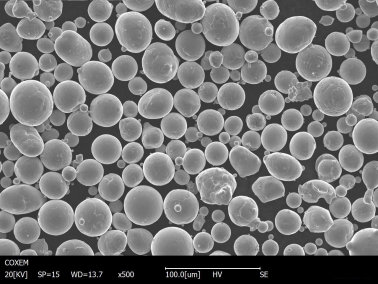
High sphericity improves powder flow through feeders and hoses and helps stabilize mass flow rate into the spray plume. Studies on FeSiBC amorphous powder note smooth surfaces and high sphericity as beneficial traits, especially when coating uniformity is a priority. That is one reason gas atomization or combined atomization routes are often favored over purely irregular crushed feedstocks for high-quality spray applications.
Oxygen, Hardness, and As-Sprayed Structure
Oxygen control is critical because iron-rich powder oxidizes readily during melting, atomization, transport, and spraying. Once oxidation increases, the deposited coating can lose toughness, show higher oxide stringer content, and become harder to process consistently. For buyers comparing suppliers, it is reasonable to ask not only for chemistry and PSD, but also for oxygen content and representative as-sprayed hardness or porosity data.
Applications Across Industries
Where FeSiBC HVOF Powder Creates Value
The value proposition of FeSiBC HVOF powder is most obvious on parts that fail at the surface before they fail in the bulk. Instead of replacing an entire component with a more expensive alloy, engineers can apply an iron-based wear-resistant coating to a steel substrate and then machine or grind it to finish. This logic is common in pumps, rollers, shafts, sealing lands, and other components exposed to abrasion, slurry, friction, or mixed wear-corrosion conditions.
| Industrie | Typical Part | Why It Is Used | AM / PM Process |
|---|---|---|---|
| Mining and minerals | Pump sleeves, slurry handling parts | Abrasion resistance with lower alloy cost than some Ni/Co systems | HVOF, HVAF, laser cladding |
| Öl und Gas | Valve parts, shafts, seal surfaces | Surface hardening and repair on steel substrates | HVOF, DED repair, cladding |
| Zellstoff und Papier | Rollers, guide surfaces, wear rings | Sliding wear control and refurbishable coating approach | HVOF, spray-and-grind |
| Stromerzeugung | Boiler auxiliaries, fan parts, erosion-prone hardware | Erosion and moderate corrosion resistance | HVOF, HVAF |
| Allgemeine Fertigung | Dies, tooling faces, sleeves, plungers | Extend service life without redesigning the whole part | HVOF, cladding, PM overlays |
| Marine and process equipment | Impellers, sleeves, protective rings | Fe-based option for mixed wear service where chemistry is tailored | HVOF, HVAF |
Industrial Wear Parts and Refurbishment
FeSiBC HVOF powder is especially relevant when the substrate is a conventional steel and only the working surface needs upgrading. This repair-oriented logic can produce lower lifecycle cost than replacing the part in a through-hardened or cobalt-rich alloy, particularly when the component is large, geometrically simple, or already integrated into an installed machine.
Comparison with Alternative Powder Families
In some environments, an iron-based HVOF coating is the most economical answer; in others, it is not. Severe corrosion may push the selection toward nickel-rich chemistry, while hot wear or galling in aggressive service may justify a cobalt-bearing material. Readers comparing broader portfolios can use a stainless steel powder catalog as a baseline for corrosion-focused iron alloys and a cobalt alloy powder portfolio when wear resistance must be maintained at higher service temperatures.
A Note on “AM” Positioning
Although HVOF is not powder bed fusion, it belongs to the same wider ecosystem of engineered metal powders and digital manufacturing workflows. In many factories, thermal spray, cladding, machining, and additive repair are already combined in one component strategy. That makes FeSiBC HVOF powder relevant to AM-oriented buyers who need surface engineering rather than fully net-shaped printed parts.
Manufacturing and Quality Assurance
Powder-Making Route Changes Coating Performance
The coating quality achievable with FeSiBC HVOF powder begins upstream at melting and powder production. Gas atomization, vacuum induction gas atomization, and plasma rotating electrode processing do not create identical powders; they differ in cleanliness, yield, morphology, and cost. For Fe-Si-B-C alloys, those differences influence oxidation behavior, amorphous retention, flow, and final spray consistency.
| Production / QA Factor | GA (Gas Atomization) | VIGA (Vacuum Induction Gas Atomization) | PREP (Plasma Rotating Electrode Process) | Typical Acceptance Focus |
|---|---|---|---|---|
| Partikelform | Good sphericality, some satellites possible | Better morphology consistency from vacuum melt handling | Very high sphericality, minimal satellites | Smooth surface, minimal irregular particles |
| Oxygen control | Good with strict shielding | Better chemistry and oxygen control | Excellent cleanliness if electrode quality is high | Low O, low contamination |
| Fine fraction yield | Good for 15–53 µm and 20–53 µm cuts | Good and consistent | Often lower fine yield | Stable commercial sieving yield |
| Cost / throughput | Efficient for scale | Higher process control, higher cost | Highest cost, lower throughput | Cost-performance balance |
| Best-fit use | General HVOF/HVAF powder | Premium controlled spray feedstock | Niche premium spherical powder | Match route to coating qualification needs |
The reason route selection matters is simple: FeSiBC alloys are sensitive to process history. If the powder arrives with poor sphericity, excessive oxide, or uncontrolled fines, the coating window narrows before spraying even begins. That is why experienced users ask for powder-production details and not just nominal composition.
QA Data Buyers Should Request
For technical procurement, coating-grade consistency matters more than a single attractive hardness value from one trial coupon. Buyers should request chemistry, PSD, oxygen level, apparent density, Hall flow, morphology images, lot traceability, and, where available, representative coating porosity and microhardness from a documented spray condition. Measurement discipline can be benchmarked against broad NIST materials measurement resources when aligning test language across suppliers and end users.
Coating Validation, Not Just Powder Validation
A powder can meet lab specification and still fail in production if deposition efficiency, bonding strength, or grinding behavior is unstable. For FeSiBC HVOF powder, practical qualification usually includes spray trials, metallography, hardness mapping, porosity review, and wear testing on the actual substrate class. Published Fe-based HVOF coatings show that process parameters such as oxygen-to-fuel ratio, feed rate, and spray distance materially affect porosity, amorphous content, and hardness.
Why Choose Truer as Your Supplier
For FeSiBC HVOF powder, supplier selection should be based on technical fit rather than generic catalog breadth. The useful questions are whether the supplier can align chemistry, size cut, and morphology with the intended process, whether it can document powder properties consistently, and whether it understands downstream routes such as HVOF, laser cladding, PM, and additive repair.
Truer is relevant in that context because its published capability set spans powder-making equipment, gas atomization, PREP-related technology, and end-use processes that go beyond one single manufacturing route. That broader process view matters when a customer is comparing an iron-based spray powder with adjacent materials used in thermal spray, cladding, or hybrid manufacturing chains. Buyers screening multiple engineered metals may also compare the company’s nickel alloy powder portfolio when corrosion severity exceeds what an FeSiBC-type system can reasonably deliver.
Another decision factor is documentation. For project-based powders without a universal alloy code, traceable powder data is often the real qualification backbone. That includes lot identification, morphology control, PSD consistency, and the ability to keep commercial deliveries aligned with the same technical assumptions used in initial spray trials.
Ordering Guide and Support
What to Define Before You Request a Quote
A serious RFQ for FeSiBC HVOF powder should specify at least five things: target chemistry window, particle size distribution, intended spray process, packaging format, and whether the order is for trial work or repeat production. If the coating will be benchmarked against Ni- or Co-based alternatives, it is also smart to request the same test set across all candidate powders so the comparison is fair.
| Verpackungsformat | Typical MOQ Tier | Typical Lead Time | Sample Policy |
|---|---|---|---|
| 500 g lab bottle | Screening trial | 1–2 weeks for available stock | Small paid sample common |
| 1 kg sealed container | Parameter development | 1-3 Wochen | Usually supplied with basic COA |
| 5 kg vacuum-packed can | Extended coating trials | 2–4 weeks | Sample often deductible from bulk order |
| 10–25 kg industrial lot | Pilot production | 3–6 Wochen | Pre-shipment data package typically requested |
| Reserved project batch | Qualification or repeat program | By agreement | Retained sample and lot lock available by agreement |
Support Documents That Matter
For this material family, buyers usually need a certificate of analysis, PSD report, safety data sheet, and basic handling guidance. Where the application is qualification-driven, retained samples and a pre-agreed acceptance plan are often more valuable than getting the lowest unit price. When project details need to be aligned before supply, the most practical route is a direct discussion through the powder inquiry channel.
Unser Unternehmen
Shanghai Truer Technology Co., Ltd. was established in 2009 and created its additive manufacturing business in 2019. The company focuses on integrating 3D printing powder-making equipment and services with metal powders for engineering applications. Its technical scope includes selective electron beam melting equipment, plasma rotating electrode process powder-making equipment, and gas atomization-related capabilities, together with powder and process support for SLM, SEBM, DED, laser cladding, powder metallurgy, MIM, HIP, spraying, welding, and coating. Truer’s powder portfolio includes TiNi, TiTa, TiAl, TiNbZr, CoCrMo, and broader families such as nickel-based, cobalt-based, titanium-based, copper-based, aluminum-based, and stainless steel spherical powders. The company also participates in a joint innovation center for metal 3D printing with laboratories and external experts, serving sectors such as 3C electronics, hand tools, remote control cars, medical, aerospace, and nuclear power. Additional company background appears on the manufacturer overview page.
FAQ
Q1. Is FeSiBC HVOF powder the same thing as a standard Fe-based hardfacing powder?
Not exactly. FeSiBC HVOF powder usually refers to an Fe-Si-B-C composition family engineered for high-velocity thermal spray deposition, often with amorphous or near-amorphous intent, whereas conventional hardfacing powders may use broader Fe-Cr-B-Si-C chemistry and different deposition routes. The overlap is real, but the process window and microstructural target are not always the same.
Q2. Is FeSiBC HVOF powder mainly for coating, or can it also be used for 3D printing?
Its primary use is coating, especially HVOF or related thermal-spray service. Some Fe-based powders can participate in broader hybrid manufacturing workflows, but FeSiBC HVOF powder should generally be specified as a surface-engineering feedstock unless the supplier explicitly qualifies it for another route.
Q3. What particle size is typical for FeSiBC HVOF powder?
A fine, narrow cut such as 15–53 µm or 20–53 µm is common in published Fe-based HVOF work. Those fractions are popular because they balance feedability, particle heating, and coating density in high-velocity spray systems.
Q4. Does FeSiBC HVOF powder offer better wear resistance than stainless steel coatings?
Often yes in abrasion-focused service, because boron-, silicon-, and carbon-containing Fe-based coatings are usually designed for higher hardness than corrosion-first stainless overlays. However, the right comparison depends on whether the failure mode is abrasion, sliding wear, erosion, corrosion, or a mixed mechanism.
Q5. How important is oxygen content in FeSiBC HVOF powder?
It is very important. Excess oxygen can increase oxide content in the sprayed coating, narrow the process window, and reduce consistency in hardness and cohesion, which is why serious buyers request oxygen values and morphology data together.
Q6. Are all FeSiBC HVOF powders chemically the same?
No. Published FeSiBC compositions range from very Fe-rich low-alloy versions to higher-Si/higher-B amorphous grades, and some commercial variants also add chromium or other elements. A purchase order should therefore define the exact chemistry window in wt.% rather than relying on the family name alone.
Learn more:
- HVOF and Laser-Cladded Fe–Cr–B Coating in Simulated Biomass Combustion: Microstructure and Fireside Corrosion | High Temperature Corrosion of Materials | Springer Nature Link
- Soft magnetic properties regulation of FeSiBC amorphous powders/CIP magnetic powder core with single and double-layer core–shell structure – ScienceDirect
- Electric insulation of a FeSiBC soft magnetic amorphous powder by a wet chemical method: Identification of the oxide layer and its thickness control – ScienceDirect
- J. Iron Steel Res. Int. (2023) 30:193–215
- The Corrosion and Wear-Corrosion of the Iron-Base Amorphous Coating Prepared by the HVOF Spraying | MDPI
- Magnetic property regulation and mechanism analysis of FeSiBC soft magnetic composites by mixing with FeSiCr or carbonyl iron powder – ScienceDirect
- HVOF and Laser-Cladded Fe–Cr–B Coating in Simulated Biomass Combustion: Microstructure and Fireside Corrosion | High Temperature Corrosion of Materials | Springer Nature Link
- Effects of Oxygen/Fuel Ratio on Properties of HVOF Fe-based Amorphous Coatings