Kurzantwort
hollow-free CM247LC powder is a nickel-based superalloy powder based on the CM247LC grade and engineered to minimize internal voids inside individual powder particles. It is preferred for SLM and EBM when users need better particle integrity, more stable melting behavior, and lower risk that trapped gas in the feedstock will contribute to pores, spatter, or inconsistent densification. In practice, the highest-value use cases are hot-section aerospace, energy, and advanced R&D parts where thermal capability matters and powder quality must support repeatable process development.
What Is hollow-free CM247LC powder?
Hollow-free CM247LC powder is the powder form of CM247LC with a specific emphasis on minimizing cavities, entrapped gas pockets, and shell-like particles within the powder population. CM247LC itself is a cast nickel-base superalloy developed for elevated-temperature service, especially in environments where creep resistance, oxidation resistance, and microstructural stability under heat are more important than ease of processing. In powder form, that same alloy becomes relevant to additive manufacturing, powder metallurgy, HIP, and repair technologies.
The phrase “hollow-free” does not normally define a separate standards-based alloy grade. Instead, it describes a powder-quality characteristic. A hollow particle can look spherical from the outside yet contain internal porosity that changes its true density, thermal response, and collapse behavior when exposed to a laser or electron beam. For advanced AM, that difference matters because powder morphology is not only about shape; it is also about what is happening inside each particle.
CM247LC belongs to the family of precipitation-hardened nickel superalloys with a high fraction of gamma-prime phase. That places it in a more demanding category than common AM powders such as 316L stainless steel or AlSi10Mg. The alloy exists because hot-section components need a chemistry that can retain strength at temperatures where simpler alloys soften, creep, or oxidize too quickly. An ASM resource on nickel superalloys is useful background for understanding why alloys like CM247LC remain central to turbine materials engineering.
Why “Hollow-Free” Matters in AM Powder Quality
A powder can meet chemistry targets and still create processing problems if too many particles are hollow, partially collapsed, or gas-filled. In laser and electron beam systems, those defects can influence powder-bed packing, local energy absorption, melt-pool stability, and the final pore structure of the part. That is why high-end buyers increasingly look beyond particle size distribution and ask for evidence of particle integrity as well.
In practical terms, hollow-free powder is usually associated with better true density and more predictable behavior during melting. It can also improve the reliability of downstream screening, dosing, and recycling because the powder population behaves more uniformly. For a crack-sensitive alloy such as CM247LC, reducing variability in the feedstock is especially valuable.
CM247LC in the Superalloy Landscape
CM247LC was derived from the broader 247/MAR-M247 alloy family and modified toward a low-carbon composition to balance castability and hot-property performance. It is best understood as a turbine-class superalloy rather than a general industrial nickel powder. The chemistry supports a gamma-prime-strengthened microstructure built for elevated-temperature load bearing.
That makes CM247LC attractive for combustor-adjacent parts, shrouds, vanes, rig hardware, and hot gas path development. It also makes the alloy harder to print than more common nickel grades such as 718. A user selecting hollow-free CM247LC powder is therefore usually solving a high-temperature materials problem, not simply shopping for a generic spherical feedstock.
Hollow-Free vs. Merely Spherical
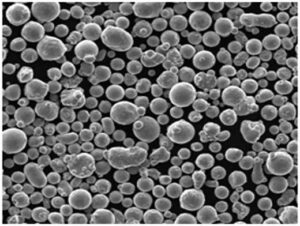
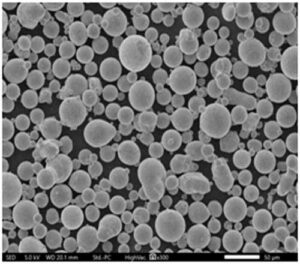
Sphericity remains important, but it is only one layer of powder quality. A particle may be highly spherical yet still be hollow, contain a central void, or have a thin shell that breaks or melts differently from a dense particle. Hollow-free quality aims to improve both geometry and internal soundness.
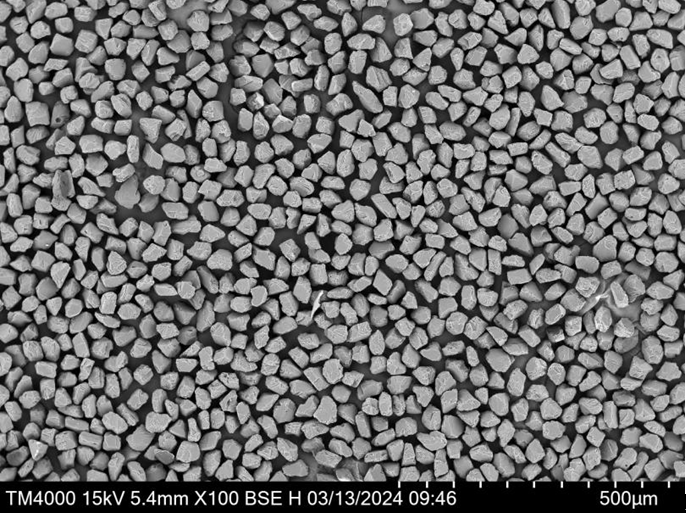
This distinction becomes more important as parts move from simple coupons to demanding production geometries. A powder that spreads nicely but has an unstable internal structure may perform well enough in a basic flow test and still become problematic in high-density AM builds. That is why serious material qualification programs often combine SEM imaging, density measurements, gas analysis, and process trials rather than relying on one metric alone.
In metal AM, powder quality is defined by morphology, chemistry, cleanliness, and internal soundness—not by particle shape alone.
Why the Topic Is Gaining Attention
As additive manufacturing matures, users are pushing nickel superalloys into more demanding geometries and service conditions. That shift naturally increases scrutiny on feedstock quality. Users who once focused only on PSD and oxygen are now more likely to ask how often hollow particles appear, how the powder was produced, and whether the supplier can demonstrate a low hollow-particle rate across lots.
The trend is strongest in aerospace and power generation because qualification costs are high and the penalty for inconsistent feedstock can be severe. For these sectors, hollow-free CM247LC powder is not a marketing phrase; it is a risk-control concept tied directly to process reliability.
Chemical Composition and Material Grade
CM247LC chemistry is complex by design. It uses chromium, cobalt, tungsten, tantalum, aluminum, titanium, hafnium, and controlled trace elements to develop the high-temperature microstructure expected from a turbine-class nickel alloy. In service, the chemistry supports a combination of strength, creep resistance, and oxidation performance that simpler AM alloys cannot easily match.
For procurement, it is important to separate alloy identity from powder quality. Hollow-free CM247LC powder uses the same basic alloy chemistry as conventional CM247LC powder, but the acceptance focus includes the integrity of the particles themselves. This means the buyer should specify composition, PSD, morphology, oxygen, and hollow-particle limits together instead of assuming the alloy name alone is sufficient.
| Element / Grade Reference | Typisch wt% | Common Nominal Range | ASTM / AMS / GB / ISO / DIN Cross-Reference Notes |
|---|---|---|---|
| Ni | Waage | Waage | Nickel-base proprietary superalloy; usually procured by CM247LC composition rather than a single universal powder standard |
| Cr | 8.0–8.5 | about 8.1 | No one-to-one ASTM or DIN commodity equivalent commonly used for AM powder |
| Co | 9.0–10.0 | about 9.2 | Often identified by proprietary alloy family reference in purchasing documents |
| W | 9.0–10.0 | about 9.5 | Key refractory addition for elevated-temperature strength |
| Ta | 3.0–3.5 | about 3.2 | Important gamma-prime former; closely monitored in qualification |
| Al | 5.4–5.8 | about 5.6 | Principal strengthening element for gamma-prime precipitation |
| Hf | 1.2–1.6 | about 1.4 | Supports grain-boundary behavior and carbide-related response |
| Ti / Mo | Ti 0.6–0.9; Mo 0.4–0.7 | Ti about 0.7; Mo about 0.5 | Secondary strengthening additions with process relevance |
| C / B / Zr | C 0.05–0.10; B about 0.015; Zr about 0.015 | tightly controlled | Usually documented as composition-specific supply criteria rather than mapped to a single ISO or AMS powder grade |
Composition Control in hollow-free CM247LC powder
Chemistry control is still the first checkpoint because CM247LC performance depends on a tightly balanced alloy system. Aluminum, tantalum, titanium, and tungsten influence strengthening; chromium supports oxidation resistance; and hafnium, boron, carbon, and zirconium affect carbide formation and grain-boundary behavior. Small deviations can change heat-treatment response and cracking behavior.
At the same time, composition control alone does not make the powder hollow-free. A lot can hit chemistry targets and still contain a higher-than-desired population of voided particles. For that reason, many buyers treat chemistry as necessary but not sufficient.
Grade Designation and Standards Reality
Unlike mainstream stainless or titanium AM powders, CM247LC is not usually bought through a universally harmonized single-line standards designation. It is better described as a proprietary nickel-based superalloy with an agreed chemical envelope and powder specification. That is one reason technical purchase orders for this alloy tend to be more detailed.
Standards are still relevant for the broader framework of additive manufacturing. The ISO/ASTM 52900 additive manufacturing terminology helps define process language consistently, while buyers may also consult the ASTM standards catalog for additive manufacturing and powder test methods when drafting supply requirements. Those references do not replace a custom CM247LC specification, but they help structure one.
Why Hollow-Particle Control Belongs Beside Chemistry
The internal quality of powder particles affects how that chemistry is delivered into the process. If hollow particles collapse, burst, or melt unevenly, they can alter local packing and gas evolution. In a superalloy with limited processing margin, that can create noise that masks the true effect of scan strategy, preheat temperature, or post-build heat treatment.
For that reason, advanced buyers increasingly request X-ray, cross-section, true-density, or metallographic evidence that supports a hollow-free claim. The result is a more complete view of feedstock quality.
Technische Daten
Technical specifications for hollow-free CM247LC powder must be matched to the intended process. SLM usually requires finer PSD ranges and stricter recoating behavior, while EBM and DED can tolerate coarser cuts depending on layer thickness and beam conditions. Across all routes, the defining idea is that the powder should be not only spherical and clean, but also internally dense enough to support predictable melting.
Because CM247LC is a specialized superalloy, values are commonly expressed as typical commercial targets rather than universal limits. Buyers should treat the ranges below as realistic specification guidance for premium AM powder rather than as mandatory standards values. The key is repeatability from lot to lot.
| PSD-Bereich | Typical Process Fit | Scheinbare Dichte (g/cm³) | Tap Density (g/cm³) | Hall Flow (s/50 g) | Oxygen Content (wt%) | Sphärizität |
|---|---|---|---|---|---|---|
| 15–45 µm | Fine-feature SLM / PBF-LB | 4.8–5.3 | 5.3–5.9 | 13–19 | 0.01–0.05 typical | ≥0.95 typical |
| 15–53 µm | General SLM and parameter development | 4.9–5.4 | 5.4–6.0 | 12–18 | 0.01–0.05 typical | ≥0.95 typical |
| 20–63 µm | Broader AM trials and thicker layers | 4.9–5.4 | 5.4–6.0 | 12–18 | 0.01–0.05 typical | ≥0.95 typical |
| 45–105 µm | DED / laser cladding / coarse-feed studies | 5.0–5.6 | 5.6–6.2 | 11–17 | 0.01–0.04 typical | ≥0.96 typical |
| 53–150 µm | HIP, spray, and specialized deposition routes | 5.0–5.7 | 5.7–6.3 | 11–16 | 0.01–0.04 typical | ≥0.96 typical |
Particle Size Distribution for hollow-free CM247LC powder
Particle size distribution controls layer packing, beam interaction, and feed consistency. For SLM, 15–45 µm and 15–53 µm are common because they balance spreadability and resolution. For EBM or deposition-based routes, coarser fractions may be preferred depending on preheat practice and delivery hardware.
In hollow-free CM247LC powder, PSD interacts with internal particle soundness. Very fine shell-like particles can behave differently from solid particles of the same nominal diameter. That is one reason advanced users review both PSD data and image-based morphology evidence.
Apparent Density, Tap Density, and True Powder Behavior
Apparent and tap density remain useful shop-floor metrics because they reveal how the powder packs and responds to vibration. However, when hollow-particle content is a concern, true density becomes more informative than loose-bed measurements alone. Two lots can show similar Hall flow and still behave differently if one contains more internally voided particles.
This is where testing strategy matters. A hollow-free claim is stronger when supported by multiple measurements rather than by one convenient number. The NIST metal additive manufacturing measurement programs underscore the broader point that powder metrology is essential for process consistency.
Oxygen Content and Surface Condition
Oxygen content is routinely monitored because oxide films affect wetting and melting behavior. For reused powder, oxygen drift may become more important than it first appears, especially in a difficult superalloy. Hollow-free CM247LC powder should therefore be considered together with reuse policy, sieving history, and storage atmosphere.
Powder cleanliness is also a practical handling issue. If a lot contains broken shells, satellites, or debris from damaged particles, then even good chemistry and nominal PSD may not translate into stable machine behavior.
Sphericity Is Important, but Not Enough
High sphericity helps the powder spread and flow, which is why spherical superalloy powders dominate AM feedstocks. Yet sphericity alone does not guarantee dense particles. A buyer looking for premium CM247LC feedstock should ask how particle hollowness was evaluated, not just whether the particles look round under SEM.
This matters even more in qualification builds where engineers are trying to isolate the true effect of scan speed, hatch spacing, or preheat conditions. Better powder internal integrity reduces one major source of uncertainty.
Applications Across Industries
Hollow-free CM247LC powder is used where the service environment is too severe for common stainless or lower-alloy nickel powders and where process reliability justifies premium feedstock requirements. The alloy is most relevant to elevated-temperature development, especially when the final part must resist creep, oxidation, and thermal fatigue.
Not every application requires hollow-free feedstock. But where a program is already pushing the limits of a crack-sensitive superalloy, reducing powder-related defects becomes a rational engineering step. That logic is strongest in aerospace propulsion, gas turbines, and advanced heat-exposed hardware.
| Industrie | Typical Part | Main Performance Driver | AM / PM Process |
|---|---|---|---|
| Luft- und Raumfahrtantriebe | Shrouds, vane segments, hot-section demonstrators | High-temperature strength and creep resistance | SLM / EBM / HIP |
| Industriegasturbinen | Combustor-adjacent hardware, nozzle components, trial inserts | Oxidation resistance and thermal stability | SLM / DED / laser cladding |
| Energy R&D | Coupon arrays, lattice thermal components, rig parts | Materials screening under thermal cycling | SLM / EBM / PM |
| Repair and refurbishment | Local rebuilds, feature restoration, deposition trials | Matching superalloy behavior in hot zones | DED / cladding |
| Materials research labs | Crack-mitigation studies, scan strategy matrices, post-heat-treatment work | Understanding processability of 247-series alloys | SLM / EBM |
| Specialized industrial tooling | Furnace fixtures, hot-gas test tooling, alloy evaluation components | Better heat resistance than common tooling alloys | SLM / HIP / PM |
Aerospace and Hot-Section Prototyping
Aerospace remains the clearest use case because CM247LC was designed for turbine environments. Hollow-free CM247LC powder can support development of internal cooling concepts, segmented hardware, and reduced-mass geometries that are hard to cast conventionally. In these applications, feedstock quality matters because the parts already sit at the edge of metallurgical feasibility.
EBM can be especially relevant where higher build temperatures help reduce thermal gradients. SLM may still be preferred for finer detail, but it often demands a narrower process window. In either route, high-integrity powder supports cleaner interpretation of build results.
Industrial Energy Systems
Gas turbines and related energy hardware also benefit from superalloys that hold strength under prolonged heat exposure. Here, hollow-free CM247LC powder may be chosen for test pieces, upgrade programs, repair studies, and components that need more thermal margin than mainstream AM alloys can offer. The value is less about general manufacturability and more about targeted service performance.
Repair, Deposition, and Hybrid Routes
Some users are interested in CM247LC not for full near-net-shape printing but for restoring or adding material to expensive high-temperature parts. In those cases, powder quality still matters because feeding consistency and melt stability affect dilution, bead geometry, and the integrity of rebuilt zones. Hollow-free particles can contribute to a more stable deposition response in these hybrid workflows.
When Another AM Powder May Be Better
The right answer is not always CM247LC. If the application needs broader processability and more established AM workflows, a wider nickel alloy powder range may contain easier alternatives. If weight reduction is more important than extreme heat capability, a titanium powder selection may be more appropriate.
Similarly, for corrosion-led industrial parts without turbine-level heat exposure, a stainless steel powder portfolio can often deliver lower cost and simpler qualification. Material choice should follow the service envelope, not the perceived prestige of a superalloy.
Manufacturing and Quality Assurance
The manufacturing route strongly influences whether a powder remains truly dense at the particle level. Gas atomization, PREP, and VIGA-type controlled-melt routes can all produce high-quality spherical feedstocks, but they differ in throughput, droplet formation, contamination control, and the risk profile for internal particle defects. That is why a hollow-free requirement should always be tied to both process route and verification method.
For CM247LC, quality assurance must address more than chemistry and sieve cuts. It should include a structured plan for checking morphology, density, oxygen, flow, and evidence of minimal hollowness. This is where lot-to-lot consistency becomes more important than isolated best-case data from one showcase batch.
| Route or QA Check | Main Advantage | Main Limitation | Typical Acceptance Focus |
|---|---|---|---|
| Gas Atomization (GA) | Commercial scale and broad PSD flexibility | Hollow-particle control may vary with melt and gas conditions | PSD, morphology, oxygen, hollow-particle screening |
| PREP | Excellent sphericity and clean particle formation route | Lower throughput and higher cost | Dense particles, low satellites, stable flow |
| VIGA-type controlled-melt route | Strong atmosphere and chemistry control | Higher equipment complexity | Composition precision, contamination control, morphology review |
| Metallographic cross-section check | Direct evidence of particle voids and shell structure | Sampling must be representative | Maximum acceptable hollow-particle fraction |
| Helium pycnometry / true-density test | Sensitive to internal density changes | Requires correlation with microscopy | True density versus expected alloy baseline |
| SEM morphology and satellite review | Fast visual assessment of surface shape and defects | Does not prove internal soundness alone | Sphericity, satellites, fractured shells, debris |
GA vs. PREP vs. VIGA for hollow-free CM247LC powder
Gas atomization is widely used because it is scalable and versatile. However, depending on parameters, atomized powders can include some hollow or satellite-rich particles, which is why premium lots may require tighter inspection. PREP often attracts interest where very spherical, clean particles are preferred and where the buyer is willing to trade some throughput for powder quality.
VIGA-type controlled-melt routes can improve chemistry and atmosphere management before atomization, which can support overall cleanliness and consistency. Still, the practical question is not which route sounds best in theory, but which route can repeatedly deliver the agreed hollow-particle control in production.
How Hollow-Free Claims Should Be Verified
A serious verification approach usually combines cross-section microscopy with true-density measurement and standard powder characterization. Microscopy shows whether particles are genuinely dense or shell-like, while true-density testing can reveal whether the average internal integrity matches the alloy expectation. Neither method is perfect alone, but together they are more convincing.
Buyers should also ask how samples are taken. If a supplier only checks a very small, hand-picked fraction of powder, the result may not reflect the lot. Representative sampling is an underrated part of powder QA.
Why QA Is Especially Important for CM247LC
CM247LC is already prone to cracking and segregation challenges in AM. When the alloy itself is difficult, hidden feedstock variability becomes even more dangerous because it can lead engineers to misread the process window. A bad parameter set may look acceptable if the powder happens to be unusually forgiving, and a good strategy may be discarded if the powder is inconsistent.
That is why hollow-free qualification belongs within the larger AM control plan. Powder data, machine settings, thermal strategy, and post-processing should be reviewed together rather than in separate silos.
Why Choose Truer as Your Supplier
For hollow-free CM247LC powder, supplier selection should focus on technical alignment rather than generic sales claims. The buyer normally needs clarity on powder-making route, PSD control, morphology expectations, inspection capability, and suitability for SLM, EBM, or related processes. Those points matter more for CM247LC than they do for easier alloys because qualification margins are narrower.
Shanghai Truer Technology is relevant in this context because its additive manufacturing business combines knowledge of powder-making equipment with supply of spherical metal powders for AM and related powder processes. A neutral overview of the company’s background and scope appears in the Truer corporate profile. That combination of equipment familiarity and powder application context can be useful when the purchasing conversation needs to cover not only chemistry, but also morphology, process fit, and inspection expectations.
Ordering Guide and Support
Ordering hollow-free CM247LC powder should begin with the end use, not the alloy name alone. A technically complete RFQ should identify whether the powder is intended for SLM, EBM, DED, HIP, cladding, or research screening, because that changes the target PSD, morphology priorities, and packaging format. For this alloy, generic requests often create avoidable ambiguity.
Buyers should also decide whether the immediate need is a small R&D lot, a pilot qualification lot, or recurring supply. That decision affects documentation depth, retained samples, and lead time. In many cases, sample-scale evaluation is the right first step before committing to a larger batch.
| Verpackungsformat | Typical MOQ Tier | Typical Lead Time | Sample Policy |
|---|---|---|---|
| 250 g bottle | Feasibility screening or coupon trials | 1–2 weeks if stock or pilot lot is available | Paid technical sample or project-based arrangement |
| 500 g bottle | Early SLM or EBM parameter development | 1–3 weeks typical | Common for initial morphology and crack-screening work |
| 1 kg bottle | Extended build trials and recycle studies | 2–4 weeks typical | Usually supplied with basic powder test data |
| 5 kg sealed can | Pilot qualification and machine-matched trials | 3–5 weeks typical | Retained sample may be agreed in advance |
| 10 kg+ batch supply | Pre-production or recurring engineering programs | 4–8 weeks typical | Larger release often follows prior sample approval |
What to Put in the RFQ
A useful RFQ for hollow-free CM247LC powder should include target PSD, intended machine family, preferred production route if relevant, and the powder tests required for acceptance. If internal particle integrity is critical, the RFQ should say so directly and request the inspection method, not merely the phrase “high quality powder.”
It is also wise to define whether the powder will be used as virgin feedstock only or within a reuse program. That affects how incoming values should be interpreted and what follow-up controls may be needed after sieving or blending.
Samples, Documentation, and Technical Contact
For high-temperature AM powders, technical evaluation often proceeds in stages: sample screening, parameter development, metallographic review, then larger-lot qualification. This staged approach reduces cost and reveals whether the powder behavior aligns with the intended process window. Buyers who need project coordination, specification review, or quotation support can use the powder inquiry contact page to open a technical discussion.
Unser Unternehmen
Shanghai Truer Technology Co., Ltd. was established in 2009 and created its additive manufacturing business in 2019. The company focuses on integrating 3D printing powder-making equipment and services with high-quality 3D printing powders for engineering applications of additive manufacturing. Its core technologies include Selective Electron Beam Melting equipment, Plasma Rotating Electrode Process powder-making equipment, and gas atomization relevant to spherical metal powders. The company’s powder portfolio includes TiNi, TiTa, TiAl, TiNbZr, and CoCrMo, together with nickel-based, cobalt-based, titanium-based, copper-based, aluminum-based, and stainless steel spherical metal powders. It also participates in a joint innovation center for metal 3D printing with laboratories and well-known experts, and supports SLM, SEBM, DED, laser cladding, PM, MIM, HIP, cold and hot spraying, welding, and coating for industries including 3C electronics, hand tools, remote control cars, medical, aerospace, and nuclear power.
FAQ
Q1. What does hollow-free CM247LC powder actually mean?
It means the powder is supplied with an emphasis on minimizing internal cavities, shell-like particles, and gas-filled particles within the powder population. The phrase usually refers to particle integrity rather than to a different alloy chemistry. In procurement terms, it should be backed by a defined inspection method.
Q2. Why is hollow-free CM247LC powder important for SLM and EBM?
Dense particles tend to melt more predictably than hollow ones because their thermal mass and gas content are more consistent. In SLM and EBM, that can help reduce one source of variability in spreading, energy absorption, and final part porosity. The effect is especially relevant for difficult superalloys where the process window is already narrow.
Q3. Is hollow-free CM247LC powder the same as spherical CM247LC powder?
No. Spherical describes external shape, while hollow-free refers to the absence or strong minimization of internal voids. A powder may be highly spherical and still contain hollow particles, so the two terms should not be treated as interchangeable.
Q4. Which industries are most likely to use hollow-free CM247LC powder?
Aerospace propulsion, industrial gas turbines, energy R&D, and repair-focused programs are the most likely users. These sectors care about high-temperature performance and often invest more heavily in feedstock quality because build failures and qualification delays are costly.
Q5. What tests should buyers ask for before ordering hollow-free CM247LC powder?
They should ask for chemistry, PSD, oxygen content, apparent density, tap density, Hall flow, and morphology data. If hollow-particle control is important, they should also request the method used to assess internal particle integrity, such as metallographic cross-sections or true-density testing.
Q6. Is hollow-free CM247LC powder suitable only for additive manufacturing?
No. It can also be relevant to HIP, powder metallurgy, laser cladding, and some repair or hybrid manufacturing routes. The preferred PSD, packaging, and acceptance criteria should be matched to the end process rather than assumed to be identical across all applications.