Resposta rápida
FeCoNiCrMnAl High Entropy Alloys are multi-component metallic systems built around iron, cobalt, nickel, chromium, manganese, and aluminum in near-equiatomic or deliberately tuned ratios. For additive manufacturing, they are chosen because they can deliver an unusual combination of strength, thermal stability, work-hardening behavior, and microstructural flexibility compared with many conventional alloys. In practical terms, they are most attractive for research-led aerospace, energy, tooling, and advanced industrial parts where designers want to optimize phase balance, crack resistance, and temperature capability through both powder chemistry and process control.
What Is FeCoNiCrMnAl High Entropy Alloys?
FeCoNiCrMnAl High Entropy Alloys belong to the broader class of high-entropy alloys, often abbreviated as HEAs. Unlike traditional alloys that use one principal element with smaller additions of others, HEAs are based on several major elements mixed at relatively high concentrations. The concept became important because this multi-element design strategy can stabilize simple solid-solution structures, alter diffusion behavior, and create combinations of properties that are difficult to achieve in conventional stainless steels, nickel superalloys, or tool steels.
FeCoNiCrMnAl High Entropy Alloys in Powder Form
The FeCoNiCrMnAl family builds on the well-known Fe-Co-Ni-Cr-Mn matrix often associated with the Cantor-type alloy concept, but adds aluminum to shift phase stability and strengthen the system. Aluminum is not a trivial addition. It can promote BCC or B2 character, reduce density modestly, alter oxidation behavior, and change the balance between ductility and strength. That makes FeCoNiCrMnAl compositions especially interesting for powder-based manufacturing, where rapid solidification can further refine microstructure.
Why This Alloy Family Exists
The alloy family exists because advanced engineering increasingly requires materials that can do more than satisfy a single property target. Designers may want high strength without abandoning toughness, stable behavior over a broad temperature range, or better resistance to microstructural coarsening under repeated thermal cycles. HEAs are one answer to that challenge. The FeCoNiCrMnAl branch is particularly relevant because it allows researchers and manufacturers to tune from more ductile FCC-dominant behavior toward stronger mixed or BCC-rich structures by changing aluminum and manganese levels.
Distinguishing Features Versus Conventional Alloys
Compared with common stainless steels, FeCoNiCrMnAl High Entropy Alloys are not primarily selected for corrosion resistance at the lowest possible cost. Compared with nickel superalloys, they are not yet as standardized or as broadly qualified, but they can offer compelling phase engineering freedom. Compared with simple ferritic or martensitic steels, they provide a broader design space for strength, strain hardening, and thermal response. Definitions and process terminology used around these materials often align with [ISO/ASTM 52900 additive manufacturing terminology], which is useful when comparing powder bed fusion, directed energy deposition, and other powder-based routes.
Why Aluminum Changes the Design Logic
A FeCoNiCrMn system without aluminum is often discussed for its ductility and low-temperature toughness. When aluminum is introduced, the alloy’s behavior changes materially. Density may decrease somewhat, hardness can increase, ordered phases may appear, and oxidation characteristics can improve depending on the exact chemistry and process window. This is why FeCoNiCrMnAl High Entropy Alloys are usually treated as a tunable branch of the HEA family rather than as a single fixed grade.
From Lab Curiosity to Engineering Candidate
HEAs began mainly as research materials, but that phase has passed. Today they are increasingly discussed as candidates for additive manufacturing because AM can produce small batches of complex geometries while also taking advantage of rapid solidification and localized thermal cycles. For emerging alloys that are not yet available in every wrought product form, powder-based routes can be one of the most practical ways to move from alloy design to component testing. A broad overview of the field is captured in the [high-entropy alloy overview].
Composição química e tipo de material
FeCoNiCrMnAl High Entropy Alloys do not map neatly onto the long-established grade systems used for stainless steel or titanium alloys. There is no single universal ASTM or DIN grade number that defines the entire family. Instead, the market usually works with nominal chemistries, atomic ratios, and internal supplier specifications. That means the buyer should always ask whether the quoted composition is given in weight percent or atomic percent, because the two presentations can look similar in naming but produce very different numerical values.
Typical FeCoNiCrMnAl High Entropy Alloys Chemistry
| Nominal Grade / Composition Style | Fe (wt%) | Co (wt%) | Ni (wt%) | Cr (wt%) | Mn (wt%) | Al (wt%) | Typical Cross-Reference |
|---|---|---|---|---|---|---|---|
| FeCoNiCrMnAl, near-balanced lab grade | 16–20 | 16–21 | 16–21 | 16–20 | 14–19 | 8–14 | Internal HEA designation; no universal ASTM grade |
| Al-lean FeCoNiCrMnAl variant | 17–21 | 17–21 | 17–21 | 16–20 | 15–19 | 4–8 | Research or customer-defined AM powder grade |
| Al-rich FeCoNiCrMnAl variant | 15–19 | 15–20 | 15–20 | 15–19 | 12–17 | 12–18 | Internal specification for higher-strength phase balance |
| FeCoNiCrMnAl powder for AM trials | Customer-specific | Customer-specific | Customer-specific | Customer-specific | Customer-specific | Customer-specific | Typically controlled by supplier COA and project specification |
This table reflects typical industrial and research-style composition windows rather than a harmonized international standard. In real procurement, the powder producer and the end user usually agree on a nominal composition, accepted deviation band, impurity limits, and whether the values are reported as elemental wt% in the powder certificate or converted from an atomic design basis.
Material Grade Language and Cross-Reference Reality
Because the field is still maturing, FeCoNiCrMnAl High Entropy Alloys are commonly ordered by nominal chemistry rather than by a legacy grade designation. That has two consequences. First, documentation quality matters more than shorthand naming. Second, a “same-name” HEA from two suppliers may not truly be equivalent if the aluminum level, oxygen limit, or particle-size distribution differs.
The Importance of Atomic Ratio Versus Weight Ratio
HEA literature often discusses equiatomic design. However, a powder buyer receiving a certificate of analysis will usually see weight-percent values. The conversion matters because aluminum and manganese are much lighter than cobalt and nickel, so a composition that is equiatomic in atomic percent will not appear equal in weight percent. For engineering teams moving from published papers to commercial powder sourcing, this is one of the most common points of confusion.
FeCoNiCrMnAl High Entropy Alloys as a Tunable Family
Instead of one frozen chemistry, it is more accurate to think of this family as a composition corridor. Slight aluminum increases can shift the alloy toward higher strength and different phase fractions, while manganese adjustments can affect stability and processability. This is where multi-principal-element alloy system design becomes useful: the material is chosen not only for what it is, but for how it can be tuned.
Especificações técnicas
For additive manufacturing and advanced powder metallurgy, technical specifications matter as much as chemistry. HEA powders are commonly qualified through particle size distribution, morphology, flowability, bulk behavior, interstitial control, and melting consistency. Since FeCoNiCrMnAl High Entropy Alloys are often used in development-oriented programs, specification sheets may be more detailed than those for established commodity powders.
Typical FeCoNiCrMnAl High Entropy Alloys Powder Specifications
| Powder Class | Typical PSD Range | Densidade aparente | Densidade da torneira | Hall Flow | Conteúdo de oxigênio | Esfericidade |
|---|---|---|---|---|---|---|
| Grau LPBF fino | 15–53 µm | 3.8–4.7 g/cm³ typical | 4.8–5.8 g/cm³ typical | 14–22 s/50 g typical | ≤0.15 wt% typical | High, usually ≥0.90 typical |
| Broad LPBF / EBM grade | 20–63 µm | 3.9–4.8 g/cm³ typical | 5.0–6.0 g/cm³ typical | 13–21 s/50 g typical | ≤0.15 wt% typical | High, low satellite content typical |
| DED grade | 45–105 µm | 4.1–5.0 g/cm³ typical | 5.2–6.2 g/cm³ typical | 12–20 s/50 g typical | ≤0.12 wt% typical | Spherical, free-flowing typical |
| Thermal / PM trial grade | 53–150 µm | 4.2–5.1 g/cm³ typical | 5.3–6.3 g/cm³ typical | 11–18 s/50 g typical | ≤0.12 wt% typical | Spherical to near-spherical typical |
These values should be treated as representative rather than universal. The exact density and flow numbers depend on alloy ratio, atomization route, surface condition, and the amount of fine satellite particles remaining after classification.
Spherical Powder Requirements for HEA Processing
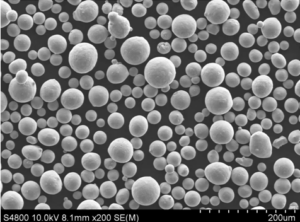
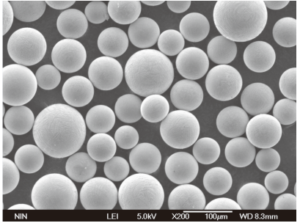
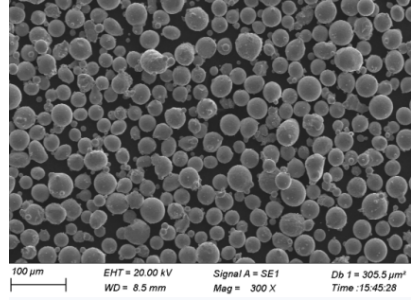
For laser powder bed fusion, uniform recoating is essential. Powders with poor sphericity or excessive satellites can create inconsistent layers, local porosity, and unstable melt-pool behavior. That is why spherical AM powder is generally preferred for FeCoNiCrMnAl High Entropy Alloys, especially when the project goal is repeatable parameter development rather than a one-off build.
Thermal Behavior and Phase Development
One reason engineers are interested in this alloy family is the relationship between powder chemistry, rapid solidification, and phase formation. Depending on composition and thermal history, the alloy may solidify into FCC, BCC, or mixed structures, and subsequent reheating in AM can further redistribute phases. This opens a broader design space than many standard alloys offer, but it also means process windows must be built carefully.
Mechanical Property Expectations
Published data for FeCoNiCrMnAl High Entropy Alloys varies widely because even small compositional changes alter outcomes. In general, Al-lean variants tend to preserve more ductility, while Al-richer variants trend toward higher hardness and strength with lower elongation. The material is therefore less about one headline number and more about dual-phase tunability through composition plus process control.
Why Oxygen and Nitrogen Matter
HEA powders are not immune to the same interstitial issues that affect titanium, nickel, and steel powders. Excess oxygen can influence oxide formation and melt behavior; uncontrolled nitrogen may also change phase stability in some compositions. Powder storage, packaging, and handling therefore need to be treated seriously, especially for repeated AM builds and qualification work. Measurement approaches used in metal AM are closely related to the metrology themes covered by [NIST additive manufacturing research].
Aplicações em diversos setores
FeCoNiCrMnAl High Entropy Alloys are not yet general-purpose materials for every production line. Their most credible current role is in advanced applications where property tailoring, thermal stability, or novel microstructural behavior justifies a more specialized alloy choice. In those settings, AM offers a practical route to evaluate the alloy in component geometry rather than only as a cast coupon.
Typical Applications for FeCoNiCrMnAl High Entropy Alloys
| Setor | Typical Part | AM / PM Process | Why the Alloy Is Considered |
|---|---|---|---|
| Aerospace R&D | Brackets, thermal-structure coupons, lattice test parts | LPBF, EBM | High specific performance potential and phase tunability |
| Energia e potência | Burner hardware, heat-exposed fixtures, experimental flow parts | LPBF, DED | Thermal stability and alloy-design flexibility |
| Tooling and wear systems | Inserts, nozzles, wear coupons, functional prototypes | LPBF, PM, cladding | Hardness and tailored microstructure |
| Academic and industrial labs | Benchmark specimens, gradient builds, alloy screening parts | LPBF, DED, HIP-assisted routes | Fast iteration of composition-process-property relationships |
Aerospace and Space Development
Aerospace programs are drawn to HEAs because they can potentially combine mechanical strength, thermal resistance, and lighter design strategies better than some legacy materials in selected windows. FeCoNiCrMnAl High Entropy Alloys are particularly attractive for experimental brackets, heat-exposed secondary structures, and lattice demonstrators where engineers want to study the effect of composition on phase stability under AM conditions. Qualification is still case-specific, but the research momentum is clear.
Energy, Heat, and Process Equipment
In energy systems, material selection is often constrained by both temperature and fabrication complexity. HEAs offer a route to investigate microstructures that remain useful after repeated thermal cycling or localized heat exposure. For burner-adjacent hardware, advanced fixtures, or component prototypes that see aggressive process conditions, FeCoNiCrMnAl can be more interesting than standard structural alloys, even if it is not yet the lowest-cost production answer.
Tooling, Wear, and Surface-Engineered Parts
The aluminum-containing versions of this alloy family can develop relatively high hardness, making them candidates for wear-oriented prototypes or functional tooling inserts. In some cases, the goal is not a fully dense final production part but a deposited or printed test geometry that allows engineers to compare wear tracks, thermal response, or microhardness maps. The alloy’s value lies in the ability to tailor structure rather than to mimic a commodity steel.
High-entropy alloys are most useful when alloy design and process design are treated as the same engineering problem.
Comparing HEAs With Other Powder Families
When engineers screen materials for AM, FeCoNiCrMnAl High Entropy Alloys usually sit beside more established categories rather than replacing them outright. If oxidation and hot strength dominate, some teams still compare against [nickel-based superalloy powders]. If biocompatibility or low density is central, they may instead review a [titanium AM powder range]. For wear-focused systems containing cobalt, related comparisons may also involve [cobalt alloy powder grades]. That comparative approach is healthy because HEAs are most valuable in applications where their tunability solves a real problem.
Limits of Current Adoption
Despite their promise, these alloys are not yet standardized across industry in the way 316L, Inconel 718, or Ti-6Al-4V are. Cost can be higher, process qualification may take longer, and design data is less mature. That does not reduce their value, but it does mean they are typically adopted through targeted engineering programs rather than broad commodity substitution.
Fabricação e Garantia de Qualidade
The manufacturing route has a disproportionate influence on HEA powder performance because multiple principal elements must be melted, homogenized, atomized, and classified without introducing major segregation or contamination. Powder buyers should therefore look beyond nominal chemistry and ask how the powder was made, what the melt practice was, and how lot consistency is verified.
Typical QA Framework for FeCoNiCrMnAl High Entropy Alloys
| QA Test | Instrument / Method | Typical Acceptance Focus | Por que é importante |
|---|---|---|---|
| Composição química | ICP-OES, XRF cross-check, combustion analysis | All principal elements within agreed tolerance band | Verifies target alloy balance |
| Distribuição do tamanho das partículas | Laser diffraction and sieve confirmation | D10/D50/D90 consistent with ordered AM grade | Affects layer quality and melt stability |
| Morphology and satellites | SEM and image analysis | High sphericity, limited agglomerates and satellites | Influences recoating and flow |
| Oxygen, nitrogen, and carbon | Inert gas fusion / combustion methods | Interstitials within internal specification | Supports repeatable fusion and properties |
| Powder flow and density | Hall flow, apparent and tap density tests | Stable lot-to-lot handling characteristics | Helps predict build consistency |
Gas Atomization, PREP, and VIGA Logic
For most HEA powders intended for AM, gas atomization is a realistic mainstream route because it offers good control over particle shape and scalable powder production. PREP is often favored for reactive or premium spherical powders where cleanliness is essential, although its applicability depends on electrode preparation and alloy form. Vacuum induction gas atomization can also be relevant for cleaner melting and better atmospheric control in multi-element systems.
Why Homogeneity Is More Challenging in HEAs
A six-element alloy demands more from melt practice than a binary or ternary alloy. The producer must manage evaporation tendencies, element distribution, and thermal history so that the atomized droplets represent the intended chemistry as closely as possible. That is why composition control is not a paperwork issue but a process issue, especially for manganese- and aluminum-containing systems.
Quality Assurance Beyond the Certificate
A well-prepared powder certificate should include chemistry, PSD, and oxygen data, but HEA projects usually need more. Serious qualification often includes SEM images, flow test results, tap density, and sometimes phase analysis by XRD after building trial coupons. If the part is critical, the buyer may also request retained samples and powder reuse guidance.
Powder Reuse and Lot Management
Powder reuse can be especially sensitive for emerging alloys because repeated thermal exposure may shift chemistry or particle surface condition. Reclaimed fines, oxygen pickup, and changed size distribution can alter build behavior more quickly than expected. For that reason, powder-to-part traceability is a sensible requirement in any serious FeCoNiCrMnAl AM development program.
Por que escolher a Truer como seu fornecedor
For FeCoNiCrMnAl High Entropy Alloys, supplier capability matters because the material sits at the intersection of alloy development and powder-process discipline. Buyers need a partner that understands spherical powder production, classification, and the downstream requirements of LPBF, SEBM, DED, PM, and related routes. In that context, the company background outlined in the [Truer company profile] is relevant because it connects powder-making equipment capability with metal AM powder supply and engineering-oriented applications.
Truer’s published technical context also matters for HEA-related discussions because the company works across titanium, cobalt-based, nickel-based, copper-based, aluminum-based, and stainless spherical powders, along with specialized alloy systems such as TiNi, TiTa, TiAl, TiNbZr, and CoCrMo. For buyers screening a new HEA against more established powders, that broader portfolio creates a useful comparative framework rather than limiting the discussion to one alloy family.
Guia de pedidos e suporte
Ordering FeCoNiCrMnAl High Entropy Alloys should begin with application intent. A request for LPBF parameter development needs a different powder window than a request for DED feedstock or a PM trial lot. The most efficient procurement path is therefore one that defines chemistry basis, particle-size class, and qualification expectations before price is discussed.
Typical Ordering Framework for FeCoNiCrMnAl High Entropy Alloys
| Embalagem | MOQ Tier | Prazo de entrega | Sample Policy |
|---|---|---|---|
| 100–250 g sealed sample bottle | Screening and chemistry review | 1–2 weeks typical | Small paid sample for lab evaluation |
| 500 g to 1 kg inert-packed can | Desenvolvimento de processos | 2–4 weeks typical | Recommended for first LPBF parameter trials |
| 5 kg vacuum or argon-protected pack | Pilot build stage | 3–6 weeks typical | Often supplied with full COA and retained sample |
| 20 kg+ production-style lot | Extended qualification or repeat builds | 4–8 weeks typical | Batch approval terms usually defined in advance |
What a Good RFQ Should Include
A high-quality RFQ should specify whether the alloy is desired in nominal equiatomic form or with an Al-lean or Al-rich adjustment. It should also state the target process, such as LPBF, EBM, DED, or PM, along with the preferred PSD range and any oxygen limit. If the end user has target properties after build or after HIP, those should be listed as well.
Samples, Pilot Lots, and Build Trials
For FeCoNiCrMnAl High Entropy Alloys, small samples are often used first to verify chemistry, morphology, and initial printability. The next step is normally a pilot lot large enough for parameter screening, mechanical coupons, and metallography. Teams that need to discuss sample availability, lot size, or AM powder documentation can use the [powder inquiry channel] to define those requirements early.
Nossa empresa
Shanghai Truer Technology Co., Ltd. was established in 2009 and created its additive manufacturing business in 2019. The company focuses on integrating 3D printing powder-making equipment and services with 3D printing powders for engineering applications. Its core technologies include Selective Electron Beam Melting equipment, Plasma Rotating Electrode Process powder-making equipment, and gas atomization-related capability. The powder portfolio includes TiNi, TiTa, TiAl, TiNbZr, CoCrMo, and spherical nickel-based, cobalt-based, titanium-based, copper-based, aluminum-based, and stainless steel powders for use in SLM, SEBM, DED, laser cladding, powder metallurgy, MIM, HIP, cold or hot spraying, welding, and coating across industries including 3C electronics, hand tools, remote control cars, medical, aerospace, and nuclear power.
Perguntas frequentes
Q1. Are FeCoNiCrMnAl High Entropy Alloys suitable for laser powder bed fusion?
Yes, many compositions in this family are suitable for laser powder bed fusion when the powder has appropriate sphericity, size distribution, and oxygen control. However, printability depends strongly on aluminum level, scan strategy, and the target phase balance. Most users qualify the alloy through coupon builds before moving to functional parts.
Q2. How do FeCoNiCrMnAl High Entropy Alloys compare with Inconel or stainless powders?
They are usually selected for different reasons. Nickel superalloys offer mature qualification and strong high-temperature performance, while stainless powders provide broad corrosion-focused utility and lower adoption risk. FeCoNiCrMnAl High Entropy Alloys are chosen when tunable microstructure and composition-driven property design justify a more experimental route.
Q3. What particle size is typical for FeCoNiCrMnAl High Entropy Alloys AM powder?
For LPBF, a common commercial window is around 15–53 µm or 20–63 µm. DED powders are usually coarser, often 45–105 µm or broader. The right range depends on machine type, recoating behavior, and whether the program prioritizes fine resolution or high deposition rate.
Q4. Do FeCoNiCrMnAl High Entropy Alloys need heat treatment after printing?
Often, yes. Heat treatment or HIP may be used to reduce residual stress, modify phase balance, improve density, or tune hardness and ductility. Because the alloy family is highly composition-sensitive, the optimal thermal cycle should be verified experimentally rather than copied from a conventional alloy datasheet.
Q5. Are there international standards for FeCoNiCrMnAl High Entropy Alloys powder?
Not in the same mature sense seen with common aerospace titanium or stainless AM powders. Most material supply is based on nominal chemistry, internal technical specifications, and project-specific acceptance criteria. That is why powder certificates, agreed tolerances, and traceability are especially important.
Q6. What should buyers request with each lot of FeCoNiCrMnAl High Entropy Alloys?
At minimum, buyers should request elemental chemistry, PSD, oxygen content, and morphology information. For serious development work, it is also wise to ask for tap density, flowability, packaging atmosphere, lot traceability, and any retained-sample policy. Those details help connect powder quality to build consistency and later property analysis.