간단한 답변
FeNi42 연자성 분말 is a spherical iron-nickel alloy powder containing approximately 42% nickel, valued for its combination of soft magnetic behavior and exceptionally low thermal expansion. In additive manufacturing and powder metallurgy, it is used to produce magnetic cores, shielding components, hermetic sealing parts, and precision electronic structures where dimensional stability across temperature changes is as important as magnetic performance.
When sourcing FeNi42 soft magnetic powder for AM, three factors matter most. First, verify particle size distribution and sphericity against your process window, because LPBF, MIM, and press-and-sinter each demand different cuts. Second, control oxygen content and interstitial impurities, which directly degrade permeability and raise coercivity. Third, confirm the atomization route and post-treatment, since gas atomized powder with proper annealing delivers the flowability and magnetic softness that water atomized or un-annealed material cannot match.
| 속성 | 가치 |
|---|---|
| Nominal nickel content | 41.5–42.5 wt% |
| 밀도 | 8.11 g/cm3 |
| 포화 자속 밀도 (Bs) | approx. 1.2–1.4 T |
| 퀴리 온도 | approx. 330–350 °C |
| Coefficient of thermal expansion (20–300 °C) | 4.5–5.5 x 10⁻⁶ /K |
| Typical AM particle size | 15–45 um (LPBF), 45–106 um (EBM) |
| Common equivalents | Alloy 42, Nilo 42, Invar 42, 1.3917, 4J42 |
What Is FeNi42 soft magnetic powder and Its Material Benefits
FeNi42 연자성 분말 is a binary iron-nickel alloy powder with a nominal nickel content of 42%, positioned at a special point in the Fe-Ni phase diagram where thermal expansion reaches a deep minimum and magnetic behavior remains soft and isotropic. It belongs to the broader family of 부드러운 자성 분말 grades used in additive manufacturing, metal injection molding, and conventional powder metallurgy.
The alloy is also widely known under trade and standard names such as Alloy 42, Nilo 42, Invar 42, and the Chinese grade 4J42, with the European material number 1.3917. Its defining engineering value comes from three overlapping characteristics.
The first is low thermal expansion. Between room temperature and roughly 300 °C, FeNi42 expands at only 4.5–5.5 x 10⁻⁶ /K, a rate closely matched to borosilicate glass and many alumina ceramics. This is why the alloy has decades of history in glass-to-metal seals, lead frames, and hermetic electronic packaging.
The second is soft magnetic performance. With low coercivity, high initial permeability in the annealed condition, and near-zero magnetostriction in this nickel range, FeNi42 responds efficiently to alternating magnetic fields with minimal hysteresis loss.
The third is processability. As a spherical powder produced by gas atomization, FeNi42 flows consistently through recoaters and feeders, sinters to high density, and tolerates the rapid thermal cycles of laser powder bed fusion without cracking.
For buyers, the material benefit is a single powder grade that serves both functional magnetic roles and structural sealing roles, reducing qualification effort when a component must do both. Components printed or molded from FeNi42 soft magnetic powder retain their dimensional relationship with mating glass or ceramic parts through thermal cycling, which is a requirement that higher-expansion magnetic alloys such as FeSi or FeCo grades cannot satisfy.
화학 조성 데이터와 성능 요소 간의 상관관계
The performance of FeNi42 is governed almost entirely by the precision of its nickel content and the cleanliness of its impurity profile. Nickel sits close to the 42% point that minimizes thermal expansion in the Fe-Ni system; even a 1% shift in nickel moves the expansion curve measurably and changes the Curie temperature.
Chemical Composition of FeNi42 Soft Magnetic Powder
| 요소 | 민 (%) | 맥스 (%) | 역할 |
|---|---|---|---|
| Ni | 41.5 | 42.5 | Sets low-expansion minimum, controls Curie point and permeability |
| Fe | 잔액 | 잔액 | Base magnetic matrix, provides saturation flux |
| Mn | 0 | 0.80 | Deoxidizer from melting, aids hot workability |
| Si | 0 | 0.30 | Residual from melting, raises electrical resistivity slightly |
| C | 0 | 0.05 | Interstitial; must stay low to protect permeability |
| P | 0 | 0.025 | Impurity; embrittles grain boundaries at higher levels |
| S | 0 | 0.025 | Impurity; harms ductility and magnetic softness |
| O (powder) | 0 | 0.030 | Atomization pickup; directly raises coercivity |
The correlation between composition and performance is direct and unforgiving for soft magnetic use. Carbon, sulfur, and oxygen act as pinning sites for magnetic domain walls. A powder that leaves the atomizer with 800 ppm oxygen can show double the coercivity of a 300 ppm powder after the same heat treatment, which translates into measurable hysteresis loss in an AC core.
Nickel precision matters for a different reason. The low-expansion trough of the Fe-Ni system is narrow, and buyers using FeNi42 for glass or ceramic sealing should request a certified nickel analysis per heat rather than accepting a nominal 42% label. A heat at 41.2% Ni will expand noticeably faster above 200 °C and can crack a matched seal in service.
Manganese and silicon are benign within their specification limits and are usually inherited from the melting practice. For critical magnetic cores, some buyers specify vacuum induction melting feedstock to push interstitials lower still. When reviewing a certificate of analysis for FeNi42 soft magnetic powder, the three numbers to check first are nickel content, oxygen, and carbon, in that order.
물리적 및 기계적 특성 개요 및 데이터 요약
FeNi42 combines moderate mechanical strength with distinctive physical behavior. Its properties below apply to wrought or fully dense material in the annealed condition, which is the reference state for AM parts after stress relief or annealing heat treatment.
Key Properties of FeNi42
| 속성 | 가치 | 단위 |
|---|---|---|
| 밀도 | 8.11 | g/cm3 |
| 용융 범위 | 1430–1440 | °C |
| 포화 자속 밀도 (Bs) | 1.2–1.4 | T |
| Coercivity (annealed) | 10–30 | A/m |
| Initial permeability (annealed) | 3,000–8,000 | – |
| 전기 저항 | 0.65–0.70 | uohm.m |
| 퀴리 온도 | 330–350 | °C |
| CTE (20–300 °C) | 4.5–5.5 | x 10-6 /K |
| Thermal conductivity (20 °C) | approx. 15 | W/(m.K) |
| 탄성 계수 | approx. 145 | GPa |
| 항복강도 (어닐링 처리) | approx. 280–340 | MPa |
| 인장 강도 (어닐링 처리) | approx. 550–620 | MPa |
| Elongation (annealed) | 30–40 | % |
| 경도 (어닐링 처리 후) | 130–160 | HV |
Several points deserve attention when interpreting this data for AM parts. First, magnetic values are condition-dependent. As-printed LPBF material carries residual stress and a fine, dislocation-rich microstructure, so coercivity directly off the build plate may be several times higher than the annealed figures above. A hydrogen or vacuum anneal at 1050–1150 °C typically restores the soft magnetic response.
Second, the saturation flux density of FeNi42 is modest compared with iron-cobalt alloys. At roughly 1.3 T it sits well below FeCo grades near 2.3 T. Designers choose FeNi42 not for maximum flux but for the pairing of adequate permeability with the lowest practical expansion in a magnetic alloy.
Third, the moderate elastic modulus and good ductility make FeNi42 tolerant of thermal gradients during printing. Crack sensitivity is low, and support removal is easier than with brittle high-silicon iron alloys.
For powder form, add flowability of roughly 15–18 s per 50 g (Hall flow) and apparent density around 4.2–4.6 g/cm3 for gas atomized material, both of which support uniform recoating layers in LPBF and consistent die filling in pressing.
적용 가능한 등급, 입자 분포 및 허용 오차 기준
FeNi42 soft magnetic powder is supplied in several particle size cuts matched to specific consolidation routes. The grade name on a datasheet usually encodes the intended process, so buyers should specify both the alloy and the process window when requesting quotations.
사용 가능한 사양
| 매개변수 | 표준/값 |
|---|---|
| LPBF grade PSD | 15–45 um (D10 approx. 18–22 um, D90 approx. 48–53 um) |
| EBM / DED grade PSD | 45–106 um |
| MIM grade PSD | D90 below 22 um, typical cut 5–20 um |
| Press-and-sinter grade PSD | 45–150 um, or fine cut below 45 um |
| Sphericity (GA powder) | 0.90 or higher |
| 산소 함량 | 300 ppm typical, 500 ppm max for magnetic grades |
| 홀 유량 | 15–18 s/50 g |
| 겉보기 밀도 | 4.2–4.6 g/cm3 |
| 탭 밀도 | 4.9 g/cm3 or higher |
| Nickel tolerance | 42.0 +/- 0.5 wt% |
| 인증 | COA per heat, chemistry plus PSD per lot |
The 15–45 um LPBF cut is the highest-volume commercial grade and matches the standard layer thickness of 30–60 um used on most laser powder bed fusion machines running 선택적 레이저 용융(SLM) parameters. Finer cuts below 20 um improve MIM feedstock loading but reduce flowability and raise oxygen per unit mass, so they should only be sourced for processes that genuinely require them.
Tolerance discipline matters beyond size. For magnetic applications, request lot-level oxygen and flowability data rather than a single certificate covering a production campaign, because atomization conditions drift between heats. Reputable suppliers also report satellite particle content and hollow particle fraction, since both affect packing density and, downstream, the magnetic continuity of the sintered or printed part.
Custom cuts outside the standard ranges are normally available at minimum order quantities of 20–50 kg for gas atomized material.
제조 공정: 용융 분무 및 분류 단계
FeNi42 soft magnetic powder for AM is produced almost exclusively by 가스 분무, a route that delivers the sphericity and low oxygen content that soft magnetic performance demands. The process follows five steps.
Step one is melting. High-purity electrolytic iron and nickel are charged into a vacuum induction furnace and melted under vacuum or inert cover. Melting under vacuum keeps carbon and oxygen low from the start and allows precise trimming of the nickel content to the 42% target before tapping.
Step two is atomization. The molten alloy flows through a tundish nozzle into the atomization chamber, where high-pressure argon or nitrogen jets break the stream into fine droplets. Argon is preferred for premium magnetic grades because nitrogen can form trace nitrides that pin domain walls. The droplets spheroidize in free fall and solidify before collection.
Step three is classification. The as-atomized powder has a broad distribution, typically from a few microns to over 150 um. Cyclones and precision screens or air classifiers separate the target cuts, for example 15–45 um for LPBF, and the oversize and undersize fractions are recycled or sold into conventional PM markets.
Step four is post-treatment. For soft magnetic grades, powder lots may be annealed in hydrogen or vacuum to relieve atomization stress and reduce oxygen at particle surfaces. This step is often where a commodity powder and a true soft magnetic powder diverge.
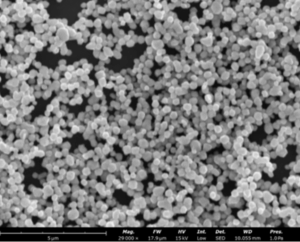
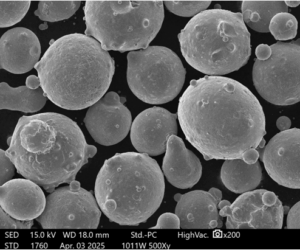
Step five is quality control and packaging. Each lot is sampled for chemistry, PSD, flowability, and morphology by SEM, then sealed under argon in moisture-barrier containers.
An alternative route, the 플라즈마 회전 전극 공정(PREP), produces even cleaner powder with virtually no satellites, but at coarser distributions and higher cost. PREP FeNi42 is chosen mainly for hot isostatic pressing and demanding aerospace work. Water atomized FeNi42 exists for low-cost press-and-sinter parts, but its irregular shape and high oxygen exclude it from AM magnetic cores.
산업별 적용 분야: 의료, 항공우주 및 발전
FeNi42 soft magnetic powder serves industries where magnetic function and dimensional stability must coexist in one component. Its 애플리케이션 span electronics, aerospace, medical devices, and power generation.
In electronics and semiconductor packaging, the largest historical use of Alloy 42, FeNi42 forms lead frames, hermetic package bases, and glass-to-metal seal feedthroughs. Additive manufacturing now enables complex package geometries, integrated cooling channels, and small-batch custom headers that stamping and machining cannot economically deliver. The low expansion coefficient keeps seals intact through solder reflow and service thermal cycling.
In aerospace and defense, FeNi42 is selected for magnetic shielding enclosures, sensor housings, and flux-guiding structures inside avionics. Satellites and instruments that pass through wide temperature swings benefit from the alloy’s near-constant dimensions. LPBF printing in FeNi42 allows shielding geometries to follow the contour of the electronics they protect, saving mass and volume. Feedstock from the same powder lots can also serve 금속 사출 성형(MIM) for high-volume small parts such as connector shells and relay components.
In medical technology, the alloy appears in hermetic feedthroughs for implantable pulse generators, magnetic components in imaging equipment, and shielding elements for sensitive diagnostics. The combination of biostable surface chemistry, hermetic sealing to ceramic, and non-ferromagnetic-adjacent behavior in controlled fields makes it a practical choice where stronger magnets would interfere with imaging.
In power generation and energy conversion, FeNi42 cores and shielding parts appear in instrument transformers, current sensors, and control electronics for turbines and switchgear. Here the alloy competes on permeability stability across temperature rather than raw flux capacity. Its low expansion prevents air-gap drift in precision magnetic circuits, which is a common failure mode for higher-expansion core materials.
Beyond these headline sectors, the powder finds use in research-scale soft magnetic core prototyping, where AM allows rapid iteration of core topologies such as toroids with integrated windings and 3D flux paths that laminated stacks cannot realize. Post-processing by hot isostatic pressing (HIP) closes residual porosity in printed parts and raises permeability to near-wrought levels, extending FeNi42 into qualification-critical roles.
다른 등급 및 대체 합금 시스템 옵션과의 비교
FeNi42 occupies a specific niche, and buyers should confirm it is the right niche before committing. The table below compares it with the most common alternatives in the soft magnetic powder family.
FeNi42 대 다른 연자성 합금
| 속성 | FeNi42 | FeNi50 | FeCo50 | FeSi (6.5% Si) |
|---|---|---|---|---|
| 포화 플럭스 밀도 | 1.2–1.4 T | 1.5–1.6 T | 2.3–2.4 T | 1.8 T |
| 퀴리 온도 | 330–350 °C | approx. 500 °C | 940–980 °C | approx. 700 °C |
| CTE (20–300 °C) | 4.5–5.5 x 10⁻⁶ /K | 8–9 x 10⁻⁶ /K | 10–11 x 10-6 /K | 11–12 x 10-6 /K |
| Relative permeability | 높음 | 매우 높음 | 보통 | 보통 |
| Core loss (AC) | 낮음 | 매우 낮음 | 보통 | 낮음 |
| Ductility / printability | 우수 | 우수 | Moderate, brittle | Poor, very brittle |
| Glass / ceramic sealing | Yes, matched | 제한적 | 아니요 | 아니요 |
| 분말의 상대적 원가 | Medium | Medium | 높음 | 낮음 |
The comparison clarifies selection logic. Choose FeNi42 when the design requires magnetic function together with low thermal expansion, typically sealing, packaging, or temperature-stable magnetic circuits. Choose FeNi50 when maximum permeability at higher flux is the priority and expansion is unconstrained. Choose FeCo50 when saturation flux density dominates the design, accepting higher cost and lower ductility. Choose FeSi grades for low-cost AC cores where expansion matching is irrelevant, though their brittleness complicates AM processing.
Outside the soft magnetic family, Invar (FeNi36) offers even lower expansion but weaker magnetic response, while Kovar (FeNi29Co17) matches borosilicate glass with cobalt-enhanced properties at a higher price. Neither substitutes directly when soft magnetic performance is a requirement.
For most buyers, the deciding factor remains the application pairing: if the part must seal, shield, or hold a precise gap across temperature, FeNi42 soft magnetic powder is usually the most economical qualified option.
우리 회사
상하이 트루어 기술 유한공사 is a China-based additive manufacturing supplier integrating PREP powder making equipment and high-quality spherical metal powders. Established in 2009 and active in additive manufacturing since 2019, the company offers both 가스 분무법 (GA) 그리고 준비 manufacturing capabilities across nickel alloys, titanium alloys, aluminum alloys, stainless steels, cobalt alloys, copper alloys, high-entropy alloys, and specialty materials including soft magnetic grades.
Truer provides custom alloy development, small-batch prototyping, and scale production services for industries including aerospace, medical implants, oil & gas, and automotive. The company operates a joint innovation center for metal 3D printing in collaboration with top research institutions, supporting composition tuning, process qualification, and application testing from trial orders through serial supply.
For inquiries about FeNi42 soft magnetic powder, custom particle size cuts, or other metal powder requirements, 팀에 문의하기.
자주 묻는 질문
Q1: FeNi42 연자성 분말의 일반적인 입도 분포는 어떻게 됩니까? A: The standard LPBF grade is 15–45 um with D90 controlled near 50 um. EBM and DED processes use a coarser 45–106 um cut, while MIM feedstock uses fine powder below 20 um. Custom distributions are available on request.
Q2: Can FeNi42 soft magnetic powder be used in both SLM and EBM systems? A: Yes. The alloy prints well in both laser and electron beam systems because of its good ductility and low crack sensitivity. The main adjustment is particle size: SLM runs 15–45 um powder, while EBM uses 45–106 um. Post-build annealing is recommended in both cases to restore full soft magnetic performance.
Q3: FeNi42 분말에는 어떤 인증서가 첨부되어 있나요? A: Standard supply includes a certificate of analysis per heat covering chemistry and a per-lot report of particle size distribution, oxygen content, flowability, and apparent density. Third-party testing and aerospace documentation packages can be arranged for qualification programs.
Q4: What is the MOQ for ordering FeNi42 soft magnetic powder? A: Typical minimum order quantities start at 5–10 kg for standard 15–45 um LPBF grade. Custom compositions or special size cuts generally require 20–50 kg to justify a dedicated atomization run.
Q5: Can the composition of FeNi42 be customized? A: Yes. Nickel content can be trimmed within the 41.5–42.5% window to target a specific expansion coefficient or Curie point, and interstitial limits can be tightened for high-permeability cores. Small additions for resistivity or strength adjustments are also possible through custom melting.
Q6: FeNi42 분말 주문의 일반적인 리드 타임은 얼마입니까? A: Standard grades ship from stock or within 2–4 weeks. Custom heats and non-standard size cuts typically require 4–8 weeks including atomization, classification, and quality control testing.