Kurzantwort
AlSi10Mg additive manufacturing powder is a pre-alloyed aluminum-silicon-magnesium feedstock used in metal AM processes such as laser powder bed fusion and, in some cases, directed energy deposition. It is often chosen because it combines light weight, stable printability, and useful post-build mechanical performance better than many other printable aluminum grades. For engineers focused on lightweight structures, complex geometries, and repeatable production, AlSi10Mg is usually one of the most practical starting materials in the aluminum AM category.
What Is AlSi10Mg additive manufacturing powder?
AlSi10Mg additive manufacturing powder is an aluminum alloy powder developed for powder-based manufacturing routes rather than traditional wrought stock supply. The designation indicates an aluminum base with roughly 10 wt% silicon and a smaller magnesium addition. In additive manufacturing, it is typically delivered as a spherical powder with tightly controlled size distribution, chemistry, and oxygen content so that it can spread evenly and melt consistently.
The alloy belongs to the Al-Si-Mg family, which has long been valued in foundry practice for good castability and balanced engineering properties. In AM, those same characteristics translate into a material that is generally more process-tolerant than several higher-strength aluminum alloys. That tolerance matters in a field where cracking, porosity, and variability can quickly turn a promising design into an unreliable production part.
AlSi10Mg exists at the intersection of metallurgy and manufacturability. Silicon lowers the alloy’s tendency toward hot cracking and supports more manageable solidification during rapid thermal cycling. Magnesium contributes to age-hardening response, helping the printed material reach a practical combination of strength and hardness after suitable thermal treatment.
Unlike generic aluminum feedstock, AlSi10Mg additive manufacturing powder is not defined by chemistry alone. Powder morphology, satellite level, particle cleanliness, and surface oxidation all influence the way the material behaves during recoating, melting, and reuse. That is why AM users treat the alloy name as only the beginning of the specification.

Why AlSi10Mg AM powder became an industry baseline
Among aluminum materials for metal AM, AlSi10Mg became one of the most widely adopted because it reduces risk in multiple stages of the workflow. It is printable on a wide range of laser powder bed fusion systems, it has a mature body of processing knowledge, and it serves both prototype and production use cases. Many organizations start with it for the simple reason that there is more real manufacturing experience behind it than behind many niche aluminum powders.
The maturity of AlSi10Mg also helps downstream operations. Designers, machine operators, heat-treatment specialists, and quality engineers can usually find established practices for support design, machining allowances, stress relief, and finishing. That makes qualification less speculative than it would be with a less familiar alloy.
How AlSi10Mg additive manufacturing powder differs from other aluminum grades
The main differentiator is balance rather than extremity. Pure aluminum may offer different conductivity behavior, while some stronger wrought-type alloys may promise higher peak strength. However, those alternatives can be harder to print reliably or may require more restrictive processing windows.
AlSi10Mg remains attractive because it offers a broad compromise: moderate-to-good strength, good corrosion resistance, low density, and comparatively manageable printing behavior. That profile is especially useful in design-for-AM projects where the geometry itself contributes heavily to part performance.
Why spherical metal powder matters
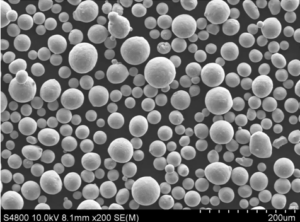
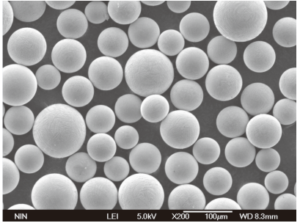
Spherical powder morphology is central to the value of this alloy in AM. Near-spherical particles flow more predictably, spread more evenly, and generally pack more consistently than irregular particles. That improves layer uniformity and reduces the chance that recoating disturbances will create local defects.
For that reason, buyers should think in terms of a complete feedstock system rather than just an alloy label. AM-ready AlSi10Mg is a combination of chemistry, size range, morphology, and controlled handling from atomization through packaging.
In metal AM, a powder that meets chemistry but fails on flow or cleanliness can still fail the application.
For terminology alignment across the industry, many engineers reference ISO standards catalog and the broader ASTM standards platform when developing internal material definitions.
Chemical Composition and Material Grade
The chemistry of AlSi10Mg is simple in outline but important in detail. Aluminum is the balance element, silicon is the major alloy addition, and magnesium is a smaller but functionally important strengthening element. Secondary elements such as iron, copper, manganese, zinc, titanium, and nickel are typically controlled as residuals because they can affect ductility, corrosion behavior, or consistency after printing and heat treatment.
In commercial AM practice, the buyer should distinguish between a composition window and a complete powder specification. The composition confirms alloy identity, but it does not by itself guarantee printability. A conforming AlSi10Mg heat can still perform poorly if oxygen is high, fines are excessive, or morphology is irregular.
| Element / Standard Reference | Typical Content (wt%) | Common Grade Mapping | Standard Family Context | Practical Note |
|---|---|---|---|---|
| Silizium (Si) | 9.0–11.0 | AlSi10Mg / EN AC-AlSi10Mg(a) | DIN / EN cast-alloy family analog | Supports fluidity and crack resistance during solidification |
| Magnesium (Mg) | 0.20–0.45 | AlSi10Mg family | ISO / EN analog | Enables age hardening and strength response |
| Eisen (Fe) | typically ≤0.55 | residual control | ASTM / EN chemistry framework | Excess iron can reduce ductility |
| Kupfer (Cu) | typically ≤0.05 | residual control | ASTM / EN chemistry framework | Kept low for corrosion and consistency reasons |
| Aluminium (Al) | balance | aluminum base alloy | universal base element | Balance element in the alloy system |
| Cross-reference note | project-defined | ASTM / AMS / GB / ISO / DIN nearest analogs | specification comparison only | AM powder acceptance usually relies on supplier and user requirements rather than one universal powder standard |
AlSi10Mg additive manufacturing powder and chemistry stability
The silicon level is central to why this alloy behaves well in additive manufacturing. A relatively high silicon content helps moderate solidification behavior during rapid thermal cycling, reducing the sensitivity that some other aluminum grades show to cracking. Magnesium then provides an avenue for strengthening after printing, especially when thermal processing is used to tune the final microstructure.
For procurement teams, the question is not simply whether the powder “is AlSi10Mg.” The more important issue is how tightly the chemistry is controlled from lot to lot and whether residual elements remain consistent enough to support repeatable builds. In serial production, chemistry drift can translate into changes in hardness, strength, elongation, or post-process response.
Grade mapping is useful, but not sufficient
AM buyers often ask for ASTM, AMS, GB, ISO, or DIN equivalents because cross-references make communication easier across regions and industries. That practice is useful for orientation, but it does not replace a powder specification linked to actual AM use. Many published alloy designations originate in casting or conventional metallurgy, not in the full requirements of modern powder-bed manufacturing.
As a result, it is common for engineering teams to use a nearest alloy-family analog for nomenclature while relying on internal documentation for powder acceptance. That documentation usually adds morphology, particle size distribution, oxygen level, and test requirements on top of chemistry.
Residual elements and contamination control
Residuals deserve more attention than they often receive in simplified product sheets. Iron may affect ductility, copper can shift corrosion behavior, and contamination introduced during production or repackaging can create variability that does not show up in a nominal chemistry line. In aluminum AM, trace control and powder cleanliness are not secondary concerns; they are part of the material definition.
This is especially relevant for parts that move from prototype work into validated production. Once process windows are locked, even small shifts in incoming powder condition can generate new qualification work.
Technische Daten
Technical specifications determine whether AlSi10Mg additive manufacturing powder will behave predictably on a machine and within a documented workflow. The most important parameters usually include particle size distribution, apparent density, tap density, Hall flow, oxygen content, and particle shape. Together, these properties influence powder spreading, local packing density, and melt consistency layer by layer.
For aluminum AM, PSD selection is particularly important. Fine cuts can support thinner layers and higher detail, but they also increase surface area and may raise sensitivity to oxidation or poor handling. Coarser cuts may offer different feeding and recoating behavior and are often better suited to deposition processes outside standard laser powder bed fusion.
| Pulverqualität | PSD Range (µm) | Scheinbare Dichte (g/cm³) | Tap Density (g/cm³) | Hall Flow (s/50 g) | Sauerstoffgehalt | Sphärizität |
|---|---|---|---|---|---|---|
| Fine L-PBF cut | 15–45 | 1.25–1.42 | 1.40–1.62 | 15–25 | typically low, controlled by spec | high |
| Standard L-PBF cut | 15–53 | 1.30–1.48 | 1.45–1.66 | 14–23 | typically low, controlled by spec | high to very high |
| Broad L-PBF cut | 20–63 | 1.34–1.55 | 1.50–1.70 | 13–21 | typically low, controlled by spec | high |
| DED / cladding cut | 45–105 | 1.40–1.66 | 1.56–1.80 | 11–18 | application-specific | kugelförmig |
| Coarse deposition cut | 53–150 | 1.44–1.70 | 1.60–1.84 | 10–17 | application-specific | spherical to near-spherical |
PSD choice for AlSi10Mg additive manufacturing powder
Most laser powder bed fusion users evaluate AlSi10Mg in the 15–53 µm or 20–63 µm range because those cuts support typical layer thicknesses and resolution expectations. They also tend to match common recoater behavior and machine parameter libraries. In contrast, directed energy deposition and laser cladding commonly use much coarser fractions because the powder delivery method and melt pool geometry are different.
The right PSD should therefore be tied to the machine and application rather than copied from a generic datasheet. Thin-wall parts, large support-free structures, and repair-cladding work may all benefit from different size distributions even when the alloy is unchanged.
Flow and packing properties
Powder flowability is one of the most practical predictors of whether a lot will be easy to run. Apparent density helps show how loosely the powder packs in its natural state, tap density indicates how it responds to consolidation, and Hall flow gives a quick sense of discharge behavior under standardized conditions. None of these values guarantees part quality by itself, but together they form a useful first screening set.
In aluminum systems, morphology strongly shapes these numbers. Highly spherical particles with limited satellites generally flow and spread better, which supports more uniform powder layers and fewer recoater interactions across long builds.
Oxygen, reuse, and powder condition
Oxygen is not just a certificate entry; it is a process-management issue. Aluminum powders naturally form oxide films, but excessive oxygen or poor reuse discipline can change the way the powder melts and consolidates. That is why oxygen is often monitored both at incoming inspection and during reuse studies.
Powder condition after delivery also matters. Sealed storage, moisture exclusion, controlled sieving, and documented recycle ratios are all part of maintaining the same powder behavior over time. Users comparing conductive or structural alternatives often review an aluminum alloy powder range alongside other material families before finalizing the specification.
Applications Across Industries
AlSi10Mg additive manufacturing powder is used where geometry-driven performance and mass reduction matter more than maximum high-temperature strength. It is common in applications that benefit from part consolidation, internal channels, weight reduction, and short production runs. The material is especially well suited to designs that would be inefficient to machine from billet or uneconomical to cast at low volume.
The alloy is not confined to one sector. Aerospace uses it for lightweight structures, industrial automation uses it to reduce moving mass, electronics manufacturers apply it in housings and heat-management components, and tooling teams use it for fixtures and prototype hardware.
| Industrie | Typical Part | Why the Alloy Is Used | AM / PM Process |
|---|---|---|---|
| Luft- und Raumfahrt | brackets, housings, ducting | low density with complex geometry | L-PBF, DED |
| Automobilindustrie und Motorsport | manifolds, mounts, cooling parts | lightweighting and rapid iteration | L-PBF, DED |
| Robotics and automation | grippers, arms, end effectors | reduced inertia and faster system response | L-PBF, PM |
| Electronics and 3C | frames, shells, thermal structures | low mass and design flexibility | L-PBF, PM |
| Medical and lab equipment | fixtures, instrument frames, support hardware | low-volume complexity and corrosion resistance | L-PBF |
| Tooling and industrial equipment | jigs, fixtures, prototype inserts | integrated features and short lead times | L-PBF, DED, PM |
Leichte Strukturkomponenten
This is the application category most closely associated with AlSi10Mg. Brackets, mounts, and housings benefit from low density, while AM enables ribbing, lattice support, internal hollows, and consolidated interfaces. The result is often a component that is lighter than a machined counterpart and less assembly-intensive than a multi-part design.
That is also why the alloy aligns so well with topology optimization. If the design team is already using software to remove unnecessary mass, AlSi10Mg often provides a manufacturable path to realizing that geometry in metal.
Functional housings and moderate thermal parts
The alloy is also used in enclosures, sensor bodies, moderate-performance heat-management structures, and process equipment components. It is not the top choice when maximum thermal conductivity is the overriding requirement, but it can still perform well when heat dissipation is important and low mass is equally valuable.
In comparative studies, some engineers evaluate a copper alloy powder catalog for higher heat-transfer needs or a stainless steel powder selection for applications prioritizing durability and broader corrosion-performance tradeoffs. AlSi10Mg remains relevant when design freedom and lightweighting outweigh the need for the highest conductivity or the toughness profile of steel.
From prototype to serial manufacture
A practical advantage of AlSi10Mg is its continuity across development stages. The same alloy family is regularly used for coupon studies, prototype parts, pilot lots, and ongoing production once parameters are stabilized. That continuity reduces the friction of changing materials midstream.
Because it is already well understood in the AM ecosystem, downstream operations such as machining, blasting, shot peening, and heat treatment are also easier to plan. For industrial users, that maturity often matters as much as the nominal mechanical properties.
Manufacturing and Quality Assurance
Most industrial AlSi10Mg additive manufacturing powder is produced by gas atomization. In this route, a molten alloy stream is broken into droplets by inert gas and rapidly solidifies into fine particles. Those particles are then classified, sampled, tested, and packaged under controlled conditions.
Gas atomization dominates commercial aluminum AM feedstock because it is scalable and capable of producing the spherical morphology required for reliable powder handling. However, atomization route alone does not define quality. Melting practice, atmosphere control, particle classification, blending discipline, and packaging all influence the final lot.
| Production Route | Typical Strengths | Typical Limitations | Common Use Case | Relevance to AlSi10Mg |
|---|---|---|---|---|
| GA | scalable output, good spherical morphology, broad commercial availability | satellites may need tighter control, oxygen discipline is essential | mainstream AM and PM supply | most common route for AlSi10Mg powder |
| PREP | very high sphericity, clean powder, narrow contamination risk | higher cost, less typical for mainstream aluminum volume supply | specialty applications, premium morphology demands | possible but less common for this alloy |
| VIGA | controlled melting atmosphere, good chemistry management | process economics vary by alloy and scale | high-value alloy production | relevant where melt cleanliness is a priority |
| GA + fine classification | tailored PSD for L-PBF, better lot targeting | added processing can increase cost | production powder for specific platforms | widely used for AM-ready cuts |
| GA + coarse classification | feeder-friendly deposition fractions | less suitable for thin L-PBF layers | DED, cladding, spray uses | relevant for larger PSD AlSi10Mg lots |
Why gas atomization is usually preferred
For this alloy family, gas atomization offers the most practical combination of scale, cost, and particle quality. It can generate the sphericity needed for powder bed processes while supporting commercial lot sizes for repeat orders. That makes it well suited to companies qualifying aluminum AM for both development and production.
PREP and VIGA still matter in the broader powder industry, especially when extreme cleanliness or specialized alloy systems are involved. Yet for mainstream AlSi10Mg, gas atomization remains the dominant production route because it matches the alloy’s market demand and application profile.
Quality control points that matter most
Lot-to-lot consistency is often more important than a single attractive datasheet. Once a machine parameter set is qualified, even moderate shifts in PSD, oxygen, or morphology can affect density, surface finish, and mechanical repeatability. That is why serious powder qualification includes more than chemistry alone.
Typical release testing includes particle size analysis, morphology checks, flow measurements, density measurements, and oxygen determination. Many users also retain samples and compare new lots against prior production data as part of statistical process control.
Handling after shipment
Quality assurance does not end when the powder leaves the atomizer. Aluminum feedstock can degrade through poor storage, humidity exposure, contamination during sieving, or uncontrolled reuse. As a result, powder handling procedures after receipt are part of the real manufacturing system.
For organizations building internal qualification frameworks, NIST materials measurement resources und ASM International materials library are often useful starting points for test planning, data interpretation, and broader metallurgy context.
Why Choose Truer as Your Supplier
Choosing a supplier for AlSi10Mg additive manufacturing powder is primarily a technical decision. The supplier should understand how alloy chemistry, morphology, size classification, and process route interact in real AM production rather than treating the powder as a generic commodity. That matters when the application shifts from trial builds to controlled serial work.
Truer’s relevance in this context comes from its involvement with both powder-making equipment and additive manufacturing processes. A supplier with exposure to gas atomization, PREP-related powder technology, and end-use AM routes is better positioned to discuss why one PSD range or packaging option may fit a given application better than another. That kind of process-aware discussion is more useful than a simple list of nominal chemistry values.
The broader alloy portfolio is also relevant when engineers need comparative screening. Projects that begin with aluminum may later benchmark titanium, cobalt, nickel, or stainless systems depending on strength, thermal, or wear requirements. Truer works across those alloy families as part of a larger metal-powder ecosystem rather than only a single product line.
Another factor is the ability to align sample supply, validation, and scale-up. In AM, the gap between “printable” and “production-ready” is usually a quality-control problem, not a marketing problem. A supplier that recognizes that distinction is generally easier to integrate into a disciplined qualification program.
Ordering Guide and Support
Ordering AlSi10Mg additive manufacturing powder should start with process definition. The buyer should state whether the powder is intended for laser powder bed fusion, directed energy deposition, laser cladding, or another route because the optimal PSD and packaging format will change accordingly. A vague request for “AlSi10Mg powder” often leads to avoidable delays.
The next step is to define the purpose of the order. A small evaluation batch for parameter development does not require the same documentation package or traceability expectations as a production lot. Clear communication at the quoting stage helps avoid mismatches in PSD, sample size, and acceptance criteria.
| Verpackungsformat | Typical MOQ Tier | Typical Lead Time | Sample Policy | Typische Verwendung |
|---|---|---|---|---|
| 500 g bottle | evaluation | 1–2 weeks if available | small paid or approved sample | early screening |
| 1 kg bottle | prototype | 1-3 Wochen | common first qualification step | coupon builds and test parts |
| 5 kg sealed pack | pilot | 2–4 weeks | usually after technical review | repeatability studies |
| 10–25 kg drum | pre-production | 3–6 weeks depending on spec | supplied after specification alignment | lot validation |
| custom bulk pack | production | project-based | not typical as an initial sample | continuous manufacturing |
What to include in an RFQ for AlSi10Mg AM powder
A good RFQ typically includes alloy name, PSD target, process route, required documentation, packaging preference, annual demand estimate, and any oxygen or morphology limits. If the powder will be recycled in-house, it is also useful to note the intended reuse strategy because that influences how incoming material may be evaluated.
The intended part category should also be stated when possible. Thin-wall aerospace brackets, robotic end effectors, and cladding applications may all call for different recommendations even if the chemistry is unchanged.
Sample planning and technical support
A staged qualification path is usually the most efficient approach. Many organizations begin with a small sample for parameter mapping, then progress to a pilot quantity for repeatability studies, and only after that move into larger procurement. This sequence helps isolate powder variables from machine and post-processing variables.
When buyers need application-specific discussion, custom packaging, or nonstandard quantity planning, the most direct route is the technical inquiry page. Early technical alignment can shorten the overall time to qualification.
Unser Unternehmen
Shanghai Truer Technology Co., Ltd. was established in 2009 and created its additive manufacturing business in 2019. The company focuses on integrating 3D printing powder-making equipment and related services with metal powders used to accelerate engineering applications of additive manufacturing. Its core technologies include Selective Electron Beam Melting equipment, Plasma Rotating Electrode Process powder-making equipment, and gas atomization. The company’s powder portfolio includes TiNi, TiTa, TiAl, TiNbZr, CoCrMo, and spherical nickel-based, cobalt-based, titanium-based, copper-based, aluminum-based, and stainless steel powders for processes such as SLM, SEBM, DED, laser cladding, powder metallurgy, MIM, HIP, cold or hot spraying, welding, and coating. It also participates in a joint innovation center for metal 3D printing with laboratories and experts and serves industries including 3C electronics, hand tools, remote control cars, medical, aerospace, and nuclear power. Additional company information is available on the company background page.
FAQ
Q1. Is AlSi10Mg additive manufacturing powder mainly used for lightweight parts?
Yes. Lightweighting is one of the strongest reasons engineers select this alloy, especially for brackets, housings, fixtures, and integrated structures where low mass improves system performance. It is particularly effective when AM geometry freedom is used to remove unnecessary material.
Q2. What particle size range is typical for AlSi10Mg additive manufacturing powder in laser powder bed fusion?
Common industrial ranges include 15–45 µm, 15–53 µm, and 20–63 µm. The best choice depends on machine architecture, layer thickness, part resolution targets, and powder-handling behavior in the specific build environment.
Q3. Why is AlSi10Mg easier to print than some other aluminum alloys?
Its silicon-rich chemistry generally improves solidification behavior and helps reduce hot-cracking sensitivity compared with several alternative aluminum grades. That makes the processing window more forgiving and supports repeatable builds across a wider range of machines and applications.
Q4. Can AlSi10Mg additive manufacturing powder be used in processes other than L-PBF?
Yes, selected coarser cuts can be used in directed energy deposition, laser cladding, and some related powder-based routes. However, the PSD, flow characteristics, and acceptance criteria should always be matched to the process rather than assumed to transfer directly from powder bed fusion.
Q5. What properties should buyers check on an AlSi10Mg powder datasheet?
They should review chemistry, PSD, apparent density, tap density, Hall flow, oxygen level, morphology, and packaging condition. For production work, it is also important to confirm lot traceability and whether reported values are representative, typical, or part of a controlled release specification.
Q6. How does AlSi10Mg compare with titanium or steel AM powders?
AlSi10Mg is lighter than both titanium and steel, which makes it highly attractive for mass-sensitive components. Titanium is often preferred for higher specific strength or more demanding environments, while steel is often chosen for broader toughness, wear, or structural familiarity in industrial settings.