Kurzantwort
AlSi10Mg powder for 3D printing is a pre-alloyed aluminum-silicon-magnesium feedstock widely used in metal additive manufacturing. It is often the right choice when a project needs low weight, reliable printability, and strong post-build performance in one material. Compared with many other aluminum alloys, AlSi10Mg offers a practical balance of laser process stability, good corrosion resistance, and useful mechanical properties, which is why it is frequently selected for lightweight brackets, housings, heat-management parts, and topology-optimized components.
What Is AlSi10Mg powder for 3D printing?
AlSi10Mg powder for 3D printing is an aluminum alloy powder engineered for powder-based manufacturing routes, especially laser powder bed fusion and related metal AM processes. The alloy belongs to the Al-Si-Mg family, where silicon improves castability and process behavior while magnesium contributes to age-hardening response and strength development after printing and heat treatment. In commercial supply form, the powder is typically atomized to achieve high sphericity, controlled particle size distribution, and stable flow during recoating or powder feeding.
The name describes both chemistry and intended use. “Al” refers to aluminum as the balance element, “Si10” indicates approximately 10 wt% silicon, and “Mg” denotes a smaller magnesium addition. In practice, the powder is chosen not only for alloy chemistry, but also for its combination of morphology, cleanliness, and repeatable layer deposition behavior.
AlSi10Mg became one of the most established aluminum materials in metal additive manufacturing because it is more process-tolerant than many high-strength wrought aluminum alloys. Some aluminum grades are highly sensitive to cracking during rapid melting and solidification. AlSi10Mg is generally more forgiving, which helps explain its widespread use in production environments where machine uptime, part density, and repeatability matter as much as nominal alloy strength.
This alloy is especially relevant in design-for-AM workflows. Engineers often choose it when conventional machining would waste too much material or when casting cannot economically deliver the same internal complexity. Thin-wall geometries, internal channels, lattice structures, and part consolidation strategies all align well with the performance envelope of AlSi10Mg.
Why AlSi10Mg AM powder became a standard material
In metal additive manufacturing, a material becomes a standard when it reduces uncertainty across multiple variables at once. AlSi10Mg does that by offering a workable melt behavior, relatively mature parameter development, and broad application relevance. That maturity is important for teams transitioning from prototype builds to serial production.
Many buyers also prefer a material with a large installed knowledge base. When a powder is widely used, there is usually more process experience available around support design, surface finishing, heat treatment, machining, and powder reuse. That makes AlSi10Mg easier to evaluate than a newer or more specialized aluminum feedstock.
What distinguishes AlSi10Mg powder from other aluminum alloys
The distinguishing feature of this alloy is balance. Pure aluminum powders may offer different conductivity characteristics, but they are typically less attractive for load-bearing printed parts. Higher-strength aluminum alloys may promise stronger final properties, yet they are often harder to print consistently. AlSi10Mg occupies the middle ground where buildability and functional performance meet.
Its silicon-rich chemistry also changes how the material solidifies. The alloy tends to develop a fine microstructure during rapid solidification, which can support useful as-built strength and respond well to downstream thermal treatment. Definitions of additive manufacturing feedstocks and process categories are also standardized in ISO/ASTM 52900 terminology, which helps position AlSi10Mg within the broader AM materials landscape.
For aluminum additive manufacturing, powder behavior before melting is often as important as alloy chemistry after solidification.
Why spherical powder morphology matters
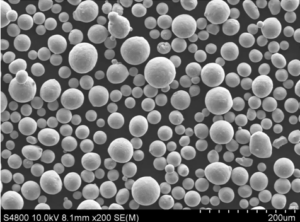
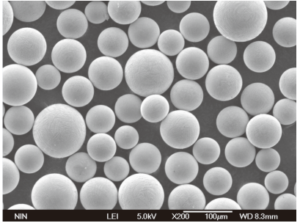
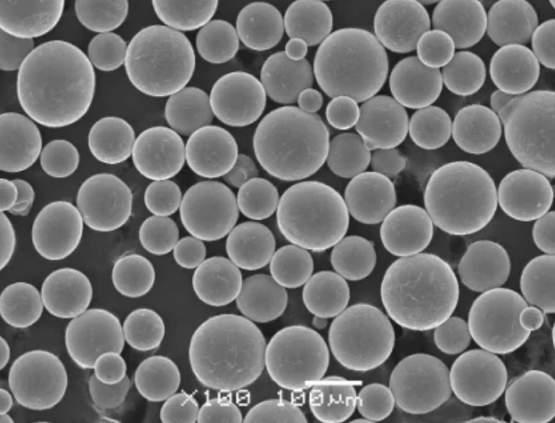
Although the target keyword focuses on alloy identity, morphology is inseparable from usability. Spherical particles typically spread more evenly than irregular ones, which helps create uniform powder layers in laser powder bed systems. Better layer uniformity can reduce defects associated with inconsistent local packing or poor recoating.
That is why buyers rarely evaluate AlSi10Mg powder only by chemistry. The real purchasing decision usually includes particle shape, size range, oxygen condition, and packaging integrity. A chemically correct powder that handles poorly can still create production risk.
Chemical Composition and Material Grade
The chemical composition of AlSi10Mg is simple in outline but important in detail. Aluminum is the balance element, silicon is the major alloying addition, and magnesium is present at a lower level to support strengthening and heat-treatment response. Residual elements such as iron, copper, manganese, zinc, and titanium are usually controlled to supplier or customer specifications because even minor variations can influence ductility, corrosion behavior, and consistency after printing.
In metal AM, chemistry should be interpreted together with process history. A lot that meets nominal composition still needs to demonstrate acceptable oxygen, particle size distribution, and morphology. This is especially true for aluminum powders, where surface oxidation and fines content can affect both handling and melting behavior.
| Reference Framework | Typical Composition Window (wt%) | Nearest Grade / Designation | Standard Context | Cross-Reference Note |
|---|---|---|---|---|
| AM AlSi10Mg powder, typical | Si 9.0–11.0, Mg 0.20–0.45, Al balance | AlSi10Mg | Powder for additive manufacturing | Supplier specification usually governs final acceptance |
| ASTM chemistry analog | Si about 9.0–10.5, Mg about 0.17–0.45, Al balance | A360 / AlSi10Mg-type cast analog | ASTM cast-alloy family reference | Useful as a chemistry comparison, not a full AM powder equivalence |
| DIN / EN analog | Si about 9.0–11.0, Mg about 0.20–0.45, Al balance | EN AC-AlSi10Mg(a) / EN AC-43000 | European cast alloy designation | Commonly used for alloy-family mapping in technical discussions |
| ISO analog | Si about 9.0–11.0, Mg about 0.20–0.45, Al balance | ISO AlSi10Mg(a) family designation | ISO cast alloy reference | Helps align alloy nomenclature internationally |
| GB analog | Si about 9.0–11.0, Mg typical controlled range, Al balance | ZL104-type reference | Chinese cast aluminum alloy framework | Often used as a nearest chemistry analog rather than a direct AM standard |
| AMS reference status | Project-defined | No single universal AMS powder equivalent | Aerospace procurement context | Programs often use internal specifications linked to chemistry and powder quality |
AlSi10Mg powder for 3D printing and chemistry control
The chemistry range exists for a reason. Silicon helps stabilize processing by improving solidification behavior and reducing crack sensitivity relative to some alternative aluminum alloys. Magnesium then supports precipitation strengthening, which becomes important when printed parts are stress relieved, aged, or otherwise thermally processed.
For the buyer, the main issue is not whether the powder is merely “AlSi10Mg,” but how tightly that chemistry is held from lot to lot. In serial production, small shifts in magnesium or residual content can contribute to meaningful differences in hardness, elongation, or heat-treatment response.
Grade cross-reference does not replace a powder specification
Cross-reference tables are useful for orientation, especially when engineering teams compare cast, machined, and additively manufactured versions of similar alloys. However, no cast-alloy designation automatically defines the quality of a powder feedstock. An AM-ready aluminum powder must also be specified by morphology, cleanliness, PSD, and handling requirements.
This is why procurement teams often combine chemistry references with process-specific material requirements. In effect, the alloy family tells you what the material is, while the powder specification tells you whether it is suitable for a stable AM workflow.
Residual elements and contamination risk
Trace elements deserve more attention than they often receive in summary data sheets. Iron can affect ductility, copper may influence corrosion behavior, and uncontrolled contamination can disrupt print consistency. In aluminum AM, chemistry and cleanliness should be read as one system rather than separate quality categories.
For rigorous qualification work, internal material requirements may cite broader ASTM additive manufacturing standards alongside supplier data. That does not create a universal AlSi10Mg powder standard, but it does provide a structured framework for incoming inspection and lot release.
Technische Daten
Technical specifications determine whether AlSi10Mg powder for 3D printing will behave predictably in production. The most important data points usually include particle size distribution, apparent density, tap density, Hall flow, oxygen level, and particle morphology. These properties influence how the powder spreads, how evenly it packs into layers, and how consistently it interacts with the heat source.
Because aluminum is relatively light and oxidation-sensitive, PSD and morphology deserve particular attention. A finer cut may help support high detail resolution, but it also increases total surface area and can raise sensitivity to oxygen pickup. A coarser cut may flow differently and suit larger melt pools or powder-fed processes better than thin-layer powder bed systems.
| Pulver Typ | PSD Range (µm) | Scheinbare Dichte (g/cm³) | Tap Density (g/cm³) | Hall Flow (s/50 g) | Sauerstoffgehalt | Sphärizität |
|---|---|---|---|---|---|---|
| Fine L-PBF grade | 15–45 | 1.28–1.45 | 1.42–1.65 | 15–24 | typically low, controlled by spec | high, low satellites |
| Standard L-PBF grade | 15–53 | 1.30–1.50 | 1.45–1.68 | 14–22 | typically low, controlled by spec | highly spherical |
| Broad L-PBF grade | 20–63 | 1.35–1.58 | 1.50–1.72 | 13–20 | typically low, controlled by spec | spherical to near-spherical |
| DED / cladding grade | 45–105 | 1.42–1.68 | 1.58–1.82 | 11–18 | application-specific | spherical, feeder-friendly |
| Coarser deposition grade | 53–150 | 1.45–1.70 | 1.60–1.85 | 10–17 | application-specific | spherical, broad-cut typical |
Particle size selection for AlSi10Mg 3D printing powder
For laser powder bed fusion, the most familiar cuts are 15–53 µm and 20–63 µm. These ranges generally support layer thicknesses and surface-finish targets common in industrial aluminum printing. In contrast, directed energy deposition and laser cladding often use coarser fractions because feed behavior and melt volume requirements are different.
The correct PSD always depends on the machine, recoating mechanism, layer thickness, and build strategy. A powder that performs well in one platform may not be optimal in another, even if both systems nominally process AlSi10Mg.
Flowability and packing behavior
Powder flowability is a practical production concern, not just a lab value. Apparent density gives insight into loose packing, tap density indicates compaction response, and Hall flow offers a quick measure of discharge behavior. None of these metrics guarantees good part quality by itself, but together they help screen whether a powder is likely to spread and refill consistently.
For aluminum powders, morphology strongly shapes these results. High sphericity and limited satellite formation generally improve flow and reduce mechanical interlocking between particles. That translates into more stable powder layers and fewer recoating disturbances during long builds.
Oxygen content and powder condition
Surface oxides are unavoidable in aluminum powders, so the issue is control rather than elimination. Excessive oxygen can reduce fusion consistency, alter surface behavior, and complicate reuse strategies. This is why oxygen content is often monitored both at lot release and during powder recycling studies.
Handling after delivery matters as much as test data at shipment. Sealed storage, moisture control, disciplined sieving, and documented reuse ratios all affect whether the powder behaves like the certificate suggests it should. For basic alloy-family orientation, many engineers also review the NIST materials data gateway when developing qualification plans and test structures.
Applications Across Industries
AlSi10Mg powder for 3D printing is used where geometry and weight reduction deliver measurable value. It is especially relevant when designers want to replace machined or cast parts with lighter components that include internal channels, lattice reinforcement, integrated mounting features, or consolidated subassemblies. That combination explains why the alloy appears across both advanced and cost-sensitive industries.
The material is not restricted to aerospace. Automotive, medical equipment, electronics, robotics, industrial tooling, and energy-adjacent sectors all use AlSi10Mg where lightweight functional parts are more important than extreme high-temperature service. In many of these applications, the design freedom of AM is the main reason the powder is chosen at all.
| Industrie | Typical Part | Why AlSi10Mg Fits | AM / PM Process |
|---|---|---|---|
| Luft- und Raumfahrt | brackets, housings, ducts | low mass with complex geometry | L-PBF, DED |
| Automobilindustrie und Motorsport | manifolds, supports, cooling components | lightweighting and rapid design iteration | L-PBF, DED |
| Robotics and automation | grippers, arm parts, end effectors | reduced moving mass and faster response | L-PBF, PM |
| Electronics and 3C | frames, shells, heat-management structures | low weight with moderate thermal utility | L-PBF, PM |
| Medical and laboratory equipment | fixtures, structural supports, instrument parts | low-volume complexity and corrosion resistance | L-PBF |
| Tooling and industrial equipment | jigs, fixtures, prototype tooling inserts | short lead times and integrated features | L-PBF, DED, PM |
Lightweight structural parts
This is the most common use case. Brackets, mounts, and housings benefit from aluminum’s low density while additive manufacturing enables geometry that cannot be easily machined from billet. When topology optimization is applied, AlSi10Mg can deliver a favorable stiffness-to-weight outcome for non-extreme service conditions.
These parts are often chosen not because AlSi10Mg is the strongest alloy available, but because it creates the best total engineering balance. The final component may be lighter, involve fewer fasteners, and require fewer assembly steps than a conventional alternative.
Functional thermal and enclosure components
AlSi10Mg is also used in thermally relevant parts such as electronic housings, sensor enclosures, and moderate-performance heat-management structures. Although it is not the conductivity leader among metal AM powders, it still offers better mass efficiency than many ferrous alloys and enough thermal utility for numerous industrial designs.
At this stage, the material decision often becomes comparative. Some teams look at copper alloy powder options when heat transfer dominates the design, while others evaluate titanium when specific strength or elevated corrosion performance matters more. AlSi10Mg remains attractive when the application requires a broad compromise rather than a single extreme property.
Prototype-to-production continuity
One of the reasons AlSi10Mg remains widely specified is that it works across multiple development stages. It is commonly used for prototype parts, then carried into pilot runs and limited serial production once parameters are stabilized. That continuity reduces the material-change risk that often slows AM adoption.
Compared with more specialized alloys, it also has a larger practical knowledge base around support removal, machining, stress relief, and surface finishing. For operations teams, that process maturity can be as valuable as the alloy itself.
Manufacturing and Quality Assurance
Most industrial AlSi10Mg powder for 3D printing is produced by gas atomization. In this process, a molten stream of alloy is disintegrated by inert gas into droplets that rapidly solidify into fine particles. The resulting powder is then sieved, classified, blended where appropriate, sampled, tested, and packaged under controlled conditions.
Gas atomization is widely used because it is compatible with industrial-scale aluminum powder production and can provide the spherical morphology required by AM systems. However, the atomization route alone does not guarantee quality. Melt cleanliness, atmosphere control, classification accuracy, and post-atomization handling all influence the final powder.
| QA or Production Factor | Method / Equipment | Zweck | Typical Acceptance Logic | Importance for AM |
|---|---|---|---|---|
| Chemische Zusammensetzung | ICP-OES, XRF, wet chemistry | confirm alloy identity and residual control | within agreed chemistry range | supports repeatable metallurgy |
| Partikelgrößenverteilung | laser diffraction, sieve analysis | verify D10, D50, D90 and cut compliance | within ordered PSD window | affects spreading and melt behavior |
| Morphologie der Partikel | SEM, optical image analysis | evaluate sphericity, satellites, agglomerates | predominantly spherical particles | improves recoating stability |
| Apparent / tap density and flow | density cup, tap tester, Hall funnel | assess handling and packing behavior | within supplier or buyer target band | screens lot consistency |
| Oxygen and contamination | ONH analyzer, visual cleanliness checks | monitor oxidation and foreign matter | low oxygen, clean appearance, no abnormal contamination | protects build quality and reuse control |
Why gas atomization is the main route
For AlSi10Mg, gas atomization usually offers the right balance between output volume and particle quality. It can generate the spherical or near-spherical particles required for stable recoating while remaining commercially viable for larger production lots. That makes it especially relevant for buyers who need repeatable supply, not just one-off development batches.
Other technologies such as PREP and VIGA are important in the broader powder industry, particularly for specialty alloys and high-purity workflows. But for mainstream aluminum AM feedstock, gas atomization remains the most common production route because it aligns well with the alloy’s scale and application profile.
Lot traceability and release practice
Lot-to-lot consistency matters more in additive manufacturing than many first-time buyers expect. A successful parameter set is only useful if the next lot behaves in a comparable way. That is why robust traceability, retained samples, and batch-linked documentation are standard expectations in serious AM supply chains.
The best lot release packages connect lab data with process relevance. A certificate showing chemistry, PSD, morphology, and oxygen content gives the user a better predictive basis than chemistry alone. Supplemental technical context on powder metallurgy and alloy behavior is often found in ASM materials resources, especially when teams build internal qualification procedures.
Powder handling after delivery
Even a high-quality atomized powder can underperform if stored or recycled poorly. Aluminum powders should be kept sealed, protected from humidity, and returned to production only through a documented reuse protocol. Fine accumulation, oxide growth, and contamination from shop handling can all shift performance over time.
This is one reason experienced users treat powder management as part of process control rather than a warehouse function. In AM, feedstock condition evolves with use, and aluminum can be less forgiving of poor handling than heavier alloy systems.
Why Choose Truer as Your Supplier
Selecting a supplier for AlSi10Mg powder for 3D printing is fundamentally about technical fit and supply discipline. The buyer needs a source that understands how powder characteristics affect actual manufacturing outcomes, including layer deposition, density development, and downstream part performance. In practical terms, that means the supplier should be able to discuss chemistry, PSD, morphology, flow, packaging, and application route as one connected system.
Truer’s relevance lies in its combined focus on powder-making equipment, additive manufacturing processes, and metal powder supply. That background is useful when a project needs more than a generic material description, such as when choosing between powder cuts, aligning a batch to a specific AM route, or comparing aluminum with alternative alloy families.
The company context also matters when material selection extends beyond one aluminum grade. Some users begin with AlSi10Mg, then compare stainless steel for toughness or titanium for a higher strength-to-weight profile. In those cases, access to a broader titanium alloy powder portfolio or a related metal-powder range can simplify evaluation under a consistent supply framework.
Another practical factor is process-aware powder specification. A supplier that recognizes the difference between prototype material, pilot qualification material, and production-grade material is usually better positioned to support reliable adoption. That matters because the same alloy name can behave very differently depending on morphology, oxygen level, and powder handling discipline.
Ordering Guide and Support
Buying AlSi10Mg powder for 3D printing should begin with the process, not just the alloy designation. A request for quotation should clearly identify whether the powder is intended for laser powder bed fusion, directed energy deposition, laser cladding, or another powder-based route. The right PSD, packaging format, and quality controls depend directly on that process choice.
Buyers should also define what success looks like. A powder for parameter screening may only need evaluation-scale packaging and basic certification, while a powder for serial production may require tight batch traceability, retained samples, and agreed re-order tolerances. The clearer the application context, the more likely the supplier can recommend an appropriate material cut and support path.
| Verpackungsformat | Typical MOQ Tier | Typical Lead Time | Sample Policy | Typischer Anwendungsfall |
|---|---|---|---|---|
| 500 g bottle | evaluation tier | 1–2 weeks if stock is available | paid or approved screening sample | parameter exploration |
| 1 kg bottle | prototype tier | 1-3 Wochen | common first-step sample size | test coupons and small builds |
| 5 kg sealed container | pilot tier | 2–4 weeks | usually after technical review | repeatability studies |
| 10–25 kg drum | pre-production tier | 3–6 weeks depending on spec | supplied after alignment on requirements | lot validation and pilot runs |
| custom bulk package | production tier | project-based | not typical as an initial sample | ongoing manufacturing programs |
What to include in an RFQ
An effective RFQ usually includes the alloy name, preferred PSD range, intended AM process, packaging preference, annual volume estimate, and any special quality requirements. If there are limits on oxygen, morphology, documentation format, or reuse expectations, they should be stated early. That saves time and reduces the risk of trialing an unsuitable batch.
It is also useful to mention the target part category. Thin-wall structural components, thermal parts, and cladding applications may all require different powder cuts even when the chemistry is identical.
Sample strategy and technical communication
Many organizations benefit from a staged qualification path that starts with a small sample, moves to a pilot quantity, and only then proceeds to larger production lots. This approach makes it easier to separate material behavior from machine settings and post-processing variables. It also gives procurement and engineering teams a clearer basis for long-term specifications.
When a project needs tailored packaging, a nonstandard size range, or application-specific discussion, the most direct route is the technical inquiry contact page. Early technical communication often prevents later delays in validation.
Unser Unternehmen
Shanghai Truer Technology Co., Ltd. was established in 2009 and created its additive manufacturing business in 2019. The company focuses on integrating 3D printing powder-making equipment and related services with metal powders intended to accelerate engineering applications of additive manufacturing. Its core technologies include Selective Electron Beam Melting equipment, Plasma Rotating Electrode Process powder-making equipment, and gas atomization. The powder portfolio includes TiNi, TiTa, TiAl, TiNbZr, CoCrMo, and spherical nickel-based, cobalt-based, titanium-based, copper-based, aluminum-based, and stainless steel powders for processes such as SLM, SEBM, DED, laser cladding, powder metallurgy, MIM, HIP, cold or hot spraying, welding, and coating. The company also participates in a joint innovation center for metal 3D printing with laboratories and industry experts, and it serves sectors including 3C electronics, hand tools, remote control cars, medical, aerospace, and nuclear power. Additional background is available in the company profile overview.
FAQ
Q1. Is AlSi10Mg powder for 3D printing mainly used for lightweight parts?
Yes, lightweighting is one of the main reasons engineers choose this alloy. It allows designers to reduce mass while still producing functional metal parts with complex geometry, especially in brackets, housings, frames, and integrated assemblies.
Q2. What particle size range is common for AlSi10Mg powder for 3D printing in L-PBF?
Common ranges include 15–45 µm, 15–53 µm, and 20–63 µm. The best range depends on machine type, layer thickness, recoater behavior, and the balance between fine detail and stable powder handling.
Q3. Why is spherical morphology important in AlSi10Mg AM powder?
Spherical particles generally spread more evenly and flow more consistently than irregular particles. That helps create uniform powder layers, which supports stable melting and reduces the risk of print defects caused by poor recoating.
Q4. Can AlSi10Mg powder be used outside laser powder bed fusion?
Yes. Although it is most strongly associated with powder bed fusion, selected size ranges can also be relevant for directed energy deposition, laser cladding, and some powder metallurgy workflows. The acceptance criteria should always match the intended process.
Q5. How does AlSi10Mg compare with stainless steel or titanium in metal AM?
AlSi10Mg is much lighter than stainless steel and titanium, which makes it attractive for weight-sensitive designs. Titanium is often selected when higher specific strength is needed, while stainless steel is often preferred for broader toughness, wear, or corrosion-driven industrial applications.
Q6. What should buyers ask for on an AlSi10Mg powder data sheet?
They should ask for chemical composition, particle size distribution, apparent density, tap density, flow data, oxygen condition, morphology information, packaging format, and lot traceability details. For production work, it is also important to know whether those values are one-time measured results or part of a controlled release specification.