Kurzantwort
Inconel 718 powder for additive manufacturing is a nickel-based superalloy feedstock engineered for metal 3D printing processes such as laser powder bed fusion, electron beam melting, and directed energy deposition. It is widely chosen because it combines strong mechanical performance at elevated temperature, good corrosion and oxidation resistance, and relatively mature processing knowledge compared with more crack-sensitive superalloys. For aerospace, energy, tooling, and high-load industrial parts, that balance makes it one of the most practical materials for repeatable builds and post-build heat treatment.
What Is Inconel 718 powder for additive manufacturing?
Inconel 718 powder for additive manufacturing refers to spherical alloy 718 powder prepared for layer-wise metal fabrication routes rather than conventional wrought or cast processing alone. Alloy 718 belongs to the nickel-chromium superalloy family and is best known for retaining useful strength across demanding thermal and mechanical conditions while remaining more weldable and more process-tolerant than many other high-performance nickel alloys.
From a metallurgical standpoint, it is a precipitation-hardenable nickel superalloy strengthened primarily through niobium-bearing phases together with aluminum and titanium contributions. That matters in additive manufacturing because the alloy can be printed in a relatively workable condition and then heat treated to develop the strength profile required for service. This sequence helps designers separate geometric freedom from final property optimization.
The name “Inconel 718” is also used commercially alongside the numeric designation 718 and the UNS family N07718. In industry practice, the exact purchasing language often depends on whether the buyer is focused on chemistry equivalence, powder specification, aerospace traceability, or end-part qualification. For AM users, the powder specification becomes just as important as the alloy name itself.
Compared with Inconel 625, 718 is typically selected when higher structural strength is required rather than corrosion resistance alone. Compared with more advanced high-temperature superalloys, it is often easier to process and less prone to severe cracking during parameter development. That balance explains why it remains one of the most qualified and most frequently discussed superalloys in metal AM.
The additive manufacturing context is important. Feedstock for powder bed fusion and DED must meet tighter expectations for flowability, particle-size distribution, surface condition, and impurity control than the same nominal alloy might require in bulk mill product form. In the framework of [ISO/ASTM additive manufacturing terminology], feedstock is part of the process definition, so the phrase “Inconel 718 powder for additive manufacturing” implies both alloy selection and powder engineering.
Another reason this material matters is design economics. Many engineers do not choose 718 because it is the cheapest powder or the lightest structural alloy. They choose it because it occupies a useful middle ground: better elevated-temperature structural capability than many steels, better AM familiarity than more exotic superalloys, and more forgiving behavior than alloys with narrower print windows.
Chemical Composition and Material Grade
Chemically, Inconel 718 is centered on nickel, chromium, iron, niobium, and molybdenum, with smaller but important additions of titanium and aluminum. Each of these elements supports a different aspect of performance, from corrosion resistance to precipitation hardening response. For additive manufacturing, chemical control must also extend to residual elements and interstitials because powder chemistry can influence print stability, defect formation, and heat-treatment repeatability.
Nickel forms the alloy base and supports phase stability at temperature. Chromium contributes oxidation and corrosion resistance, while iron serves as a balance element that helps distinguish 718 from more heavily nickel-loaded superalloys. Niobium is especially important because it drives key strengthening reactions after suitable thermal treatment.
For powder buyers, the practical question is not only whether the chemistry falls within a recognized range, but whether the lot is documented against the intended use case. A research lab may accept a broad commercial chemistry window, while an aerospace or nuclear-adjacent program may require additional impurity limits, powder-lot traceability, and explicit alignment with procurement standards.
The table below summarizes typical composition ranges and common grade cross-references used when sourcing Inconel 718 powder for additive manufacturing. Ranges are representative and should always be checked against the supplier’s certificate of analysis and the purchaser’s specification.
| Element / Grade Reference | Typical or Common Range (wt%) | ASTM Cross-Reference | AMS Cross-Reference | GB Cross-Reference | ISO / DIN Context |
|---|---|---|---|---|---|
| Nickel (Ni) | 50.0–55.0 | Commonly aligned with AM feedstock chemistry for alloy 718 | Chemistry consistent with aerospace 718 usage | Often associated with GH4169 equivalence | Frequently mapped to DIN 2.4668 / NiCr19Fe19Nb5Mo3 |
| Chrom (Cr) | 17.0–21.0 | Standard 718 family range | Same chemistry family | Same chemistry family | Same grade context |
| Eisen (Fe) | Waage | Balance per alloy family | Waage | Waage | Waage |
| Niobium + Tantalum (Nb+Ta) | 4.75–5.50 | Critical strengthening range | Same | Same | Same |
| Molybdän (Mo) | 2.80–3.30 | Standard 718 family range | Same | Same | Same |
| Titan (Ti) | 0,65–1,15 | Standard 718 family range | Same | Same | Same |
| Aluminium (Al) | 0.20–0.80 | Standard 718 family range | Same | Same | Same |
| Kohlenstoff (C) | ≤ 0.08 | Impurity control important for AM | Same | Same | Same |
| Kobalt (Co) | ≤ 1.00 typical limit | Residual control | Residual control | Residual control | Residual control |
| Oxygen / Nitrogen / Sulfur | Supplier-controlled, typically low for AM powder | Often tighter than wrought-only needs | Application-dependent | Application-dependent | Application-dependent |
Material-grade language around 718 can be confusing because standards may address different things: bulk alloy chemistry, feedstock requirements, test methods, or final part properties. That is why procurement teams often begin with chemistry equivalence and then layer on additional AM-specific requirements such as particle size, flow, apparent density, and oxygen control. When reviewing standards pathways, it is useful to cross-check the [ASTM additive manufacturing standards catalog] alongside internal customer specifications.
In practical sourcing, Inconel 718 powder for additive manufacturing is usually evaluated against other nickel systems rather than against every metal powder category. Within a broader [nickel superalloy powder selection], 718 is typically the choice when designers need a heat-treatable alloy with strong fatigue and elevated-temperature performance without moving immediately to harder-to-process superalloys.
Technische Daten
Technical specifications for Inconel 718 powder for additive manufacturing combine chemistry, particle engineering, and powder-handling behavior. A lot can satisfy nominal alloy chemistry and still perform poorly if it has a wide particle-size spread, too many satellites, unstable flow, or elevated oxygen. For that reason, serious users review the full powder data package rather than only the alloy name.
Particle Size Distribution for AM Powder
The target particle-size distribution depends on the process route. Laser powder bed fusion commonly uses fine cuts such as (15\text{–}45\ \mu m) or (15\text{–}53\ \mu m), while coarser fractions like (45\text{–}105\ \mu m) and (53\text{–}150\ \mu m) are more common in directed energy deposition, laser cladding, and some powder metallurgy applications. The chosen range affects layer thickness, powder spread, packing behavior, and melt-pool stability.
Flowability, Density, and Spherical Powder Behavior
Powder flow is often discussed too narrowly. Hall flow, apparent density, and tap density each describe different aspects of how the feedstock behaves during filling, transport, and spreading. For Inconel 718 powder for additive manufacturing, high-temperature strength in the final part still depends on stable feedstock behavior in the machine.
Oxygen and Surface Cleanliness
Fine nickel alloy powders naturally present a large surface area, so oxygen control matters. Low oxygen is especially valuable for reuse programs and for demanding qualification routes where property drift must be minimized. Surface cleanliness and limited satellite formation also contribute to more predictable layering and reduced variability in recoating.
| Specification Item | Fine LPBF Grade | Standard PBF Grade | Coarse DED / Cladding Grade | Anmerkungen |
|---|---|---|---|---|
| Partikelgrößenverteilung | 15–45 µm typical | 15–53 µm typical | 45–105 µm or 53–150 µm typical | Match to machine and layer thickness |
| Scheinbare Dichte | 4.3–4.8 g/cm³ typical | 4.4–4.9 g/cm³ typical | 4.5–5.0 g/cm³ typical | Influenced by PSD and morphology |
| Zapfstellendichte | 4.9–5.4 g/cm³ typical | 5.0–5.5 g/cm³ typical | 5.1–5.6 g/cm³ typical | Indicates packing behavior |
| Hallströmung | 13–20 s/50 g typical | 12–18 s/50 g typical | 11–17 s/50 g typical | Very fine cuts may flow slower |
| Sauerstoffgehalt | ≤ 500 ppm typical premium lots | ≤ 500–800 ppm typical | ≤ 800 ppm typical | Buyer specs may be tighter |
| Sphärizität | Near-spherical, high | Near-spherical | Near-spherical | Usually confirmed by image analysis |
These figures are best treated as typical commercial benchmarks, not universal mandatory limits. The exact acceptance range depends on whether the powder will be used in R&D, serial production, or qualification-critical hardware. Experienced buyers also ask whether reported values represent as-produced powder, sieved powder, or the packaged condition shipped to the customer.
Powder reuse deserves separate attention. A strong virgin lot can still degrade through repeated thermal exposure, oxygen pickup, and accumulation of fines or spatter-related contamination. That is why powder management plans should define screening practice, blend ratios, and requalification checkpoints rather than assuming that all used powder behaves like virgin material.
Another key point is machine dependence. One LPBF platform may print successfully with a slightly finer distribution to improve surface quality, while another may prefer a broader cut to support throughput and robust recoating. Technical specification, then, is not just a powder property issue; it is a process-matching exercise between feedstock, machine architecture, and post-build requirements.
Applications Across Industries
Inconel 718 powder for additive manufacturing is used in industries where thermal stability, structural reliability, and design complexity intersect. It is especially relevant when a part cannot be easily machined from bar stock, when internal channels or topology optimization matter, or when low-volume production makes tooling-intensive manufacturing uneconomic.
Aerospace remains the most visible application area because 718 has long service history in engine-adjacent and high-performance structural environments. Engineers use the alloy for brackets, housings, manifolds, ducts, tooling, and development hardware that must tolerate high stress and elevated temperature without excessive distortion or corrosion.
Energy and power-generation applications are also important. Components exposed to hot gas, cyclic thermal loads, or aggressive process conditions often benefit from 718’s balance of strength and oxidation resistance. In repair-driven environments, the powder can also support cladding or DED-based restoration strategies.
The alloy is equally useful in industrial tooling and specialty manufacturing. It appears in hot-work fixtures, inserts, custom jigs, and process equipment where conventional steels may lose performance under thermal cycling. Compared with options in a [titanium alloy powder portfolio], 718 is heavier and less attractive for strict lightweighting, but it can deliver better heat resistance and broader corrosion tolerance in the right service envelope.
| Industrie | Typical Part | Performance Driver | AM / PM Process |
|---|---|---|---|
| Luft- und Raumfahrt | Brackets, manifolds, housings, engine-adjacent hardware | Thermal strength and fatigue resistance | LPBF, SEBM, DED |
| Energy / Power | Burner hardware, seals, hot-gas components, repair builds | Oxidation resistance at elevated temperature | LPBF, DED, laser cladding |
| Oil & Gas / Process | Valve trims, corrosion-resistant inserts, wear components | Structural integrity in harsh environments | LPBF, PM, HIP |
| Automotive / Motorsport | Turbo-related hardware, test fixtures, hot-zone prototypes | Fast iteration under heat load | LPBF, DED |
| Tooling / Industrial Equipment | Hot-work tooling, molds, jigs, inserts | Thermal cycling durability | LPBF, PM, MIM |
| Research / Defense | Development coupons, custom hardware, low-volume geometries | Qualification and geometry freedom | LPBF, SEBM, HIP |
The broad applicability of 718 does not mean it is always the best choice. If corrosion resistance is the main design driver and temperature is moderate, alloy 625 may be sufficient. If the key requirement is lightweight biomedical performance, titanium grades may outperform it. If extreme wear dominates the duty cycle, materials in a [stainless and specialty steel powder range] or cobalt alloys may become more appropriate.
The most successful applications are usually those where alloy choice is tied to system-level reasoning. Engineers who start with service temperature, loading mode, corrosion exposure, qualification pathway, and economic production volume tend to make better powder choices than teams that select materials only by brand recognition or headline tensile strength.
Manufacturing and Quality Assurance
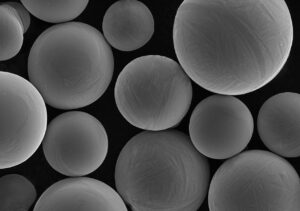
The production route strongly affects how Inconel 718 powder for additive manufacturing behaves in real equipment. Most commercial supply is based on gas atomization or vacuum induction gas atomization, while some premium spherical powders may be made by plasma rotating electrode process. Each route produces usable material, but not identical particle morphology, surface texture, or contamination profile.
GA, VIGA, and PREP Compared
Gas atomization is widely used because it is scalable and commercially flexible. VIGA adds tighter atmosphere control and is often preferred when cleanliness and melt discipline are important. PREP is often associated with very spherical particles and low satellite formation, making it attractive for demanding applications where feedstock consistency matters.
Key QA Checks for Inconel 718 Additive Manufacturing Powder
A meaningful quality program typically includes chemistry verification, particle-size distribution analysis, morphology inspection, apparent density, tap density, flow testing, and oxygen or nitrogen measurement. Depending on the customer’s requirements, it may also include SEM imaging, ICP-OES chemistry, LECO interstitial analysis, retained sample management, and packaging-atmosphere verification.
Why Powder Documentation Matters
For qualification-driven users, certificates alone are not enough. What matters is the chain from melting and atomization through sieving, sampling, testing, packaging, storage, and shipment. That is where powder morphology control and documentation discipline become decisive.
| Attribut | GA-Pulver | VIGA Powder | Vorbereitungspulver | Warum es wichtig ist |
|---|---|---|---|---|
| Partikelform | Generally spherical, some satellites common | Spherical, often cleaner than standard GA | Very spherical, low satellites typical | Affects spreading and packing |
| Atmosphere control | Good commercial standard | High, due to vacuum/inert melting practice | High, with minimal crucible interaction | Supports cleanliness |
| PSD flexibility | Broad and scalable | Broad and well controlled | Controlled, often premium rather than mass-volume focused | Impacts application fit |
| Surface condition | Gut | Clean to premium | Very clean and smooth typical | Influences flow behavior |
| Cost position | Usually lowest | Mid to premium | Premium | Must fit part value |
| Best-fit scenario | General AM and PM production | Higher-purity AM programs | Critical AM parts and strict feedstock requirements | Selection depends on risk level |
An effective supplier evaluation should emphasize lot-to-lot consistency rather than one attractive certificate from one batch. Buyers should ask how often the supplier recalibrates test instruments, how representative sampling is performed, how sieve fractions are controlled, and whether the documentation structure remains stable between lots. Those operational details often determine whether a material can move from successful trials to routine production.
In metal AM, feedstock variation is often the hidden cause of process variation.
For organizations building formal quality systems, external technical references can help frame measurement discipline. [NIST materials measurement resources] are useful for understanding the role of method consistency, while [ASM International superalloy guidance] provides broader context for nickel alloy processing and property development. Those references are not substitutes for a supplier audit, but they are useful benchmarks when defining incoming inspection and qualification logic.
Why Choose Truer as Your Supplier
Selecting a supplier for Inconel 718 powder for additive manufacturing is fundamentally about technical fit, process understanding, and documentation control. The strongest suppliers are those that can discuss atomization route, powder classification, process compatibility, and downstream application risks with the same level of confidence as they discuss price and lead time.
Truer is relevant in this context because its metal additive manufacturing activities include powder-making equipment and powder supply rather than only distribution. The company’s scope includes PREP powder-making equipment, gas atomization capability, and process familiarity with SLM, SEBM, DED, laser cladding, PM, MIM, and HIP. That combination is useful when customers need discussion grounded in process behavior rather than catalog language alone.
A practical sourcing advantage is breadth across adjacent alloy families. When a buyer is comparing 718 not only with another 718 lot but also with cobalt, titanium, copper, aluminum, or stainless options, cross-material understanding matters. A neutral overview of Truer’s capabilities and product scope is available in its [company background profile].
For buyers, the most important supplier questions remain straightforward: Can the supplier provide the required PSD? Are chemistry and interstitials documented per lot? Is packaging suitable for long-distance transport and controlled storage? Can the supplier align the feedstock to critical AM workflows rather than treating all powder users as if they have the same process window?
Ordering Guide and Support
Ordering Inconel 718 powder for additive manufacturing starts with defining the process route and the qualification objective. A request for quotation is more effective when it specifies machine type, preferred particle-size distribution, required documentation, annual volume, whether the powder is for initial validation or repeat production, and whether custom packaging or inert packing is needed.
Small evaluation orders can be valuable, but they should be designed carefully. The best practice is to request a traceable sample with the same documentation framework expected for larger production lots. Otherwise, a successful development trial may not translate cleanly to scaled procurement.
Information to Include in a Purchase Inquiry
Most suppliers will need to know the target application, process family, and geography of delivery. It also helps to state whether the user is concerned most with flow, surface finish, density, oxygen, reuse stability, or certification burden. If the inquiry is detailed, the quotation is usually more technically relevant.
| Verpackungsformat | Typical MOQ Tier | Typical Lead Time | Sample Policy |
|---|---|---|---|
| 1 kg bottle | Lab / feasibility quantity | 1–3 weeks typical if stock is available | Small paid sample commonly offered |
| 5 kg bottle | Evaluation batch | 2–4 weeks typical | Often available from a traceable lot family |
| 10 kg bottle | Pilot production | 2–5 weeks typical | Useful for machine parameter development |
| 25 kg drum | Standard production quantity | 3–6 weeks typical | Usually linked to formal quote approval |
| Custom inert-packed lot | Qualified project or long-term order | 4–8 weeks depending on test scope | Documentation agreed before shipment |
Lead time depends on whether the material is drawn from an established production lot or requires a fresh melt, custom sieving, or extended testing. Additional requests such as SEM imagery, extra chemistry points, retained samples, or special export packing can extend delivery time even when the base powder is available.
It is also wise to align sample policy with approval logic. A lab sample is useful for initial spread tests and coupon builds, but full qualification programs often require lot reservation, duplicate testing, and change-control commitments. Detailed project inquiries can be submitted through Truer’s [metal powder inquiry page], where process and documentation needs can be defined before order release.
Unser Unternehmen
Shanghai Truer Technology Co., Ltd. was established in 2009 and created its additive manufacturing business in 2019. The company focuses on integrating 3D printing powder-making equipment and services with spherical metal powders for engineering applications of additive manufacturing. Its core technologies include Selective Electron Beam Melting equipment, Plasma Rotating Electrode Process powder-making equipment, and gas atomization. The company’s powder portfolio includes TiNi, TiTa, TiAl, TiNbZr, CoCrMo, and nickel-based, cobalt-based, titanium-based, copper-based, aluminum-based, and stainless steel spherical metal powders for SLM, SEBM, DED, laser cladding, powder metallurgy, MIM, HIP, cold and hot spraying, welding, and coating across industries such as medical, aerospace, nuclear power, 3C electronics, hand tools, and remote-control cars.
FAQ
Q1. Is Inconel 718 powder for additive manufacturing the same as standard Inconel 718 alloy?
The base alloy family is the same, but AM powder is a feedstock specification rather than only a chemistry label. It must also meet requirements for particle-size distribution, flow behavior, morphology, cleanliness, and packaging. In practice, that makes AM powder more tightly defined than a generic reference to wrought or cast 718.
Q2. Which particle size is best for Inconel 718 powder for additive manufacturing in LPBF?
For many laser powder bed fusion systems, (15\text{–}45\ \mu m) and (15\text{–}53\ \mu m) are common starting points. The best choice depends on machine architecture, layer thickness, recoater type, target surface finish, and productivity goals. Validation on the actual machine remains essential.
Q3. Can Inconel 718 powder for additive manufacturing be reused after printing?
Yes, but only with controlled powder management. Users should monitor oxygen pickup, fines accumulation, spatter contamination, and changes in flow or PSD across cycles. Reuse protocols are especially important for safety-critical or tightly qualified components.
Q4. Why is Inconel 718 so common in aerospace additive manufacturing?
It combines strong elevated-temperature performance, corrosion and oxidation resistance, and a relatively mature qualification history. It is also more process-tolerant than many other superalloys, which helps during development and serial production. That combination reduces adoption risk for complex aerospace hardware.
Q5. How does Inconel 718 powder compare with Inconel 625 powder for additive manufacturing?
Inconel 625 is often easier to print and is highly valued for corrosion resistance, but it is not strengthened in the same way as 718 for higher structural service. Inconel 718 is usually chosen when heat-treated strength and fatigue capability matter more than corrosion resistance alone. The better alloy depends on service conditions, not just printability.
Q6. What documents should buyers request when sourcing Inconel 718 powder for additive manufacturing?
At minimum, ask for a certificate of analysis covering chemistry, PSD, flow, density, and oxygen content, plus lot identification and packaging details. For demanding programs, buyers often request SEM morphology images, retained samples, testing methods, and change-control information. The more qualification-sensitive the application, the more important complete traceability becomes.