Kurzantwort
Inconel 738LC powder for DED is a nickel-based superalloy feedstock used in directed energy deposition for building, repairing, or adding features to components exposed to high heat and stress. It is chosen for DED when engineers need strong elevated-temperature performance, oxidation resistance, and the ability to deposit material selectively on large or high-value parts. In practice, it is especially relevant for turbine hardware, industrial hot-section components, and repair workflows where a cast or wrought replacement would be slower, less flexible, or more expensive.
What Is Inconel 738LC powder for DED?
Inconel 738LC powder for DED refers to a low-carbon nickel-base superalloy powder prepared for directed energy deposition rather than for conventional powder bed fusion alone. The alloy belongs to the broader family of precipitation-strengthened nickel superalloys used where creep resistance, oxidation resistance, and thermal stability are all required in the same component. The “LC” suffix means low carbon, a modification that helps balance carbide formation and crack behavior relative to earlier high-carbon variants.
DED itself is an additive manufacturing route in which powder is fed into a melt pool created by a focused energy source, usually a laser. Unlike powder bed systems, DED is optimized for localized deposition, feature addition, surface restoration, and building medium-to-large geometries with relatively high deposition rates. The process terminology is aligned with [ISO/ASTM 52900 additive manufacturing terminology], which distinguishes directed energy deposition from powder bed fusion and other AM categories.
For this reason, Inconel 738LC powder for DED occupies a specific niche. It is not simply a generic “nickel powder” and it is not selected only for printability. It is selected because the final part or repaired zone must continue functioning in aggressive thermal service, often where lower-strength nickel alloys such as 625 or easier-to-process grades such as 718 may not provide enough creep margin at temperature.
The alloy’s strengthening mechanism is centered on gamma-prime precipitation, supported by aluminum and titanium additions in a nickel matrix. Chromium contributes oxidation and hot-corrosion resistance, while cobalt, tungsten, tantalum, molybdenum, niobium, boron, and zirconium help stabilize high-temperature properties and grain-boundary behavior. Those same features that make the alloy valuable in service also make it more demanding to process than more forgiving AM alloys.
In DED, the powder is commonly used for near-net-shape deposition, repair, wall building, and functionally adding material onto existing substrates. Because DED melt pools are larger and thermal histories differ from laser powder bed fusion, the preferred powder size range is typically coarser. That affects how users specify flowability, size distribution, powder cleanliness, and acceptable morphology.
A useful way to think about this alloy is as a performance-first material. Engineers usually adopt it when the application is already difficult, the operating temperature is already high, and the part cost is already significant. Under those conditions, DED becomes attractive because it can restore or build critical features directly where they are needed rather than forcing the entire component into a conventional remake route.
Chemical Composition and Material Grade
The chemistry of Inconel 738LC powder for DED is designed to support high-temperature strength through precipitation hardening while preserving environmental resistance. In practical procurement, buyers should evaluate both nominal chemistry and powder-specific controls, because a cast-alloy designation alone does not define oxygen content, morphology, or particle-size suitability for DED.
Typical Composition of Inconel 738LC Powder for DED
| Element / Grade Item | Typical wt.% | Function / Cross-Reference Note |
|---|---|---|
| Nickel (Ni) | Waage | Matrix element for the superalloy system |
| Chrom (Cr) | 15.7–16.3 | Oxidation and hot-corrosion resistance |
| Kobalt (Co) | 8.0–9.0 | Phase stability and elevated-temperature strength |
| Tungsten (W) | 2.4–2.8 | Solid-solution strengthening |
| Molybdän (Mo) | 1.6–1.9 | High-temperature strength contribution |
| Tantal (Ta) | 1.5–2.0 | Gamma-prime support and creep resistance |
| Niobium (Nb) | 0.7–1.1 | Secondary strengthening contribution |
| Aluminium (Al) | 3.2–3.7 | Primary gamma-prime former |
| Titan (Ti) | 3.2–3.7 | Primary gamma-prime former |
| Kohlenstoff (C) | 0.08–0.13 | Controlled carbide formation; low-carbon grade |
| Bor (B) | 0.005–0.015 | Grain-boundary strengthening |
| Zirkonium (Zr) | 0.03–0.10 | Grain-boundary support |
| Eisen (Fe) | ≤ 0.50 typical | Residual control |
| Silizium (Si) | ≤ 0.30 typical | Residual control |
| Manganese (Mn) | ≤ 0.20 typical | Residual control |
| ASTM status | No single dedicated ASTM AM powder grade universally used | Often ordered to supplier specification with chemistry limits |
| AMS status | No universal AMS powder purchase code common for DED feedstock | Customer drawing or internal material spec usually governs |
| GB status | Often supplied to enterprise or project specification | Cross-reference depends on purchaser documentation |
| ISO status | No one-to-one ISO alloy purchase code for this exact powder form | Process standards exist separately from alloy procurement |
| DIN / EN status | No exact universal DIN equivalent for AM powder ordering | Chemistry-based equivalence is more common than formal code |
One of the most important procurement realities is that Inconel 738LC is widely recognized as an alloy family name, yet powder orders are frequently placed against technical agreements rather than against a single global powder standard. That is normal in high-performance AM because the user usually needs more detail than legacy cast-alloy references provide. Chemistry, oxygen, particle-size distribution, morphology, and packaging often sit in the same controlled purchase specification.
The low-carbon designation is not a trivial suffix. Carbon plays a role in carbide distribution and grain-boundary condition, both of which affect cracking behavior, thermal fatigue resistance, and service response. In repair and DED applications, where dilution and thermal cycling must be controlled carefully, that lower-carbon balance can be especially relevant.
Another practical point is naming. Many engineers use “Inconel 738LC” as shorthand, although procurement documents may also refer to IN738LC or simply 738LC. In technical writing, it is better to focus less on branding convention and more on verifying the actual chemistry, powder route, and deposition intent.
Why composition matters more in DED than many buyers expect
DED introduces localized remelting, dilution with the substrate, and broader thermal gradients than many powder bed builds. As a result, composition is not only a feedstock issue but part of the final deposit chemistry after processing. If the substrate is dissimilar, the deposited region may not exactly match virgin powder composition, especially in early layers or repair transitions.
That is why experienced users treat chemistry as a system input. The right powder must be paired with the right substrate, shielding approach, deposition strategy, and heat treatment. Buying the correct nominal alloy is only the first step.
Technische Daten
Powder specification for DED should reflect how the feedstock travels through the feeder, hose, and nozzle before it ever reaches the melt pool. Fine powder optimized for powder bed fusion may not feed consistently in a DED system, while an excessively coarse or broad distribution can create unstable mass flow, spatter, or inefficient capture. For Inconel 738LC powder for DED, specification discipline is therefore central to repeatable deposition.
Typical Technical Specification for Inconel 738LC Powder for DED
| Parameter | 45–105 µm | 53–150 µm | 75–180 µm | Typical Note |
|---|---|---|---|---|
| Main process fit | Fine DED, laser cladding | Standard DED, repair, build-up | High-rate DED, larger nozzles | Equipment dependent |
| D10 | 45–55 µm | 53–65 µm | 75–90 µm | Typical laser diffraction result |
| D50 | 70–80 µm | 90–105 µm | 115–135 µm | Typical median range |
| D90 | 100–105 µm | 145–150 µm | 170–180 µm | Typical upper cut |
| Scheinbare Dichte | 4.7–5.2 g/cm³ | 4.8–5.3 g/cm³ | 4.9–5.4 g/cm³ | Morphology dependent |
| Zapfstellendichte | 5.2–5.8 g/cm³ | 5.3–5.9 g/cm³ | 5.4–6.0 g/cm³ | Typical range |
| Durchflussmenge im Hall-Kanal | 12–18 s/50 g | 11–17 s/50 g | 10–16 s/50 g | Spherical powder generally flows better |
| Sauerstoffgehalt | ≤ 0.03 wt.% typical target | ≤ 0.03 wt.% typical target | ≤ 0.04 wt.% typical target | Final limit by agreement |
| Stickstoffgehalt | Low, often ≤ 0.02 wt.% | Low, often ≤ 0.02 wt.% | Low, often ≤ 0.02 wt.% | Supplier controlled |
| Sphärizität | typically ≥ 0.93 | typically ≥ 0.93 | typically ≥ 0.93 | Image-analysis basis, typical |
| Satellite content | low | low | low | Qualitative or image-based control |
| Packaging condition | dry, sealed, inert preferred | dry, sealed, inert preferred | dry, sealed, inert preferred | Important for storage stability |
The 45–105 µm and 53–150 µm cuts are common starting points because many DED systems favor particles large enough for stable transport but not so large that melting efficiency drops sharply. Some high-rate or large-nozzle setups move further upward in size, especially when feature resolution is secondary to deposition throughput.
Powder morphology and feed behavior in DED
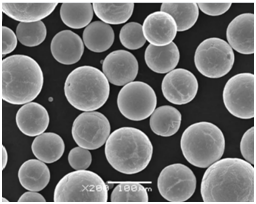
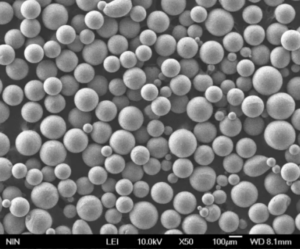
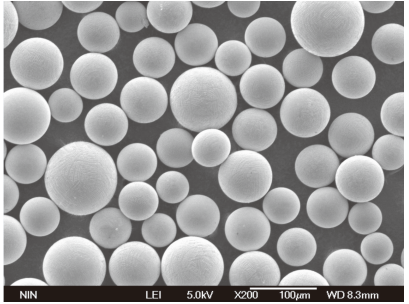
Spherical powder morphology is especially important in DED because the material must move consistently through a powder feeder and nozzle assembly. Irregular particles can bridge, feed unevenly, or alter catch efficiency at the melt pool. Rounder particles usually improve flow stability and reduce variability in the delivered mass rate.
This has downstream effects on bead geometry. If powder feed fluctuates, layer height and track width can drift, forcing frequent parameter correction or post-machining allowances. For a crack-sensitive superalloy, avoiding unnecessary thermal instability is already difficult enough without adding erratic feed behavior.
DED-specific property interpretation
In DED, flowability is not just a storage or lab number. It interacts with carrier gas settings, nozzle design, stand-off distance, and beam-powder convergence. A powder that appears acceptable in a simple Hall flow test may still perform differently in a coaxial versus off-axis feeding setup.
The same is true for oxygen content. Low oxygen is desirable, but how much it changes in service depends on powder handling, exposure time, and reuse discipline. Since DED often involves open handling steps between feeder loading and deposition, storage and shop-floor practice matter almost as much as the incoming certificate.
Why particle size for DED differs from powder bed fusion
Powder bed fusion prioritizes thin layers, fine detail, and controlled spreading over a flat build plane. DED prioritizes powder delivery into a dynamic melt pool and often builds larger features with thicker layers. That difference is why DED powders are typically coarser and why “best powder” always means best for the process, not best in the abstract.
For readers comparing alloy families, a broader [nickel superalloy powder range] helps illustrate how one chemistry can be offered in different size cuts depending on end use. In the same way, [stainless steel AM powders] may use different feedstock windows for DED versus powder bed applications even when the nominal alloy is familiar.
Applications Across Industries
Inconel 738LC powder for DED is used where the geometry, part size, or repair economics favor directed deposition over powder bed manufacturing. It is most relevant when the component is both expensive and thermally demanding, which explains why hot-section and repair-driven sectors account for much of its practical use.
Typical Applications for Inconel 738LC Powder for DED
| Industrie | Typical Part | AM / PM Process | Main Technical Driver |
|---|---|---|---|
| Luft- und Raumfahrt | Turbine blade tip rebuilds, vanes, shrouds | DED, laser cladding | High-temperature repair and feature restoration |
| Stromerzeugung | Gas turbine nozzles, combustor-related hardware, hot-section rebuilds | DED, cladding | Creep strength and oxidation resistance |
| Industrial Turbomachinery | Seal segments, wear zones, thermal parts | DED | Localized deposition on costly components |
| MRO and Service | Edge repair, dimensional recovery, crack-removal rebuilds | DED, cladding | Extending part life instead of full replacement |
| Energy Equipment | Burner parts, heat-resistant inserts, high-load hot surfaces | DED | Thermal durability in oxidizing service |
| R&D and Prototyping | Wall structures, material studies, process coupons | DED | Rapid validation of repair and deposition strategies |
Aerospace is the clearest example because hot-section components are expensive, safety-critical, and often constrained by long lead times. DED enables local rebuilds on areas such as blade tips or edges without remanufacturing the entire part from scratch. Where a repair can return a component to service safely, the economic case can be strong.
Power generation follows a similar logic. Gas turbine operators are often less interested in decorative design freedom than in uptime, turnaround speed, and high-temperature reliability. DED supports those goals by adding material only where wear, erosion, or thermal damage has occurred.
In high-value turbine hardware, the most important deposition is often the one that avoids replacing the whole component.
DED is also valuable for industrial turbomachinery, where parts may be large, custom, or intermittently demanded. A localized additive process is well suited to seal areas, dimensional recovery, and adding engineered layers in zones that experience the most severe thermal or mechanical stress.
When DED is a better fit than powder bed fusion
Powder bed fusion is excellent for intricate freeform parts, internal channels, and high-resolution structures, but it is less efficient for very large components or localized repairs on existing hardware. DED is usually the better choice when the starting point is a substrate, a worn part, or a feature that needs to be added only in a defined area.
Inconel 738LC powder for DED therefore fits a different decision path than a powder-bed alloy purchase. The buyer is not just asking whether the alloy can be printed. The buyer is asking whether material can be added precisely, metallurgically soundly, and economically to a part that already exists or to a geometry too large for a powder-bed machine envelope.
Industry comparisons with adjacent powder families
Although Inconel 738LC serves high-heat applications, it is not a universal answer. Some wear-dominant environments may favor [cobalt alloy powder grades], while applications driven by heat transfer rather than creep strength may move toward copper systems. The strength of this alloy lies specifically in hot-section structural performance, especially where oxidation and sustained thermal load act together.
Manufacturing and Quality Assurance
Powder-making route and quality control determine whether Inconel 738LC powder for DED behaves as a stable feedstock or an unpredictable one. DED is somewhat more tolerant of coarser powders than powder bed systems, but it is not tolerant of inconsistent flow, contamination, or poorly controlled particle morphology. That makes upstream manufacturing and batch release testing highly consequential.
Powder production routes for DED superalloys
Gas atomization remains one of the most common industrial routes for nickel superalloy powder because it offers scalability and broad alloy compatibility. In vacuum or inert conditions, molten alloy is disintegrated into droplets that solidify into largely spherical particles. Well-controlled gas atomization can provide strong chemistry retention and suitable morphology for DED size fractions.
PREP, or plasma rotating electrode process, is often associated with premium spherical particles and low contamination. It can produce very clean powder with excellent roundness, though size distribution and cost structures differ from atomized production. For certain demanding applications, users may evaluate PREP powder when morphology or cleanliness requirements are especially tight.
Vacuum induction gas atomization, sometimes discussed alongside VIGA terminology, emphasizes environmental control before and during atomization. That can be important for reactive elements and gas-sensitive alloys, including complex nickel superalloys. The powder route should therefore be selected not only for output quantity but also for how well it supports chemistry and morphology targets.
Typical QA Framework for Inconel 738LC Powder for DED
| QA Check | Typical Method / Instrument | What It Evaluates | Typical Acceptance Direction |
|---|---|---|---|
| Chemische Zusammensetzung | ICP-OES, combustion analysis | Alloy chemistry conformity | Within agreed purchase limits |
| Partikelgrößenverteilung | Laserbeugung, Siebanalyse | DED size-range compliance | Inside ordered cut |
| Morphologie der Partikel | SEM, optical image analysis | Roundness, satellites, surface condition | Predominantly spherical particles |
| Scheinbare Dichte | Hall or Scott volumeter | Bulk packing behavior | Stable within qualified range |
| Zapfstellendichte | Gewindebohrer-Dichtheitsprüfer | Compaction response | Stable within qualified range |
| Fließfähigkeit | Hall flowmeter or feeder trial where specified | Powder transport suitability | Stable and process-suitable |
| Oxygen and nitrogen | Inertgasfusion | Cleanliness and gas pickup control | At or below defined maximum |
| Moisture / packaging integrity | Seal check, dryness verification | Storage condition | Dry, intact, traceable |
| Internal porosity check | Metallographic sectioning, SEM review | Hollow-particle frequency | Low and controlled fraction |
DED users should not look at QA as a paperwork exercise. Powder feed consistency directly affects bead shape, dilution, and deposition efficiency, so flow-related tests have real production meaning. For this alloy, that is especially relevant because thermal cracking risk rises when process stability falls.
The quality conversation should also include reuse strategy. Recycled powder can shift in fines content, oxygen level, and flow response after repeated circulation through feeders and sieving steps. A lot that was excellent when virgin may behave differently after several reuse loops, so requalification thresholds should be established before production begins.
Documentation and standards context
There is no single universal powder purchase standard that captures every DED-relevant requirement for Inconel 738LC. Even so, external technical frameworks remain useful. Buyers often reference the [ASTM standards database] for testing structure and materials context, and many engineers consult [ASM superalloy reference materials] when reviewing high-temperature alloy behavior, heat treatment, and failure mechanisms.
Traceability is another essential layer. A meaningful release package should connect chemistry, PSD, morphology, gas content, packaging date, and lot number to the actual powder shipped. For aerospace or critical industrial work, retained sample policy and powder history can be just as important as the certificate values themselves.
Practical DED quality concerns beyond the COA
A certificate of analysis cannot capture every variable that affects deposited quality. Carrier gas purity, nozzle wear, powder feeder calibration, laser power stability, overlap strategy, and substrate preparation all influence the final microstructure. The safest way to qualify Inconel 738LC powder for DED is therefore through a combined powder-and-process program rather than by approving powder in isolation.
This is also where equipment familiarity matters. Truer’s background in SEBM equipment, PREP powder-making equipment, and metal powder supply is relevant because suppliers with process-side awareness often communicate powder requirements in more operational terms. That does not replace customer-side qualification, but it can make early specification work more precise.
Why Choose Truer as Your Supplier
Supplier selection for Inconel 738LC powder for DED should be based on process understanding, technical communication, and powder consistency rather than on catalog breadth alone. Because this alloy is used in demanding thermal service and deposited through a process-sensitive route, the buyer benefits from working with a supplier that can discuss morphology, size fraction, and application context in concrete terms.
Truer’s relevance in this area comes from its combined focus on powder-making equipment, additive manufacturing systems, and metal powder supply across several alloy families. That combination is useful when the buyer must align powder characteristics with DED, laser cladding, or other downstream processes instead of treating powder as a generic commodity.
The company context also includes a joint innovation center for metal 3D printing with laboratories and experts. For a superalloy like 738LC, where deposition trials, microstructure review, and parameter optimization are often necessary, that ecosystem can support more technically grounded discussions during qualification planning. A concise [overview of Truer’s company profile] provides the factual background for that operating model.
From an editorial perspective, the strongest reason to choose a supplier in this category is the ability to define the purchase requirement correctly before material is shipped. For Inconel 738LC powder for DED, that means clarifying size range, chemistry envelope, oxygen target, packaging condition, and documentation scope in advance. That kind of process-aware powder supply reduces ambiguity, which is one of the main causes of delay in superalloy AM programs.
Ordering Guide and Support
Ordering this powder should begin with the application, not with the container size. A buyer should state whether the powder is intended for repair, wall building, near-net-shape deposition, or laser cladding; identify the DED platform and feeder type; define the target size range; and specify whether virgin-only use or recycled blending is planned. These details shape what “correct powder” actually means.
Typical Ordering Framework for Inconel 738LC Powder for DED
| Verpackungsformat | MOQ Tier | Typical Lead Time | Sample Policy |
|---|---|---|---|
| 500 g sealed bottle | Laboratory screening | 1–2 weeks if sample stock exists | Paid sample commonly available |
| 1 kg bottle | Early process setup | 1–3 weeks typical | COA usually supplied with sample |
| 5 kg canister | DED parameter development | 2–4 weeks typical | Same-lot sample often possible |
| 10 kg drum | Pilot repair or prototype run | 3–5 weeks typical | Expanded QA package by request |
| 25 kg drum | Standard production or MRO use | 3–6 weeks typical | Documentation defined in purchase order |
| Custom inert-sealed pack | Project-specific or export logistics | By agreement | Tailored handling policy possible |
For development programs, a small sample order is often the most efficient first step. It allows the user to evaluate feeding stability, dilution behavior, bead geometry, cracking tendency, and post-deposition response before committing to a larger production lot. With a challenging alloy, that staged approach is usually more realistic than moving directly to bulk procurement.
Documentation should also match the technical risk of the application. A repair program for turbine hardware may require stricter traceability, microstructural review, or retained-sample practice than a general industrial cladding trial. That is why the quotation stage should include not just price and lead time, but also test scope, packaging format, and acceptance criteria.
Where project details need to be aligned before ordering, the most useful next step is often direct discussion through the [technical inquiry and quotation contact]. For DED feedstock, early clarification prevents late-stage confusion over feeder compatibility, PSD window, and batch-release expectations.
Unser Unternehmen
Shanghai Truer Technology Co., Ltd. was established in 2009 and created its additive manufacturing business in 2019. The company focuses on integrating 3D-printing powder-making equipment and services with metal powders for engineering applications of additive manufacturing. Its core technologies include Selective Electron Beam Melting equipment and Plasma Rotating Electrode Process powder-making equipment, with gas atomization also relevant to powder production. The product portfolio includes TiNi, TiTa, TiAl, TiNbZr, CoCrMo, plus spherical nickel-based, cobalt-based, titanium-based, copper-based, aluminum-based, and stainless-steel powders. The company serves processes including SLM, SEBM, DED, laser cladding, PM, MIM, HIP, cold or hot spraying, and welding or coating, with end-use industries that include 3C electronics, hand tools, remote-control cars, medical, aerospace, and nuclear power.
FAQ
Q1. Is Inconel 738LC powder for DED mainly used for repair or for new builds?
It is used for both, but repair and feature restoration are among the most common use cases. DED is especially effective when only a specific zone of a high-value hot-section component needs material added back or upgraded.
Q2. What particle size is typical for Inconel 738LC powder for DED?
Many DED programs use coarser ranges such as 45–105 µm or 53–150 µm, though the exact window depends on feeder design and nozzle configuration. The best size cut is the one that provides stable flow and adequate melting efficiency in the user’s actual system.
Q3. Why is Inconel 738LC powder for DED harder to process than Inconel 625 or 718?
738LC is more strongly oriented toward high-temperature strength and gamma-prime strengthening, which generally reduces process tolerance. That can make it more sensitive to cracking, thermal stress, and the details of heat input and cooling history.
Q4. Does spherical morphology really matter for DED powder?
Yes, because DED depends on consistent powder feeding through a nozzle rather than only on layer spreading. More spherical powder usually improves flow, reduces bridging risk, and helps maintain a steadier delivered mass rate.
Q5. Can Inconel 738LC powder for DED be reused after deposition trials?
Often yes, but only under a controlled powder-management plan. Reused powder should be screened, tracked, and checked for changes in oxygen, fines content, and flow behavior before it is returned to critical production work.
Q6. What should buyers request from a supplier before qualifying Inconel 738LC powder for DED?
At minimum, buyers should request chemistry, particle-size distribution, oxygen content, density, flowability, morphology information, and packaging details. For higher-risk applications, it is also sensible to request retained-sample policy, traceability records, and any feeder-relevant powder handling recommendations.