Kurzantwort
Inconel 713 nickel alloy powder is a precipitation-strengthened nickel-base superalloy powder, usually supplied in a 713C-type chemistry for high-temperature manufacturing. It is chosen for hot-section 3D printing and powder metallurgy because it offers strong oxidation resistance, good cast-alloy heritage, and useful strength retention at elevated temperatures where many stainless steels and lighter alloys lose margin. In practice, it is most relevant for turbine-adjacent hardware, turbocharger components, and complex industrial parts that need heat resistance more than easy weldability or broad-process forgiveness.
What Is Inconel 713 nickel alloy powder?
Inconel 713 nickel alloy powder belongs to the family of nickel-base superalloys developed for demanding thermal environments. In industry usage, buyers often use “Inconel 713,” “IN713,” and “Inconel 713C” somewhat interchangeably, but the chemistry most commonly associated with modern supply chains is the 713C-type composition tied to UNS N07713 and long-established casting specifications. The alloy is best known as a gamma-prime strengthened nickel-chromium system designed to maintain useful mechanical performance under sustained heat exposure.
Why This Alloy Exists
The alloy was originally developed for hot components that see thermal cycling, oxidation, and mechanical load at the same time. Its metallurgical design relies on a nickel-rich matrix plus strengthening additions such as aluminum, titanium, and niobium or tantalum, which promote ordered precipitates that improve high-temperature strength. Chromium contributes oxidation resistance, while molybdenum helps reinforce elevated-temperature performance.
Inconel 713 Nickel Alloy Powder in AM Context
For additive manufacturing, the powder form is not simply a cast alloy ground into particles. It is a controlled feedstock with targeted particle size distribution, morphology, and chemistry so it can spread, melt, or feed consistently in processes such as laser powder bed fusion, directed energy deposition, and related thermal routes. Core AM terminology for these routes is standardized in ISO/ASTM 52900 terminology.
How It Differs From More Common Nickel AM Powders
Compared with Inconel 625 or 718, 713C-type material is less forgiving in processing and more strongly associated with crack-sensitive high-gamma-prime behavior. That makes it interesting for engineers pursuing hotter service or cast-alloy replacement, but it also means powder quality, process window control, and post-build thermal strategy matter more. Studies on K418, a composition widely described as close to or equivalent in family to IN713C, repeatedly note that the LPBF process window is relatively narrow compared with easier-printing nickel superalloys.
Why the Powder Form Matters
A part made from the right nominal chemistry can still fail qualification if the powder is too irregular, too oxidized, or too broad in size distribution. For nickel superalloys, powder condition influences not only spreadability and packing but also defect formation, melt-pool stability, and final microstructure. That is why engineering teams qualify the feedstock as a process material, not just as an alloy name on a label. NIST powder metrology work highlights how powder flowability, spreadability, and particle characteristics affect AM part quality.
Chemical Composition and Material Grade
Inconel 713 nickel alloy powder is usually discussed through nominal chemistry ranges rather than one globally unified powder-only standard. The challenge is that the alloy comes from a casting-superalloy lineage, while AM buyers increasingly need spherical feedstock for laser or electron-beam processing. As a result, specification sheets typically combine alloy identity, powder class, and internal acceptance criteria rather than relying on a single universally adopted AM feedstock standard for this grade.
Typical Inconel 713 Nickel Alloy Powder Composition and Cross-Reference
| Material / Reference | Ni (wt%) | Cr (wt%) | Mo (wt%) | Al (wt%) | Nb+Ta (wt%) | Ti (wt%) | Typical Cross-Reference |
|---|---|---|---|---|---|---|---|
| Inconel 713C nominal family | Bal. | 12–14 | 4.0–5.0 | 5.5–6.5 | 1.8–2.8 | 0.6–1.0 | UNS N07713, 713C-type chemistry |
| AMS casting reference family | Bal. | about 13 | about 4.5 | about 6.0 | about 2.3 | about 0.75 | SAE AMS 5391, AMS 5377 family |
| Powder market designation | Bal. | typical 12.5–14 | typical 4.0–5.0 | typical 5.7–6.2 | typical 2.0–2.6 | typical 0.6–0.9 | IN713C spherical powder, 3D printing feedstock |
| China comparison grade | Bal. | similar | similar | similar | similar | similar | K418, commonly treated as close or equivalent family in practice |
The table above is intentionally framed as typical or nominal. In purchase documents, carbon, boron, zirconium, silicon, manganese, sulfur, and iron limits can be just as important as the major strengthening elements because they influence castability, crack sensitivity, and elevated-temperature response.
Common Naming Conventions
“Inconel” is a trademarked alloy family name historically associated with Special Metals, but in global technical communication the market often uses it generically to describe the 713 alloy type. Engineers may also encounter IN713C, 713C, UNS N07713, W.Nr. 2.4671, and K418 in cross-border sourcing or literature searches. A useful general overview of the broader alloy family appears in the Inconel alloy overview.
Composition Control and Crack Sensitivity
This alloy’s high aluminum content is part of what makes it attractive at temperature, because it supports strong gamma-prime precipitation and oxidation resistance. The same chemistry, however, contributes to challenging solidification behavior and a narrower AM processing window than more forgiving nickel grades. In powder buying, that means chemistry control is necessary but not sufficient; morphology, fines level, and contamination control are equally important.
Material Grade Versus Application Grade
A nominally correct 713C chemistry does not automatically mean a powder is qualified for every use case. A lot intended for cladding, for example, may use a different size cut than powder intended for LPBF, and a development-grade batch may not carry the same documentation package expected in turbine or aerospace-adjacent work. Engineers therefore separate alloy identity from application grade, even when the chemistry looks similar on paper.
Technische Daten
Technical specifications for this alloy are driven primarily by process route. Fine powder is usually targeted for powder bed systems, medium powder for laser cladding or DED, and coarser fractions for thermal spray or certain PM routes. Because IN713-type material is comparatively crack-sensitive, users typically care not only about chemistry but also about powder shape, clean feeding behavior, and stable layer formation.
Typical Inconel 713 Nickel Alloy Powder Specifications
| Powder Class | Typical PSD Range | Scheinbare Dichte | Zapfstellendichte | Hall Flow | Sauerstoffgehalt | Sphärizität |
|---|---|---|---|---|---|---|
| Fine LPBF grade | 15–45 µm | 4.2–4.8 g/cm³ typical | 4.8–5.5 g/cm³ typical | 18–30 s/50 g typical | ≤0.08 wt% typical | High, typically ≥0.90 |
| Standard PBF grade | 15–53 µm | 4.3–4.9 g/cm³ typical | 5.0–5.7 g/cm³ typical | 17–28 s/50 g typical | ≤0.08 wt% typical | High, low satellite level typical |
| DED / cladding grade | 45–105 µm | 4.4–5.0 g/cm³ typical | 5.2–5.9 g/cm³ typical | 14–24 s/50 g typical | ≤0.07 wt% typical | Spherical, free-flowing typical |
| Coarser PM / spray grade | 53–150 µm | 4.5–5.2 g/cm³ typical | 5.4–6.1 g/cm³ typical | 13–22 s/50 g typical | ≤0.07 wt% typical | Spherical to near-spherical typical |
These figures are representative market values for spherical nickel superalloy powders rather than a single mandatory standard for Inconel 713 nickel alloy powder. Exact limits vary with atomization route, sieve cut, and end-use acceptance criteria.
Spherical Powder and Layer Quality
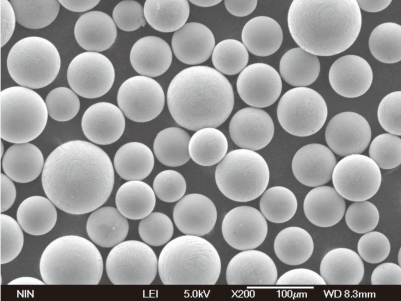
For powder bed fusion, spherical powder morphology is preferred because it improves spreading behavior and supports a more uniform powder layer. A better layer generally means more consistent energy absorption and fewer opportunities for local defects to start early in the build. NIST’s AM powder characterization work repeatedly emphasizes the link between particle morphology, powder-bed quality, and part outcomes.
Why PSD Selection Is Process-Specific
A 15–45 µm cut may suit fine-feature LPBF development, but it can be unnecessarily fine for cladding or DED, where a coarser cut often feeds more efficiently and reduces handling losses. Conversely, a DED-friendly 45–105 µm product may not recoat well in a thin powder-bed layer. The right choice depends on the machine, layer thickness, hatch strategy, and part geometry rather than on a generic assumption about “best” powder size.
Oxygen and Surface Condition
Although nickel superalloys are generally less oxygen-sensitive than titanium, oxygen and surface contamination still matter because they affect melt behavior and cleanliness. Fine powder fractions have more surface area and therefore demand tighter handling discipline. Inconel 713 nickel alloy powder used for repeatable AM work is usually stored in sealed, low-moisture packaging with careful lot traceability and sampling control.
Printability Is Not Only a Powder Problem
Even an excellent powder does not erase alloy-specific challenges. IN713-type alloys are known for hot cracking risk if process parameters, scanning strategy, or thermal gradients are poorly controlled. That is why development programs typically combine powder qualification with parameter optimization, scan strategy refinement, support design, and post-build heat-treatment work before releasing the material into serious production.
Applications Across Industries
Inconel 713 nickel alloy powder is most attractive when service temperature and oxidation resistance are more important than easy fabrication. It is not the first-choice alloy for general-purpose corrosion service, nor is it the easiest nickel grade for additive manufacturing. Its economic logic becomes strongest when the part lives close to combustion, exhaust, or sustained thermal cycling.
Typical Applications for Inconel 713 Nickel Alloy Powder
| Industrie | Typical Part | AM / PM Process | Why It Is Used |
|---|---|---|---|
| Luft- und Raumfahrt | Turbine-adjacent vanes, small hot-structure brackets, combustor hardware | LPBF, DED, PM-HIP hybrids | Retains useful strength and oxidation resistance at elevated temperature |
| Turbocharging / automotive performance | Turbine wheels, nozzle rings, hot gas path hardware | LPBF, investment-cast replacement trials, cladding | Good hot-strength heritage and thermal-fatigue resistance |
| Stromerzeugung | Burner tips, vane segments, repair builds | DED, laser cladding, PM | Suitable for heat-exposed components with complex geometry |
| Industrial processing | Furnace fixtures, high-temperature jigs, heat-resistant inserts | LPBF, PM, spray routes | Better hot-environment capability than many stainless grades |
Aerospace and Turbine-Adjacent Components
The alloy’s heritage is strongest in gas-turbine and turbocharger environments. In those settings, designers care about elevated-temperature stability, oxidation resistance, and hot-strength retention over long cycles. Powder-based manufacturing becomes relevant when complex geometry, low-volume production, or repair economics make conventional casting or machining less efficient.
Additive Manufacturing Use Cases
In AM, the most practical applications are often small or medium components with value concentrated in geometry rather than volume. Engineers use the powder for development builds, prototype hot-end parts, repair-oriented deposition, and selective replacement of cast features that are difficult to tool conventionally. For many programs, the real value lies in shortening the route from design iteration to tested hardware.
Repair, Cladding, and Hybrid Manufacturing
Inconel 713 nickel alloy powder is not only a powder-bed material. Coarser cuts are also relevant to DED and cladding, especially when rebuilding localized hot-zone features or adding material to high-value substrates. In repair scenarios, the question is often not whether the entire part should be additively built, but whether a targeted powder process can extend component life or reduce replacement lead time.
For high-temperature alloys, the most valuable powder is the one that reaches the service condition with the fewest defects, not merely the one with the widest nominal chemistry tolerance.
How It Compares With Other AM Powder Families
If the operating temperature is moderate and crack resistance is more important than peak hot strength, users may shift toward broader nickel superalloy powder options. If wear or biocompatibility is the main driver, cobalt alloy powder grades may be more relevant. If corrosion resistance matters more than extreme heat, stainless steel powder selections often provide a lower-cost path. Inconel 713 nickel alloy powder tends to justify itself when the application sits clearly in the hot-section or oxidation-critical envelope.
Manufacturing and Quality Assurance
The production method affects how this alloy behaves in the machine. Gas atomization is widely used for nickel superalloy powder because it can deliver spherical particles at commercially meaningful scale, while vacuum-induction gas atomization is especially relevant where chemistry cleanliness and oxidation control are priorities. PREP is more often associated with titanium systems but can still serve as a useful benchmark when discussing spherical-powder quality criteria across alloy families.
Typical QA Framework for Inconel 713 Nickel Alloy Powder
| QA Test | Instrument / Method | Typical Acceptance Focus | Warum es wichtig ist |
|---|---|---|---|
| Chemische Zusammensetzung | ICP-OES, combustion analysis | Major elements match 713C-type target; trace elements within agreed limits | Confirms alloy identity and precipitation-strengthening balance |
| Partikelgrößenverteilung | Laser diffraction plus sieve check | D10 / D50 / D90 align to ordered process window | Controls spreadability, feed rate, and layer consistency |
| Morphologische Prüfung | SEM and image analysis | High sphericity, limited satellites, low agglomeration | Reduces recoating problems and feeding instability |
| Flow and bulk density | Hall flowmeter, apparent/tap density tests | Lot-to-lot handling consistency | Screens practical machine behavior |
| Oxygen / moisture / contamination | Gas analysis and controlled sampling | Low contamination, no abnormal pickup during packing | Protects cleanliness and process repeatability |
The acceptance language above is intentionally generic because user requirements vary sharply between R&D powder, industrial production powder, and aerospace-adjacent development material. Even when chemistry passes, a lot can still be rejected for poor morphology, excessive fines, or unstable flow behavior.
Atomization Route and Powder Behavior
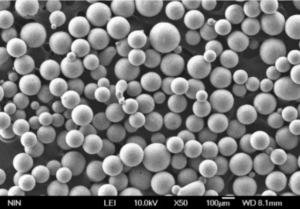
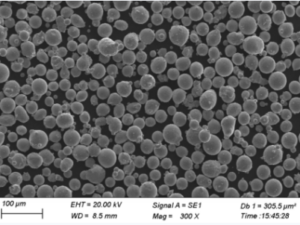
For nickel alloys, atomization route influences satellite formation, surface condition, and the balance between yield and flowability. A powder with too many satellites may still pass chemistry but behave poorly during spreading or narrow-nozzle feeding. This is one reason AM buyers increasingly request SEM morphology images and not just a certificate of chemistry and PSD.
Lot Consistency in High-Gamma-Prime Alloys
With crack-sensitive superalloys, consistency matters because machine tuning is often tighter than it is for more forgiving alloys. A slight shift in fines content, oxygen level, or packing behavior can alter melting and defect behavior enough to require parameter adjustment. For production users, lot-to-lot consistency is therefore a quality attribute in its own right, not merely a commercial convenience.
Powder Reuse and Lifecycle Control
Reuse is possible, but it should be governed by data. Over multiple cycles, the powder can experience subtle shifts in size distribution, contamination, and flow behavior that affect the final build. NIST’s powder metrology programs and related literature show why disciplined powder lifecycle control has become central to serious AM quality systems.
Standards Context
Unlike very common AM grades such as 316L or Inconel 718, IN713-type powders do not yet sit inside one simple, universally recognized AM feedstock standard used everywhere. Instead, teams often work from legacy alloy references, internal powder specifications, and application-specific qualification plans. For material lineage, many engineers still look back to AMS 5391 alloy casting specification.
Why Choose Truer as Your Supplier
For this alloy, supplier choice is mainly about feedstock discipline, not slogans. Buyers need a source that understands particle-size classification, spherical morphology, traceability, and the practical differences among LPBF, SEBM, DED, laser cladding, and PM-related routes.
In that context, Truer’s published capabilities are relevant because the company works across powder-making equipment and spherical metal powder supply for additive manufacturing. Engineers comparing this grade against adjacent high-temperature systems can place it within Truer’s broader spherical nickel powder portfolio and can discuss project-specific requirements through the company’s technical inquiry page. The decision is less about buying a generic nickel powder and more about matching chemistry, PSD, packaging, and process intent to the actual thermal duty of the part.
Ordering Guide and Support
Ordering Inconel 713 nickel alloy powder efficiently starts with the application, not the marketing label. A good RFQ identifies whether the powder is intended for LPBF, DED, cladding, PM, or another route; the desired size cut; the oxygen or contamination threshold; and the level of documentation required. Because this alloy can be more process-sensitive than 625 or 718, under-specified RFQs often create delays later in qualification.
Typical Ordering Framework
| Verpackung | MOQ Tier | Vorlaufzeit | Sample Policy |
|---|---|---|---|
| 100–250 g sealed bottle | Lab screening | 1–2 weeks typical | Paid sample for chemistry, PSD, and initial morphology review |
| 500 g to 1 kg inert-packed can | Prozessentwicklung | 2–3 weeks typical | Suitable for coupons, scan tests, and flow checks |
| 5 kg vacuum or argon-protected pack | Pilot production | 3–5 weeks typical | Common for machine parameter qualification |
| 20 kg+ industrial lot packaging | Repeating demand | 4–8 weeks typical | Lot approval, retained sample, and documentation usually agreed in advance |
The ranges above are representative rather than universal. Lead time depends heavily on whether the customer wants an off-the-shelf sieve cut, a tighter oxygen ceiling, or a special documentation package tied to downstream validation.
What to Include in the RFQ
A strong RFQ should specify the target process, nominal PSD window, acceptable chemistry range, morphology expectation, and packaging format. It should also say whether the project is early research, pilot production, or a qualification-driven program where retained samples, test coupons, and lot traceability are mandatory. Clear technical intent reduces the risk of receiving a powder that is correct in name but unsuitable in practice.
Sampling and Validation Strategy
Sample evaluation should move beyond the certificate quickly. For this alloy, a sensible sequence is chemistry check, PSD verification, morphology review, coupon builds or deposit trials, metallography, and elevated-temperature or crack-susceptibility evaluation where relevant. That approach is especially important for high-gamma-prime nickel alloys because nominally acceptable feedstock can still behave very differently from one machine setup to another.
Unser Unternehmen
Shanghai Truer Technology Co., Ltd. was established in 2009 and created its additive manufacturing business in 2019. The company focuses on integrating 3D printing powder-making equipment and services with 3D printing powders for engineering applications. Its core technologies include Selective Electron Beam Melting equipment, Plasma Rotating Electrode Process powder-making equipment, and gas atomization-related capability. The company’s powder portfolio includes TiNi, TiTa, TiAl, TiNbZr, CoCrMo, and spherical nickel-based, cobalt-based, titanium-based, copper-based, aluminum-based, and stainless steel powders for use in SLM, SEBM, DED, laser cladding, powder metallurgy, MIM, HIP, cold or hot spraying, welding, and coating across industries including 3C electronics, hand tools, remote control cars, medical, aerospace, and nuclear power. Additional background appears in the company profile overview.
FAQ
Q1. Is Inconel 713 nickel alloy powder the same as Inconel 713C powder?
In most powder-market discussions, yes, the term usually points to a 713C-type chemistry rather than a separate modern alloy family. Buyers should still verify the actual certificate because trade language can be looser than qualification language.
Q2. What is the main advantage of Inconel 713 nickel alloy powder?
Its main advantage is elevated-temperature capability combined with oxidation resistance. That makes it relevant for hot-section, exhaust, and turbine-adjacent parts where more general-purpose alloys may lose performance margin.
Q3. Is Inconel 713 nickel alloy powder easy to 3D print?
Not usually. Compared with more common AM nickel alloys, it is generally considered more crack-sensitive and less forgiving, so process development tends to be narrower and more demanding.
Q4. What particle size is typical for Inconel 713 nickel alloy powder in LPBF?
A typical LPBF cut is 15–45 µm or 15–53 µm, depending on the machine platform and build strategy. Coarser ranges are more common for DED, cladding, and some PM routes.
Q5. How does Inconel 713 nickel alloy powder compare with Inconel 718 powder?
Inconel 718 is generally more mature and forgiving in additive manufacturing, with a broader industrial knowledge base for printing. Inconel 713-type powder becomes attractive when hotter service and cast-superalloy heritage matter more than ease of processing.
Q6. What documents should buyers request with each powder lot?
At minimum, buyers should request chemistry, PSD, and oxygen or contamination data, plus information on morphology and packaging condition. For serious development or production work, retained sample policy, lot traceability, and process-specific sampling records are also worthwhile.
Learn more:
- AMS5391C: ALLOY CASTINGS, INVESTMENT, CORROSION AND HEAT RESISTANT 73Ni – 13Cr – 4.5Mo – 2.3(Cb+Ta) – 0.75Ti – 6.0Al – 0.010B – 0.10Zr Vacuum Melted As Cast – Material Specification
- ISO/ASTM 52900:2021 – Additive manufacturing — General principles — Fundamentals and vocabulary
- Laser Powder Bed Fusion of K418 Superalloy: Process, Microstructure, Texture Feature, and Mechanical Property
- Additive Manufacturing Powder Metrology Laboratory | NIST
- Inconel 713C | NiCr13MoAl | N07713 – Schmitz-Metallographie GmbH
- Powder Bed Fusion | NIST
- Characterization of Metal Powders Used for Additive Manufacturing
- In-process monitoring and non-destructive evaluation for metal additive manufacturing processes
- Inconel
- Particle shape and size analysis for metal powders used for additive manufacturing: Technique description and application to a gas-atomized Ti64 powder and a plasma-atomized Ti64 powder | NIST
- NISTIR 7873