Hızlı Cevap
FeCoNiCr High Entropy Alloys are equiatomic quaternary alloys of iron, cobalt, nickel, and chromium that solidify as a stable single-phase FCC solid solution, combining excellent ductility, strong corrosion resistance, and reliable printability in one additive manufacturing material. Produced as spherical powder by gas atomization or PREP, FeCoNiCr powder is supplied in 15-45 um cuts for LPBF, 45-106 um for EBM and HIP, and fine fractions for MIM, with as-built tensile strength of 550-700 MPa and elongation frequently exceeding 30 percent. As the manganese-free sibling of the famous Cantor alloy, it serves as both a practical corrosion-resistant AM material and one of the most widely used reference systems in high-entropy alloy research, gradient materials, and alloy-design programs.
| Mülkiyet | Değer |
|---|---|
| Alaşım Sistemi | Equiatomic Fe-Co-Ni-Cr (quaternary HEA) |
| Faz Yapısı | Tek fazlı FCC katı çözeltisi |
| Yoğunluk | 8.1-8.2 g/cm3 |
| Tipik Toz Boyutu (LPBF) | 15–45 um |
| Typical Powder Size (EBM/HIP) | 45–106 um |
| As-Built Çekme Mukavemeti | 550-700 MPa |
| As-Built Uzama | 30-50% |
| En Önemli Avantaj | Ductile, corrosion-resistant, highly printable FCC HEA |
What Is FeCoNiCr High Entropy Alloys and Its Material Benefits
FeCoNiCr High Entropy Alloys şuna aittir yüksek entropili alaşım (HEA) tozu family, built from four principal elements in near-equal atomic proportions rather than one dominant base element. The high configurational entropy of mixing stabilizes a simple face-centered cubic solid solution, suppressing the intermetallic compounds that would form in a conventionally designed alloy of similar complexity.
The system is the quaternary core of the five-element CoCrFeMnNi Cantor alloy, the most studied high-entropy alloy in the literature. Removing manganese brings the alloy closer to its three-element CoCrNi parent, which is known for exceptional damage tolerance, and gives the quaternary a slightly higher stacking fault energy, better oxidation behavior, and freedom from the manganese volatility that complicates atomization and welding of the five-element variant.
For engineering and research programs, the alloy offers concrete benefits:
- Excellent ductility and toughness. The FCC matrix with twinning-assisted deformation delivers elongation of 30-50 percent in the as-built condition, among the highest of any printable alloy class, with toughness retained at cryogenic temperatures.
- Strong general corrosion resistance. Chromium passivation gives aqueous corrosion behavior comparable to austenitic stainless steels, without the sensitization issues of high-carbon grades.
- Outstanding printability. A single-phase solidification path with no eutectic reactions means low hot-cracking susceptibility and forgiving parameter windows on LPBF, EBM, and DED platforms.
- Compositional flexibility. The equiatomic baseline accepts minor additions of Al, Ti, Mo, or carbon to tune strength and precipitation behavior, making the alloy a common starting point for custom HEA development.
- Research infrastructure. As one of the most characterized HEA systems, the alloy offers published property data, simulation models, and processing maps that shorten qualification programs.
The designation follows the elemental naming convention of the HEA field rather than a standardized grade number, so the same material appears in supplier documents as FeCoNiCr, CoCrFeNi, Fe25Co25Ni25Cr25, or equiatomic quaternary HEA. All refer to the same alloy system, and purchase specifications should state the target composition explicitly, since the written order of elements carries no metallurgical meaning and slight off-equiatomic variants are common between producers.
The honest limitation is moderate strength: the single-phase solid solution work-hardens well but starts at lower yield strength than precipitation-hardened superalloys, so the alloy competes on ductility, toughness, and corrosion balance rather than on maximum load capacity.
Kimyasal Bileşim Standartları ve Elementlerin Amaçları Hakkında Açıklama
The composition centers on 25 atomic percent of each element, with commercial lots typically quoted in weight percent and held to tight windows around the equiatomic target.
Chemical Composition of FeCoNiCr High Entropy Alloys
| Element | Min (wt%) | Max (wt%) | Rol |
|---|---|---|---|
| Fe | 24.0 | 27.5 | Balances cost; FCC former in combination with Ni and Co |
| Co | 25.0 | 29.0 | Raises stacking fault energy balance; improves high-temperature stability |
| Ni | 25.0 | 29.0 | Primary FCC stabilizer; drives ductility and cryogenic toughness |
| Cr | 22.0 | 26.0 | Provides passive-film corrosion and oxidation resistance |
| C | – | 0.05 | Interstitial limit; excess forms carbides that reduce ductility |
| O | – | 0.03 | Powder-quality limit; oxides harm interlayer bonding |
| N | – | 0.05 | İnterstisyel sınır; uzamayı korumak üzere kontrol edilir |
| Si | – | 0.5 | Melting residual; kept low to avoid silicide formation |
| Mn | – | 0.5 | Incidental; the alloy is defined by manganese’s absence relative to Cantor |
Each element serves a defined purpose. Nickel anchors the austenite stability that keeps the alloy single-phase from cryogenic temperatures to near melting, and it is chiefly responsible for the retained ductility at 77 K. Chromium, nominally a ferrite former, is fully accommodated in the high-entropy matrix and supplies the Cr2O3 passive film behind the corrosion performance. Cobalt contributes solid-solution strengthening and improves the stability of the FCC phase at elevated temperature, while iron completes the equiatomic balance and holds raw material cost below that of cobalt-heavy compositions.
Because no single standardized specification governs this alloy yet, composition certificates should be checked against the agreed equiatomic window rather than a published grade standard, and buyers should fix acceptable element ranges in the purchase specification to keep successive lots functionally consistent.
Fiziksel ve Mekanik Özellikler: Tam Teknik Veri Sayfası Referansı
The data below consolidate typical values for as-built LPBF material and HIP-consolidated reference material at standard test temperature (23 +/- 5 C), with cast reference values where relevant.
Anahtar Özellikler
| Mülkiyet | Değer | Birim |
|---|---|---|
| Yoğunluk | 8.1-8.2 | g/cm3 |
| Erime Aralığı | 1350-1420 | C |
| Isıl İletkenlik (RT) | 12-14 | W/m·K |
| Termal Genleşme Katsayısı | 15-17 x 10-6 | /K |
| Young’s Modülü | 200-220 | GPa |
| Akışkanlık Dayanımı (inşa edildiği haliyle LPBF) | 350-480 | MPa |
| Çekme Mukavemeti (üretim halindeki LPBF) | 550-700 | MPa |
| Elongation (as-built LPBF) | 30-50 | % |
| Sertlik (inşa edildiği haliyle) | 160-210 | HV |
| Impact Toughness (RT) | >150 | J (Charpy, wrought-class) |
| Tensile Strength (77 K, wrought-class) | >900 | MPa |
The mechanical signature is the wide gap between modest yield strength and high ultimate strength, reflecting the alloy’s strong work-hardening response. Components loaded into plasticity gain strength progressively, which gives crash-energy-absorbing and fatigue-limited structures a generous deformation reserve.
Cryogenic behavior follows the family pattern of FCC high-entropy alloys: strength rises and ductility is largely retained as temperature falls, with wrought-class tensile values above 900 MPa at 77 K and no ductile-to-brittle transition. This makes the alloy a credible candidate for liquefied-gas and space-hardware duty where conventional steels embrittle.
After hot isostatic pressing and homogenization at 1000-1150 C, as-built strength relaxes slightly while ductility and toughness improve further, and this post-treatment is standard practice for fatigue-critical and pressure-boundary applications. Oxidation resistance is adequate to roughly 800 C in continuous service, positioning the alloy below the true superalloys but comfortably above plain carbon and low-alloy steels for moderately hot, corrosion-prone environments.
One property attracting growing design attention is hydrogen compatibility. FCC high-entropy alloys of this family show slower hydrogen diffusion and less severe embrittlement than high-strength steels at comparable strength, and while qualification data are still accumulating, the early results make the alloy a credible candidate for hydrogen-handling components where austenitic stainless steels are the incumbent but strength margins are thin.
Boyut Dağılımı Toleransları ve Mevcut Tedarik Sınıfları Listesi
FeCoNiCr powder is supplied as spherical gas-atomized or PREP product in process-matched fractions, with certified size-distribution tolerances on every lot.
Mevcut Teknik Özellikler
| Parametre | Standart/Değer |
|---|---|
| Parçacık Boyut Dağılımı (LPBF) | 15-45 um, 15-53 um |
| Parçacık Boyut Dağılımı (EBM) | 45–106 um |
| Parçacık Boyut Dağılımı (DED/kaplama) | 53–150 µm |
| Parçacık Boyut Dağılımı (MIM) | 0-25 um |
| Küresellik | >= 0.90 for GA product, >= 0.95 for PREP product |
| Görünür Yoğunluk | >= 4,2 g/cm³ |
| Yığın Yoğunluğu | >= 4,9 g/cm³ |
| Salon Akış Hızı | <= 18 saniye/50 g |
| Oksijen İçeriği | <= 300 ppm |
| PSD Toleransı | D10/D50/D90 certified per lot, typically +/- 2 um on D50 |
| Sınıf Seçenekleri | Standard equiatomic grade; high-purity PREP grade; modified variants (Al, Ti, Mo, C additions) on request |
| Paketleme | Vakumla kapatılmış, argonla doldurulmuş, 1-50 kg |
The modified-variant grade deserves emphasis because it is where much of the commercial interest lies: aluminum additions toward the FeCoNiCrAl family, titanium for precipitation response, molybdenum for pitting resistance, and carbon for interstitial strengthening are all produced on the same atomization platform, letting development programs move from the baseline alloy to a tailored composition without changing supplier or powder handling practice.
Storage and reuse follow standard practice: containers are opened under dry inert conditions, recycled LPBF powder is refreshed with 30-50 percent virgin material per build cycle, and oxygen is re-verified periodically, since interstitial pickup directly erodes the ductility that defines the alloy’s value.
Üretim Süreci: Ergitme, Atomizasyon ve Sınıflandırma Aşamaları
Production begins with virgin elemental or master-alloy charges melted under vacuum induction, with the four principal elements dissolving readily into a homogeneous single-phase melt. The melt is then converted by gaz atomizasyonu (GA), in which argon jets disintegrate the stream into droplets that spheroidize and solidify in flight, retaining the FCC solid solution at the high cooling rates of atomization.
The alloy is an accommodating atomization system: no element is excessively volatile, the melt is fully miscible, and the single-phase structure forms regardless of cooling rate, so chemistry transfer from melt to powder is faithful and lot-to-lot variation is small. For programs requiring the highest purity, HAZIRLIK offers crucible-free production with sphericity above 0.95 and minimal oxygen pickup, at the cost of a coarser natural distribution. Mechanical alloying is an alternative laboratory route for small research quantities, but its irregular particle morphology and higher contamination risk make it unsuitable for recoater-based AM production, and spherical atomized powder remains the correct feedstock for any qualification or production intent.
Post-atomization processing follows the standard quality sequence:
- Sınıflandırma by sieving and air separation isolates the target size fractions and removes fines that would impair flowability.
- Akış ve yoğunluk doğrulaması confirms Hall flow rate, apparent density, and tap density values.
- Kimyasal analiz by ICP-OES and inert gas fusion certifies the four principal elements plus carbon, oxygen, nitrogen, and silicon content per lot.
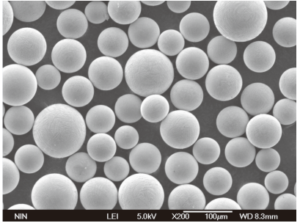
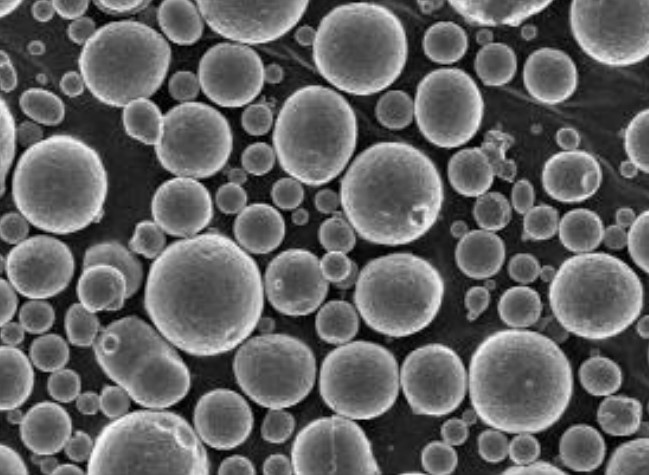
- Morfolojik inceleme by SEM verifies sphericity, satellite content, and overall surface condition.
- İç kalite kontrolü by cross-section metallography or X-ray CT quantifies hollow particle content on premium lots.
- Documentation and packaging close each lot with a certificate of analysis, retained reference sample, and argon-flushed vacuum-sealed containers.
For buyers, the certification points that matter most are the equiatomic window conformity and the oxygen level, since the first governs phase stability and the second governs as-built ductility and long-term fatigue performance.
Sektörlere Göre Uygulamalar: Tıp, Havacılık ve Uzay ile Enerji Üretimi
FeCoNiCr powder serves applications that exploit its ductility-toughness-corrosion balance and its role as a development platform. Sector context is available on the uygulamalar sayfa.
Aerospace and space. Cryogenic fuel-system components, ducting, brackets, and structural elements use the alloy where retained low-temperature toughness and corrosion resistance justify its moderate strength. Research programs are evaluating printed lattice and energy-absorbing structures that exploit the alloy’s large plastic deformation reserve, and thermal-protection-adjacent hardware uses its oxidation margin to 800 C. DED repair of corrosion-damaged ground-support and test-stand equipment is an additional practical use that leverages the alloy’s cladding behavior.
Power generation and chemical processing. Valve internals, pump components, heat-exchanger elements, and fittings exposed to corrosive media across wide temperature swings are natural applications, with the alloy occupying the space between austenitic paslanmaz çeli̇k tozu grades and nickel superalloys. DED repair of corrosion-damaged process equipment is a growing use, and HIP-consolidated near-net shapes serve small-batch replacement parts where original castings are no longer available.
Medical and dental. The alloy’s biocompatibility profile, being free of the manganese volatility concerns of the Cantor alloy and comparable to established surgical alloys, supports instrument prototypes and research into HEA implant surfaces, though implant qualification remains at the research stage and any clinical use would require the full regulatory pathway applicable to new metallic biomaterials.
Energy and emerging technologies. Hydrogen-service components are an active research area because FCC high-entropy alloys show encouraging resistance to hydrogen embrittlement relative to high-strength steels, and printed manifolds and fittings for electrolyzer and fuel-cell systems are under evaluation. Nuclear-adjacent research is also examining the alloy’s radiation-damage tolerance, another consequence of its compositionally complex, vacancy-rich lattice.
Research and alloy development. As a baseline system, the alloy is one of the most ordered HEA powders by universities and corporate laboratories, serving gradient-material builds, composite reinforcement studies, and as the starting composition for derivative alloy development.
Across these industries, the qualification sequence is consistent: coupon builds to establish parameter windows and as-built properties, then subcomponent testing in the service environment, then full-part production. Suppliers who maintain lot-to-lot chemistry within a narrow equiatomic band across all three phases materially simplify the qualification argument, because each stage’s data remains valid for the next.
Alternatif Tozlarla Karşılaştırma ve Temel Performans Göstergeleri
Selection around FeCoNiCr typically benchmarks it against the Cantor alloy, against 316L stainless as the incumbent corrosion-resistant AM material, and against Inconel 718 for higher-strength duty.
FeCoNiCr vs Alternative Alloys
| Mülkiyet | FeCoNiCr HEA | CoCrFeMnNi (Cantor) | 316L Paslanmaz | Inconel 718 |
|---|---|---|---|---|
| Yoğunluk (g/cm³) | 8.1-8.2 | 8.0 | 8.0 | 8.2 |
| As-Built Çekme Mukavemeti (MPa) | 550-700 | 550-680 | 550-650 | 1100-1300 |
| Üretim Anındaki Uzama (%) | 30-50 | 25-40 | 30-45 | 12-20 |
| Kriyojenik Tokluk | Mükemmel | Mükemmel | İyi | Orta düzeyde |
| Korozyon Direnci | Yüksek | Yüksek | Yüksek | Çok yüksek |
| Maksimum Çalışma Sıcaklığı (°C) | ~800 | ~800 | ~870 | ~700 |
| LPBF Basılabilirliği | Mükemmel | Mükemmel | Mükemmel | İyi |
| Göreceli Toz Maliyeti | Yüksek | Orta-Yüksek | Düşük | Orta-Yüksek |
Against the Cantor alloy, FeCoNiCr offers comparable ductility and corrosion behavior without manganese’s atomization volatility and with slightly better high-temperature oxidation, at somewhat higher raw material cost due to cobalt. Against 316L, it provides superior cryogenic toughness and work hardening at a substantial cost premium, making it the upgrade when 316L reaches its low-temperature or fatigue limits. Against Inconel 718, it concedes room-temperature strength decisively but offers roughly triple the as-built ductility and easier, crack-free printing.
The selection rule mirrors the broader HEA logic: choose FeCoNiCr when ductility, toughness, and corrosion resistance govern and moderate strength is acceptable; choose 316L when cost dominates; choose 718 when strength is the priority; and treat the alloy as a development platform whenever a tailored derivative composition is the eventual goal. In mixed-material programs, the alloy also pairs naturally with its own derivatives, so a structure printed in baseline FeCoNiCr can transition compositionally into an aluminum- or molybdenum-bearing variant within the same build, a graded-design option that conventional alloy systems cannot offer.
Şirketimiz
Shanghai Truer Technology Co, Ltd Çin merkezli bir katmanlı üretim tedarikçisi olup, PREP toz üretim ekipmanları ile yüksek kaliteli küresel metal tozlarını bir arada sunmaktadır. 2009 yılında kurulan şirket, hem gaz atomizasyonu (GA) ve HAZIRLIK nikel alaşımları, titanyum alaşımları, alüminyum alaşımları, paslanmaz çelikler, kobalt alaşımları, bakır alaşımları, yüksek entropili alaşımlar ve özel malzemeler alanlarında üretim kapasiteleri.
Truer, havacılık ve uzay, tıbbi implantlar, petrol ve gaz ile otomotiv gibi sektörlere yönelik özel alaşım geliştirme, küçük seri prototip üretimi ve seri üretim hizmetleri sunmaktadır. Şirket, önde gelen araştırma kurumlarıyla işbirliği içinde metal 3D baskı alanında bir ortak inovasyon merkezi işletmektedir.
For inquiries about FeCoNiCr High Entropy Alloys or other metal powder requirements, ekiple iletişime geçin.
SSS
Q1: What is the typical particle size distribution for FeCoNiCr High Entropy Alloys? A: LPBF uses 15-45 um or 15-53 um cuts, EBM and HIP use 45-106 um, DED uses 53-150 um, and MIM uses fine fractions below 25 um. All fractions are supplied as spherical powder with certified D10, D50, and D90 data referenced to each production lot.
Q2: Can FeCoNiCr powder be used in both SLM and EBM systems? A: Yes. The single-phase FCC solidification path gives the alloy low cracking susceptibility on both platforms, and parameter development is straightforward compared with precipitation-hardened alloys. EBM’s hot build chamber further reduces residual stress in large builds, while SLM achieves finer as-built microstructure.
Q3: What certifications does FeCoNiCr powder come with? A: Each lot ships with a certificate of analysis covering the four principal elements, carbon, oxygen, nitrogen, PSD, flow rate, and density data, all referenced to the production lot number. Premium PREP lots add enhanced morphology and hollow-particle inspection, and retained samples support full batch traceability.
Q4: What is the MOQ for ordering FeCoNiCr powder? A: Standard equiatomic grade is available from 1-5 kg for research and parameter development, which comfortably covers coupon builds and initial mechanical characterization. Production volumes ship in 25-50 kg argon-flushed, vacuum-sealed containers, with pricing scaled to quantity and manufacturing route.
Q5: Can the composition of FeCoNiCr be customized? A: Yes, and this is one of the alloy’s main uses. Elemental ratios can shift around the equiatomic baseline, and Al, Ti, Mo, or carbon additions are produced on the same platform as derivative HEA variants. Custom work starts with trial atomization batches of 20-50 kg before commitment to campaign volumes.
Q6: What is the typical lead time for FeCoNiCr powder orders? A: Stock fractions of the standard grade usually ship within one to two weeks. PREP high-purity lots and modified compositions typically require four to eight weeks depending on electrode bar preparation, atomization campaign scheduling, and the certification package required.