Hızlı Cevap
CoCrMo powder for dental 3D printing is a cobalt-chromium-molybdenum alloy powder designed for additive manufacturing of dental frameworks, crowns, bridges, and partial denture components. It is widely selected because it combines high strength, corrosion resistance, biocompatibility, and stable laser powder bed fusion behavior in a single material system. For dental labs and device manufacturers, that means thin yet rigid structures, repeatable fit, efficient digital workflows, and lower dependence on conventional casting variability.
What Is CoCrMo powder for dental 3D printing?
CoCrMo powder for dental 3D printing belongs to the broader family of cobalt-based superalloy-type materials used where mechanical strength, corrosion resistance, and microstructural stability are important. In dentistry, the powder is supplied as a pre-alloyed spherical feedstock tailored for metal additive manufacturing, especially selective laser melting and related laser powder bed fusion processes. The alloy centers on cobalt as the base, chromium as the main corrosion-resistant element, and molybdenum as a key strengthening addition.
The “dental” qualifier is important. Not every cobalt-chromium alloy powder is suitable for dental use, even if the shorthand chemistry looks similar. Dental applications demand a narrow combination of printability, fine feature resolution, surface finishing response, and oral-environment durability that differs from powders intended for hardfacing, tooling, or high-wear industrial parts.
Historically, cobalt-chromium alloys became established in dentistry as an alternative to noble metal systems because they offered high rigidity, acceptable biological performance, and better cost stability. The transition from casting to additive manufacturing did not change those core reasons; instead, it amplified them. With digital workflows, dental labs can now design and build restorations directly from CAD data, making CoCrMo especially relevant for modern production of patient-specific parts.
How CoCrMo dental powder differs from generic cobalt alloy powder
A generic cobalt alloy feedstock may be acceptable for industrial AM but still fall short in a dental context. Dental builds involve thin margins, intricate connectors, clasp geometries, and tight fit tolerances. That makes powder morphology, oxygen control, residual elements, and particle size consistency more critical than they might be in larger engineering parts.
Dental CoCrMo powder is therefore typically specified not only by alloy chemistry but also by sphericity, size distribution, flow behavior, and cleanliness. A powder that nominally meets the alloy family can still produce poor recoating, rough surfaces, inconsistent density, or unpredictable support behavior if those additional parameters are not tightly controlled.
Why the alloy remains relevant in digital dentistry
The continued use of CoCrMo in dentistry is tied to both metallurgy and workflow compatibility. Mechanically, it offers high stiffness, wear resistance, and long-term structural reliability in thin sections. From a manufacturing perspective, it integrates well with scanning, CAD design, nesting, powder bed fusion, heat treatment, and post-processing routines already familiar to advanced dental labs.
That combination explains why the alloy remains a practical choice in removable partial denture frameworks, bridge substructures, and implant-supported superstructures. When clinicians and technicians need thin geometry without excessive flex, CoCrMo often remains the benchmark material.
Standards and terminology in the dental AM context
Clear terminology helps buyers compare materials across suppliers and regions. Process language is commonly aligned with ISO/ASTM 52900 additive manufacturing terminology, while dental metallic material performance is often discussed in relation to ISO 22674 dental metallic materials. Those documents do not replace a supplier’s detailed powder specification, but they help establish a common technical framework for alloy classification, intended use, and manufacturing language.
In dental additive manufacturing, powder consistency matters as much as alloy chemistry.
Chemical Composition and Material Grade
The chemistry of CoCrMo powder for dental 3D printing is based on a cobalt-rich matrix with chromium and molybdenum as the principal alloying elements. Depending on the supplier and the intended dental classification, exact targets may vary within recognized cobalt-chromium-molybdenum ranges. The practical goal is to balance corrosion resistance, rigidity, printability, and downstream finishing performance.
For buyers, composition should never be reviewed in isolation. A certificate showing acceptable chromium and molybdenum levels is valuable, but the powder must also demonstrate suitable morphology, oxygen control, and reproducible lot quality. In dental applications, those secondary attributes often determine whether a nominally correct alloy performs as expected during high-precision production.
| Element / Grade Item | Typical Content (wt%) | Dental Relevance | Cross-Reference | Notlar |
|---|---|---|---|---|
| Kobalt (Co) | balance | base matrix for strength and high modulus | ASTM F75 / ISO 22674 family | principal alloy constituent |
| Krom (Cr) | 26.0–30.0 | passive film formation and corrosion resistance | ASTM / ISO / DIN comparable families | high Cr is central to oral-environment durability |
| Molibden (Mo) | 5.0–7.0 | strengthening and pitting resistance support | ASTM F75 / dental CoCrMo references | helps stabilize performance in aggressive environments |
| Karbon (C) | typically ≤0.35, often lower in AM-focused grades | affects carbide content, hardness, and ductility | supplier specification with dental context | must be tightly controlled for print consistency |
| Mn / Si / Fe / residuals | controlled minor levels | impurity and process-balance management | ASTM / GB / ISO / DIN cross-review | excessive residuals can impair consistency |
Typical composition logic for dental CoCrMo powder
Chromium is the element most responsible for the alloy’s passive oxide film, which helps explain the strong corrosion resistance associated with cobalt-chromium dental alloys. Molybdenum contributes to strength and resistance in localized corrosive environments, while cobalt provides the matrix that supports rigidity and elevated mechanical performance. Carbon is often watched closely because it affects carbide formation, which in turn influences hardness, wear behavior, and ductility balance.
In dental 3D printing, slightly different chemistry strategies may be used depending on whether the supplier emphasizes maximum hardness, polishing response, or broader print-window stability. That is why serious buyers compare not only the nominal chemistry but also how the supplier defines “typical,” “maximum,” and “acceptance” values.
Material grade mapping and standard references
No single document fully defines every requirement for CoCrMo powder for dental 3D printing. Instead, the market uses a layered approach. Alloy-family chemistry is frequently discussed with reference to ASTM F75 cobalt-chromium-molybdenum alloy requirements, while dental applications rely more heavily on dentistry-specific classification and supplier-level control plans.
This distinction is important because ASTM F75 originated around cast implant alloy language rather than powder-bed dental manufacturing. It remains useful for chemistry orientation, but powder buyers should not assume it alone guarantees suitability for fine-feature dental printing.
Residual elements and dental material acceptance
Residual element control can be as important as the headline chemistry. In dental environments, labs and OEMs often pay close attention to nickel, iron, silicon, manganese, and any trace contaminants that may come from melting, atomization, sieving, or packaging. Even when such elements remain within reasonable limits, they should be documented clearly to support internal quality systems and downstream customer communication.
The same principle applies to oxygen and nitrogen. These are not “alloying elements” in the usual sense, but they influence performance enough that many buyers treat them as part of the practical material definition.
Teknik Özellikler
The technical specification of CoCrMo powder for dental 3D printing is what determines whether the alloy can be processed reliably on actual equipment. Particle size distribution, apparent density, tap density, Hall flow, oxygen content, and sphericity all affect spreading, laser interaction, packing behavior, and defect sensitivity. For dental parts, where dimensions are small and detail is critical, these variables matter at a much finer scale than they do in many larger industrial builds.
Most dental systems use laser powder bed fusion, so powder is generally offered in fine spherical cuts suitable for thin layers. Common PSD ranges include 10–30 µm, 15–45 µm, and 15–53 µm, depending on the machine platform and supplier’s internal classification strategy. Coarser cuts can exist for development work or other processes, but they are less typical for high-resolution dental production.
| Powder Class | PSD Range (µm) | Görünür Yoğunluk (g/cm³) | Tap Density (g/cm³) | Hall Flow (s/50 g) | Oksijen İçeriği | Küresellik |
|---|---|---|---|---|---|---|
| Fine dental build grade | 10–30 | 4.1–4.5 | 4.8–5.3 | 15–23 | typically low, supplier-controlled | high |
| Standard dental AM grade | 15–45 | 4.2–4.7 | 4.9–5.5 | 13–21 | typically low, supplier-controlled | high to very high |
| Broad production grade | 15–53 | 4.3–4.8 | 5.0–5.6 | 12–20 | low, lot controlled | high |
| Process development grade | 20–63 | 4.4–4.9 | 5.1–5.7 | 12–19 | application-specific control | kÜRESEL |
| Coarse engineering grade | 45–105 | 4.6–5.2 | 5.3–6.0 | 11–18 | controlled per use case | spherical to near-spherical |
Particle size distribution and layer quality
Fine PSD ranges support the thin layer thicknesses commonly used in dental laser powder bed fusion. Smaller particles can improve detail resolution and edge formation, especially in margins and clasp regions, but they also bring higher surface area and more sensitivity to oxidation and powder handling. That tradeoff is why many dental producers prefer a balanced distribution rather than simply choosing the finest available cut.
In practice, the best PSD depends on the machine, recoater type, parameter set, and part family. Crowns, bridges, and partial frameworks may all respond slightly differently to the same powder if support strategy and thermal mass vary significantly across the build.
Flow, spreadability, and packing behavior
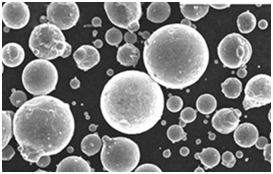
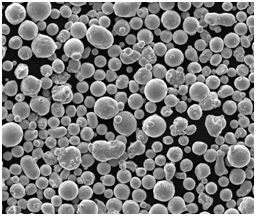
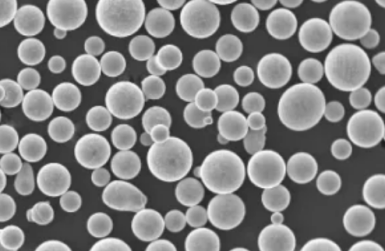
Spherical powder morphology is critical for even recoating and stable packing density. Highly irregular particles tend to interlock, generate poor layer smoothness, and increase the risk of incomplete melting or local porosity. Apparent density and tap density provide insight into how efficiently the powder packs, while Hall flow is a practical indicator of discharge and handling behavior.
No single number tells the whole story. A powder can post decent Hall flow and still perform poorly if it contains too many satellites, a broad tail of fines, or elevated oxygen after reuse. That is why dental AM users often review flow metrics together with SEM morphology images and PSD data.
Oxygen control and powder lifecycle management
Powder condition evolves during storage and reuse. Every cycle of sieving, blending, exposure, and transport can change oxygen level, fine fraction balance, and overall handling behavior. In dental manufacturing, those changes may first appear as surface roughness drift, incomplete thin-wall formation, or support detachment rather than total build failure.
For that reason, advanced users frequently monitor lot identity, reuse ratio, and sieve practice as part of their production SOP. General guidance on powder property measurement can also be informed by NIST resources on metal powder characterization, which help explain how morphology, density, and chemistry influence AM repeatability.
Applications Across Industries
Although the keyword is specific to dentistry, CoCrMo powder for dental 3D printing sits within a broader industrial context of cobalt-based AM materials. Its main use remains the production of dental frameworks and prosthetic structures, but the underlying alloy system also appears in selected medical and engineering applications that value stiffness, wear resistance, and corrosion performance.
From a market perspective, dentistry is distinctive because it combines serial customization with very small part geometry. A single build may include many different patient-specific components, each with its own topology and thickness transitions. That makes CoCrMo especially useful because it pairs structural rigidity with established downstream finishing routines.
| Endüstri | Typical Part | Kullanım Nedeni | AM / PM Process |
|---|---|---|---|
| Dental lab production | crowns and bridge frameworks | fine detail, high stiffness, repeatable digital fabrication | SLM / L-PBF |
| Removable prosthetics | partial denture frameworks and clasps | thin-section rigidity and long-established dental alloy use | SLM / L-PBF |
| Implant prosthetics | bars and superstructures | customized geometry with strong structural support | SLM / L-PBF |
| Medical manufacturing | fixtures and specialized support parts | corrosion resistance and durable cobalt-alloy behavior | L-PBF / PM |
| Research and validation | benchmark coupons and process studies | mature alloy family for AM process development | L-PBF |
| Engineering prototyping | small wear-resistant metal parts | strength and dimensional stability in compact geometries | L-PBF / PM |
Dental crowns, bridges, and framework structures
Fixed restorations are among the most common use cases for CoCrMo in digital dentistry. The alloy supports thin coping and framework designs while maintaining enough rigidity for long-span structures. Because the parts are generated from CAD data, AM also reduces dependence on wax pattern quality and investment-casting variability.
Bridge frameworks benefit particularly from the alloy’s stiffness. When section thickness must be controlled tightly for fit and veneering space, CoCrMo offers a useful balance between slender geometry and structural security.
Removable partial denture frameworks
Removable partial dentures remain one of the strongest application areas for CoCrMo powder. These frameworks involve clasps, connectors, rests, and lattice features that are geometrically complex and traditionally technique-sensitive when cast. Additive manufacturing allows those forms to be built directly from digital designs with a high degree of repeatability.
The alloy’s high elastic modulus is a major advantage in this category. Compared with softer or lower-stiffness alternatives, CoCrMo helps preserve framework rigidity without requiring excessive bulk.
Broader material selection context
Dental manufacturers do not choose CoCrMo in isolation. They often compare it with titanium alloys for lightweighting, stainless steels for cost-sensitive prototypes, or nickel-based materials for high-temperature industrial applications outside dentistry. A broader cobalt alloy powder catalog is useful when a buyer wants to compare different cobalt-family options, while a titanium alloy powder range or a stainless steel powder selection can help frame tradeoffs in density, stiffness, corrosion behavior, and clinical workflow fit.
Manufacturing and Quality Assurance
The manufacturing route for CoCrMo powder strongly influences its print performance. Most commercial dental grades are produced by gas atomization, where a molten alloy stream is broken into droplets under inert gas and then solidified into fine particles. The powder is subsequently classified, screened, tested, and packaged under controlled conditions.
In some broader AM contexts, alternative powder-making methods such as PREP or VIGA may be considered. For dental CoCrMo, however, the main issue is not simply which route sounds most advanced; it is whether the supplier can produce a stable, clean, fine spherical powder with consistent lot characteristics over time.
| Production Route / QA Item | Typical Equipment or Method | Main Strength | Main Limitation | Relevance to Dental CoCrMo |
|---|---|---|---|---|
| Gas Atomization (GA) | inert gas atomizer + classification system | scalable production of fine spherical powder | requires strong control of fines, satellites, and oxygen | most common route for dental AM powder |
| HAZIRLIK | rotating electrode plasma process | very high sphericity and cleanliness | less typical for mainstream fine dental production economics | relevant for premium spherical powder discussions |
| VIGA | vacuum induction melting with gas atomization | improved melt cleanliness and controlled atmosphere | equipment complexity and cost | useful where chemistry cleanliness is prioritized |
| PSD verification | laser diffraction and sieve analysis | confirms powder range and lot uniformity | method correlation must be managed | critical for layer consistency |
| Morphology / chemistry QA | SEM, ICP-OES, combustion analysis | verifies shape and composition | requires disciplined release criteria | central to lot acceptance |
Process route versus powder performance
It is easy to overemphasize the production route and underemphasize the finished powder. A theoretically superior route does not automatically guarantee better dental printing results if classification, handling, or packaging are inconsistent. For most buyers, the better question is whether the released powder meets a repeatable set of morphology, chemistry, PSD, and cleanliness requirements.
That is why serious qualification programs rely on incoming inspection and build trials, not on route labels alone. In dental manufacturing, practical print performance remains the final measure of powder suitability.
Lot release and traceability expectations
Lot-to-lot consistency is one of the most important purchasing criteria for dental AM powder. A lab may optimize scanning parameters, supports, and post-processing around one material lot and then expect the next shipment to behave nearly identically. Any shift in PSD, oxygen, flow, or residual contamination can create visible differences in fit or surface quality long before a catastrophic defect appears.
Traceability therefore matters at multiple levels: melt source, atomization batch, sieve fraction, packaging date, and release testing. Buyers that serve regulated or quality-sensitive dental markets often retain retained samples of each lot and compare them with production history.
Powder reuse and internal quality discipline
Powder qualification does not end at delivery. Once the material enters a lab or manufacturing site, the user’s own procedures determine whether the initial powder quality is preserved. Sieve strategy, maximum reuse ratio, blend policy between virgin and recycled powder, and environmental control all influence long-term build consistency.
A supplier involved in powder production equipment and AM process understanding can often discuss these issues more clearly than a distributor that only resells powder. That practical process context is one reason technically oriented buyers evaluate supplier capability beyond a single datasheet.
Why Choose Truer as Your Supplier
When selecting a source for CoCrMo powder for dental 3D printing, the most relevant factors are powder process knowledge, documentation depth, and the ability to support qualification from trial stage to routine production. Dental manufacturing is sensitive to small shifts in powder behavior, so the supplier should understand not only the alloy family but also the relationship between morphology, flow, PSD, and build outcomes.
Truer’s relevance comes from its position across powder-making equipment, spherical metal powders, and additive manufacturing applications rather than from a single isolated dental product line. That broader technical scope matters because users often need support that connects powder characteristics to actual AM routes such as SLM, SEBM, DED, laser cladding, and related powder-based processes. For a buyer qualifying cobalt alloys, that kind of process-level discussion is often more useful than generic marketing claims.
Another practical advantage is portfolio breadth. A supplier working across TiNi, TiTa, TiAl, TiNbZr, CoCrMo, and multiple families of nickel-based, cobalt-based, titanium-based, copper-based, aluminum-based, and stainless powders can support comparative material studies more effectively. In development projects, that helps labs and OEMs benchmark CoCrMo against neighboring material systems rather than evaluating it in isolation.
Ordering Guide and Support
Ordering CoCrMo powder for dental 3D printing begins with a more precise question than simply asking for “dental cobalt chrome powder.” Buyers should specify the intended process, machine platform, particle size range, packaging format, and any required certification documents. Without that information, it is difficult to determine whether a quoted powder is optimized for dental laser powder bed fusion, broader AM development work, or a different powder-based process entirely.
The order stage should also distinguish between feasibility trials, process qualification, pilot production, and stable serial purchasing. Each stage tends to require a different quantity, a different level of documentation, and a different expectation for lead time management. In dental manufacturing, where even small shifts can affect fit, those distinctions are operationally important rather than administrative.
| Packaging Format | Typical MOQ Tier | Typical Lead Time | Sample Policy | Typical Use Stage |
|---|---|---|---|---|
| 500 g bottle | evaluation | 1–2 weeks if inventory exists | small paid or approved sample | early machine trials |
| 1 kg bottle | prototype | 1-3 hafta | common first purchase size | parameter development |
| 5 kg sealed pack | pilot | 2–4 hafta | usually after technical alignment | repeatability builds |
| 10–25 kg drum | pre-production | 3–6 weeks depending on specification | follows qualification review | validation and scaled output |
| custom bulk packaging | production | project-based | not typical for initial sampling | routine manufacturing supply |
What to include in a serious RFQ
An effective RFQ should mention machine model, preferred PSD, part category, expected monthly or annual consumption, and required certificates such as composition, PSD, and oxygen data. It is also helpful to state whether the powder will be used in a closed reuse loop and whether the buyer needs support for first-article validation or only routine replenishment.
The more specific the RFQ, the more meaningful the supplier response becomes. In dental AM, ambiguity at the quotation stage often leads to requalification work later.
Samples, pilot lots, and technical communication
A staged purchasing path is usually the safest approach. Many users start with a small sample for buildability testing, then move to a pilot lot for repeatability trials before committing to larger-volume production orders. That structure makes it easier to separate powder behavior from machine setup and post-processing variability.
When quotation details or application-specific discussion are needed, the most direct route is the technical inquiry page. Broader background on the organization and its additive manufacturing focus is available through the company background page.
Şirketimiz
Shanghai Truer Technology Co., Ltd. was established in 2009 and created its additive manufacturing business in 2019. The company works on integrating 3D printing powder-making equipment and services with spherical metal powders for engineering applications of additive manufacturing. Its core technologies include Selective Electron Beam Melting equipment, Plasma Rotating Electrode Process powder-making equipment, and gas atomization. The powder portfolio includes TiNi, TiTa, TiAl, TiNbZr, CoCrMo, as well as nickel-based, cobalt-based, titanium-based, copper-based, aluminum-based, and stainless steel spherical powders. The company also participates in a joint innovation center for metal 3D printing with laboratories and industry experts and serves end-use processes including SLM, SEBM, DED, laser cladding, powder metallurgy, MIM, HIP, cold and hot spraying, welding, and coating for sectors such as 3C electronics, hand tools, remote control cars, medical, aerospace, and nuclear power.
SSS
Q1. Is CoCrMo powder for dental 3D printing safe for dental restorations?
CoCrMo dental alloys are widely used because they offer strong corrosion resistance, good mechanical performance, and long-standing acceptance in dental applications. However, suitability depends on the exact chemistry, manufacturing route, post-processing condition, and the restoration type being produced.
Q2. What particle size is best for CoCrMo powder for dental 3D printing?
For laser powder bed fusion, common dental ranges include 10–30 µm, 15–45 µm, and 15–53 µm. The best option depends on the machine, layer thickness, recoater system, and whether the priority is maximum detail resolution or a broader processing window.
Q3. Why is CoCrMo often chosen instead of cast dental alloy workflows?
Additive manufacturing reduces dependence on wax pattern quality, investment behavior, and casting shrinkage control. It also fits better into digital dental workflows built around scanning, CAD, nesting, and repeatable serial production of customized parts.
Q4. Can CoCrMo powder for dental 3D printing be reused after a build?
Yes, many users employ controlled reuse strategies, but only with documented sieving, storage, and blending procedures. Oxygen pickup, fine fraction drift, and contamination risk must be monitored because small powder changes can affect dental fit and surface quality.
Q5. What certificates should buyers request with dental CoCrMo powder?
At minimum, buyers often request chemical composition and particle size distribution data. Depending on the quality system, they may also ask for oxygen content, apparent density, tap density, Hall flow, lot traceability, and packaging condition records.
Q6. Is CoCrMo powder for dental 3D printing only used in dentistry?
No. Related cobalt-chromium-molybdenum powders are also used in medical, research, and engineering contexts where strength and corrosion resistance are important. Even so, a dental-optimized powder should not automatically be assumed suitable for another application without checking the full specification and process requirements.