Resposta rápida
PREP spherical CM247LC powder is a nickel-based superalloy powder made from the low-carbon CM247LC grade and produced by the Plasma Rotating Electrode Process for demanding additive manufacturing and powder metallurgy applications. It is chosen when designers need excellent high-temperature strength, strong creep resistance, and oxidation capability in parts exposed to turbine-like thermal loads. Its value is highest in aerospace, energy, and hot-section development work where powder cleanliness, near-perfect particle shape, and stable feeding behavior matter as much as nominal alloy chemistry. (patents.justia.com)
What Is PREP spherical CM247LC powder?
PREP spherical CM247LC powder is the powder form of CM247LC, a cast nickel-base superalloy derived from the MAR-M247 family and modified to reduce carbon while retaining very high-temperature capability. In metallurgical terms, CM247LC belongs to the class of precipitation-strengthened nickel superalloys designed around a high volume fraction of gamma-prime strengthening phases. That alloy family is used where conventional stainless steels and lower-alloy nickel grades lose mechanical stability under sustained heat. (patents.justia.com)
The “LC” in CM247LC means low carbon. That wording is not trivial: the low-carbon modification was introduced to improve castability and reduce some of the grain-boundary issues associated with its parent chemistry, while keeping the alloy’s strong elevated-temperature profile. In additive manufacturing, that heritage matters because users are often adapting a turbine-class casting alloy to rapid solidification processes that impose steep thermal gradients and repeated reheating. (patents.justia.com)
The PREP portion of the name refers to the Plasma Rotating Electrode Process, in which a rotating electrode is melted at the tip and ejected into droplets that solidify as powder under controlled conditions. Compared with many atomization routes, PREP is associated with very spherical particles and a very low level of satellites, both of which are useful for stable powder flow and predictable layer formation. That combination makes PREP especially attractive for premium AM feedstocks where consistency can outweigh sheer production volume. (jstage.jst.go.jp)
CM247LC as a Nickel Superalloy Feedstock
CM247LC is not a general-purpose nickel alloy. It was developed for severe thermal service, especially turbine-related environments, and its alloy design reflects that purpose. Chromium supports oxidation and hot-corrosion resistance, cobalt and tungsten contribute to high-temperature strength, tantalum and aluminum strengthen the gamma-prime network, and hafnium, boron, carbon, and zirconium influence carbide and grain-boundary behavior. (patents.justia.com)
That makes CM247LC fundamentally different from feedstocks such as 316L stainless steel or Inconel 718. It is less forgiving than many mainstream powders, but it can deliver a much more specialized performance envelope when the application truly requires a cast-style superalloy response under heat. For engineers working on combustion hardware, shrouds, vanes, or experimental hot-section components, that distinction is central to material selection. (sciencedirect.com)
Why PREP Matters for Spherical Powder Quality
Powder production route strongly affects how an AM feedstock behaves. PREP starts from a solid electrode rather than a free molten stream, which helps limit certain contamination pathways and encourages clean, rounded droplets. The result is often a powder with excellent geometry, low satellite content, and reliable packing behavior in feed systems or powder beds. (jstage.jst.go.jp)
For a difficult superalloy such as CM247LC, the route matters even more because process windows can already be narrow. A premium powder morphology cannot solve every metallurgical challenge, but it can reduce variability in spreading, feeding, and local melt behavior. In practical AM development, good powder form is often the first control lever before scan strategy and heat treatment are optimized. (mdpi.com)
How It Differs From More Common AM Powders
Many metal AM users are familiar with 316L, AlSi10Mg, Ti-6Al-4V, or Inconel 718. PREP spherical CM247LC powder sits in a different category because it targets more severe thermal duty and more demanding microstructural control. It is closer to a turbine-material feedstock than to a broad industrial alloy. (en.wikipedia.org)
That does not mean it is automatically better. It means it is more specialized. Engineers choose it when design priorities center on hot strength, creep resistance, and microstructural stability at temperature rather than on easy printability, low density, or routine post-processing. (mdpi.com)
For high-temperature AM, powder morphology and alloy solidification behavior must be evaluated together, not separately. (iso.org)
Composição química e tipo de material
CM247LC chemistry is one reason the alloy remains relevant in advanced hot-section development. It is a complex nickel superalloy with significant additions of chromium, cobalt, tungsten, tantalum, aluminum, titanium, and hafnium, plus controlled low levels of carbon, boron, and zirconium. In service, this chemistry supports a strong gamma/gamma-prime microstructure and good resistance to deformation at elevated temperature. (patents.justia.com)
Unlike commodity stainless or titanium grades, CM247LC is usually specified by proprietary or composition-based designation rather than by a single globally harmonized ASTM or ISO powder grade number. Buyers should therefore define the alloy by chemistry, process route, PSD, and quality requirements rather than relying on a short code alone. This is especially important when the powder will be used for additive manufacturing qualification rather than for generic R&D consumption. (patents.justia.com)
| Element / Grade Reference | Típico wt% | Common Nominal or Reference Range | ASTM / AMS / GB / ISO / DIN Cross-Reference Notes |
|---|---|---|---|
| Ni | Equilíbrio | Equilíbrio | Proprietary nickel-base superalloy chemistry; typically specified as CM247LC composition |
| Cr | 8.0–8.4 | about 8.1 | No single universal ASTM/AMS equivalent used across all powder supply chains |
| Co | 9.0–9.5 | about 9.2 | Often referenced by proprietary cast superalloy designation rather than EN or DIN short name |
| C | 9.2–9.8 | about 9.5 | High refractory loading for elevated-temperature strength |
| Ta | 3.0–3.4 | about 3.2 | Important gamma-prime former in the alloy system |
| Al | 5.4–5.8 | about 5.6 | Principal strengthening addition for gamma-prime precipitation |
| Hf | 1.2–1.6 | about 1.4 | Grain-boundary and carbide-related role; tightly watched in AM cracking studies |
| Ti / Mo | Ti 0.6–0.9; Mo 0.4–0.6 | Ti about 0.7; Mo about 0.5 | Both contribute to strengthening and solidification behavior |
| C / B / Zr | C 0.05–0.09; B about 0.015; Zr about 0.015 | low-controlled residual/intentional additions | Best handled as composition-specific procurement notes, not generic standards shorthand |
Alloying Logic in PREP Spherical CM247LC Powder
The chemistry of CM247LC reflects its origin as a high-performance cast superalloy. Aluminum, tantalum, and titanium promote gamma-prime strengthening; tungsten and cobalt improve high-temperature load-bearing behavior; chromium helps oxidation resistance; and hafnium, carbon, boron, and zirconium influence carbides and grain boundaries. The alloy is therefore engineered as a system, not a simple corrosion-resistant nickel grade. (patents.justia.com)
This also explains why CM247LC can be powerful but difficult in AM. The same chemistry that gives it outstanding hot-section potential also contributes to a wide solidification interval and notable cracking risk during rapid melting and cooling. That tradeoff appears repeatedly in current additive manufacturing studies on 247-series superalloys. (sciencedirect.com)
Material Grade and Standards Context
In procurement language, it is usually safer to describe CM247LC as a proprietary nickel-base superalloy powder with agreed chemistry and feedstock properties than to imply that it maps neatly onto a universally recognized commodity standard. Additive manufacturing buyers should also distinguish between alloy identity and AM process qualification requirements. The ISO/ASTM 52900 terminology standard and the ISO/ASTM 52907 powder characterization framework are useful references for that distinction. (iso.org)
Why Chemistry Review Alone Is Not Enough
An AM user can receive the right nominal chemistry and still face unstable process results if the powder has inconsistent morphology, elevated oxygen, or too many fines. That is particularly true for CM247LC because it already has limited process tolerance compared with easier alloys. For this reason, incoming inspection typically combines chemistry review with PSD, flow, density, oxygen, and morphology checks. (iso.org)
Especificações técnicas
Technical specifications for PREP spherical CM247LC powder should be read as application-dependent ranges, not as single universal values. Powder bed fusion, directed energy deposition, HIP canning, laser cladding, and spray-related routes all require different PSD windows and handling characteristics. In premium superalloy powder procurement, the key is not only the number on the datasheet but the consistency of that number across lots. (iso.org)
The table below gives representative commercial-style values that are realistic for high-quality spherical nickel superalloy powders. Actual requirements vary by machine platform, layer thickness, nozzle design, and customer acceptance protocol. Where values are stated as typical, they should be treated as specification guidance rather than universal standards limits. (iso.org)
| Faixa de PSD | Typical Process Fit | Dwysedd Amlygol (g/cm³) | Tap Density (g/cm³) | Hall Flow (s/50 g) | Oxygen Content (wt%) | Esfericidade |
|---|---|---|---|---|---|---|
| 15–45 µm | Fine-feature LPBF / PBF-LB | 4.7–5.2 | 5.2–5.8 | 13–19 | 0.01–0.05 typical | ≥0.95 typical |
| 15–53 µm | General AM development | 4.8–5.3 | 5.3–5.9 | 12–18 | 0.01–0.05 typical | ≥0.95 typical |
| 20–63 µm | Broader LPBF or hybrid evaluation | 4.8–5.4 | 5.4–6.0 | 12–18 | 0.01–0.05 typical | ≥0.95 typical |
| 45–105 µm | DED / laser cladding feedstock | 4.9–5.5 | 5.5–6.1 | 11–17 | 0.01–0.04 typical | ≥0.96 typical |
| 53–150 µm | HIP, spray, or coarse deposition routes | 5.0–5.6 | 5.6–6.2 | 11–16 | 0.01–0.04 typical | ≥0.96 typical |
Particle Size Distribution for CM247LC AM Powder
Particle size distribution controls how the powder packs, spreads, and melts. Finer cuts are used where thin layers and high geometric resolution are required, while coarser cuts are more common in deposition processes that inject powder into a melt pool or plume. For a superalloy as crack-sensitive as CM247LC, stable PSD control also helps reduce one variable in an already complex qualification problem. (iso.org)
A narrow and repeatable PSD can improve recoating uniformity and reduce local variability in energy absorption. That does not eliminate cracking, but it can improve process reproducibility. In development work, reproducibility is often more valuable than chasing the absolute finest cut. (nist.gov)
Flowability, Density, and Feeding Behavior
Apparent density, tap density, and Hall flow are practical indicators of how the powder behaves before it ever reaches the laser or electron beam. These metrics are not full proxies for printability, but they help detect lot-to-lot variation and give operators an early warning of abnormal handling behavior. NIST’s work on powder bed fusion and powder rheology highlights the importance of feedstock measurement for process repeatability. (nist.gov)
Because PREP powder is known for very rounded particles, it is commonly associated with excellent feed consistency. That advantage can be meaningful in CM247LC because poor spreading or erratic feeding only adds noise to a material system that already has substantial solidification challenges. (mdpi.com)
Oxygen Content and Powder Cleanliness
Oxygen content is closely watched in spherical superalloy powders because surface condition influences melting behavior, wetting, and the consistency of reused material. PREP is often selected in part because users want a clean feedstock with controlled surface contamination. That matters most in premium R&D, hot-section prototyping, and critical test programs where the cost of a failed build can exceed the cost of better powder. (jstage.jst.go.jp)
Powder reuse strategy is equally important. Virgin powder, recycled powder, and blended powder may all be nominally CM247LC, but they do not necessarily behave identically. For difficult superalloys, strict reuse rules are usually more important than they are for easier stainless grades. (iso.org)
Why Morphology Is Critical for PREP Spherical CM247LC Powder
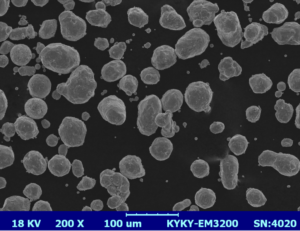
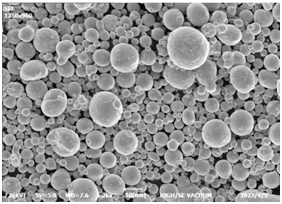
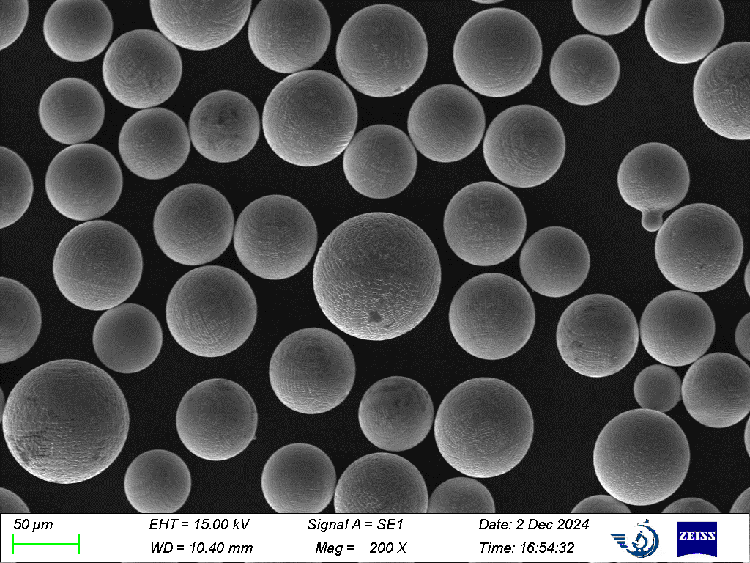
high sphericity is not just a selling phrase; it affects friction, flow, powder-bed homogeneity, and feeder stability. PREP is favored because it can produce highly spherical particles with fewer satellites than some alternative routes, which makes it valuable when the goal is premium powder behavior rather than commodity output scale. In practical AM terms, that can help reduce stochastic powder-spreading defects. (jstage.jst.go.jp)
Aplicações em diversos setores
PREP spherical CM247LC powder is not a broad industrial default; it is a specialty feedstock used where thermal performance justifies the added difficulty of processing a high-gamma-prime superalloy. Its most credible use cases are tied to hot gas flow, heat shielding, combustor-adjacent hardware, repair development, and prototype hot-section geometries. These are applications where standard stainless, aluminum, or lower-strength nickel powders are not enough. (mdpi.com)
Because the alloy is challenging, many real-world programs begin with research coupons, subscale demonstrators, or near-net-shape HIP preforms before moving toward complex serial parts. That development sequence is normal for advanced superalloys. It reflects qualification reality rather than any weakness in the material concept itself. (iso.org)
| Setor | Typical Part | Main Performance Driver | AM / PM Process |
|---|---|---|---|
| Propulsão aeroespacial | Turbine shrouds, vane segments, hot-section demonstrators | Creep and oxidation resistance at elevated temperature | LPBF / HIP / repair development |
| Turbinas a gás industriais | Combustor-adjacent inserts, nozzles, trial hardware | Estabilidade térmica e resistência a altas temperaturas | LPBF / DED / laser cladding |
| Power generation R&D | Test coupons, lattice heat-path concepts, rig hardware | Materials screening under thermal cycling | LPBF / PM / HIP |
| Repair and refurbishment | Build-up features, local restoration zones, repair studies | Matching hot-section alloy behavior | DED / laser cladding |
| Advanced manufacturing research | Crack-mitigation studies, scan strategy coupons, microstructure programs | Understanding printability of 247-series alloys | LPBF / SEBM research |
| Specialized tooling for heat exposure | Hot gas test fixtures, furnace internals, alloy evaluation hardware | Better heat tolerance than common tooling alloys | LPBF / PM |
Aerospace and Turbine Development
Aerospace is the most natural fit for CM247LC-derived powder because the alloy family was created for turbine service. AM makes it possible to test internal channels, lighter support structures, segmented thermal hardware, and geometry concepts that would be slow to cast conventionally. For hot-section R&D, the combination of a turbine-grade chemistry and premium spherical powder can be strategically useful. (mdpi.com)
That said, aerospace qualification is demanding. Feedstock suitability, machine settings, heat treatment, NDE, and service validation all matter. The material should therefore be viewed as a candidate within a full engineering qualification path, not as a drop-in replacement for every cast component. (iso.org)
Energy and Industrial Hot-Section Hardware
Industrial gas turbines and other thermal systems use alloys that tolerate long exposure to heat, oxidation, and mechanical load. In that context, CM247LC can make sense for prototype components, repair trials, and specialized hardware where service temperature exceeds the comfort zone of more common AM alloys. The payoff is most convincing when temperature capability matters more than easy printability. (mdpi.com)
Repair, Cladding, and Hybrid Manufacturing
Not every use case involves printing a full freestanding part. Some programs use nickel superalloy powder for deposition-based restoration, feature addition, or cladding studies. Coarser PSD variants of CM247LC can therefore be relevant in hybrid or repair workflows where powder delivery stability is still important but the geometry and heat-input conditions differ from powder bed fusion. (mdpi.com)
When Another Powder Family Is the Better Choice
CM247LC should not be specified by default just because it is advanced. For more routine oxidation-resistant or general high-temperature AM work, a broader nickel superalloy powder portfolio may offer alloys with easier processability. If the application is primarily wear-related rather than hot-structure-related, cobalt alloy powder options may be more appropriate. (sciencedirect.com)
Likewise, if low density is a core design target, titanium alloy powder grades can outperform any nickel system on mass efficiency. Material choice should follow service conditions, not prestige. (en.wikipedia.org)
Fabricação e Garantia de Qualidade
Manufacturing route is unusually important for PREP spherical CM247LC powder because both powder shape and cleanliness affect process stability. PREP is valued for generating spherical particles from a rotating electrode, while other routes such as gas atomization and VIGA-based approaches may prioritize scalability or melt-atmosphere control. None of these routes is universally “best”; they serve different cost, volume, and feedstock-quality priorities. (jstage.jst.go.jp)
For a difficult alloy like CM247LC, quality assurance must connect the powder route to the intended end process. A lot acceptable for laser cladding may not be ideal for thin-layer powder bed fusion, and a lot that looks excellent by chemistry may still fail by morphology or oxygen control. The NIST powder bed fusion program overview is a useful reminder that materials, process parameters, and qualification are inseparable in metal AM. (nist.gov)
| Route or QA Check | Main Advantage | Main Limitation | Typical Acceptance Focus |
|---|---|---|---|
| PREPARAÇÃO | Very spherical particles, low satellites, clean feedstock route | Lower throughput and higher cost than bulk atomization | Sphericity, cleanliness, stable flow |
| Gas Atomization (GA) | Commercial scale and broad availability | More satellite control may be needed | PSD, flow, oxygen, morphology consistency |
| VIGA-type controlled melt route | Strong atmosphere and chemistry control | Process complexity and cost | Chemistry precision and low contamination |
| Laser diffraction PSD | Fast screening of particle size window | Does not describe shape directly | Conformance to agreed PSD cut |
| Hall flow / density testing | Practical lot comparison | Limited prediction of all in-machine effects | Lot-to-lot handling consistency |
| Gas analysis / SEM morphology | Tracks oxygen and particle condition | Requires disciplined sampling and interpretation | Surface cleanliness and defect screening |
PREP vs. Gas Atomization for CM247LC Powder
PREP and gas atomization can both produce spherical superalloy feedstocks, but their typical strengths differ. PREP is usually associated with superior particle morphology and lower satellite content, while gas atomization is more scalable and common in the wider AM market. For a premium, crack-sensitive superalloy, users may accept higher powder cost in exchange for a cleaner and more geometrically consistent particle population. (jstage.jst.go.jp)
That tradeoff is most rational when the powder cost is small relative to the engineering cost of failed builds. In early-stage aerospace or turbine development, that is often the case. In less critical industrial programs, it may not be. (nist.gov)
Key QA Tests for PREP Spherical CM247LC Powder
A serious QA plan generally includes chemistry, PSD, oxygen or inert gas analysis, apparent density, tap density, Hall flow, and SEM-based morphology review. Some users also require retained samples, lot traceability, and additional checks after powder recycling or blending. The point is to define powder fitness for the actual process route, not just to confirm that the alloy name on the label is correct. (iso.org)
AM Risks Unique to CM247LC
The defining technical issue for CM247LC in additive manufacturing is crack sensitivity. Multiple recent studies on 247-series AM report that solidification cracking, liquation behavior, segregation, and thermal stress all contribute to processing difficulty. Powder quality helps, but cracking control usually requires coordinated work on scan strategy, thermal management, support design, and post-build treatment. (sciencedirect.com)
This is why buyers should not evaluate the powder in isolation. For CM247LC, a powder purchase is really the first step in a process-development program. (sciencedirect.com)
Por que escolher a Truer como seu fornecedor
For PREP spherical CM247LC powder, supplier selection is mostly about technical fit: route capability, powder consistency, application understanding, and communication quality. Buyers usually need more than a nominal alloy label; they need clear alignment among chemistry, PREP feedstock production, PSD control, packaging, and the intended AM or PM route. That is particularly true for superalloys that are more difficult to qualify than mainstream powders. (iso.org)
Shanghai Truer Technology is relevant in this context because its additive business combines powder-making equipment knowledge with application-facing metal powder supply. For background on the firm’s equipment and process focus, the Truer company profile provides a factual overview. Buyers comparing CM247LC with other heat-resistant systems may also find Truer’s nickel powder materials catalog useful for positioning this alloy within a wider superalloy range.
Guia de pedidos e suporte
Ordering PREP spherical CM247LC powder should begin with a process-defined RFQ rather than a generic request for “CM247LC powder.” The buyer should state whether the target route is LPBF, DED, HIP, cladding, or another powder process, because PSD, morphology, and packaging priorities change accordingly. For advanced superalloys, vague ordering language often leads to avoidable delays. (iso.org)
A good ordering package also identifies whether the need is for R&D sampling, pilot qualification, or recurring production supply. That staging affects MOQ, retained-sample practice, inspection documentation, and lead-time expectations. In demanding AM programs, process-specific qualification should be planned from the first sample onward. (iso.org)
| Formato da embalagem | Typical MOQ Tier | Typical Lead Time | Sample Policy |
|---|---|---|---|
| 250 g bottle | Metallurgical screening or coupon trials | 1–2 weeks if available | Paid evaluation sample or by project agreement |
| 500 g bottle | Early parameter development | 1–3 weeks typical | Common for crack-screening studies |
| garrafa de 1 kg | Extended print trials or PSD comparison | 2–4 weeks typical | Often linked to basic powder test data |
| Lata selada de 5 kg | Pilot qualification lot | 3–5 weeks typical | Retained sample may be arranged by agreement |
| 10 kg+ batch supply | Pre-production or recurring technical programs | 4–8 weeks typical | Sample approval usually precedes larger release |
What to Include in an RFQ
An effective RFQ should specify target PSD, intended machine or process, required test items, packaging type, and expected annual or project volume. Many buyers also ask for oxygen limits, morphology images, flow and density data, and traceability expectations. For CM247LC, stating the intended application temperature and whether crack-mitigation studies are part of the program can also help align the data package with the engineering need. (iso.org)
Samples, Pilot Lots, and Technical Follow-Up
Most qualified buyers do not move directly from a brochure to full production quantity. They begin with a sample, verify feeding and build behavior, then expand to a pilot lot that is closer to the eventual process window. For RFQs, sample requests, or project communication, Truer maintains a technical inquiry channel for direct coordination.
Nossa empresa
Shanghai Truer Technology Co., Ltd. was established in 2009 and created its additive manufacturing business in 2019. The company focuses on integrating 3D printing powder-making equipment and services with high-quality 3D printing powders for engineering applications of additive manufacturing. Its core technologies include Selective Electron Beam Melting equipment, Plasma Rotating Electrode Process powder-making equipment, and gas atomization relevant to spherical metal powders. The company’s powder portfolio includes TiNi, TiTa, TiAl, TiNbZr, and CoCrMo, together with nickel-based, cobalt-based, titanium-based, copper-based, aluminum-based, and stainless steel spherical metal powders. It also participates in a joint innovation center for metal 3D printing with laboratories and industry experts, and supports SLM, SEBM, DED, laser cladding, PM, MIM, HIP, cold and hot spraying, welding, and coating for industries including 3C electronics, hand tools, remote control cars, medical, aerospace, and nuclear power.
Perguntas frequentes
Q1. What is the main advantage of PREP spherical CM247LC powder over gas-atomized CM247LC powder?
The main advantage is usually particle morphology. PREP is commonly selected when users want very spherical particles with low satellite content and highly stable flow behavior, especially for premium AM or HIP feedstock. That benefit can improve powder handling consistency even though it does not remove the alloy’s inherent cracking challenges.
Q2. Is PREP spherical CM247LC powder easy to print by laser powder bed fusion?
No, it is generally considered a difficult alloy for LPBF. CM247LC is widely studied because of its high-temperature potential, but it is also known for cracking susceptibility and a relatively narrow process window. Successful use usually depends on coordinated tuning of powder quality, thermal strategy, scan parameters, and post-processing.
Q3. Which particle size range is most common for PREP spherical CM247LC powder?
For fine powder bed applications, 15–45 µm and 15–53 µm are common commercial-style target ranges. Coarser fractions such as 45–105 µm are more typical for DED, cladding, or other deposition routes. The correct choice depends on the machine, powder-delivery method, and qualification objective.
Q4. Is CM247LC the same as Inconel 718?
No. Both are nickel-based alloys, but they are designed for different balances of processability and service performance. CM247LC is a more heavily alloyed, gamma-prime-strengthened superalloy associated with turbine-class temperature capability, while Inconel 718 is generally easier to process and more widely standardized in AM workflows.
Q5. Can PREP spherical CM247LC powder be used for HIP or powder metallurgy as well as AM?
Yes. Although the alloy receives attention in additive manufacturing, spherical CM247LC powder can also be relevant to HIP, PM, and some repair or deposition routes. The exact PSD, cleanliness targets, and packaging format should be selected for the end process rather than assumed to be identical across all uses.
Q6. What should buyers request before ordering PREP spherical CM247LC powder?
They should request chemistry data, PSD range, oxygen content, morphology information, flow and density values, packaging details, and lot traceability. They should also define the intended process route and whether the material is for coupon development, pilot qualification, or recurring technical supply, because those details directly affect how the powder should be specified.
Learn more:
- U.S. Patent Application for ADDITIVE MANUFACTURING Patent Application (Application #20140034626 issued February 6, 2014) – Justia Patents Search
- Study on the Operation Practice of Plasma Rotating Electrode Process (PREP)
- A review on additive manufacturing of CM247LC nickel-based superalloy: Cracking mechanisms, suppression strategies, and microstructure-property control – ScienceDirect
- An Overview of the Process Mechanisms in the Laser Powder Directed Energy Deposition
- Superliga
- Microstructural Evolution and Tensile Properties of a Corrosion-Resistant Ni-Based Superalloys Used for Industrial Gas Turbines
- ISO/ASTM 52907:2019(en), Additive manufacturing ? Feedstock materials ? Methods to characterize metal powders
- ISO/ASTM 52900:2021 – Additive manufacturing — General principles — Fundamentals and vocabulary
- Powder Bed Fusion | NIST
- REPEATABILITY AND SENSITIVITY OF A ROTATING DRUM METHOD FOR RHEOLOGICAL CHARACTERIZATION OF STAINLESS STEEL POWDERS USED FOR ADDITIVE MANUFACTURING | NIST
- ISO/ASTM 52920:2023 – Additive manufacturing — Qualification principles — Requirements for industrial additive manufacturing processes and production sites