Resposta rápida
Hastelloy B nickel-molybdenum superalloy powder is a nickel-molybdenum corrosion-resistant alloy powder designed for highly reducing chemical environments, especially where hydrochloric acid and related media are more critical than oxidation resistance. For additive manufacturing, it is the right choice when a part needs complex geometry plus strong resistance to non-oxidizing acids, chloride-bearing process streams, and aggressive chemical service. It is usually selected for specialized industrial hardware, repair builds, and corrosion-driven components where conventional stainless steels or general-purpose nickel alloys can fail prematurely.
What Is Hastelloy B nickel-molybdenum superalloy powder?
Hastelloy B nickel-molybdenum superalloy powder belongs to the nickel-molybdenum branch of corrosion-resistant superalloys rather than the nickel-chromium branch that dominates many high-temperature AM discussions. That distinction matters. While alloys such as Inconel 718 are chosen primarily for strength retention at elevated temperature, the Hastelloy B family is known for surviving severe reducing environments that attack many common stainless steels and even some other nickel alloys.
In practical metallurgy terms, Hastelloy B powder is built around a high nickel matrix strengthened and chemically modified by substantial molybdenum content. The molybdenum level is the main reason the alloy performs so well in reducing acids, especially hydrochloric acid service under controlled conditions. Compared with chromium-rich superalloys, however, the trade-off is lower oxidation resistance in strongly oxidizing environments. Engineers therefore choose it selectively, not universally.
The word “Hastelloy” is also important to interpret correctly. It refers to a trademarked alloy family with several B-series variants, including legacy Hastelloy B, Hastelloy B-2, and Hastelloy B-3. In day-to-day powder procurement, buyers may use “Hastelloy B” as a broad commercial shorthand even when they actually mean a B-family chemistry window or a supplier-specific nickel-molybdenum alloy aligned with B-type corrosion behavior. That is why procurement documents should always clarify the exact chemical target rather than relying on family naming alone.
From an additive manufacturing standpoint, Hastelloy B nickel-molybdenum superalloy powder is interesting because corrosion-critical parts often benefit from AM-enabled features such as internal channels, compact manifolds, integrated fittings, and part consolidation. Chemical-processing hardware is frequently geometry-limited by welding access or machining complexity, so AM can create value even when production volumes are low.
In corrosion engineering, the best alloy is rarely the strongest alloy; it is the alloy that fails last in the exact chemistry you must handle.
Another reason the alloy remains relevant is that corrosive industrial systems are often customized rather than standardized. Small-batch production, redesign after field failure, and replacement parts for legacy equipment all fit naturally with powder-based manufacturing routes. For these applications, a nickel-molybdenum AM powder can bridge corrosion science and geometric freedom in a way plate, bar, or casting routes cannot always match.
Composição química e tipo de material
Understanding the Hastelloy B Family
The B family is centered on nickel and molybdenum, with relatively low chromium and controlled iron, carbon, and silicon. Different generations within the family were developed to improve thermal stability, weldability, and resistance to heat-affected-zone embrittlement. In a powder context, these distinctions remain relevant because AM includes repeated thermal cycling, reheating, and post-build heat treatment that can expose composition-sensitive behavior.
Because the target keyword refers to Hastelloy B rather than a single modern powder specification, buyers should treat the term as a family-level search phrase and then lock the order to a precise chemistry. In many technical conversations, B-family chemistry control matters more than the marketing label on its own.
Typical Composition Windows and Grade Cross-Reference
The table below summarizes widely recognized B-series chemistry patterns and common grade references used in industrial discussion. Exact equivalency depends on product form, trademark use, regional practice, and the supplier’s declared specification for powder rather than wrought material.
| Alloy / Grade | Typical Composition (wt.%) | UNS / Common Reference | ASTM Cross-Reference | AMS Cross-Reference | GB / China Reference | ISO Reference | DIN / EN Reference |
|---|---|---|---|---|---|---|---|
| Hastelloy B (legacy) | Ni balance; Mo 26–30; Fe 4–7; Cr ≤1; Co ≤2.5; Mn, Si, C low | Legacy B family, often discussed near UNS N10001/N10665 lineage depending on source context | Supplier-declared or wrought-form comparison only; no universal AM powder ASTM grade name used commercially | No widely used direct AMS powder designation in common AM trade practice | Supplier specification or enterprise standard | Supplier specification | Often compared with NiMo alloy families rather than a single direct EN match |
| Hastelloy B-2 | Ni balance; Mo 26–30; Fe ≤2; Cr ≤1; Co ≤1; Mn ≤1; Si ≤0.1; C very low | UNS N10665 | Commonly aligned by chemistry with wrought ASTM references such as B333/B335 family discussions, depending on form | No common direct AMS AM-powder equivalent | Supplier specification | Supplier specification | Frequently associated with NiMo28-type family comparisons |
| Hastelloy B-3 | Ni balance; Mo 27–32; Fe 1–3; Cr 1–3; Co ≤3; Mn, Si low; C very low | UNS N10675 | Wrought-form ASTM comparison commonly used; powder supplied to internal or customer specs | No common direct AMS AM-powder equivalent | Supplier specification | Supplier specification | Often discussed against modern Ni-Mo corrosion-alloy equivalents |
| AM-grade nickel-molybdenum powder aligned to Hastelloy B behavior | Chemistry set by customer need, typically near B-2 or B-3 corrosion window | Supplier declaration plus lot traceability | Powder usually supplied to customer, internal, or AM program specification | Not typically AMS-defined | Supplier specification | Supplier specification | Supplier specification |
This table highlights an important procurement reality: standards for wrought pipe, plate, or bar do not automatically function as powder standards. An AM buyer should therefore ask not only “Is this Hastelloy B?” but also “Which B-type chemistry, by what test method, with what impurity limits, and for which powder process?”
Why Composition Matters So Much in Nickel-Molybdenum AM Powder
In this alloy family, corrosion performance is extremely sensitive to elemental balance and impurity control. Carbon and silicon are particularly important because they can affect the tendency toward undesirable secondary phases or degraded corrosion behavior after thermal exposure. Iron and chromium must also be controlled carefully so the alloy retains the reducing-acid performance that makes the B family valuable in the first place.
For general alloy classification, many engineers begin with the [ASM materials reference library] or the broader [nickel-molybdenum alloy background] used in technical education. Those resources help explain why B-type alloys are considered chemically specialized rather than interchangeable with more common nickel-chromium-molybdenum materials.
B, B-2, and B-3: Practical Distinctions
Legacy Hastelloy B established the basic corrosion concept, but later variants improved manufacturability and thermal stability. B-2 is often the most familiar industrial reference point for strong resistance in reducing acids, while B-3 was developed to improve fabrication robustness and reduce sensitivity to stress-corrosion and thermal processing issues in certain conditions. In powder procurement, these distinctions matter because additive builds can introduce thermal histories that resemble difficult weld-metal situations in miniature.
Especificações técnicas
Typical Powder Data for Hastelloy B Nickel-Molybdenum Superalloy Powder
As with most corrosion-resistant AM powders, performance begins with particle engineering rather than chemistry alone. A good powder lot should combine controlled size distribution, stable flow, low oxygen, and a near-spherical morphology appropriate to the intended process. The exact target depends on whether the powder is used in laser powder bed fusion, electron beam systems, directed energy deposition, thermal spraying, or powder metallurgy.
| Powder Grade / Use Case | Typical PSD | Densidade aparente | Densidade da torneira | Hall Flow | Conteúdo de oxigênio | Esfericidade |
|---|---|---|---|---|---|---|
| Grau LPBF fino | 15–45 µm | 4.1–4.8 g/cm³ | 4.7–5.4 g/cm³ | 15–22 s/50 g | 250–600 ppm typical | High, near-spherical |
| Tipo LPBF padrão | 15–53 µm | 4.0–4.7 g/cm³ | 4,6–5,3 g/cm³ | 15–23 s/50 g | 250–700 ppm typical | High, low satellite content |
| EBM / broader-bed grade | 45–105 µm | 4.2–4.9 g/cm³ | 4.8–5.5 g/cm³ | 14–21 s/50 g | 300–800 ppm typical | Esférico a quase esférico |
| DED / grau de revestimento | 53–150 µm | 4,3–5,0 g/cm³ | 4.9–5.6 g/cm³ | 13–20 s/50 g | 300–900 ppm typical | Flow-oriented spherical morphology |
These are typical commercial values rather than mandatory universal limits. Nickel-molybdenum powders can vary somewhat from nickel-chromium superalloys because molybdenum content influences density, melting behavior, and the way particles are managed during atomization and reuse.
Particle Size Distribution for Additive Manufacturing Powder
Fine fractions are usually selected for high-detail LPBF builds where thin layers and dense packing are required. Coarser cuts are more common in DED, cladding, and some broader powder-bed applications where flow stability and delivery dynamics are prioritized over fine surface resolution. Matching PSD to machine architecture is especially important for corrosion-resistant powders because a poor fit can create porosity or roughness that later becomes a corrosion initiation site.
Flowability, Packing, and Morphology
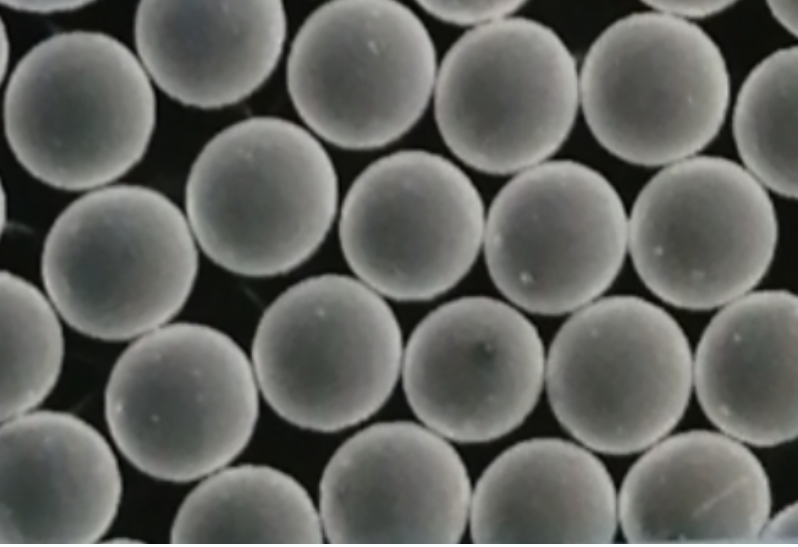
For any spherical AM powder, particle shape is not just a handling issue; it also affects layer consistency and final part quality. Near-spherical particles with limited satellites usually spread more uniformly, reducing the risk of uneven layers and lack-of-fusion defects. In corrosion service, that matters because local defects can concentrate aggressive media and accelerate attack.
Oxygen, Moisture, and Surface Chemistry
Oxygen control is particularly important in nickel-molybdenum powders because surface contamination can alter melting behavior and potentially complicate corrosion performance after printing. Powder that has acceptable PSD but poor storage control may still produce inconsistent results. Users should therefore review not only the certificate values but also the packaging method, shelf-life guidance, and recommended handling environment.
Property Targets Depend on Post-Processing
Unlike age-hardenable superalloys, Hastelloy B-type powders are chosen more for corrosion resistance than for precipitation hardening response. Mechanical properties still matter, but in many applications they are secondary to corrosion performance, weldability, and structural soundness after stress relief or solution-type thermal treatment. That means print parameters, HIP where used, and surface finishing may influence service life as much as raw powder chemistry.
Aplicações em diversos setores
Where Hastelloy B Nickel-Molybdenum Superalloy Powder Adds Value
The strongest use case for Hastelloy B nickel-molybdenum superalloy powder is not general-purpose 3D printing. It is niche, high-consequence hardware exposed to reducing chemicals, contaminated acids, chlorides in specific low-oxidizing conditions, and corrosive process streams where geometry also matters. In those cases, AM can reduce weld count, shorten lead times, and enable corrosion-resistant parts that would be difficult to machine from solid stock.
| Setor | Typical Part | Service Driver | AM / PM Process |
|---|---|---|---|
| Processamento químico | Nozzles, manifolds, injectors, acid-handling fittings | Resistance to reducing acids and localized corrosion | LPBF, DED, PM |
| Pharmaceutical and fine chemical equipment | Custom flow components, dosing hardware, compact reaction fittings | Corrosion control in specialized process media | LPBF, MIM, PM |
| Pollution control and scrubber systems | Corrosion-exposed inserts, transition pieces, spray components | Survival in aggressive wet-chemical environments | DED, LPBF, thermal spray feedstock |
| Oil, gas, and specialty refining | Valving internals, corrosion-critical seals, test hardware | Chemical compatibility in process-specific streams | LPBF, DED |
| Repair and maintenance engineering | Rebuild material for chemical-service hardware | Low-volume replacement of legacy corrosion parts | DED, laser cladding, PM |
| Research and pilot-scale plants | Prototype corrosion loops, experimental reactors, sampling parts | Fast iteration for nonstandard chemical systems | LPBF, PM |
Equipamento de processamento químico
This is the clearest application field because Hastelloy B-type alloys are fundamentally corrosion-driven materials. Components such as acid nozzles, metering hardware, manifolds, and customized transfer elements often operate in reducing media where common stainless grades lose mass rapidly or pit aggressively. AM becomes attractive when those parts need internal passages, integrated mounts, or short-run replacements.
Specialized Flow Hardware and Compact Assemblies
Compact skid-mounted chemical systems increasingly use densely packed flow architectures with awkward connection angles and hard-to-machine internal geometries. Powder bed fusion can consolidate multiple corrosion-resistant components into one part, reducing welds and potential crevice sites. That is especially useful when weld quality itself would otherwise become a corrosion concern.
Repair, Overlay, and Directed Energy Deposition
Not every use case is a fully printed component. Hastelloy B-type powders can also be relevant in DED and cladding-style applications for restoring corrosion resistance on local zones of expensive industrial hardware. In these cases, the powder functions as both a material and a maintenance tool, extending component life without remanufacturing the entire assembly.
Comparing Hastelloy B to Other AM Alloy Families
Hastelloy B is not the default answer for heat, wear, or structural lightweighting. If oxidation resistance or high-temperature strength is the main requirement, nickel-chromium superalloys may be better. If abrasion, biocompatibility, or thermal conductivity dominate, a team may compare a [nickel superalloy powder catalog] with [cobalt alloy powder options], [copper alloy powder grades], or [aluminum alloy powder selections] before committing to a corrosion-specific Ni-Mo chemistry.
Fabricação e Garantia de Qualidade
Powder Production Route and Corrosion Reliability
The route used to make the powder influences more than appearance. It can affect particle cleanliness, oxygen level, satellite formation, lot consistency, and downstream print stability. Because Hastelloy B-type alloys are used in demanding chemical service, these upstream powder characteristics can have a real impact on defect population and ultimately on corrosion performance in finished parts.
| Production Route | Typical Strengths | Typical Limitations | Best-Fit Powder Use | Common Acceptance Focus |
|---|---|---|---|---|
| GA (Gas Atomization) | High throughput, broad size-cut flexibility, good commercial scalability | More satellite population possible than premium routes | General LPBF, DED, PM feedstock | PSD, chemistry, flow, oxygen, morphology |
| VIGA (Vacuum Induction Gas Atomization) | Cleaner melt environment, tighter chemistry and gas control | Higher cost and more process complexity | Qualification-focused AM powder | Low contamination, lot stability, traceability |
| PREP (Plasma Rotating Electrode Process) | Very high sphericity and low contamination potential | Lower throughput and less common for some Ni-Mo grades | Premium specialty spherical powder | Morphology, satellite control, cleanliness |
| Reconditioned / blended route | Supports controlled internal powder economy in closed systems | Requires strict reuse validation and segregation control | Internal reuse programs only | Trend data, contamination drift, PSD stability |
Key QA Checks for Hastelloy B Additive Manufacturing Powder
For a corrosion-critical material, incoming inspection normally includes full chemistry, PSD, apparent density, tap density, Hall flow, oxygen and nitrogen, and morphology review by microscopy. More rigorous programs add moisture control, retained sample archiving, and batch-to-batch comparison through standardized print coupons. These checks matter because a powder can look acceptable in a datasheet yet behave very differently in service if contamination or reuse history is poorly managed.
A useful framework for process terminology and feedstock discussions is the [ISO/ASTM 52900 terminology page], while powder and defect metrology concepts are often cross-checked against the [NIST additive manufacturing measurement program]. Together, those references help quality teams align vocabulary, qualification logic, and measurement expectations across suppliers and end users.
Corrosion Testing Should Follow Printing
One of the most common mistakes with Hastelloy B-type AM parts is to assume that nominal chemistry alone predicts service behavior. In reality, porosity, surface finish, remelt pattern, and heat treatment can all influence corrosion response. For that reason, corrosion qualification should include printed coupons or representative parts, not only powder certificates or wrought-alloy data.
Heat Treatment, Surface Condition, and Defect Control
These alloys are generally solution-type corrosion materials rather than precipitation-hardened superalloys, so thermal processing is aimed more at homogenization, stress reduction, and microstructural stability than at maximizing hardness. Surface finishing is also unusually important because chemically aggressive media can exploit rough surfaces, semi-open pores, or unmelted particle features. In many real applications, finishing method and inspection discipline have as much influence on field life as the initial build parameters.
Documentation That Buyers Should Request
A serious order file should include certificate of analysis, PSD report, gas analysis, morphology summary, batch number, packaging data, and declared manufacturing route. If the powder is intended for qualification work, users may also want print-trial support, powder reuse guidance, and change-notification procedures. For a specialized material like this, traceability discipline is not optional; it is part of the engineering value of the powder.
Por que escolher a Truer como seu fornecedor
For Hastelloy B nickel-molybdenum superalloy powder, supplier evaluation should focus on whether the supplier understands powder production and the end-use manufacturing route, not merely whether it can quote a chemistry. This alloy family is specialized enough that discussions often include corrosion environment, process type, morphology targets, and post-build inspection requirements all at once.
Within that context, Truer is relevant because its public capability scope includes gas atomization, PREP-related technology, and downstream process coverage across SLM, SEBM, DED, laser cladding, powder metallurgy, and spraying routes. That matters for a nickel-molybdenum alloy because the best powder choice may depend on whether the end use is a dense LPBF part, a DED repair, or a corrosion-resistant cladding program.
Another practical point is portfolio context. Hastelloy B is rarely evaluated in isolation; it is usually compared with other corrosion, heat, or wear alloys during material down-selection. A supplier active across multiple spherical metal powder families can discuss those trade-offs with more realism than a seller treating every alloy as interchangeable.
Guia de pedidos e suporte
What to Specify Before You Buy
An RFQ should define the target chemistry family, intended AM or PM process, particle size range, morphology expectation, oxygen limit if critical, and packaging format. It should also state whether the powder is for feasibility trials, qualification, repair work, or serial production. That prevents a common failure mode in procurement: ordering a chemically correct powder with the wrong PSD or documentation level.
| Formato da embalagem | Typical MOQ Tier | Typical Lead Time | Sample Policy |
|---|---|---|---|
| 500 g lab bottle | Screening and bench trials | 1–2 weeks if stocked | Small paid sample commonly available |
| 1 kg sealed container | Parameter development | 1 a 3 semanas | Usually supplied with basic COA |
| 5 kg vacuum-packed can | Extended machine trials | 2 a 4 semanas | Sample may be credited to later bulk order |
| 10–25 kg industrial lot | Pilot production or qualification | 3–6 weeks | Data package commonly requested before shipment |
| Reserved batch program | Repeat industrial supply | By agreement | Retained sample and batch reservation by agreement |
Sample Evaluation Strategy
For this alloy, sample approval should include both printability and corrosion thinking. A good program normally reviews flow behavior, density, microscopy, and chemistry first, then moves to machine-specific coupons, density checks, microstructure, and corrosion testing that reflects the actual service medium. That is more useful than relying on generic room-temperature tensile data alone.
Technical Communication and Support
The most effective purchasing conversations happen when powder supply, process route, and service environment are discussed together. If a project needs batch details, PSD confirmation, or process-fit discussion before release, the [technical inquiry contact page] is the natural place to define those requirements in writing.
Nossa empresa
Shanghai Truer Technology Co., Ltd. was established in 2009 and created its additive manufacturing business in 2019. The company focuses on integrating 3D printing powder-making equipment and services with metal powders for engineering applications. Its technical scope includes selective electron beam melting equipment, plasma rotating electrode process powder-making equipment, and gas atomization-related capabilities, together with support for SLM, SEBM, DED, laser cladding, powder metallurgy, MIM, HIP, cold or hot spraying, welding, and coating. The powder portfolio includes TiNi, TiTa, TiAl, TiNbZr, CoCrMo, as well as nickel-based, cobalt-based, titanium-based, copper-based, aluminum-based, and stainless steel spherical metal powders. The company also participates in a joint innovation center for metal 3D printing with laboratories and external experts, serving industries such as 3C electronics, hand tools, remote control cars, medical, aerospace, and nuclear power.
Perguntas frequentes
Q1. Is Hastelloy B nickel-molybdenum superalloy powder mainly for corrosion resistance rather than high-temperature strength?
Yes. Its main value is resistance to reducing chemical environments, especially where nickel-molybdenum chemistry outperforms stainless steel or more oxidation-oriented nickel alloys. It can handle elevated temperatures in service, but it is generally chosen for corrosion behavior first.
Q2. Is “Hastelloy B” the same as Hastelloy B-2 or B-3 powder?
Not exactly. In online searches and commercial discussions, “Hastelloy B” is often used as a family-level shorthand, but B, B-2, and B-3 are different variants with different composition balances and fabrication characteristics. A purchase order should always specify the exact chemistry target rather than the family name alone.
Q3. What particle size is typical for Hastelloy B nickel-molybdenum superalloy powder?
For LPBF, 15–45 µm and 15–53 µm are typical commercial ranges. Coarser fractions such as 45–105 µm or 53–150 µm are more common for DED, cladding, or broader-bed applications where delivery behavior differs from fine powder-bed fusion.
Q4. Can Hastelloy B AM powder be used for chemical process parts with internal channels?
Yes, and that is one of its most compelling use cases. Additive manufacturing allows internal flow paths, compact manifolds, and part consolidation that are difficult to machine conventionally, which is especially useful in corrosive systems with custom layouts or low production volume.
Q5. Does Hastelloy B nickel-molybdenum superalloy powder need corrosion testing after printing?
In most serious applications, yes. Powder chemistry alone does not capture the effects of porosity, surface roughness, thermal history, or post-processing on corrosion performance. Printed coupons or representative parts should be tested in media that reflect the real service environment.
Q6. Is Hastelloy B powder a better choice than stainless steel for all acid-service AM parts?
No. It is a specialized solution for specific reducing environments, not a universal upgrade. In oxidizing acids, mixed-acid systems, or less severe duties, stainless steels or other nickel alloys may be more practical, more economical, or more corrosion-appropriate.