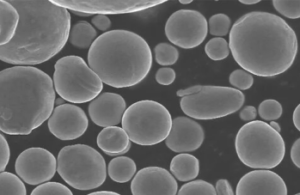
Resposta rápida
FeNiMo soft magnetic powder is the powder-metallurgy form of molybdenum permalloy, a nickel-iron-molybdenum alloy containing roughly 78-80 percent nickel and 4-5 percent molybdenum that delivers the highest magnetic permeability of any commercially practical alloy system. Gas-atomized spherical powder is supplied in 15-45 um cuts for LPBF, 0-25 um for MIM, and insulated fractions for pressed powder cores, with initial permeability of 50,000-100,000, coercivity below 5 A/m, and electrical resistivity two to three times that of silicon iron. The alloy serves magnetic shielding, high-frequency inductor cores, precision current sensors, and flux concentrators wherever minimum core loss and maximum permeability outweigh its moderate 0.75-0.9 T saturation induction.
| Propriedade | Valor |
|---|---|
| Sistema de liga metálica | Ni-Fe-Mo molybdenum permalloy (~79Ni-4Mo-Fe) |
| Densidade | 8.7 g/cm3 |
| Tamanho típico do pó (LPBF) | 15–45 µm |
| Typical Powder Size (MIM/cores) | 0-25 um |
| Initial Permeability | 50,000-100,000 |
| Coercividade (recocida) | < 5 A/m |
| Indução de saturação | 0.75-0.9 T |
| Resistividade elétrica | 0.55-0.62 uOhm.m |
| Principal vantagem | Highest practical permeability with very low core loss |
What Is FeNiMo Soft Magnetic Powder and Its Material Benefits
FeNiMo soft magnetic powder pertence ao pó magnético macio family and replicates the chemistry of molybdenum permalloy, the alloy class that has defined the upper limit of magnetic softness for over half a century. The molybdenum addition to the high-nickel permalloy base is the critical refinement: it raises electrical resistivity, which suppresses eddy-current loss, and it permits simultaneous minimization of magnetocrystalline anisotropy and magnetostriction through heat treatment, the two physical properties that together determine how freely domain walls move.
In powder form, the alloy’s benefits for engineering programs include:
- Record-class permeability. Properly annealed molybdenum permalloy reaches initial permeability of 50,000-100,000 and maximum permeability several times higher, enabling sensors and shielding that respond to microtesla-level fields.
- Very low core loss at frequency. High resistivity combined with near-zero hysteresis loss gives total core loss among the lowest of any metallic magnetic material in the kilohertz range, which is why MPP (molypermalloy powder) cores remain a premium choice in power electronics.
- Near-zero magnetostriction. The alloy barely changes dimensions under magnetization, so magnetic properties survive the mechanical stress of winding, assembly, and encapsulation better than most alternatives.
- Stable temperature coefficient. Magnetic properties vary predictably across the -40 to 120 C electronics operating window, simplifying thermal design.
- Powder-route design freedom. Additive manufacturing and MIM produce shielding geometries, integrated flux paths, and miniaturized cores that laminations cannot form, opening designs that were previously impossible rather than merely cheaper.
The designation varies by register: buyers will encounter the material as molybdenum permalloy, 4-79 Mo-Permalloy, 79HMA in Russian standards, 1.3931 or similar DIN numbers, and MPP when referring specifically to the insulated powder-core product. Chemistries across these names are close but not interchangeable, and purchase specifications should state the nickel and molybdenum windows explicitly rather than relying on the trade name alone.
The principal trade-off is saturation induction: at 0.75-0.9 T the alloy saturates well below silicon iron or FeCo alloys, so it is a precision, low-loss material rather than a power-density material, and selection should be made on that basis.
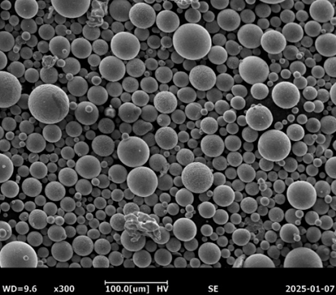
Visão geral da composição química com referência às funções dos elementos
The composition window of molybdenum permalloy is tight because magnetic softness depends on holding the anisotropy and magnetostriction zero-crossings simultaneously, a balance that shifts measurably with each alloying element.
Chemical Composition of FeNiMo (Molybdenum Permalloy)
| Elemento | Min (wt%) | Max (wt%) | Função |
|---|---|---|---|
| Ni | 77.0 | 80.0 | Sets the anisotropy/magnetostriction zero balance; governs permeability ceiling |
| Mo | 3.5 | 5.0 | Raises resistivity; widens the annealing window for maximum softness |
| Fe | Equilíbrio | Equilíbrio | Completes the FCC matrix; carries magnetic induction |
| Mn | – | 0.60 | Deoxidizer residual; limited to protect permeability |
| Si | – | 0.30 | Deoxidizer residual; minor resistivity contribution |
| C | – | 0.03 | Interstitial limit; excess raises coercivity sharply |
| P | – | 0.02 | Impurity limit; grain-boundary and domain-wall pinning control |
| S | – | 0.02 | Impurity limit; magnetic aging and inclusion control |
| Cu | – | 0.20 | Incidental; affects ordering kinetics during anneal |
| O | – | 0.03 | Powder-quality limit; oxides pin domain walls |
The nickel level is the master variable. Moving one percent within the window shifts the magnetostriction zero-crossing and with it the achievable permeability, which is why premium lots are melted to a +/- 0.3 percent nickel tolerance rather than the full specification width. Molybdenum’s role is subtler: it slows atomic ordering during cooling, which widens the practical heat-treatment window and makes the extraordinary permeability figures reproducible in production rather than achievable only in laboratory conditions.
For powder buyers, the interstitial limits carry the same weight as the principal elements. Carbon and oxygen each pin magnetic domain walls, and coercivity rises steeply once either exceeds a few hundred parts per million in the consolidated part. Certificates of analysis should report both, and magnetic-critical programs should specify incoming powder oxygen at or below 300 ppm.
A practical specification-writing approach for this alloy is to fix four numbers: the nickel range, the molybdenum range, the oxygen limit, and the carbon limit, and to reference the remainder of the window to the governing national standard. This keeps procurement documents short, directly auditable against certificates, and tied to the parameters that actually move magnetic performance, rather than burdening incoming inspection with elements that vary without functional consequence.
Propriedades físicas e mecânicas: Densidade, Resistência, Dureza
The data below reflect fully annealed reference material at standard test temperature (23 +/- 5 C), with powder-consolidated values depending on densification and annealing practice.
Principais propriedades
| Propriedade | Valor | Unidade |
|---|---|---|
| Densidade | 8.7 | g/cm3 |
| Faixa de fusão | 1420-1450 | C |
| Condutividade térmica (RT) | 20-25 | W/m·K |
| Coeficiente de expansão térmica | 12-13 x 10-6 | /K |
| Resistividade elétrica | 0.55-0.62 | uOhm.m |
| Temperatura Curie | 400-460 | C |
| Indução de saturação | 0.75-0.9 | T |
| Initial Permeability | 50,000-100,000 | – |
| Maximum Permeability | 200,000-400,000 | – |
| Coercividade (recocida) | 2-5 | A/m |
| Resistência ao escoamento (recozido) | 150-250 | MPa |
| Tensile Strength (annealed) | 450-550 | MPa |
| Alongamento (recocido) | 30-40 | % |
| Dureza (recocida) | 120-150 | HV |
The mechanical profile is soft and ductile, typical of high-nickel alloys, which favors MIM feedstock formulation and powder-core pressing but demands care in machining and handling, since cold work degrades permeability until relieved by annealing.
The magnetic figures require one qualification: they are achieved only after a full softening anneal, typically 1100-1200 C in pure dry hydrogen followed by controlled cooling through the ordering range. As-consolidated material, whether printed, pressed, or sintered, delivers a fraction of these values, and the anneal is therefore an integral part of the manufacturing route rather than a finishing option. Densification matters equally: each percent of residual porosity in a sintered or printed core costs permeability and adds to effective loss, which is why HIP-assisted routes and high-green-density MIM dominate performance-critical production.
Frequency behavior completes the picture. Below roughly 1 kHz, hysteresis loss dominates and the near-zero coercivity does most of the work; in the 10-100 kHz range typical of modern power conversion, eddy-current loss takes over and the high resistivity, together with fine effective particle or feature size, becomes the decisive advantage. This is why insulated MPP cores and thin-walled printed geometries outperform solid cores of the same chemistry at switching frequencies, a point worth carrying into component design rather than treating loss as a fixed material constant.
Lista de tolerâncias de distribuição de tamanhos e classes de fornecimento disponíveis
FeNiMo powder is supplied in fractions matched to AM, MIM, and insulated powder-core production, with each grade carrying certified size-distribution tolerances.
Especificações disponíveis
| Parâmetro | Padrão/Valor |
|---|---|
| Distribuição do tamanho das partículas (LPBF) | 15-45 µm, 15-53 µm |
| Distribuição do tamanho das partículas (MIM) | 0-25 um, D90 <= 25 um |
| Particle Size Distribution (powder cores) | 45-150 um (insulated grades) |
| Particle Size Distribution (press-sinter) | 0 a 45 µm |
| Esfericidade | >= 0.90 (GA) |
| Densidade aparente | >= 4,2 g/cm³ |
| Densidade da torneira | >= 5,0 g/cm³ |
| Vazão do Hall | <= 18 s/50 g |
| Conteúdo de oxigênio | <= 300 ppm |
| Tolerância PSD | Certificado segundo as normas D10/D50/D90 por lote |
| Opções de notas | Standard permalloy grade; high-purity low-O/C grade; insulated MPP core grade |
| Magnetic Certification | Reference-ring permeability and loss data on request |
| Embalagem | Selado a vácuo, com injeção de argônio, 1 a 50 kg |
The insulated MPP core grade deserves special note: particles are coated with an inorganic dielectric layer that electrically isolates each particle in the pressed core, distributing the air gap throughout the material and giving the soft saturation behavior and low high-frequency loss that distinguish MPP cores in inductor and choke service. This grade is supplied to powder-core manufacturers rather than AM users, and its coating quality, not just its chemistry, determines final core performance.
For LPBF and MIM users, the standard and high-purity grades differ mainly in oxygen and carbon control, and the premium grade is recommended whenever the consolidated part will receive magnetic certification. Storage and reuse follow standard practice for functional powders: containers are opened only under dry inert conditions, recycled LPBF powder is refreshed with 30-50 percent virgin material per cycle, and oxygen is re-verified after repeated reuse rounds, since surface oxidation directly erodes the permeability the alloy is purchased for.
Processo de fabricação: da matéria-prima ao pó esférico
Production begins with high-purity electrolytic nickel, carbonyl iron, and molybdenum melted under vacuum induction, because starting-stock purity propagates directly into the magnetic quality of the finished powder. The melt is held within a narrow superheat window and converted by atomização a gás (GA) with argon as the atomizing gas, producing spherical particles that solidify without phase transformation in the single-phase FCC system.
The alloy is metallurgically forgiving in atomization, and the quality-critical work happens afterward:
- Classificação by sieving and air separation isolates the target fractions, with the sub-10 um fraction strictly limited in core grades to control insulation-layer thickness distribution.
- Condicionamento de superfícies under hydrogen or forming gas reduces atomization-formed surface oxides, directly improving both sinterability and post-anneal permeability.
- Insulation coating for MPP core grades applies and cures the dielectric layer under controlled thickness and coverage.
- Verificação do fluxo e da densidade confirma o fluxo de Hall, a densidade aparente e a densidade de compactação em relação às especificações do produto.
- Análise química by ICP-OES and inert gas fusion certifies the full element window including oxygen and carbon.
- Magnetic reference testing on premium lots presses and anneals reference rings to verify permeability and core loss before release.
- Embalagem inerte in argon-flushed, vacuum-sealed containers protects conditioned surfaces through storage and shipping.
The magnetic reference test is the step that separates functional-grade production from commodity powder supply, and buyers qualifying a source should request the reference-ring data alongside chemistry for at least the first three lots. PREPARAÇÃO production is an available alternative for programs requiring crucible-free cleanliness, though GA quality suffices for most current applications.
Aplicações por setor: setores aeroespacial, médico e de energia
FeNiMo soft magnetic powder serves applications where its permeability and loss advantages are decisive. Sector context is available on the aplicativos página.
Power electronics and energy. MPP powder cores remain a premium standard for PFC chokes, output inductors, and DC-DC converter magnetics in server power, solar inverters, and EV charging, where kilohertz-range efficiency justifies material cost. Printed and MIM-produced flux concentrators and shaped cores for wireless power transfer are active development areas as charging systems miniaturize.
Aerospace and defense. Magnetic shielding for inertial navigation, magnetometers, and sensitive avionics exploits the alloy’s attenuation of low-level fields, and AM-produced multi-wall shields with integrated mounting features replace assembled sheet-metal enclosures. Current sensors for more-electric-aircraft power distribution use the alloy’s linear, low-hysteresis response for accurate measurement across wide temperature ranges.
Medical devices. MRI-adjacent instrumentation, biomagnetic sensors, and implantable-device telemetry components use the alloy where weak-signal magnetic performance matters. MIM produces the small, complex shielding and sensor elements these devices require at medical-device volumes, with the purity documentation regulated markets demand.
Precision sensing and instrumentation. Fluxgate magnetometers, residual-current devices, and precision current transformers depend on the alloy’s near-zero coercivity for measurement linearity. Additive routes enable toroidal and closed-flux-path geometries that improve sensor immunity to external interference.
Automotive electrification. EV onboard chargers, DC-DC converters, and current-sensing modules in 800-volt architectures are growth applications, with powder cores and MIM components qualifying against the automotive temperature and vibration envelope. The higher switching frequencies of silicon-carbide and gallium-nitride power stages play directly to the alloy’s resistivity advantage, and several Tier-1 suppliers are evaluating printed magnetic components for integrated power modules.
Across these sectors, the qualification pattern is consistent: magnetic characterization of printed or molded coupons first, then prototype components, then volume production once lot-level permeability and loss data prove stable. Suppliers who provide reference-ring magnetic data with each lot shorten this cycle measurably, because incoming inspection can verify functional quality without consolidating trial parts.
Comparação com outras classes e opções alternativas de sistemas de ligas
Selection around FeNiMo typically benchmarks it against standard permalloy grades such as FeNi50, against silicon iron, against Sendust (FeSiAl), and against ferrites for high-frequency duty.
FeNiMo vs Alternative Soft Magnetic Materials
| Propriedade | FeNiMo (Moly Permalloy) | FeNi50 Permalloy | Silicon Iron (3% Si) | Sendust (FeSiAl) | MnZn Ferrite |
|---|---|---|---|---|---|
| Densidade (g/cm³) | 8.7 | 8.25 | 7.65 | 6.9 | 4.8 |
| Saturation Induction (T) | 0.75-0.9 | 1.5-1.6 | 2.0 | 1.0 | 0.4-0.5 |
| Initial Permeability | 50,000-100,000 | 5,000-10,000 | 500-2,000 | 20,000-30,000 | 1,000-15,000 |
| Coercivity (A/m) | 2-5 | 5-20 | 30-60 | 5-15 | 5-20 |
| Resistivity (uOhm.m) | 0.55-0.62 | 0.40-0.45 | 0.48 | 0.80 | Muito alto |
| Core Loss (kHz range) | Muito baixo | Baixa | High (solid) | Baixa | Muito baixo |
| Stress Sensitivity | Baixa | Moderado | Baixa | Moderado | Alta |
| Custo relativo | Alta | Médio-alto | Baixa | Médio | Baixa |
Against FeNi50, FeNiMo trades roughly half the saturation induction for an order of magnitude more permeability and better high-frequency loss, so the two serve precision and general-purpose permalloy duty respectively. Against silicon iron, it concedes induction and cost but delivers the low-loss, low-coercivity performance that electrical steel cannot reach in solid or powder-consolidated form. Against Sendust, it offers higher permeability and lower magnetostriction at higher cost, with MPP cores preferred where lowest loss and best DC bias stability justify the premium. Against ferrites, it wins on saturation, thermal conductivity, and mechanical robustness while conceding ultimate high-frequency loss.
The selection rule is consistent: choose FeNiMo when minimum coercivity, maximum permeability, or kilohertz-range efficiency governs; move to higher-induction alloys only when flux density, not softness, is the limiting requirement. In shielding and sensor programs specifically, the decision is frequently made by measurement: prototype shields in FeNiMo routinely outperform alternatives by factors that eliminate the need for additional shielding layers, simplifying the overall assembly.
Nossa empresa
Shanghai Truer Technology Co., Ltd é uma fornecedora de manufatura aditiva sediada na China que integra equipamentos de produção de pó PREP e pós metálicos esféricos de alta qualidade. Fundada em 2009, a empresa oferece tanto atomização a gás (GA) e PREPARAÇÃO capacidades de fabricação em ligas de níquel, ligas de titânio, ligas de alumínio, aços inoxidáveis, ligas de cobalto, ligas de cobre, ligas de alta entropia e materiais especiais.
A Truer oferece serviços de desenvolvimento de ligas personalizadas, prototipagem em pequenos lotes e produção em escala para setores como o aeroespacial, de implantes médicos, de petróleo e gás e automotivo. A empresa opera um centro de inovação conjunto para impressão 3D em metal, em colaboração com instituições de pesquisa de ponta.
For inquiries about FeNiMo soft magnetic powder or other metal powder requirements, entre em contato com a equipe.
Perguntas frequentes
Q1: What is the typical particle size distribution for FeNiMo soft magnetic powder? A: LPBF uses 15-45 um or 15-53 um cuts, MIM uses fine fractions with D90 at or below 25 um, and insulated MPP core grades use coarser 45-150 um distributions. Every lot ships with certified D10, D50, and D90 data.
Q2: Can FeNiMo powder be used in LPBF systems? A: Yes. The single-phase FCC alloy prints without cracking issues, and LPBF produces shielding and flux-path geometries unavailable from laminations. A full hydrogen anneal after printing is essential to develop the alloy’s signature permeability, since as-built magnetic properties are far below the annealed figures.
Q3: What certifications does FeNiMo powder come with? A: Standard documentation covers full chemistry, oxygen and carbon content, PSD, flow, and density per lot. Magnetic-critical programs can add pressed-and-annealed reference-ring data verifying permeability and core loss for the specific lot.
Q4: What is the MOQ for ordering FeNiMo powder? A: Development quantities of 1-5 kg are available for LPBF parameter work and core prototyping, which is typically sufficient for initial magnetic characterization. Production volumes are supplied in 25-50 kg argon-flushed, vacuum-sealed containers, with insulated MPP core grades quoted against annual volumes.
Q5: Can the composition of FeNiMo be customized? A: Yes. Nickel and molybdenum levels can be positioned within the permalloy window to optimize either permeability or saturation, and copper-bearing supermalloy-type variants are available for programs seeking the absolute minimum coercivity. Custom melts start with trial atomization batches of 20-50 kg before commitment to campaign volumes.
Q6: What is the typical lead time for FeNiMo powder orders? A: Standard grades in stock fractions usually ship within one to two weeks. High-purity and insulated grades typically require four to six weeks including conditioning, coating, and reference testing, with custom chemistries at six to eight weeks.