Resposta rápida
Pó magnético macio FeNi42 is the powder-metallurgy form of Alloy 42, a 42 percent nickel-iron alloy that uniquely combines soft magnetic behavior with a very low, glass-matching coefficient of thermal expansion. Gas-atomized spherical powder is supplied in 15-45 um cuts for LPBF, 45-106 um for EBM and HIP, and fine fractions below 25 um for MIM, with saturation induction around 1.4-1.5 T, Curie temperature near 420-450 C, and thermal expansion of only 4-6 x 10⁻⁶ /K. The three sourcing factors that most affect part performance are powder purity (oxygen and carbon control), PSD and morphology consistency, and the supplier’s ability to certify magnetic and expansion properties lot by lot, since all three determine whether printed or molded components meet electronic packaging and magnetic core specifications.
| Propriedade | Valor |
|---|---|
| Sistema de liga metálica | Ni-Fe controlled-expansion soft magnetic alloy (Alloy 42) |
| Conteúdo de níquel | 41-43 wt% |
| Densidade | 8.12 g/cm3 |
| Tamanho típico do pó (LPBF) | 15–45 µm |
| Typical Powder Size (MIM) | 0-25 um |
| Indução de saturação | 1.4-1.5 T |
| Temperatura Curie | 420-450 C |
| Thermal Expansion (20-300 C) | 4-6 x 10⁻⁶ /K |
| Principal vantagem | Soft magnetic response plus glass-matching low expansion |
O que é o pó magnético macio FeNi42 e quais são as vantagens desse material?
Pó magnético macio FeNi42 pertence ao pó magnético macio family and replicates the chemistry of Alloy 42 (UNS K94100, ASTM F30), a nickel-iron composition positioned just above the Invar minimum of thermal expansion. That position gives the alloy its dual identity: it is magnetically soft, with useful permeability and low coercivity, and at the same time its expansion coefficient matches alumina ceramics and many sealing glasses, which is why the wrought form has served for decades in glass-to-metal seals, lead frames, and semiconductor packaging.
Converting the alloy to spherical powder extends these properties into additive manufacturing, metal injection molding, and powder metallurgy. The powder form solves a long-standing fabrication problem: wrought Alloy 42 is notoriously gummy to machine and difficult to stamp in complex geometries, so components such as multi-port feedthrough housings and shaped magnetic cores have historically been assembled from several machined and brazed pieces. Powder routes consolidate those assemblies into single near-net-shape parts, cutting both machining waste and the braze joints that limit hermetic reliability. For engineering teams evaluating the material, the sourcing decision hinges on three critical factors:
- Purity, especially oxygen and carbon. Interstitial elements degrade both magnetic softness and seal integrity. Oxygen above roughly 500 ppm forms oxide inclusions that pin domain walls and raise coercivity, while excess carbon embrittles grain boundaries and harms glass-sealing surfaces. Premium lots certify oxygen below 300 ppm.
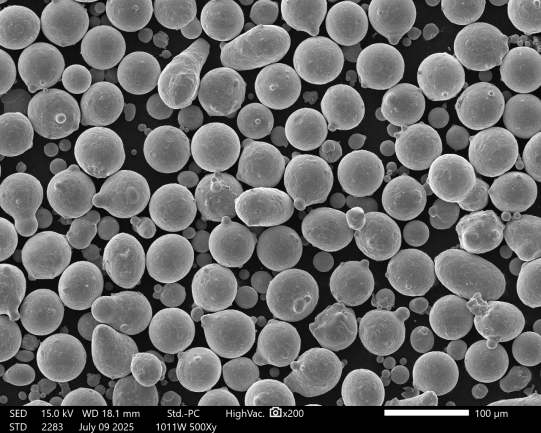
- Particle size distribution and morphology consistency. Magnetic cores and microelectronic components are frequently thin-walled and fine-featured, so spreadability and packing density directly determine green density, sintering shrinkage, and final magnetic performance. Sphericity above 0.90 with tight D10/D50/D90 tolerances is the practical requirement.
- Lot-level property certification. Unlike structural powders, FeNi42 is bought against functional properties: magnetic induction, coercivity, and expansion coefficient. Suppliers able to certify these lot by lot, rather than quoting datasheet typicals, remove an entire layer of incoming-inspection risk.
The designation follows the nominal chemistry: 42 weight percent nickel with the balance iron, and buyers will encounter the same material as Alloy 42, NILO 42, 1.3917 (DIN), or FeNi42 depending on the register quoted. When placing inquiries, it is worth stating both the designation and the governing specification, because CTE and magnetic requirements are frequently written against ASTM F30 or an equivalent national standard rather than against chemistry alone.
Beyond these sourcing factors, the alloy offers inherent material benefits: low core loss at industrial frequencies, magnetic properties that are largely insensitive to the moderate stress levels encountered in packaging duty, and the practical advantage that one material serves both the magnetic and the hermetic-sealing function in a component. The alloy is also metallurgically forgiving: a single-phase FCC structure from room temperature to melting means no phase transformations during printing, sintering, or sealing thermal cycles, which simplifies every downstream process window.
Dados de composição química e correlação com os parâmetros de desempenho
The composition of FeNi42 is deceptively simple, but each minor element correlates directly with a functional property, which is why purity control matters more here than in structural alloys.
Composição química do FeNi42
| Elemento | Min (wt%) | Max (wt%) | Função |
|---|---|---|---|
| Ni | 41.0 | 43.0 | Sets the expansion minimum and Curie point; governs magnetic and CTE behavior |
| Fe | Equilíbrio | Equilíbrio | Completes the FCC gamma matrix; carries the magnetic induction |
| Mn | – | 0.80 | Deoxidizer residual; excess degrades magnetic softness |
| Si | – | 0.30 | Deoxidizer residual; raises resistivity slightly but hardens the alloy |
| C | – | 0.05 | Interstitial limit; excess raises coercivity and harms seal surfaces |
| P | – | 0.025 | Impurity limit; grain-boundary embrittlement control |
| S | – | 0.025 | Impurity limit; hot-shortness and seal-integrity control |
| Al | – | 0.10 | Residual from melting; kept low for magnetic consistency |
| Co | – | 0.50 | Incidental; marginally raises Curie temperature and induction |
| O | – | 0.03 | Powder-quality limit; oxide inclusions pin domain walls |
The nickel content is the single most performance-determining number on the certificate. Within the 41-43 percent window, each 0.1 percent shift moves the thermal expansion curve measurably, and glass-sealing specifications frequently require CTE matched within narrow bands, so lots intended for hermetic packaging should be ordered against a certified expansion range, not just chemistry.
The correlation extends to magnetic performance: every interstitial or inclusion-forming element subtracts from permeability and adds to coercivity. This is why two powders with identical headline chemistry can deliver measurably different core loss after identical processing, and why the purity factor heads the sourcing list.
Visão geral das propriedades físicas e mecânicas e resumo dos dados
The property set below reflects wrought and HIP-consolidated reference material at standard test temperature (23 +/- 5 C), with AM and MIM values varying with densification and annealing practice.
Principais propriedades
| Propriedade | Valor | Unidade |
|---|---|---|
| Densidade | 8.12 | g/cm3 |
| Faixa de fusão | 1430-1450 | C |
| Thermal Expansion (20-300 C) | 4-6 x 10⁻⁶ | /K |
| Condutividade térmica (RT) | 15-17 | W/m·K |
| Resistividade elétrica | 0.60-0.70 | uOhm.m |
| Temperatura Curie | 420-450 | C |
| Indução de saturação | 1.4-1.5 | T |
| Coercividade (recocida) | 20-60 | A/m |
| Initial Permeability | 2000-5000 | – |
| Resistência ao escoamento (recozido) | 250-350 | MPa |
| Tensile Strength (annealed) | 450-550 | MPa |
| Alongamento (recocido) | 25-35 | % |
| Dureza (recocida) | 130-170 | HV |
The magnetic figures deserve interpretation. Saturation induction of 1.4-1.5 T is moderate, well below silicon iron or FeCo alloys, but permeability in the low thousands combined with low coercivity gives low core loss at industrial and audio frequencies, which is the actual duty cycle of most packaging and shielding components. The relatively high electrical resistivity compared with pure iron further suppresses eddy-current loss in solid, non-laminated parts, an important advantage for AM geometries that cannot be built as lamination stacks. Final magnetic properties depend strongly on post-processing: a full hydrogen or vacuum anneal above 1000 C after sintering or HIP typically halves coercivity relative to the as-consolidated state, and this anneal should be treated as part of the manufacturing route, not an optional finishing step.
Mechanically, the alloy is soft and ductile, which favors MIM feedstock formulation and cold isostatic pressing, and its expansion match to alumina and borosilicate glasses remains the property no common substitute can replicate.
Classes disponíveis, distribuição de partículas e normas de tolerância
FeNi42 powder is supplied in process-matched size fractions, with tolerance standards referenced to the certified D10, D50, and D90 values on each lot’s certificate of analysis.
Especificações disponíveis
| Parâmetro | Padrão/Valor |
|---|---|
| Distribuição do tamanho das partículas (LPBF) | 15-45 µm, 15-53 µm |
| Particle Size Distribution (EBM/HIP) | 45-106 µm |
| Distribuição do tamanho das partículas (MIM) | 0-25 um, D90 <= 25 um |
| Particle Size Distribution (press-sinter) | 0-45 um, 45-150 um |
| Esfericidade | >= 0.90 (GA) |
| Densidade aparente | >= 4.0 g/cm3 |
| Densidade da torneira | >= 4,8 g/cm³ |
| Vazão do Hall | <= 18 s/50g (coarse cuts) |
| Conteúdo de oxigênio | <= 500 ppm (standard), <= 300 ppm (premium) |
| Tolerância PSD | Certificado segundo as normas D10/D50/D90 por lote |
| Opções de notas | Standard magnetic grade; high-purity hermetic-seal grade; MIM feedstock grade |
| Magnetic Certification | Available on request per lot |
| Embalagem | Selado a vácuo, com injeção de argônio, 1 a 50 kg |
For MIM applications, the fine fraction below 25 um with high tap density is specified to maximize sintered density and magnetic performance, and powder is commonly supplied pre-blended with binder or as certified base powder for in-house feedstock formulation. For hermetic packaging programs, the high-purity grade with certified CTE and magnetic data is the appropriate choice, and the modest price premium typically costs less than a single sealing-yield failure.
Storage and reuse follow standard nickel-iron practice: sealed containers should be opened only in dry inert conditions, LPBF users typically refresh recycled powder with 30-50 percent virgin material per cycle, and oxygen content should be re-verified after repeated reuse rounds, because surface oxide accumulation directly erodes the magnetic softness the powder is purchased for.
Etapas do processo de fabricação: fusão, atomização e classificação
Production follows the standard high-quality powder route: virgin nickel and electrolytic iron are induction melted under vacuum or controlled argon atmosphere, the melt is held within a tight superheat window to stabilize chemistry, and the stream is disintegrated by atomização a gás (GA) into droplets that spheroidize and solidify in flight. Because FeNi42 contains no highly volatile alloying additions, chemistry transfer from melt to powder is faithful, and lot-to-lot nickel variation can be held within +/- 0.2 percent with disciplined melt practice.
Post-atomization processing determines the functional quality of the powder:
- Classificação by sieving and air separation isolates the target fractions, with particular care at the fine end for MIM cuts where the sub-10 um fraction must be limited to preserve sintering behavior.
- Deoxidation and surface conditioning under hydrogen or forming gas reduces surface oxides formed during atomization, directly improving magnetic response and sinterability.
- Verificação do fluxo e da densidade confirma o fluxo de Hall, a densidade aparente e a densidade de compactação em relação às especificações do produto.
- Análise química by ICP-OES and inert gas fusion certifies the full element window including oxygen, carbon, and sulfur.
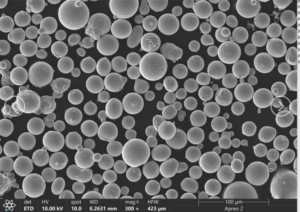
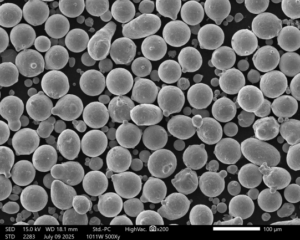
- Inspeção morfológica by SEM verifies sphericity, satellite content, and surface condition.
- Functional spot-checks on premium lots measure expansion coefficient and magnetic properties on consolidated reference samples.
- Embalagem inerte in argon-flushed, vacuum-sealed containers protects the conditioned surfaces during storage and shipping.
For programs where magnetic performance is contractual, the conditioning step and the functional spot-check are the two items to audit in a supplier’s process description, because they are the operations most often abbreviated in commodity production.
Aplicações por setor: Medicina, Aeroespacial e Geração de Energia
FeNi42 soft magnetic powder serves industries that exploit either its magnetic softness, its expansion match, or both. Sector context is available on the aplicativos página.
Electronics and semiconductor packaging. The largest application space. MIM and AM routes produce lead frames, package bases, heat spreader lids, and microelectronic housings whose expansion must track alumina substrates and glass seals across thermal cycling. Powder routes enable the thin walls, fine features, and integrated geometries that stamping and machining cannot economically reach at volume.
Power generation and electrical machines. Stator and rotor elements, flux concentrators, and sensor cores in low-to-medium frequency machines use the alloy where mechanical robustness and low expansion accompany acceptable magnetic performance. Additive manufacturing of shaped pole pieces and integrated cooling features is an active development area, complementing the pós à base de níquel used elsewhere in generator assemblies. Printed flux guides with geometry optimized by topology simulation have demonstrated measurable reductions in local saturation compared with conventionally machined laminations substitutes.
Aerospace and defense electronics. Hermetically sealed avionics modules, RF packages, and inertial-sensor housings rely on Alloy 42 for glass-to-metal sealing under vibration and thermal shock. AM-produced housings consolidate connectors, feedthroughs, and structural flanges into single components, reducing seal interfaces, which are the dominant failure mode in hermetic assemblies. Qualification programs in this sector typically run twelve to eighteen months, so early powder lot stability data is a meaningful supplier-selection criterion.
Medical devices. Implantable-device feedthroughs, diagnostic imaging components, and MRI-adjacent shielding elements use the alloy for its controlled expansion and manageable magnetic signature. MIM is the established route for small, high-volume medical components, while LPBF serves custom and low-volume instrument parts where design iteration speed matters more than unit cost.
Precision instruments and optical systems. Optical benches, laser diode mounts, and cryostat components exploit the low expansion for dimensional stability, with powder metallurgy routes supplying near-net shapes that minimize machining of this gummy, work-hardening alloy.
Comparação com outras classes e opções alternativas de sistemas de ligas
Selection around FeNi42 typically benchmarks it against Invar (FeNi36), Kovar (FeNi29Co17), the high-permeability permalloys such as FeNi50, and silicon iron.
FeNi42 x ligas magnéticas macias alternativas
| Propriedade | FeNi42 | Invar (FeNi36) | Kovar (FeNiCo) | FeNi50 | Silicon Iron (3% Si) |
|---|---|---|---|---|---|
| Densidade (g/cm³) | 8.12 | 8.05 | 8.36 | 8.25 | 7.65 |
| CTE (20-300 C, x10-6/K) | 4-6 | 1-2 | 5-6 | 9-10 | 12 |
| Saturation Induction (T) | 1.4-1.5 | 1.4 | 1.5 | 1.5-1.6 | 2.0 |
| Initial Permeability | 2000-5000 | Baixa | Baixa | 5000-10000 | Moderado |
| Coercivity (A/m, annealed) | 20-60 | Mais alto | Mais alto | 5-20 | 30-60 |
| Glass Sealing Suitability | Excellent (alumina) | Ruim | Excellent (borosilicate) | Moderado | Nenhum |
| Custo relativo do pó | Médio | Médio | Médio-alto | Médio | Baixa |
Against Invar, FeNi42 sacrifices the absolute minimum expansion for better magnetic softness and a practical glass-matching CTE, and it machines and processes more predictably. Against Kovar, it offers nearly equivalent sealing performance to alumina systems at lower cost and without cobalt, while Kovar remains the standard for borosilicate glass. Against FeNi50 permalloy, it concedes permeability but wins decisively on expansion control, so shielding and packaging components that must stay dimensionally stable favor FeNi42. Against silicon iron, it concedes induction and cost but offers the hermetic-sealing capability and ductility that brittle electrical steel cannot provide in powder-consolidated geometries.
The selection rule reduces to one question: if the component must seal to glass or ceramic and carry a magnetic or electrical function, FeNi42 is the default; if only magnetic performance matters, permalloy or silicon iron variants serve better. It is also worth noting that the five alloys in the table are all available as qualified powder grades, so mixed-material programs, such as a FeNi42 hermetic housing combined with a permalloy internal shield, can be sourced within one powder supply chain with consistent quality documentation.
Nossa empresa
Shanghai Truer Technology Co., Ltd é uma fornecedora de manufatura aditiva sediada na China que integra equipamentos de produção de pó PREP e pós metálicos esféricos de alta qualidade. Fundada em 2009, a empresa oferece tanto atomização a gás (GA) e PREPARAÇÃO capacidades de fabricação em ligas de níquel, ligas de titânio, ligas de alumínio, aços inoxidáveis, ligas de cobalto, ligas de cobre, ligas de alta entropia e materiais especiais.
A Truer oferece serviços de desenvolvimento de ligas personalizadas, prototipagem em pequenos lotes e produção em escala para setores como o aeroespacial, de implantes médicos, de petróleo e gás e automotivo. A empresa opera um centro de inovação conjunto para impressão 3D em metal, em colaboração com instituições de pesquisa de ponta.
For inquiries about FeNi42 soft magnetic powder or other metal powder requirements, entre em contato com a equipe.
Perguntas frequentes
P1: Qual é a distribuição típica do tamanho das partículas do pó magnético macio FeNi42? A: LPBF uses 15-45 um or 15-53 um cuts, EBM and HIP use 45-106 um, and MIM uses fine fractions with D90 at or below 25 um. Press-sinter grades are available in 0-45 um and 45-150 um distributions, and every cut ships with certified D10, D50, and D90 data referenced to the specific production lot.
P2: O pó de FeNi42 pode ser utilizado tanto em sistemas SLM quanto em sistemas EBM? A: Yes. The single-phase FCC alloy solidifies without cracking issues and prints readily on both laser and electron beam platforms, and parameter development is generally straightforward compared with crack-prone high-strength alloys. A post-build vacuum or hydrogen anneal is recommended regardless of process to develop final magnetic softness.
P3: Quais certificações o pó FeNi42 possui? A: Standard documentation includes full chemistry, oxygen and carbon content, PSD data, flow rate, and apparent and tap density, all referenced to the individual lot number. Premium hermetic-seal grades add certified thermal expansion ranges and magnetic property measurements on consolidated reference samples.
P4: Qual é a quantidade mínima de pedido (MOQ) para o pó de FeNi42? A: Development quantities of 1-5 kg are available for LPBF parameter work and MIM feedstock trials, which is usually enough for coupon builds and initial magnetic characterization. Production volumes are supplied in 25-50 kg argon-flushed, vacuum-sealed containers, with pricing scaled to grade and quantity.
P5: A composição do FeNi42 pode ser personalizada? A: Yes. Nickel content can be positioned within the 41-43 percent window to hit a target expansion curve, and cobalt-bearing variants approaching Kovar chemistry are available for borosilicate sealing. Custom melts are developed through the supplier’s alloy development service, typically starting with a 20-50 kg trial atomization before full-scale commitment.
P6: Qual é o prazo de entrega normal para pedidos de pó de FeNi42? A: Stock fractions of standard magnetic grade usually ship within one to two weeks. High-purity hermetic grades with functional certification typically require four to six weeks including conditioning, reference-sample consolidation, and property measurement.