Hızlı Cevap
CoCrMo powder for dental additive manufacturing is a pre-alloyed cobalt-chromium-molybdenum feedstock used to produce crowns, bridges, partial denture frameworks, and other dental metal components by powder bed fusion. It is widely selected because it combines high rigidity, corrosion resistance, biocompatibility-oriented chemistry, and dependable printability in one alloy system. For dental labs and OEMs, that usually means thinner but stronger frameworks, more consistent fit than conventional casting, and a workflow that aligns well with digital scanning, CAD, and serial customization.
What Is CoCrMo powder for dental additive manufacturing?
CoCrMo powder for dental additive manufacturing is a cobalt-based alloy powder engineered for metal AM processes used in dentistry, especially laser powder bed fusion systems that build parts layer by layer from fine spherical particles. The alloy family is known for combining mechanical strength with corrosion resistance, making it a practical material for dental frameworks that must remain dimensionally stable in service.
The abbreviation CoCrMo stands for cobalt, chromium, and molybdenum, the three defining constituents of the alloy system. Cobalt forms the base matrix, chromium promotes passive-film corrosion resistance, and molybdenum contributes to strengthening and resistance to localized attack. In dental manufacturing, those properties matter because restorations often have thin sections, precise connectors, and complex geometries that cannot tolerate excessive flex.
Why this alloy exists in dental AM
Dental metal components were historically produced by casting or subtractive methods. Those routes remain viable, but they can introduce variability through wax patterns, investment expansion, casting shrinkage, machining constraints, and manual finishing differences. Additive manufacturing changes the production path by converting digital design data directly into metal parts.
That shift created a need for powders that are not just chemically correct, but also physically suitable for layer-wise processing. Dental CoCrMo powder therefore has to meet two requirements at the same time: it must behave like a reliable dental alloy after printing, and it must behave like a reliable AM powder before printing.
How dental CoCrMo differs from generic cobalt alloys
A cobalt-chromium alloy used for hardfacing or industrial wear parts may share a similar family name but still be unsuitable for dental work. Dental applications demand finer particle size control, higher consistency in powder shape, lower contamination risk, and tighter reproducibility from batch to batch. Small differences in particle morphology can affect spreading, laser interaction, surface finish, and ultimately the fit of a bridge or framework.
This is why procurement teams should distinguish between alloy identity and application readiness. A nominal CoCrMo chemistry is only the starting point; the usable dental product is defined by the full powder specification.
CoCrMo powder for dental additive manufacturing in standards language
In technical discussions, process vocabulary is often framed by [ISO/ASTM 52900 additive manufacturing terminology], while the alloy family is commonly interpreted alongside [ISO 22674 dental metallic materials]. For broader background on cobalt-chromium-molybdenum alloy systems, many engineers also consult [cobalt-chromium-molybdenum alloy references]. These sources help create a common language, but supplier-level data remain essential because dental AM performance depends heavily on the actual released powder lot.
In dental metal AM, repeatable powder behavior is often as important as nominal alloy chemistry.
The metallurgical reason CoCrMo remains important
Dentistry continues to use CoCrMo because the alloy offers a high elastic modulus relative to many alternative metallic systems. That means designers can maintain structural rigidity without making every connector or clasp excessively bulky. In practical terms, the material helps support thin-walled structures that still need to resist deformation during use and post-processing.
The alloy is also attractive because it responds well to finishing routes such as support removal, blasting, machining, and polishing when the build parameters are properly controlled. That downstream processability matters in dental production, where surface refinement and dimensional correction are part of the normal workflow.
Chemical Composition and Material Grade
The chemistry of CoCrMo powder for dental additive manufacturing is built around a cobalt-rich base with chromium and molybdenum as the principal alloying additions. Typical dental CoCrMo grades stay within recognized cobalt-chromium-molybdenum composition windows, but exact targets vary by supplier, intended process, and internal quality plan.
Dental users should not review composition in isolation. A powder may match the expected cobalt, chromium, and molybdenum ranges yet still perform poorly if oxygen is elevated, the minor elements drift, or the particle distribution is poorly controlled. For that reason, chemistry is best treated as one section of a broader release specification.
Typical composition logic of CoCrMo dental AM powder
Chromium is essential for corrosion resistance because it supports the formation of a stable passive oxide layer in service. Molybdenum contributes to strength and helps improve behavior in localized corrosive environments. Carbon is often monitored closely because it influences carbide formation, which in turn affects hardness, wear response, and the balance between strength and ductility.
Residual elements deserve attention as well. Iron, nickel, silicon, manganese, and trace contaminants can enter the material through melting, atomization, classification, or handling. Even when present at low levels, they should be reported clearly because dental qualification programs often review them carefully.
| Element / Grade Item | Typical Content (wt%) | Metallurgical Role | ASTM / AMS / GB / ISO / DIN Cross-Reference | Notlar |
|---|---|---|---|---|
| Kobalt (Co) | balance | Base matrix, strength, high modulus | Comparable to ASTM F75 family / ISO dental CoCr families / DIN CoCr dental equivalents | Principal alloy constituent |
| Krom (Cr) | 26.0–30.0 | Corrosion resistance, passivation | Often aligned with ASTM F75-type chemistry windows / ISO 22674 classification context | High Cr supports oral-environment durability |
| Molibden (Mo) | 5.0–7.0 | Strengthening, pitting resistance support | Common in CoCrMo alloy references across ASTM / DIN / GB dental supply chains | Key differentiator from simpler CoCr grades |
| Karbon (C) | typically 0.05–0.35 | Carbide control, hardness and ductility balance | Supplier specification within broader CoCrMo grade logic | AM-focused grades may target tighter control |
| Silisyum (Si) | typically ≤1.0 | Minor alloy/process balance | Supplier-defined under multi-standard review | Excessive variation can affect consistency |
| Manganez (Mn) | typically ≤1.0 | Minor alloy/process balance | Supplier-defined under multi-standard review | Usually a controlled minor addition |
| Demir (Fe) | typically low residual | Impurity control | Internal limit, sometimes customer-specific | Should remain stable from lot to lot |
| Nikel (Ni) | typically low residual | Residual disclosure | Customer- and market-specific review | Often monitored carefully in dental applications |
Understanding grade equivalence in practice
Terms such as ASTM equivalent, ISO comparable, or DIN similar should be read carefully. They can help a buyer place a powder within the right alloy family, but they do not automatically mean one specification can replace another without further review. AM powder procurement requires more than alloy-family recognition.
For example, a chemistry window may resemble a well-known cast cobalt-chromium-molybdenum alloy standard, yet the powder still needs to prove suitability for additive manufacturing through morphology, size distribution, oxygen control, and lot consistency. That is especially true in dentistry, where feature scale is small and tolerance expectations are high.
Why chemistry alone is not enough
Dental AM users often discover that two CoCrMo powders with nearly identical composition can produce different results on the same machine. One may spread more smoothly, generate denser thin walls, and polish more predictably. The difference often comes from powder engineering rather than the headline alloy percentages.
That is why an experienced buyer asks for a complete data package rather than only a certificate of composition. A good specification connects chemistry to process performance instead of treating them as separate topics.
Teknik Özellikler
Technical specifications determine whether CoCrMo powder for dental additive manufacturing will spread into even layers, absorb laser energy consistently, and build detailed parts without excessive porosity or surface irregularity. Because dental parts are small and geometry-sensitive, minor feedstock differences can show up quickly in framework fit, edge quality, and support behavior.
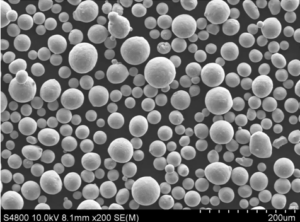
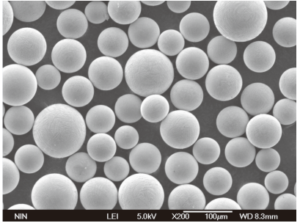
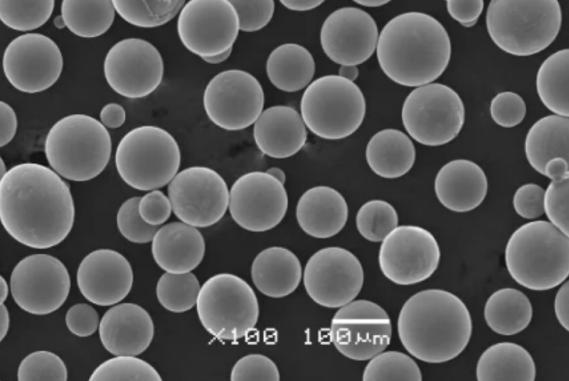
The most important powder properties usually include particle size distribution, apparent density, tap density, Hall flow, oxygen content, and sphericity. Some customers also request SEM images, laser diffraction curves, or retained sample policies to verify long-term reproducibility.
Particle size distribution for CoCrMo powder for dental additive manufacturing
Most dental laser powder bed fusion systems use relatively fine powder cuts. Typical commercial distributions include 10–30 µm, 15–45 µm, and 15–53 µm, depending on machine design, recoating strategy, and desired balance between fine-detail resolution and robust handling.
Finer powder can support thin layers and intricate features, but it also increases total surface area and therefore sensitivity to oxidation and reuse effects. Coarser powder tends to flow well, but it may reduce feature fidelity in delicate dental parts.
| Powder Class | PSD Range (µm) | Görünür Yoğunluk (g/cm³) | Tap Density (g/cm³) | Hall Flow (s/50 g) | Oksijen İçeriği | Küresellik |
|---|---|---|---|---|---|---|
| Ultra-fine dental grade | 10–30 | 4.0–4.4 | 4.7–5.2 | 16–24 | typically low, lot controlled | high |
| Standard dental LPBF grade | 15–45 | 4.2–4.7 | 4.9–5.5 | 13–22 | typically low, lot controlled | high to very high |
| Broad production grade | 15–53 | 4.3–4.8 | 5.0–5.6 | 12–20 | low, certificate-based | very high |
| Flexible development grade | 20–63 | 4.4–4.9 | 5.1–5.7 | 12–19 | application-specific control | kÜRESEL |
| Coarser engineering grade | 45–105 | 4.6–5.2 | 5.3–5.9 | 11–18 | controlled per use case | spherical to near-spherical |
Powder density and flowability
Apparent density gives a practical indication of how the powder packs under gravity, while tap density shows how much additional packing occurs under mechanical consolidation. Hall flow is a traditional indicator of discharge behavior, but it should never be treated as a complete description of powder performance.
A powder may record acceptable Hall flow and still perform inconsistently if it contains too many satellites, an excessive fine fraction, or broad distribution tails. In dental production, those subtle issues can appear as rough surface zones, irregular contour quality, or inconsistent thin-wall density before they cause total build failure.
Oxygen and powder aging
Düşük oksijen içeriği is especially important for fine AM powders because their high surface area makes them sensitive to environmental exposure. Repeated sieving, storage, transport, and blending can change oxygen levels and the fraction of fines over time. In small dental parts, that drift may affect margin formation or finishing response even when bulk coupon density still looks acceptable.
For metrology context, many powder users review the general guidance available through [NIST powder characterization resources]. While such references do not replace a supplier specification, they help explain why morphology, chemistry, and handling history must be assessed together.
Sphericity and surface condition
Highly spherical particles usually provide better spreadability and more uniform layer formation than irregular particles. Surface satellites are not always disqualifying, but excessive attachment can reduce flow consistency and alter effective packing behavior. For dental AM, where the layer quality directly affects fine feature reproduction, this matters more than many first-time buyers assume.
In practice, the most useful powder is not the one with the most extreme laboratory value on a single parameter. It is the one that holds a stable, predictable property set across repeated deliveries.
Applications Across Industries
Although the keyword focuses on dentistry, CoCrMo powder for dental additive manufacturing belongs to a wider cobalt-alloy powder ecosystem. Its principal role is still dental part production, but the underlying alloy family also appears in broader medical, research, and engineering contexts that require strength, corrosion resistance, and wear performance.
What makes dentistry unique is not only the alloy choice but also the production model. Dental AM often involves many small, individualized parts in the same build, each with fine detail and strict fit expectations. That environment rewards materials that combine process stability with high structural rigidity.
Dental frameworks and fixed prosthetics
Fixed dental prosthetic frameworks are among the most common outputs of CoCrMo powder. These include crowns, bridge substructures, and coping-like structures where dimensional consistency is critical. The alloy allows designers to maintain thin sections while still supporting the stiffness needed for functional service.
Compared with traditional casting, additive manufacturing also reduces dependence on manual wax-up accuracy and casting shrinkage control. That can improve repeatability when the design and process chain are well managed.
Removable partial denture frameworks
Partial denture frameworks are another major application because they involve connectors, rests, mesh structures, and clasps with mixed thickness and local stress concentration. The high elastic modulus of CoCrMo helps preserve rigidity without forcing every feature to become overly thick.
This is also one of the areas where powder quality becomes very visible. If spreading or fusion is inconsistent, clasp fidelity and thin-edge integrity can degrade quickly.
Beyond dental: broader cobalt AM and PM use
The same alloy family can appear in selected medical fixtures, engineering prototypes, and research validation work. In those cases, the required specification may differ from dental AM powder, but the core metallurgical logic remains similar. Buyers comparing multiple metal systems may also find it useful to review a broader set of [cobalt-based alloy powder options], a [titanium alloy powder portfolio], or a [stainless steel powder range] when evaluating density, stiffness, corrosion behavior, and cost position together.
| Endüstri | Typical Part | Main Requirement | AM / PM Process |
|---|---|---|---|
| Dental laboratory production | Crowns and bridge frameworks | Precision, rigidity, repeatable digital manufacture | SLM / LPBF |
| Removable prosthetics | Partial denture frameworks and clasps | Thin-section strength and elastic control | SLM / LPBF |
| Implant prosthetics | Bars and superstructures | Patient-specific geometry with structural stability | SLM / LPBF |
| Medical support manufacturing | Fixtures and specialized support parts | Corrosion resistance and durable alloy response | LPBF / PM |
| Research institutions | Coupons and validation samples | Benchmark alloy family for process studies | LPBF |
| Engineering prototyping | Small wear-resistant metal components | Dimensional stability and strength | LPBF / PM / MIM |
Material-selection context
Material selection in dental manufacturing is rarely a one-variable decision. Some users compare CoCrMo with titanium when weight matters, while others compare it with milling blanks or cast alloys when process economics and post-processing are the main concerns. In that context, CoCrMo remains relevant because it balances stiffness, established dental use, and compatibility with digital metal production.
Manufacturing and Quality Assurance
The manufacturing route used for CoCrMo powder strongly affects particle shape, cleanliness, and lot-to-lot consistency. Gas atomization is the most common route for fine dental AM powders because it can produce spherical particles at industrial scale. PREP and VIGA are also discussed in advanced powder supply chains, especially where cleanliness and morphology control are priorities.
Still, route labels alone do not determine performance. The important question is whether the finished powder meets the required chemistry, particle size distribution, flow behavior, oxygen limit, and morphology targets for the intended dental application.
Process routes for CoCrMo powder for dental additive manufacturing
Gas atomization typically offers the most practical balance of scale and particle control for dental AM powder supply. PREP is often associated with very high sphericity and clean particle surfaces, while VIGA supports controlled melting and atomization conditions. Each route can be technically valid if the finished powder meets the right specification.
| Production Route / QA Item | Typical Equipment or Method | Main Strength | Main Limitation | Relevance to Dental CoCrMo |
|---|---|---|---|---|
| Gas Atomization (GA) | Inert gas atomizer with classification line | Scalable supply of fine spherical powder | Requires strong control of fines and satellites | Most common commercial route |
| HAZIRLIK | Plazma döner elektrot işlemi | Very high sphericity and cleanliness | Less common for mainstream dental economics | Relevant for premium morphology discussions |
| VIGA | Vacuum induction melting plus gas atomization | Good melt cleanliness and atmosphere control | Higher equipment complexity | Useful where chemistry control is emphasized |
| PSD verification | Laser diffraction and sieve analysis | Confirms lot size distribution | Method correlation must be controlled | Essential for layer repeatability |
| Morphology and chemistry QA | SEM, ICP-OES, combustion analysis | Verifies shape, composition, and gas content | Requires disciplined release criteria | Core part of lot acceptance |
Incoming inspection and release discipline
A technically sound release package often includes chemistry, PSD, and oxygen data, supported by internal morphology review. Some customers also request retained sample practice, batch traceability, and packaging-condition records. These are not administrative extras; they help explain variation if a build parameter set suddenly behaves differently.
At the user side, incoming inspection should reflect application risk. A production dental lab may validate a new lot not only on coupons, but also on representative frameworks that test thin walls, supports, contour quality, and finishing response.
Reuse strategy and contamination control
Lot-to-lot consistency becomes even more important once powder reuse is part of the workflow. Reclaimed powder can change through oxidation, attrition, size segregation, or contamination introduced during handling. If reuse policy is not controlled, the print process may drift even when the original virgin powder met all purchase specifications.
A disciplined dental AM workflow usually defines sieve mesh, maximum recycle ratio, blend rules between virgin and reclaimed powder, and storage conditions. These factors directly affect the stability of the process window.
Why Choose Truer as Your Supplier
Selecting a supplier for CoCrMo powder for dental additive manufacturing is fundamentally a question of technical fit, documentation quality, and process understanding. Dental AM users need more than a chemistry statement; they need a supplier capable of discussing powder-making routes, morphology, PSD tailoring, and how those factors influence printed part behavior.
Truer is relevant in this context because its activities span powder-making equipment, spherical metal powders, and additive manufacturing process applications. That broader technical base supports more informed discussions about feedstock preparation and downstream use across SLM, SEBM, DED, laser cladding, and related powder-based routes.
The company’s material scope also matters. A supplier that works with CoCrMo alongside nickel-based, titanium-based, copper-based, aluminum-based, and stainless steel powders can support cross-material benchmarking rather than treating every inquiry as a single isolated item. For readers who want concise corporate background, the [company overview page] provides a factual summary of the organization and its AM focus.
Ordering Guide and Support
Ordering CoCrMo powder for dental additive manufacturing should begin with an application definition, not just a material name. Buyers should specify machine type, preferred PSD, intended part family, expected purchase volume, and required certificate set. Without that information, quotations can be technically incomplete even if they appear commercially straightforward.
The order stage should also distinguish between sample evaluation, parameter development, pilot qualification, and steady production supply. Each phase usually requires a different quantity, packaging format, and documentation depth.
Sample and pilot ordering strategy
A staged qualification path is often the safest route. Many dental users start with a small sample for spreadability and printability checks, then move to a pilot lot for repeatability studies before adopting regular production volumes. That approach reduces the risk of confusing machine setup issues with true feedstock limitations.
| Packaging Format | Typical MOQ Tier | Typical Lead Time | Sample Policy | Typical Use Stage |
|---|---|---|---|---|
| 500 g bottle | Evaluation | 1–2 weeks if inventory exists | Small paid or approved sample | Initial machine screening |
| 1 kg bottle | Prototype | 1-3 hafta | Common first technical order | Parameter development |
| 5 kg sealed pack | Pilot | 2–4 hafta | Usually after specification alignment | Repeatability builds |
| 10 kg pack | Pre-production | 3-5 hafta | Follows preliminary qualification | Validation stage |
| 25 kg drum or custom pack | Üretim | Project-based | Not typical as a first sample | Routine manufacturing |
Information that improves an RFQ
A strong RFQ usually states whether the powder is intended for crowns, bridges, partial frameworks, implant bars, or mixed dental production. It should also clarify whether reclaimed powder blending is planned and whether the buyer needs help selecting a size range compatible with a specific machine platform.
When technical questions or quotation details need to be discussed directly, the most efficient route is the [technical contact page]. A precise inquiry usually shortens the evaluation cycle and helps align specification details from the start.
Şirketimiz
Shanghai Truer Technology Co., Ltd. was established in 2009 and created its additive manufacturing business in 2019. The company focuses on integrating 3D printing powder-making equipment and services with spherical metal powders for engineering applications of additive manufacturing. Its core technologies include Selective Electron Beam Melting equipment, Plasma Rotating Electrode Process powder-making equipment, and gas atomization. The powder portfolio includes TiNi, TiTa, TiAl, TiNbZr, CoCrMo, as well as nickel-based, cobalt-based, titanium-based, copper-based, aluminum-based, and stainless steel spherical metal powders. The company also participates in a joint innovation center for metal 3D printing with laboratories and experts, and serves end-use processes including SLM, SEBM, DED, laser cladding, powder metallurgy, MIM, HIP, cold and hot spraying, welding, and coating for industries such as 3C electronics, hand tools, remote control cars, medical, aerospace, and nuclear power.
SSS
Q1. Is CoCrMo powder for dental additive manufacturing the same as ordinary cobalt alloy powder?
No. A general cobalt alloy powder may belong to a similar chemistry family, but dental AM powder is typically controlled more tightly for particle size, morphology, residual elements, and lot consistency. Those differences matter because dental parts are small, detail-sensitive, and tolerance-critical.
Q2. What particle size is most common for CoCrMo powder for dental additive manufacturing?
Common dental AM ranges include 10–30 µm, 15–45 µm, and 15–53 µm. The best range depends on the machine platform, layer thickness, recoater design, and whether the user prioritizes very fine detail or a broader processing window.
Q3. Why do dental labs use CoCrMo powder instead of casting the same alloy?
Additive manufacturing reduces dependence on wax pattern accuracy, investment behavior, and casting shrinkage control. It also fits more naturally into digital workflows built around scanning, CAD design, nesting, and serial production of customized frameworks.
Q4. Can CoCrMo powder for dental additive manufacturing be reused after printing?
Yes, but only under controlled conditions. A proper reuse strategy should define sieving practice, storage conditions, blend ratios, and maximum recycle limits so that oxygen pickup, fines drift, and contamination do not destabilize the build process.
Q5. What certificates should buyers request with dental CoCrMo powder?
At minimum, buyers usually ask for chemical composition and particle size distribution data. Depending on the quality system, they may also request oxygen content, Hall flow, apparent density, tap density, morphology evidence, batch traceability, and packaging-condition records.
Q6. Is CoCrMo powder for dental additive manufacturing used only in dentistry?
No. Related cobalt-chromium-molybdenum powders are also used in selected medical, research, and engineering applications. However, a powder optimized for dental AM should not be assumed to be automatically interchangeable with powders qualified for other processes or part categories.