簡単な回答
GRCop42 copper alloy powder is a NASA-developed copper-chromium-niobium alloy powder used for metal additive manufacturing in parts that must move heat quickly while retaining useful strength at elevated temperature. It is chosen for rocket and other high-heat-flux hardware because it combines high thermal conductivity with better high-temperature strength, creep resistance, and fatigue-relevant performance than many conventional copper choices used in extreme thermal service. For AM, the most important buying criteria are chemistry control, low oxygen, spherical morphology, and a process-matched particle-size distribution.
What Is GRCop42 copper alloy powder?
GRCop42 copper alloy powder is the powder form of GRCop-42, a copper-based alloy developed by NASA for high-heat-flux applications such as liquid rocket engine combustion hardware. In the literature, the alloy is commonly identified as a Cu-Cr-Nb system with a nominal composition of Cu-4 at.% Cr-2 at.% Nb, and it is widely discussed in connection with laser powder bed fusion, directed energy deposition, and other additive routes used for propulsion components.
Why GRCop42 Copper Alloy Powder Exists
The alloy was created to solve a classic propulsion materials problem: chamber liners and injector-side hot-wall parts must transfer heat rapidly, but pure copper and many conventional copper alloys lose strength too quickly as temperature rises. NASA’s GRCop family was formulated for channel-cooled main combustion chambers and similar components that operate under repeated high heat flux, and GRCop-42 was later developed by reducing the alloying content relative to GRCop-84 to increase thermal conductivity while maintaining useful strength characteristics.
Alloy Family, Nomenclature, and Strengthening Mechanism
GRCop-42 belongs to the copper-chromium-niobium alloy family rather than the more familiar precipitation-hardened CuCrZr family often used in industrial AM. Its strengthening mechanism is associated with a Cr2Nb phase dispersed within the copper matrix, and NASA/NIST publications describe Cr2Nb as the main strengthening phase identified in additively manufactured GRCop-42. That metallurgical identity matters because the alloy is designed to preserve high thermal conductivity while still carrying structural load in environments that are too severe for ordinary conductive copper grades.
How GRCop42 Differs from Other Copper AM Powders
Compared with pure copper powders, GRCop42 is engineered for a better balance of conductivity and elevated-temperature strength. Compared with GRCop-84, GRCop-42 uses lower alloying additions, which NASA reports were cut in half to improve conductivity while still preserving the required strength profile for high-heat-flux service. Compared with CuCrZr, GRCop42 is more tightly associated with space propulsion, combustion chambers, and regenerative cooling architectures than with generalized tooling, electrical, or industrial thermal-management use.
Why Powder Form Matters
Powder form makes the alloy usable in additive manufacturing processes that can produce internal cooling passages, consolidated assemblies, and geometry that would be difficult to machine or braze conventionally. NASA reports specifically link GRCop-42 with near-fully-dense powder bed fusion builds and with directed energy deposition studies for larger or less volume-constrained components. This is why the feedstock is discussed not just as a copper alloy, but as an AM-enabling material for rocket combustion hardware and other thermally demanding parts.
In high-heat-flux design, the best material is often the one that moves heat fast without surrendering structural margin.
化学組成および材料グレード
GRCop42 copper alloy powder is usually specified by its NASA alloy designation and nominal chemistry rather than by a broadly commercial wrought-grade shorthand. The most widely cited composition is Cu-4 at.% Cr-2 at.% Nb, which corresponds approximately to about 93.8 wt% Cu, 3.27 wt% Cr, and 2.92 wt% Nb when converted from atomic percent to weight percent.
Because the alloy is relatively specialized, buyers should not assume a universal ASTM, AMS, GB, ISO, or DIN stock-number equivalent in the same way they might for stainless or nickel superalloys. In practice, AM procurement often uses the NASA grade name, nominal chemistry, and a supplier powder specification covering interstitials, morphology, PSD, and lot documentation.
Typical Composition and Grade Cross-Reference
| Material / Grade Reference | Cu (wt%) | Cr (wt%) | Nb (wt%) | Composition Basis | ASTM / AMS / GB / ISO / DIN Cross-Reference |
|---|---|---|---|---|---|
| GRCop-42 nominal alloy | 93.8 typical | 3.27 typical | 2.92 typical | Derived from Cu-4 at.% Cr-2 at.% Nb | No widely used direct ASTM/AMS commodity grade equivalent typically cited; NASA alloy designation used |
| NASA literature notation | balance | 4 at.% | 2 at.% | Atomic-percent convention common in technical papers | Referenced by NASA/NTRS publications rather than a universal stock-code equivalent |
| AM pre-alloyed powder supply spec | balance within nominal range | target near nominal | target near nominal | Supplier powder spec built on GRCop-42 chemistry | Customer PO, internal AM spec, or qualification plan commonly used |
| DED / LPBF qualified lot | balance within agreed range | controlled near nominal | controlled near nominal | Lot chemistry plus powder cleanliness limits | Project-specific documentation package typically used for aerospace qualification |
What Buyers Should Watch in the Chemistry
The major elements are only part of the story. For copper AM powders, oxygen control is particularly important because surface oxide can affect absorptivity, flow, fusion behavior, and final properties. NASA’s characterization work on additively manufactured GRCop-42 also emphasizes the importance of minimizing contamination such as trace elements and ceramic inclusions in this alloy family.
That means a credible material callout should include both alloy chemistry and powder cleanliness. For critical builds, a buyer may request oxygen, nitrogen, moisture-handling controls, trace-element review, and retained-sample practice in addition to the nominal Cu-Cr-Nb balance. The issue is not simply passing a chemistry check; it is preserving the microstructure that allows Cr2Nb precipitates to strengthen the copper matrix effectively after processing.
Standards Context for AM Users
There is no contradiction in using a specialized NASA alloy with mainstream AM terminology and test language. AM teams commonly rely on ISO/ASTM 52900 積層造形用語集 for process vocabulary even when the alloy itself is governed by internal aerospace specifications rather than a mass-market metal standard. That distinction helps avoid confusion between the material designation and the manufacturing-process terminology used in qualification documents.
技術仕様
Technical specifications for GRCop42 copper alloy powder should always be tied to the intended process. LPBF generally requires a finer and narrower cut for stable layer spreading, while DED and cladding benefit from coarser distributions that feed predictably through nozzles. Because copper alloys can be sensitive to oxidation and powder handling, feedstock specification is usually more important than the nominal grade name alone.
Typical GRCop42 AM Powder Specifications
| Powder Class | Typical PSD Range | 見かけ密度 | タップ密度 | Hall Flow | 酸素含有量 | Sphericity / Morphology |
|---|---|---|---|---|---|---|
| 高品質なLPBFグレード | 15~45 µm | 4.7–5.3 g/cm³ typical | 5.3–6.0 g/cm³ typical | 16–28 s/50 g typical | ≤0.10 wt% typical | Highly spherical, limited satellites |
| Standard LPBF / SLM grade | 15~53 µm | 4.8–5.4 g/cm³ typical | 5.4–6.1 g/cm³ typical | 15–26 s/50 g typical | ≤0.10 wt% typical | Spherical, free-flowing |
| DED / laser cladding grade | 45~105 µm | 5.0–5.7 g/cm³ typical | 5.7–6.5 g/cm³ typical | 14–24 s/50 g typical | ≤0.12 wt% typical | 球形からほぼ球形 |
| PM / HIP broad-cut grade | 53~150 µm | 5.1–5.8 g/cm³ typical | 5.8–6.7 g/cm³ typical | 14–22 s/50 g typical | ≤0.15 wt% typical | Mostly spherical, controlled fines |
These values are representative commercial targets, not a single universal standard. The buyer should confirm acceptable ranges against the machine platform, energy source, oxygen-management approach, and any downstream HIP or heat-treatment plan. (ntrs.nasa.gov)
GRCop42 Copper Alloy Powder for LPBF
NASA has reported successful powder bed fusion builds of near-fully-dense and functional GRCop-42 components, which is one reason LPBF is now closely associated with this alloy. In practice, LPBF users typically prioritize narrow PSD, high sphericity, low oxygen, and strong layer-spreading behavior, because copper alloys are less forgiving than many steels or nickel alloys when feedstock quality drifts.
GRCop42 AM Powder for DED and Larger Components
NASA and NIST publications also show GRCop-42 in directed energy deposition workflows, including blown-powder DED and bimetallic AM work with Alloy 718. DED becomes especially relevant when build volume, wall thickness, repair strategy, or part scale makes LPBF less practical. For those applications, process-matched PSD is often more important than chasing the finest possible powder cut.
Which Powder Metrics Matter Most
Particle-size distribution affects layer thickness, feeder stability, and defect risk. Apparent density and tap density help indicate how the powder packs, while Hall flow gives a practical view of whether the lot will feed consistently through hoppers or powder delivery hardware. Oxygen content and morphology are equally important because powder cleanliness directly affects both printability and the final thermal-performance window expected from GRCop42 parts.
Post-Processing Considerations
GRCop42 is usually selected for service performance after the full process chain, not merely as-built density. Depending on the route, users may evaluate stress relief, HIP, or other thermal treatments to stabilize porosity, residual stress, and microstructure before qualification testing. The exact route is application-specific, but the goal remains consistent: preserve conductivity while achieving repeatable mechanical integrity in a high-heat-flux environment.
業界を横断した活用事例
The strongest application case for GRCop42 copper alloy powder is not generic “conductive copper.” It is advanced thermal hardware where the material must both remove heat and survive thermal-mechanical loading. That is why the alloy appears most often in rocket propulsion, but the broader engineering logic also extends to other extreme heat-transfer systems and specialized research hardware.
Typical Applications for GRCop42 Copper Alloy Powder
| 産業 | Typical Part | AM / PM Process | Why the Powder Is Used |
|---|---|---|---|
| Space propulsion | Combustion chamber liners, injector faceplates, thrust chamber components | LPBF, DED, HIP | High heat flux capability, conductivity, elevated-temperature strength |
| Aerospace R&D | Subscale test articles, cooled hot-wall structures, experimental nozzles | LPBF、DED | Fast design iteration with complex cooling channels |
| Defense / hypersonics research | Thermal-management inserts, detonation-engine hardware, high-load hot-section prototypes | LPBF、DED | Heat rejection plus structural durability under severe duty |
| Industrial thermal systems | Specialized heat-transfer hardware, custom high-temperature copper components | LPBF, PM, cladding | When ordinary copper lacks strength margin or geometry is highly complex |
GRCop42 Copper Alloy Powder in Rocket Propulsion
This is the alloy’s signature application. NASA documentation repeatedly ties GRCop-42 to regenerative-cooled combustion chambers, chamber liners, injector faceplates, thrust chamber assemblies, and rotating detonation rocket engine hardware. The attraction is straightforward: thermal conductivity helps pull heat away from the hot wall, while the alloy’s strengthened copper matrix retains useful mechanical performance in service.
NASA has also linked the alloy to real flight-related maturation. Agency reporting states that GRCop-42 moved from development into flight-ready products through work with industry, and that additively manufactured GRCop alloys were used on Relativity Space’s Terran 1 program. That does not make the alloy “commoditized,” but it does show that it has advanced well beyond purely academic interest.
Research, Prototyping, and Multi-Alloy Builds
Another important use case is research hardware where designers need to study thermal load, flow-path geometry, or interface behavior between copper and superalloys. NIST’s work on GRCop-42 / Alloy 718 bimetallic structures is a good example of how the alloy is being studied not just alone, but as part of multi-material AM systems. In those programs, the value of the powder lies as much in compatibility with advanced build strategies as in standalone conductivity.
Comparing GRCop42 with Alternative AM Powders
Design teams rarely choose GRCop42 in a vacuum. They may compare it with pure copper for conductivity, CuCrZr for broader industrial familiarity, and nickel superalloys for hot-strength-dominant zones elsewhere in the same assembly. This comparison logic is easier to manage when the powder supplier also carries adjacent materials such as a copper alloy powder portfolio, nickel AM powder gradesあるいは チタン合金粉末の選択肢, because propulsion assemblies often mix multiple material classes within one design envelope.
製造および品質保証
For AM feedstock, manufacturing route and quality assurance are inseparable. Copper alloys used in propulsion are especially sensitive to contamination, surface oxide, and morphology, so a supplier should be able to explain not only nominal chemistry but also how the powder is melted, atomized, classified, and packaged. NASA’s own materials work on GRCop-42 highlights contamination control and inclusion awareness as significant concerns in the qualification chain.
Typical QA Framework for GRCop42 Powder
| QA Test | Typical Instrument / Method | Typical Acceptance Focus | なぜ重要なのか |
|---|---|---|---|
| 化学組成 | ICP-OES, combustion analysis, supplier melt records | Cu-Cr-Nb chemistry near target; low impurities | Confirms alloy identity and thermal-performance baseline |
| PSD verification | Laser diffraction plus sieve analysis | Ordered cut within declared range; limited coarse tails | Affects recoating, feeding, and deposition consistency |
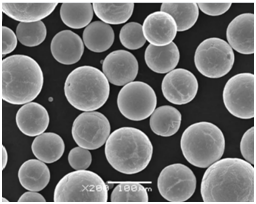
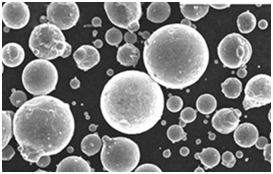
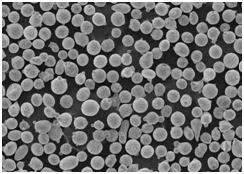
| 形状検査 | SEM and image analysis | Mostly spherical particles; limited satellites or irregulars | Supports flow, packing, and stable energy coupling |
| Oxygen / contamination review | Inert gas fusion, microscopy, handling controls | Low oxygen and minimized inclusions or foreign particles | Important for copper AM quality and repeatability |
GA, PREP, and Route Selection
Gas atomization is typically the most practical commercial route for spherical copper alloy powders because it can balance output, morphology, and cost. PREP is better known in some reactive or high-cleanliness spherical powder applications, but its fit depends on alloy system, production scale, and target size range. The practical question for GRCop42 is not which acronym sounds most advanced; it is whether the chosen route can repeatedly deliver the chemistry, PSD, and cleanliness the application requires.
Inspection Priorities for Additive Manufacturing Powder
For LPBF users, the leading concerns are often fines management, layer-spreading consistency, and oxygen pickup during reuse. For DED users, feeder behavior, coarse-fraction control, and powder delivery stability often dominate. In both cases, the feedstock should be evaluated within a consistent AM vocabulary and test framework, which is one reason engineers often refer to NIST additive manufacturing research そして NASA technical reporting on GRCop-42 printing when building qualification plans.
Reuse, Recycling, and Lot Control
Powder reuse can improve economics, but copper alloy powders should be recycled carefully. Repeated exposure to build atmospheres and handling steps can change fines content, oxygen level, and flow behavior, all of which may alter build stability or final part properties. For GRCop42 programs, a disciplined reuse protocol usually includes sieving rules, blend ratios, periodic interstitial checks, and traceable lot histories rather than an open-ended recycling loop.
なぜサプライヤーとしてTruerを選ぶべきなのか
From a technical sourcing standpoint, the main reason to evaluate a supplier for GRCop42 copper alloy powder is process understanding rather than catalog breadth alone. A suitable supplier should be able to discuss how a copper-chromium-niobium AM powder differs from generic copper feedstock in terms of oxygen management, particle morphology, process-specific PSD selection, and documentation expectations for LPBF, DED, PM, and cladding routes.
Within that framework, Shanghai Truer Technology is relevant because its published capability set includes spherical metal powders, gas-atomization-related capability, PREP powder-making equipment, and familiarity with SLM, SEBM, DED, laser cladding, PM, MIM, HIP, and spraying workflows. For readers who want a factual overview of the company’s equipment orientation and AM background, the Truer company profile provides the baseline context.
ご注文ガイドとサポート
A useful RFQ for GRCop42 copper alloy powder should define the process route first and the packaging second. Buyers should specify LPBF, DED, PM, cladding, or other use; the preferred PSD window; oxygen or impurity limits; target lot size; and the level of documentation required for qualification. That approach is much more effective than requesting “GRCop42 powder” with no process details attached.
Typical Ordering Framework
| パッケージング | MOQ Tier | リードタイム | Sample Policy | 典型的な使用例 |
|---|---|---|---|---|
| 250 g sealed bottle | Lab screening | 1–2 weeks typical | Paid sample with basic COA | Early chemistry, morphology, and flow review |
| 500 g to 1 kg inert-packed can | R&D qualification | 2–3 weeks typical | Sample lot with PSD and chemistry data | Parameter development and coupon builds |
| 5 kg vacuum or argon-packed container | Pilot program | 3–5 weeks typical | Retained sample recommended | Repeated AM trials or feeder setup |
| 20 kg+ industrial packaging | Pre-production / production | 4–8 weeks typical | Batch approval plan advised | Multi-build campaigns and formal lot qualification |
Information That Should Be in the RFQ
The most useful RFQs include machine model, energy source, intended wall thickness, part function, and post-processing route. For aerospace or propulsion work, it is also wise to define traceability needs, acceptable certificate content, and whether the powder will be used virgin-only or within a managed reuse strategy.
When a project needs direct technical discussion on PSD, packaging, or qualification scope, the appropriate route is the 技術に関するお問い合わせページ. That is especially helpful when the same program is also comparing copper with stainless or aluminum options for adjacent parts in the assembly, such as stainless powder materials or heat-management-oriented aluminum grades.
当社
Shanghai Truer Technology Co., Ltd. was established in 2009 and created its additive manufacturing business in 2019. The company focuses on integrating 3D-printing powder-making equipment and services with 3D-printing powders for engineering applications. Its core technologies include Selective Electron Beam Melting equipment, Plasma Rotating Electrode Process powder-making equipment, and gas atomization-related capability. The company’s powder portfolio includes TiNi, TiTa, TiAl, TiNbZr, CoCrMo, and spherical nickel-based, cobalt-based, titanium-based, copper-based, aluminum-based, and stainless steel powders for use in SLM, SEBM, DED, laser cladding, powder metallurgy, MIM, HIP, cold or hot spraying, welding, and coating in industries such as 3C electronics, hand tools, remote control cars, medical, aerospace, and nuclear power.
よくある質問
Q1. What is GRCop42 copper alloy powder used for most often?
Its best-known use is in rocket propulsion hardware such as combustion chamber liners, injector faceplates, and related high-heat-flux components. NASA publications consistently associate GRCop-42 with additive manufacturing routes for regenerative-cooled chamber hardware and other thermally demanding aerospace parts.
Q2. Is GRCop42 copper alloy powder better than pure copper for AM?
For components where maximum conductivity is the only target, pure copper may still be attractive. GRCop42 is usually chosen when the part must also keep useful strength and creep resistance at elevated temperature, especially in propulsion-style service where heat flux and structural loading occur together.
Q3. Can GRCop42 copper alloy powder be printed by LPBF and DED?
Yes. NASA has reported near-fully-dense powder bed fusion builds of GRCop-42, and other NASA/NIST work discusses directed energy deposition, including blown-powder DED and bimetallic builds involving GRCop-42.
Q4. What makes high-quality GRCop42 powder for additive manufacturing?
High-quality lots generally combine correct Cu-Cr-Nb chemistry, low oxygen, spherical morphology, a process-appropriate PSD, and low contamination. NASA characterization work specifically emphasizes minimizing contamination such as trace elements and ceramic inclusions for this alloy family.
Q5. Does GRCop42 copper alloy powder have a universal ASTM or AMS equivalent?
Not in the same straightforward way as many common stainless or nickel grades. In practice, the alloy is usually referenced by its NASA designation and nominal chemistry, with the purchasing specification built around AM powder characteristics and project qualification requirements.
Q6. What should buyers request on a GRCop42 powder certificate?
At minimum, they should request Cu, Cr, and Nb chemistry, particle-size distribution, and oxygen data. For serious AM qualification, it is also sensible to ask for morphology information, handling or packaging condition, and any contamination-control records relevant to the lot.
Learn more:
- Characterization of Additively Manufacture GRCop-42 and GRCop-84 – NASA Technical Reports Server (NTRS)
- Investigation of Additive Manufactured GRCop-42 Alloy Developed by Directed Energy Deposition Methods – NASA Technical Reports Server (NTRS)
- Three-Dimensional Printing GRCop-42 – NASA Technical Reports Server (NTRS)
- ISO/ASTM 52900:2021 – Additive manufacturing — General principles — Fundamentals and vocabulary
- 3D Printed Rocket Launched Using Innovative NASA Alloy – NASA
- Effects of Deposition Sequence on Microstructural Formation in Additively Manufactured GRCop-42 / Alloy 718 Bimetallic Structures | NIST