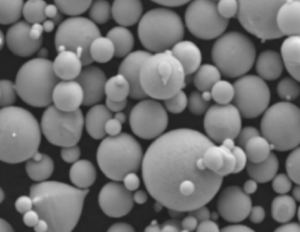
簡単な回答
CMSX-4 PREP spherical powder is the crucible-free powder form of CMSX-4, a second-generation rhenium-bearing single-crystal superalloy that has served as the industry benchmark for turbine blade temperature capability since the 1990s. With roughly 70 volume percent gamma prime and 3 weight percent rhenium, the alloy sustains metal temperatures to 1100-1150 C in single-crystal blade service, and PREP production delivers the powder with sphericity above 0.95, oxygen at or below 150 ppm, and essentially zero ceramic inclusions. The powder is used primarily for single-crystal and directionally solidified blade repair by epitaxial laser cladding and DED, for HIP-consolidated high-integrity components, and for the additive manufacturing research programs now qualifying repair schemes on some of the most valuable rotating hardware in aerospace and power generation.
| プロパティ | 価値 |
|---|---|
| 合金システム | 2nd-generation Re-bearing SX superalloy |
| Rhenium Content | ~3 wt% |
| ガンマ・プライム・フラクション | ~70 vol% |
| 密度 | 8.70 g/cm3 |
| Typical Powder Size (DED/repair) | 45-106 um, 53-150 um |
| 真円度(PREP) | >= 0.95 |
| 酸素含有量 | <= 150 ppm |
| Max Metal Temperature (SX blade) | 1100-1150 C |
| 主な利点 | Benchmark single-crystal creep and fatigue capability |
What Is CMSX-4 PREP Spherical Powder and Its Material Benefits
CMSX-4 PREP spherical powder は~に属する ニッケル系粉末 family and replicates the chemistry of CMSX-4, the Cannon-Muskegon second-generation single-crystal alloy that, together with PWA 1484 and Rene N5, defines the performance class for first-stage turbine blades in modern aero engines and industrial gas turbines. The alloy’s capability comes from three design decisions: roughly 70 volume percent of ordered gamma prime for creep strength, 3 weight percent rhenium for solid-solution strengthening and slowed coarsening, and a deliberate reduction of chromium balanced by aluminum to preserve oxidation resistance at extreme metal temperatures.
Converting this chemistry to powder by the プラズマ回転電極法(PREP) serves a specific purpose. Single-crystal blades are among the most expensive components in any engine, and repairing rather than replacing them depends on depositing chemistry-matched material that can re-grow the parent single-crystal structure epitaxially. That repair demands powder of exceptional cleanliness, because any ceramic inclusion or oxide contamination becomes a nucleation site for stray grains that destroy single-crystal integrity. PREP’s crucible-free melting is the practical way to achieve it.
The powder’s material benefits for engineering programs include:
- Benchmark temperature capability. No widely qualified alloy carries sustained blade loads at higher metal temperature, and the alloy’s decades of flight and field data underpin repair-scheme qualification.
- Epitaxial repair compatibility. Chemistry-matched deposits re-grow the parent SX orientation under controlled laser cladding, restoring blade tips, squealers, and platform edges.
- Exceptional powder purity. PREP particles are free of the crucible-derived inclusions that would seed stray grains, with oxygen at or below 150 ppm.
- Stable, transformation-free matrix. The nickel-based FCC matrix with coherent gamma prime shows no detrimental phase changes through service thermal cycles.
- HIP consolidation route. Powder metallurgy consolidation produces fine, homogeneous microstructures for small high-integrity components where single-crystal casting is impractical.
A note on naming helps avoid procurement confusion: CMSX is a Cannon-Muskegon trademark, and the same second-generation performance class includes PWA 1484 and Rene N5 from other developers. These alloys are not chemically interchangeable, and repair specifications always name the exact parent alloy, so powder orders should reference the specific grade and governing repair document rather than the performance class.
One candid limitation applies: CMSX-4 is a non-weldable-class alloy by conventional standards, and its additive processing, whether repair deposition or HIP, requires tightly controlled thermal conditions. It is not an LPBF production alloy, and buyers should plan process development accordingly.
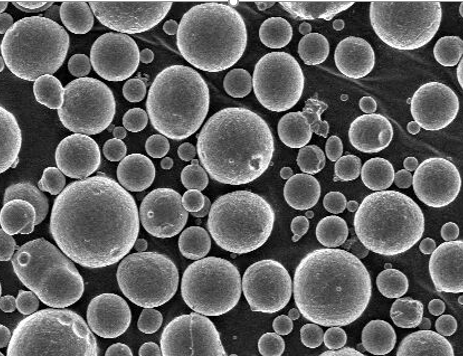
化学組成の概要と元素の機能に関する参考情報
The CMSX-4 composition is a precision balance in which rhenium, tantalum, and tungsten carry the high-temperature strength while aluminum sustains the protective oxide scale.
Chemical Composition of CMSX-4
| エレメント | Min (wt%) | Max (wt%) | 役割 |
|---|---|---|---|
| Ni | バランス | バランス | FCC gamma matrix hosting the gamma prime precipitates |
| Cr | 6.0 | 7.0 | Oxidation and hot-corrosion contribution; limited to preserve gamma prime stability |
| Co | 8.5 | 9.5 | Raises gamma prime solvus; improves microstructural stability |
| Mo | 0.4 | 0.8 | Gamma-matrix solid-solution strengthener |
| W | 5.5 | 6.5 | Heavy solid-solution strengthener; partitions to the matrix |
| タ | 6.0 | 7.0 | Potent gamma prime former; raises creep strength and phase stability |
| Al | 5.4 | 5.8 | Primary gamma prime former; sustains the protective Al2O3 scale |
| Ti | 0.8 | 1.2 | Gamma prime former; substitutes into the precipitate phase |
| レ | 2.8 | 3.2 | Signature second-generation addition; slows diffusion, coarsening, and creep |
| Hf | 0.08 | 0.15 | Trace grain-boundary and deposit-adhesion benefits in repair contexts |
| C | – | 0.006 | Essentially eliminated in SX practice; powder-grade limit |
Three features distinguish this chemistry from earlier blade alloys. First, rhenium at 3 percent is the defining second-generation element: it partitions to the gamma matrix, retards gamma prime coarsening, and is credited with the majority of the alloy’s creep advantage over first-generation single-crystal alloys. Second, chromium at 6.5 percent is deliberately low by superalloy standards, trading hot-corrosion margin for phase stability, which is why blades in this alloy are always aluminide- or MCrAlY-coated in service. Third, carbon is essentially absent, since single-crystal castings have no grain boundaries to strengthen, and powder lots should be checked against the very low carbon limit to avoid carbide-induced stray grain formation in repair deposits.
標準試験温度における物理的および機械的特性
The data below consolidate single-crystal reference values in the [001] orientation and typical HIP-consolidated polycrystalline values, at standard test temperature (23 +/- 5 C) where applicable.
主要物件
| プロパティ | 価値 | 単位 |
|---|---|---|
| 密度 | 8.70 | g/cm3 |
| Liquidus / Solidus | ~1380 / ~1330 | C |
| ガンマ・プライム・ソルバス | ~1290-1320 | C |
| 熱伝導率(RT) | ~10 | W・m・K |
| Young’s Modulus [001] (RT) | ~125 | GPa |
| Yield Strength (RT, SX) | 950-1050 | MPa |
| Tensile Strength (RT, SX) | 1050-1150 | MPa |
| Elongation (RT, SX) | 10-18 | % |
| Yield Strength (1000 C, SX) | 700-800 | MPa |
| Creep Rupture (1100 C / 137 MPa, SX) | >250 | h |
| 硬度(熱処理後) | 420-470 | HV |
| Max Metal Temperature (coated SX blade) | 1100-1150 | C |
Two aspects of this property set matter most. First, the high-temperature figures are the alloy’s reason to exist: creep rupture life exceeding 250 hours at 1100 C and 137 MPa in single-crystal form is the benchmark against which every newer blade alloy is measured, and it is preserved in properly processed powder-consolidated and repair material. Second, the anisotropic elastic behavior of the single crystal, with a [001] modulus near 125 GPa, is a design input for blade dynamics rather than a defect, and repair deposits that re-grow the parent orientation preserve it.
Heat treatment practice for the alloy uses solution temperatures very close to the gamma prime solvus, typically 1277-1320 C in multi-step cycles, followed by two-stage aging. Repair and HIP material follows equivalent cycles, and buyers should confirm the recommended cycle for powder-consolidated material, since the finer starting microstructure can shorten solution times.
It is also worth repeating that these properties describe the bare alloy. In engine service the material always operates beneath an aluminide or MCrAlY bond coat and usually a thermal barrier top coat, because its deliberately low chromium content leaves it dependent on coating for oxidation and hot-corrosion protection. Component lifetime calculations should therefore treat alloy and coating as a system, a consideration that applies equally to repaired regions, where coating must be stripped and reapplied around the deposited material.
粉末の仕様:粒度分布およびグレードの取り扱い状況
CMSX-4 PREP powder is a made-to-order premium product supplied in fractions matched to repair deposition and HIP consolidation.
利用可能な仕様
| パラメータ | 標準/値 |
|---|---|
| Particle Size Distribution (DED/laser cladding) | 45-106 um, 53-150 um |
| Particle Size Distribution (HIP) | 45~106 μm |
| 粒子径分布(溶射) | 20~75 µm |
| 球形度 | >= 0.95 |
| 見かけ密度 | >= 4.8 g/cm³ |
| タップ密度 | >= 5.3 g/cm³ |
| ホールの流量 | <= 14 秒/50g |
| 酸素含有量 | <= 150 ppm |
| 窒素含有量 | <= 100 ppm |
| 中空粒子率 | 極めて低い(遠心凝固) |
| セラミック含有量 | 実質的にゼロ(るつぼ不要) |
| グレード・オプション | Standard CMSX-4; SX-repair certified grade; low-Hf variants on request |
| パッケージング | Vacuum-sealed, argon-flushed, 5-25 kg |
The SX-repair certified grade is the specification most repair shops order: it adds enhanced inclusion inspection, tighter satellite limits, and documentation formatted for engine-OEM repair qualification, since stray-grain control begins with powder quality. Thermal spray fractions serve MCrAlY-adjacent bond-coat research rather than production blade coating.
PREP’s naturally coarse and narrow distribution suits repair deposition well, because stable, pulse-free powder feeding through small cladding nozzles depends on exactly this morphology. Buyers accustomed to GA powder pricing should note that CMSX-4 PREP powder carries both the rhenium raw-material premium and the PREP process premium, and typical order quantities of 5-25 kg reflect its use in high-value, low-volume repair campaigns. Storage is straightforward but disciplined: containers are opened only in dry inert conditions, partially used lots are resealed under argon, and powder exposed to humid shop air is requalified before use on certified repairs.
溶融から最終的な粉末製品に至るまでの製造工程
Production begins with a vacuum-induction-melted CMSX-4 electrode bar, itself produced from virgin master-alloy stock under the tight chemistry control single-crystal alloys demand. The bar is mounted in the PREP chamber, rotated at high speed, and its tip melted by a plasma arc; centrifugal force ejects molten droplets that spheroidize and solidify in the argon atmosphere without contacting any crucible, nozzle, or wall material.
This crucible-free sequence is the entire point for this alloy. Aluminum, titanium, tantalum, and hafnium are all reactive with oxide refractories, and any ceramic particle entrained from contact melting would survive into the repair deposit as a stray-grain nucleation site. PREP eliminates that failure mode at the source, and oxygen pickup is limited to the low hundreds of parts per million or below.
Post-atomization processing follows a controlled sequence:
- 分類 by sieving and air separation isolates the specified fractions, with fines strictly limited to protect feeding stability.
- 流量および密度の検証 confirms Hall flow, apparent density, and tap density.
- 包括的な化学分析 by ICP-OES and inert gas fusion certifies all eleven controlled elements including rhenium, plus oxygen and nitrogen.
- 形状検査 by SEM verifies sphericity, satellite levels, and surface condition.
- 内部品質審査 by metallographic cross-section or X-ray CT quantifies hollow particles on repair-certified lots.
- 不活性包装 in argon-flushed, vacuum-sealed containers protects the powder through storage and international transport.
Because rhenium is among the most expensive elements in the periodic table, buyers should expect suppliers to confirm the certified rhenium content lot by lot and to provide full traceability from master alloy to finished powder. 遺伝的アルゴリズム-produced CMSX-4 is a lower-cost alternative where repair certification permits it, with somewhat higher oxygen and inclusion levels accepted in exchange for finer available fractions and better pricing.
業界別用途 積層造形 最終用途市場
CMSX-4 PREP powder serves a concentrated set of very high-value applications. Sector context is available on the アプリケーション ページを参照されたい。
Aero engine blade repair. The dominant application. Epitaxial laser cladding and DED with chemistry-matched powder restore worn blade tips, damaged squealer teeth, and eroded platform edges on single-crystal CMSX-4 blades from CFM56, V2500, and later engine families, at a fraction of replacement cost. Each repaired blade avoids a five-figure replacement, which is why repair schemes tolerate premium powder pricing, and why powder certification is written into the repair specification.
Industrial gas turbine MRO. Frame-engine first-stage blades and vanes in CMSX-4 and equivalent alloys undergo the same repair logic at longer overhaul intervals. The power-generation sector is the faster-growing powder consumer, as fleet operators extend blade life beyond original design limits through repeated repair cycles.
HIP-consolidated high-integrity components. Small turbine-engine and auxiliary-power-unit components that are impractical to single-crystal cast, such as seal segments, nozzles, and test hardware, are produced by HIP consolidation of the powder followed by full heat treatment, delivering fine, homogeneous microstructures with cast-equivalent creep capability.
Research and next-generation qualification. Universities, engine OEMs, and repair-technology developers order CMSX-4 PREP powder to advance epitaxial AM processes, graded-composition repairs, and hybrid manufacturing schemes, making it one of the reference materials in the single-crystal additive literature.
Emerging adjacent markets. Concentrated-solar and advanced energy-conversion concepts that push metal temperatures beyond conventional superalloy limits are evaluating the alloy for printed hot-section prototypes, though cost currently confines serious use to the blade and repair markets.
Across all these end uses, the commercial logic is the same: the powder is purchased against the value of the hardware it restores or replaces, not against commodity powder benchmarks. A repair campaign consuming a few kilograms of certified powder can return dozens of blades to service, which is why supply reliability and lot consistency matter more to buyers than marginal price differences between qualified sources.
対象用途分野における代替グレードとの比較
Selection around CMSX-4 typically benchmarks it against first-generation SX alloys, the third-generation Re-plus-Ru alloys, and the polycrystalline high-strength cast alloys such as Inconel 738LC and MAR-M247.
CMSX-4 vs Alternative Blade Alloys
| プロパティ | CMSX-4 (2nd gen SX) | CMSX-2 (1st gen SX) | CMSX-10 (3rd gen SX) | MAR-M247 (DS/poly) |
|---|---|---|---|---|
| 密度(g/cm³) | 8.70 | 8.56 | 9.05 | 8.54 |
| Re Content (wt%) | 3 | 0 | 6 (+Ru) | 0 |
| ガンマ・プライム(vol%) | ~70 | ~65 | ~70 | ~65-70 |
| Creep Rupture (1100 C/137 MPa, h) | >250 | ~100 | >350 (SX) | ~50-100 (DS) |
| Repair Deposition Compatibility | 設立 | 設立 | 限定 | Established (poly) |
| 粉末の相対コスト | 非常に高い | 高い | エクストリーム | 高い |
| Qualification Data Depth | 広範囲 | 広範囲 | 成長 | 広範囲 |
Against first-generation CMSX-2, the rhenium addition roughly doubles creep life at temperature, which is why second-generation alloys displaced their predecessors in new blade designs. Against third-generation CMSX-10, it concedes the next increment of capability but offers far deeper qualification data, lower cost, and established repair infrastructure, so it remains the higher-volume repair alloy. Against MAR-M247 and the polycrystalline class, it provides the single-crystal temperature step that grain boundaries in those alloys cannot survive, though the polycrystalline alloys repair more forgivingly where single-crystal integrity is not required.
The selection rule for powder buyers is driven by the parent hardware: chemistry-matched repair of CMSX-4 blades mandates CMSX-4 powder, and the decision is therefore made by the fleet being serviced rather than by alloy comparison.
当社
上海Truer Technology Co., Ltd 中国を拠点とする積層造形サプライヤーであり、PREP粉末製造装置と高品質な球状金属粉末を統合しています。2009年に設立された同社は、以下の両方を提供しており、 ガスアトマイズ法(GA) そして PREP ニッケル合金、チタン合金、アルミニウム合金、ステンレス鋼、コバルト合金、銅合金、高エントロピー合金、および特殊材料にわたる製造能力。.
Truer社は、航空宇宙、医療用インプラント、石油・ガス、自動車などの業界向けに、カスタム合金の開発、小ロットの試作、および量産サービスを提供しています。同社は、一流の研究機関と提携し、金属3Dプリンティングに関する共同イノベーションセンターを運営しています。.
For inquiries about CMSX-4 PREP spherical powder or other metal powder requirements, チームにお問い合わせください.
よくある質問
Q1: What is the typical particle size distribution for CMSX-4 PREP spherical powder? A: The standard PREP cuts are 45-106 um for HIP and 53-150 um for DED and laser cladding repair, with 20-75 um fractions available for thermal spray research. PREP produces a naturally coarse, narrow distribution with very few fines, which supports stable, pulse-free feeding in small cladding nozzles.
Q2: Can CMSX-4 powder be used in LPBF systems? A: LPBF is not the normal route for this alloy. Its very high gamma prime content makes it crack-prone in powder bed fusion, and its value lies in single-crystal or directionally solidified structures that conventional LPBF cannot yet reliably reproduce. The powder is used for epitaxial repair deposition and HIP consolidation instead.
Q3: What certifications does CMSX-4 PREP powder come with? A: Every lot ships with a certificate of analysis covering full eleven-element chemistry including rhenium, oxygen and nitrogen content, PSD, flow, and density data. The SX-repair certified grade adds enhanced inclusion inspection, X-ray CT hollow-particle screening, and documentation formatted for engine-OEM repair qualification.
Q4: What is the MOQ for ordering CMSX-4 PREP powder? A: Typical minimum quantities are 5-10 kg, reflecting the alloy’s use in low-volume, high-value repair campaigns where a single lot may service months of deposition work. Pricing carries both the rhenium raw-material premium and the PREP process premium, and campaign pricing improves at 25 kg and above.
Q5: Can the composition of CMSX-4 be customized? A: Yes, within limits. Hafnium and trace-element levels can be adjusted for specific repair schemes, and related second-generation chemistries can be produced through the supplier’s custom alloy development service. The base rhenium level is generally maintained, since it defines the alloy’s performance class.
Q6: What is the typical lead time for CMSX-4 PREP powder orders? A: Production is made to order and typically requires eight to twelve weeks, reflecting electrode bar preparation, PREP conversion scheduling, and the full certification package. Repair shops with recurring demand commonly hold consignment stock or framework arrangements to shorten effective lead time.