Réponse rapide
IN939 powder for additive manufacturing is a nickel-based superalloy powder developed for parts that must retain strength, resist oxidation, and survive thermal cycling at elevated temperatures. It is a strong choice for additive manufacturing when the application involves turbine-adjacent hardware, combustion components, repair builds, or other heat-stressed geometries where standard nickel powders may not offer enough high-temperature capability. In practice, the alloy is selected less for ease of printing and more for its ability to support demanding service conditions after proper processing and heat treatment.
What Is IN939 powder for additive manufacturing?
IN939 powder for additive manufacturing is the powder-feedstock form of Inconel 939, a precipitation-strengthened nickel-based superalloy used in severe thermal environments. In wrought and cast product discussions, the alloy is known for combining oxidation resistance, hot-corrosion resistance, and useful creep strength. In powder form, it becomes relevant to metal additive manufacturing, repair deposition, powder metallurgy, and near-net-shape fabrication strategies.
The designation “IN939” is widely used in industry as shorthand for a complex nickel superalloy chemistry centered on nickel, chromium, cobalt, tungsten, titanium, aluminum, tantalum, and controlled minor additions. Its metallurgy is built around the same high-temperature design logic that drives many advanced turbine alloys: strong matrix stability, controlled carbide behavior, and precipitation hardening through gamma-prime formation. That is why the alloy appears far more often in hot-section engineering conversations than in general corrosion-service applications.
Why IN939 exists as a distinct AM powder option
The alloy exists because some environments are too aggressive for general-purpose nickel materials. A component may face simultaneous exposure to high temperature, oxidation, thermal fatigue, and combustion by-products, all while still carrying load or maintaining dimensional stability. Under those conditions, the decision is not simply about corrosion resistance; it is about whether the material can keep working after prolonged thermal exposure.
That need translates directly into powder demand. Once engineers want the design freedom of additive manufacturing or the flexibility of repair deposition, the alloy must be supplied in a feedstock form that can spread, flow, melt, and consolidate consistently. This is where high-temperature nickel superalloy powder differs from conventional metal powder supply: chemistry, morphology, gas content, and particle distribution all become process-critical.
IN939 in the broader superalloy family
Within the wider nickel alloy landscape, IN939 occupies a more temperature-driven niche than alloys often chosen for easier printing or broader corrosion-service duty. It competes not on simplicity, but on retained properties at heat. That distinction matters because many first-time buyers compare alloy names without considering how different their intended service windows actually are.
A useful process-level reference is the additive manufacturing process overview, which shows why powder feedstock requirements change across powder bed fusion, directed energy deposition, and related routes. The same alloy can behave very differently depending on particle size, feed mechanism, and thermal history.
What makes IN939 different from easier AM nickel grades
Compared with more forgiving nickel powders, IN939 usually demands tighter process control. Its precipitation-strengthening response gives it much of its value, but also means that build strategy, stress relief, and subsequent heat treatment matter more. Users typically evaluate not just density and surface finish, but also cracking tendency, residual stress behavior, and microstructural stability after thermal processing.
For that reason, IN939 powder for additive manufacturing is not a universal first-choice material. It becomes the right choice when performance at service temperature justifies the narrower process window. In sectors such as turbine repair, combustion hardware development, and heat-resistant industrial parts, that tradeoff is often entirely reasonable.
Chemical Composition and Material Grade
The behavior of IN939 powder for additive manufacturing is fundamentally controlled by chemistry. Unlike simpler alloys where one or two main elements define most of the property profile, IN939 depends on a carefully balanced multi-element system. Each major addition influences either environmental resistance, matrix stability, grain-boundary behavior, or precipitation hardening.
Typical chemistry of IN939 alloy powder
| Element or Specification Item | Poids typique : % | Metallurgical Role | Grade / Reference Note |
|---|---|---|---|
| Nickel (Ni) | Balance | Matrix phase | Base element of the alloy system |
| Chrome (Cr) | 22.0–23.0 | Oxidation and hot-corrosion resistance | Major environmental-resistance addition |
| Cobalt (Co) | 18.0–19.0 | Matrix stabilization and hot strength | Important at elevated temperature |
| Tungstène (W) | 1.8–2.3 | Solid-solution strengthening | Supports high-temperature capability |
| Molybdène (Mo) | 0.4–0.9 | Secondary strengthening | Lower than in some other nickel grades |
| Aluminium (Al) | 1.7–2.0 | Gamma-prime former | Essential to precipitation hardening |
| Titane (Ti) | 3.3–3.9 | Gamma-prime former | Major contributor to age hardening |
| Tantale (Ta) | 1.2–1.8 | Strengthening and phase stability | Valuable for hot-strength balance |
| Niobium (Nb) | 0.6–1.2 | Secondary strengthening contribution | Usually controlled within a narrow range |
| Carbone (C) | 0.10–0.18 | Carbide formation | Influences grain-boundary behavior |
| Bore (B) | 0.005–0.02 | Grain-boundary strengthening | Small addition, high importance |
| Zirconium (Zr) | 0.03–0.08 | Grain-boundary conditioning | Tight control preferred |
| ASTM reference | - | No single universal standalone AM powder grade | Often supplied to producer or buyer specification |
| AMS reference | - | Project-specific callout common | May be customer-defined rather than stock-listed |
| GB / ISO / DIN reference | - | Cross-reference varies by procurement route | No single globally dominant powder code |
The key point is that IN939 is not usually bought as a commodity metal powder. It is generally procured as a controlled superalloy feedstock to a producer specification, customer specification, or qualification package. That is especially true in additive manufacturing, where users care as much about how the powder performs in the machine as about the nominal alloy label on the certificate.
Why chemistry control matters in IN939 powder for additive manufacturing
IN939 derives much of its elevated-temperature performance from gamma-prime strengthening. Aluminum and titanium are central to that mechanism, while tantalum and other controlled additions support the broader high-temperature response. If those elements drift outside a practical operating window, the alloy may still resemble IN939 by name but behave differently during printing, heat treatment, or service.
Chromium and cobalt play equally important roles. Chromium underpins oxidation and hot-corrosion resistance, while cobalt helps stabilize the matrix and improve hot-strength characteristics. The alloy’s usefulness depends on the combined balance, not on any single standout element.
Interpreting “grade” in procurement documents
Buyers often expect a direct one-line mapping across ASTM, AMS, GB, ISO, and DIN systems. In reality, powder procurement for advanced superalloys is frequently more flexible than bar, plate, or casting procurement. The order may instead define composition limits, PSD, morphology, gas content, packaging, and inspection methods in one supplier-controlled technical data sheet.
That is why grade interpretation should start from end use. A lab trial, an LPBF parameter study, a DED repair project, and a production-scale cladding program may all request the same alloy name while asking for meaningfully different feedstock conditions. For IN939 powder for additive manufacturing, the full technical specification matters more than the shorthand alloy designation alone.
Spécifications techniques
Technical specifications determine whether powder that looks acceptable on paper will actually run well in production. Additive manufacturing feedstock must do several things at once: flow reliably, pack consistently, maintain chemistry, limit contamination, and melt in a predictable way. In superalloys, that balance becomes more critical because the part’s final performance depends on both material and process integrity.
Typical specification ranges for IN939 additive manufacturing powder
| Paramètres | 15–53 µm | 45–105 µm | 53–150 µm | Typical Notes |
|---|---|---|---|---|
| Typical process match | LPBF / SLM | DED / laser cladding | DED / larger-track deposition | Process-dependent selection |
| D10 | 15–19 µm | 45–55 µm | 53–65 µm | Laser diffraction typical |
| D50 | 28–34 µm | 68–80 µm | 88–104 µm | Median size typical |
| D90 | 48–53 µm | 100–105 µm | 145–150 µm | Upper size cut important |
| Densité apparente | 4.5–5.1 g/cm³ | 4.7–5.3 g/cm³ | 4.8–5.4 g/cm³ | Morphology dependent |
| Densité du robinet | 5.0–5.8 g/cm³ | 5.2–5.9 g/cm³ | 5.3–6.0 g/cm³ | Useful for packing behavior |
| Flux de Hall | 13–20 s/50 g | 11–18 s/50 g | 10–17 s/50 g | Typical for spherical fractions |
| Teneur en oxygène | ≤0.03 wt.% typical | ≤0.03 wt.% typical | ≤0.04 wt.% typical | Final limit by agreement |
| Teneur en azote | ≤0.02 wt.% typical | ≤0.02 wt.% typical | ≤0.02 wt.% typical | Low pickup preferred |
| Sphéricité | ≥0.93 typical | ≥0.93 typical | ≥0.93 typical | Image-analysis basis |
| Satellite content | Low typical | Low typical | Low typical | Affects spread and feed consistency |
| Packaging condition | Dry, inert-sealed | Dry, inert-sealed | Dry, inert-sealed | Storage discipline required |
These values are realistic for commercial superalloy powder discussions, but they should still be treated as typical rather than universal. Actual limits differ by production route, qualification stage, and buyer requirements. A powder for LPBF coupon work may not be optimized the same way as a powder intended for repair deposition on costly turbine hardware.
Particle size distribution and process fit
Particle size distribution is one of the most important variables in any AM feedstock. Finer fractions such as 15–53 µm are typically aimed at laser powder bed fusion because they spread into thinner layers and support finer feature resolution. Coarser cuts such as 45–105 µm or 53–150 µm are more commonly associated with directed energy deposition, laser cladding, or other feeder-based processes.
The practical takeaway is simple: specify the process before specifying the powder. The same alloy may be sold into LPBF, DED, PM, and repair markets, but each route places a different burden on particle-size selection. A PSD that works well in one platform may behave poorly in another.
Flowability, packing, and morphology
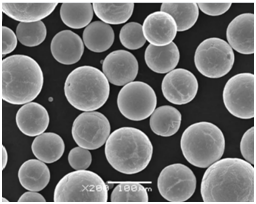
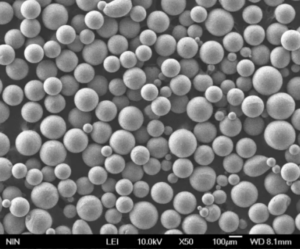
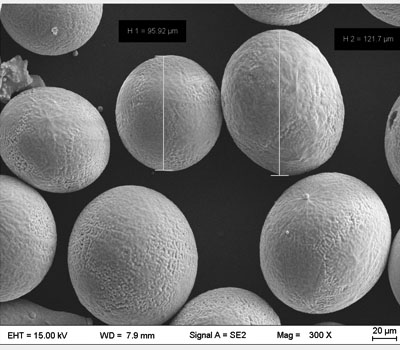
In powder metallurgy and additive manufacturing, spherical AM powder is valued because it tends to move more predictably through hoppers, recoaters, and feed systems. Better sphericity often means more stable layer formation in powder-bed systems and more consistent powder delivery in feeder-based systems. It does not guarantee success on its own, but it reduces one major source of variability.
Apparent density and tap density help users understand how the powder behaves during filling, vibration, and storage. Hall flow provides a standardized view of how readily the powder moves under test conditions. Together, these properties help distinguish a purpose-built AM feedstock from a merely atomized powder that may still be too irregular or inconsistent for reliable production use.
Gas content and surface condition
Gas content is especially important in nickel superalloys because oxygen and nitrogen pickup can affect melting behavior, cleanliness, and downstream part integrity. Surface oxides may interfere with ideal consolidation, particularly when the process window is already narrow. Moisture pickup during storage can create additional variability, which is why sealed packaging and controlled handling matter so much.
Surface condition also matters for reuse decisions. If a powder is cycled through multiple builds, users need to track how exposure changes oxygen content, particle distribution, and satellite population. For high-temperature alloys, reuse policy is not just an inventory issue; it is a quality-control issue.
Matching technical data to real production
A data sheet should never be read in isolation. The right specification depends on build geometry, machine power, layer thickness, atmosphere control, and the post-build thermal cycle. This is why serious qualification work typically combines powder characterization with coupon testing, metallography, density checks, and mechanical validation.
For engineers comparing alloy families, a broader nickel alloy powder range can be useful as a decision framework. It helps clarify whether the application truly needs IN939 or whether a less specialized nickel grade might deliver lower process risk.
Applications Across Industries
IN939 powder for additive manufacturing is mainly used where heat, oxidation, and long-term thermal exposure dominate design decisions. It is not the cheapest nickel feedstock and rarely the easiest to process, but it is often justified when service conditions are too severe for more general alloys. The strongest use cases therefore cluster around energy conversion, hot gas handling, and high-value repair work.
Typical applications by industry and process
| L'industrie | Typical Part | AM / PM Process | Why IN939 Is Used |
|---|---|---|---|
| Aérospatiale | Combustor features, hot-section hardware, shrouds | LPBF, DED, repair cladding | Strength retention and oxidation resistance at heat |
| Turbines à gaz industrielles | Vanes, segments, transition pieces, local rebuilds | DED, laser cladding | Good resistance to hot corrosion and thermal exposure |
| Production d'électricité | Burner parts, thermal shields, heat-resistant assemblies | DED, PM | Service stability in high-temperature gas environments |
| MRO and repair | Tip restoration, feature rebuild, dimensional recovery | DED, laser cladding | Extends service life of expensive components |
| Research and qualification | Coupons, parameter studies, alloy screening | LPBF, DED | Useful for superalloy process development |
| Advanced industrial equipment | Heat-exposed nozzles and structural zones | AM development, PM | Better hot-section capability than general nickel grades |
Aerospace and gas-turbine sectors are the most natural home for IN939 because those industries regularly face the failure modes the alloy was designed to resist. Components can see not only high static temperature, but also rapid thermal cycling, oxidizing atmospheres, and corrosion from combustion-derived species. In such cases, geometric freedom from AM and thermal durability from the alloy complement each other well.
IN939 powder for additive manufacturing in turbine-related parts
Turbine-adjacent applications are often the strongest economic case for IN939. These parts are expensive to replace, difficult to machine into complex shapes, and subject to conditions that punish lesser materials quickly. Additive manufacturing can reduce lead time for development builds and enable local feature restoration on worn hardware.
Not every turbine part is automatically suitable for the alloy or the process, of course. Engineers still need to evaluate crack sensitivity, post-build heat treatment, and final inspection requirements. But where the thermal environment is the main constraint, IN939 remains one of the more relevant superalloy powder options.
Repair, refurbishment, and life extension
Repair is one of the most practical uses for this alloy. Directed energy deposition and laser cladding allow operators to restore dimensions, rebuild worn zones, and return serviceable components to use without scrapping the entire part. That is especially valuable in sectors where large castings or turbine components have long replacement cycles.
In heat-critical AM applications, the real material question is not “Can it print?” but “Can it survive service after printing?”
A repair-focused specification may differ significantly from a powder-bed specification. Coarser PSD cuts, feeder-oriented flow targets, and process-specific release data often matter more than recoating behavior. Buyers should therefore state clearly whether the powder is intended for full-build manufacturing or component restoration.
Where other powder families may be more suitable
IN939 is not the right answer for every demanding application. If abrasion, galling, or edge wear is the dominant problem rather than sustained hot-gas exposure, cobalt alloy powder options may be more appropriate. If lightweighting is central to the design, especially outside the hottest zones, titanium metal powder grades may offer a better balance.
Likewise, some tooling, conductivity, or cost-driven programs may point to stainless, copper, or aluminum feedstocks instead. Proper alloy selection starts with the failure mode and service environment, not with the fact that a given powder can be sourced.
Manufacturing and Quality Assurance
The route used to make IN939 powder has a direct effect on its usability in additive manufacturing. Powder is not simply molten alloy broken into droplets; it is an engineered feedstock whose morphology, cleanliness, and particle-size distribution are shaped by the production method. For a superalloy with a relatively demanding process window, that production route becomes especially important.
Powder production route comparison
| Production Route | Typical Particle Shape | Relative Cleanliness | Main Advantage | Main Limitation |
|---|---|---|---|---|
| Gas Atomization (GA) | Spherical to near-spherical | Good with inert control | Scalable, widely used, practical AM supply route | Satellite population can vary |
| PRÉPARATION | Très sphérique | Très élevé | Excellent sphericity and low contamination tendency | Higher cost and different yield profile |
| VIGA | Sphérique | Très bon | Strong control of melt chemistry and atomization environment | Equipment-intensive process |
| Plasma-based specialty routes | Refined spherical fractions | Haut | Useful for premium feedstock tailoring | Availability may be narrower |
| Post-atomization classified powder | Process-tailored spherical fractions | Depends on upstream route | Better process matching after sieving and screening | Adds handling steps and QA burden |
Gas atomization is the most common industrial route because it offers a practical balance of throughput, cost, and powder quality. PREP is often associated with premium morphology and cleanliness, while VIGA is valued for precise control over the melt and atomization environment. The best route depends on the intended process, cost tolerance, and qualification target.
QA priorities for IN939 powder for additive manufacturing
Quality assurance for this alloy typically includes chemistry verification, PSD analysis, morphology review, apparent density, tap density, Hall flow, and gas-content measurement. Depending on application risk, buyers may also request moisture control data, contamination checks, and retained sample traceability. The objective is not merely to prove the powder exists within nominal limits, but to prove it behaves like a controlled AM feedstock.
Many procurement teams also align terminology with recognized references such as ASTM International standards resources et ASM International materials guidance. Those references do not replace customer qualification, but they help standardize how powder properties and test methods are described across suppliers and users.
Lot stability and traceability
For production AM and especially for repair of critical hardware, lot-to-lot traceability matters as much as nominal chemistry. If morphology, oxygen level, or size distribution shifts meaningfully between batches, a previously qualified machine parameter set may no longer deliver the same density or cracking response. That risk grows in superalloys because processing margins are often tighter than in simpler metals.
A strong traceability approach usually links melt source, atomization batch, sieve fraction, test report, and final packaging lot. This makes later investigations far more manageable if a part-level anomaly appears during build, heat treatment, or service.
Reuse and contamination control
Powder reuse is common in AM economics, but it must be managed carefully. Recycled fractions can shift in chemistry, pick up oxygen, or accumulate out-of-spec particles and spatter-derived contamination. For IN939 powder for additive manufacturing, those changes can matter more than they would in a more forgiving alloy.
The right reuse policy depends on build environment, sieving method, virgin-to-recycled ratio, and application criticality. Development builds may accept broader internal windows, while production or repair of heat-critical parts often demands tighter reuse discipline.
Why Choose Truer as Your Supplier
Supplier selection for IN939 powder for additive manufacturing should focus on process understanding as much as on alloy availability. A technically useful supplier must understand the difference between a fine powder-bed feedstock, a coarser deposition powder, and a repair-oriented fraction meant for feeder stability rather than thin-layer recoating. For buyers working with a demanding superalloy, that application alignment is often more valuable than a broad product list alone.
Truer is relevant in this context because its additive manufacturing activity spans both powder-related equipment and metal powder supply. That background is useful when the conversation includes atomization route, PREP relevance, SEBM compatibility, or the practical differences between SLM, DED, cladding, PM, and related processes. The Truer company profile provides a concise overview of that operating scope.
Another practical advantage is the ability to place IN939 within a broader materials decision process. Engineers seldom choose a superalloy in isolation; they often compare thermal, wear, weight, and cost tradeoffs across several families before finalizing a build plan. In that setting, application-specific powder support is more useful than a one-size-fits-all recommendation.
Ordering Guide and Support
A good purchase process starts with a clear technical brief. The buyer should define the manufacturing route, target PSD, intended use case, required inspection items, and expected order size before requesting a quote. For superalloys, this front-end clarity prevents delays and reduces the chance of receiving a powder optimized for the wrong machine or process class.
Typical packaging and commercial framework
| Format d'emballage | MOQ Tier | Typical Lead Time | Sample Policy |
|---|---|---|---|
| 500 g sealed bottle | Laboratory screening | 1–2 weeks if available | Paid sample typically possible |
| 1 kg sealed bottle | Initial process trials | 1–3 weeks typical | Same-lot sample data may be included |
| 5 kg inert-packed can | Development campaign | 2 à 4 semaines en général | Additional test report by agreement |
| 10 kg sealed drum | Pilot qualification | 3–5 weeks typical | Retained sample may be arranged |
| 25 kg sealed drum | Production planning or repair work | 3–6 weeks typical | COA and lot traceability per order |
| Custom export pack | Project or logistics-specific | By agreement | Project-specific sample terms |
For many users, the most efficient path is staged qualification. Start with a small lot to verify spreadability or feeder behavior, then move to coupon validation, then confirm microstructure and post-build properties before scaling up. This sequence reduces cost and helps isolate whether problems arise from the powder, the machine settings, or the heat-treatment path.
Information that improves quotation accuracy
A strong inquiry usually includes the machine type, process route, preferred particle-size range, annual consumption estimate, and any limits on oxygen or contamination. It should also state whether the order is for development, qualification, routine production, or repair. Those details materially affect the recommended PSD, documentation level, and packaging format.
When technical discussion is needed before ordering, the most direct route is the technical contact channel. For IN939 powder for additive manufacturing, early discussion about morphology targets, process matching, and certification format often prevents later rework.
Notre entreprise
Shanghai Truer Technology Co., Ltd. was established in 2009 and created its additive manufacturing business in 2019. The company integrates 3D printing powder-making equipment and services with metal powders for engineering applications of additive manufacturing. Its core technologies include Selective Electron Beam Melting equipment and Plasma Rotating Electrode Process powder-making equipment, with gas atomization also relevant to powder production. The company’s powder portfolio includes TiNi, TiTa, TiAl, TiNbZr, CoCrMo, as well as nickel-based, cobalt-based, titanium-based, copper-based, aluminum-based, and stainless steel spherical metal powders. It also participates in a joint innovation center for metal 3D printing with laboratories and experts, and serves processes including SLM, SEBM, DED, laser cladding, PM, MIM, HIP, cold or hot spraying, and welding or coating for industries such as 3C electronics, hand tools, remote-control cars, medical, aerospace, and nuclear power.
FAQ
Q1. Is IN939 powder for additive manufacturing mainly used for LPBF or DED?
It is used in both, but its strongest practical use cases are often associated with directed energy deposition, laser cladding, and repair-related work. LPBF is also possible, especially for development and specialized hot-section geometries, but it generally requires tighter parameter and post-processing control.
Q2. What makes IN939 different from more common nickel AM powders?
The main difference is its stronger focus on elevated-temperature performance rather than broad general-purpose printability. IN939 is typically considered when oxidation resistance, hot-corrosion resistance, and property retention at heat matter more than processing convenience.
Q3. What particle size is typical for IN939 powder for additive manufacturing?
For powder bed fusion, a fine cut such as 15–53 µm is common. For DED or laser cladding, coarser fractions such as 45–105 µm or 53–150 µm are more typical because feeder behavior and melt-pool capture become more important.
Q4. Does IN939 powder need heat treatment after printing?
In most serious engineering uses, yes. Because the alloy is precipitation-strengthened, the final property profile usually depends on a controlled post-build thermal cycle rather than on the as-built condition alone.
Q5. Can IN939 powder be reused in additive manufacturing?
It can be reused under a controlled powder-management program, but reuse limits should be based on measured changes in PSD, oxygen, and contamination rather than on guesswork. The stricter the application, the more carefully reuse should be qualified.
Q6. Is IN939 powder for additive manufacturing suitable for medical implants?
It is not typically selected for implant applications. Its main value is in high-temperature aerospace, energy, and industrial environments, not in the biocompatibility-centered material systems usually preferred for permanent implants.