Réponse rapide
IN738LC powder for directed energy deposition is a precipitation-strengthened nickel-based superalloy feedstock designed for high-temperature additive repair and build-up work. It is chosen when a DED process must restore or add material to components that operate under severe heat, oxidation, and mechanical load. In practical terms, engineers select it for turbine-class parts, hot-section hardware, and industrial repair programs because it offers better elevated-temperature capability than more general-purpose nickel alloys, while still being compatible with controlled laser-based deposition workflows.
What Is IN738LC powder for directed energy deposition?
IN738LC powder for directed energy deposition is a low-carbon nickel-based superalloy powder prepared for use in DED systems, including laser-based directed energy deposition and closely related laser cladding workflows. The alloy belongs to the gamma-prime-strengthened superalloy family developed for sustained service at temperatures where stainless steels and lower-strength nickel alloys begin to lose mechanical stability. In the additive context, the powder is used not only to create new geometry, but also to rebuild high-value surfaces, restore dimensions, and extend the life of thermally loaded parts.
The designation “LC” stands for low carbon. That suffix matters because carbon content influences carbide formation, grain-boundary behavior, and crack response during solidification and subsequent heat exposure. In an alloy already known for high hot-strength and complex chemistry, lowering carbon within a controlled range helps balance performance and manufacturability, especially where thermal cycling is unavoidable.
DED differs fundamentally from powder bed fusion. Rather than spreading a thin powder layer across a build plane, DED feeds powder directly into a melt pool created by a focused energy source. According to ISO/ASTM 52900 terminology, the process class covers techniques that deposit material as energy is applied, making it especially suitable for repair, near-net-shape build-up, and large-part feature addition.
That process difference explains why IN738LC powder for directed energy deposition is specified differently from powder intended for laser powder bed fusion. DED powders are usually coarser, more strongly optimized for flow through feeders and nozzles, and selected for reliable powder capture rather than for thin-layer spreading. A buyer evaluating this material should therefore think in terms of feeder behavior, bead stability, dilution control, and post-deposition cracking risk, not just nominal alloy identity.
From a metallurgical standpoint, IN738LC was developed for high-temperature environments where oxidation resistance, creep strength, and structural retention under long dwell times all matter at once. Chromium supports environmental resistance, while aluminum and titanium drive gamma-prime precipitation. Cobalt, tungsten, tantalum, niobium, molybdenum, boron, and zirconium contribute to the elevated-temperature balance that made the alloy historically important in turbine service.
This is also why the alloy is more demanding than easy-print nickel grades such as 625. IN738LC is selected because the application is difficult, not because the process is forgiving. When a part must survive in a hot zone and the deposition strategy must preserve that service intent, the alloy becomes relevant despite its narrower process window.
Why the DED form is strategically important
The importance of IN738LC powder for directed energy deposition is not only in new-part manufacturing. Much of its value appears in repair economics. In turbine maintenance, aerospace overhaul, and industrial power hardware, the ability to deposit the correct alloy only where needed can materially reduce scrap and shorten turnaround.
DED also enables geometry that would be inefficient in a casting-only repair route. Build-up on edges, seal lands, tip regions, and worn surfaces can often be achieved with less total material input than replacing an entire component. For users managing expensive assets, that localized deposition capability is often the real reason the powder is specified.
IN738LC versus broader superalloy choices
Not every high-temperature job needs IN738LC. Some components prioritize corrosion over creep, and some prioritize weldability over maximum hot strength. Compared with 625 or 718, however, in738lc is positioned further toward hot-section service, especially when the material must retain strength deeper into the elevated-temperature range.
The trade-off is process sensitivity. Gamma-prime-rich superalloys generally require stricter control of heat input, interpass temperature, substrate compatibility, and post-deposition heat treatment. Buyers should therefore treat this powder as part of an engineered repair or manufacturing route, not as a simple consumable.
Chemical Composition and Material Grade
The chemistry of IN738LC powder for directed energy deposition is central to its value. Unlike simpler nickel alloys, its performance comes from a carefully balanced composition that supports precipitation strengthening, oxidation resistance, and grain-boundary stability. For procurement, both the nominal alloy chemistry and the powder-specific controls matter, because DED performance depends on feedstock cleanliness and process consistency as much as on the alloy family name.
Typical IN738LC powder chemistry and grade references
| Objet | Poids typique : % | Function in Alloy | Grade / Cross-Reference Note |
|---|---|---|---|
| Nickel (Ni) | Balance | Matrix phase | Base element of the superalloy |
| Chrome (Cr) | 15.7–16.3 | Oxidation and hot-corrosion resistance | Typical IN738LC range |
| Cobalt (Co) | 8.0–9.0 | Matrix strengthening and stability | Typical IN738LC range |
| Tungstène (W) | 2.4–2.8 | Solid-solution strengthening | Typical IN738LC range |
| Molybdène (Mo) | 1.6–1.9 | Elevated-temperature strength | Typical IN738LC range |
| Tantale (Ta) | 1.5–2.0 | Gamma-prime support | Typical IN738LC range |
| Niobium (Nb) | 0.7–1.1 | Secondary strengthening | Typical IN738LC range |
| Aluminium (Al) | 3.2–3.7 | Gamma-prime former | Typical IN738LC range |
| Titane (Ti) | 3.2–3.7 | Gamma-prime former | Typical IN738LC range |
| Carbone (C) | 0.08–0.13 | Controlled carbide formation | Low-carbon “LC” version |
| Bore (B) | 0.005–0.015 | Grain-boundary strengthening | Minor addition, tightly controlled |
| Zirconium (Zr) | 0.03–0.10 | Grain-boundary conditioning | Minor addition, tightly controlled |
| ASTM reference | - | No single dedicated universal AM powder grade | Often ordered to supplier or project specification |
| AMS reference | - | No universal DED powder code used across all buyers | Customer drawing often governs |
| GB reference | - | May be handled by enterprise specification | Cross-reference varies by project |
| ISO reference | - | No one-to-one ISO powder material code for this feedstock | Process standards are separate |
| DIN / EN reference | - | Functional equivalence more common than direct code match | Chemistry verification is preferred |
The practical takeaway is that IN738LC powder for directed energy deposition is often purchased against a technical data sheet, customer specification, or jointly agreed purchase standard rather than a single universally adopted powder-grade number. That is common in advanced AM materials, where particle size, oxygen content, and morphology are just as important as elemental limits.
For this reason, buyers should never assume that an alloy name alone guarantees interchangeability. Two powders both labeled IN738LC may differ in particle size cut, cleanliness, sphericity, satellite content, and intended AM process. Those differences can be significant in DED, where feed stability and melt efficiency strongly affect deposit quality.
Why low carbon matters in this alloy family
The low-carbon variant exists for good metallurgical reasons. Carbon helps form carbides, which can support high-temperature behavior, but too much or poorly controlled distribution can aggravate brittleness and crack sensitivity at grain boundaries. In a DED environment with steep thermal gradients, that balance becomes especially important.
Low-carbon IN738LC therefore represents an optimized compromise. It retains the high-temperature design intent of the parent alloy family while helping manage the solidification and service behavior expected in repair and deposition applications. That does not make it easy to process, but it helps make the alloy more usable in practical additive workflows.
Chemistry control in deposited builds
In DED, incoming chemistry is only part of the story because the final deposit may be affected by dilution from the substrate. If the base component is a related nickel alloy, the composition shift may be manageable. If it is dissimilar or heavily repaired, however, the chemistry of early deposited layers can deviate enough to influence cracking response and final microstructure.
That is why experienced engineers qualify IN738LC powder for directed energy deposition together with the intended base material. Powder quality, substrate composition, and deposition strategy should be evaluated as one system rather than as separate purchasing decisions.
Spécifications techniques
Technical specifications for IN738LC powder for directed energy deposition must reflect how the powder behaves in the real machine environment. A DED powder must feed consistently, survive handling without excessive oxidation, and melt efficiently enough to form stable tracks. Because the process is dynamic, numbers such as particle-size distribution and Hall flow are not box-checking exercises; they are operating variables.
Typical technical specification for IN738LC powder for directed energy deposition
| Paramètres | 45–105 µm | 53–150 µm | 75–180 µm | Typical Comment |
|---|---|---|---|---|
| Recommended use | Fine-feature DED | General DED and repair | High-rate build-up | Equipment dependent |
| D10 | 45–55 µm | 53–65 µm | 75–90 µm | Typical laser diffraction |
| D50 | 68–80 µm | 88–105 µm | 115–135 µm | Typical median |
| D90 | 100–105 µm | 145–150 µm | 170–180 µm | Typical upper cut |
| Densité apparente | 4.7–5.2 g/cm³ | 4.8–5.3 g/cm³ | 4.9–5.4 g/cm³ | Morphology dependent |
| Densité du robinet | 5.2–5.8 g/cm³ | 5.3–5.9 g/cm³ | 5.4–6.0 g/cm³ | Typical packed density |
| Flux de Hall | 12–18 s/50 g | 11–17 s/50 g | 10–16 s/50 g | Typical for spherical material |
| Teneur en oxygène | ≤0.03 wt.% typical | ≤0.03 wt.% typical | ≤0.04 wt.% typical | Final limit by agreement |
| Teneur en azote | ≤0.02 wt.% typical | ≤0.02 wt.% typical | ≤0.02 wt.% typical | Low gas pickup preferred |
| Sphéricité | ≥0.93 typical | ≥0.93 typical | ≥0.93 typical | Image-analysis basis |
| Satellite level | Faible | Faible | Faible | Qualitative or image-based control |
| Packaging condition | Dry, sealed, inert preferred | Dry, sealed, inert preferred | Dry, sealed, inert preferred | Important for storage |
The most common commercial starting point for DED is often the 53–150 µm range, because it balances feeder transport, melting response, and deposition rate. Finer cuts may be preferred for smaller nozzles or tighter features, while coarser fractions can suit heavy build-up where throughput matters more than geometric precision.
Spherical powder behavior in DED systems
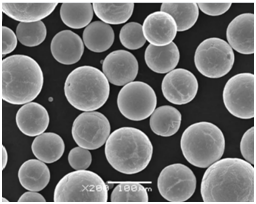
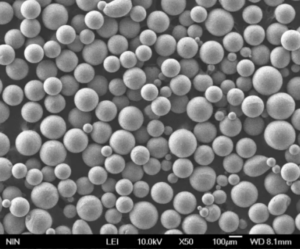
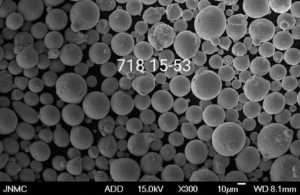
Spherical powder morphology matters because DED is a conveying process before it is a melting process. Powder must move from the hopper to the feeder, then through transport lines and a nozzle, often under carrier gas flow and vibration conditions that expose inconsistencies quickly. Particles with poor shape or too many satellites can cause unstable flow, nozzle fouling, and fluctuating mass delivery.
That instability shows up directly in the build. Bead height variation, waviness, inconsistent dilution, and higher porosity risk are all more likely when powder feed drifts. On a crack-sensitive superalloy, it is wise to eliminate feed-related variability wherever possible.
PSD selection by application
A repair on a thin edge or seal land may benefit from a somewhat finer cut because the operator needs better control over local material input. A large-area rebuild on a robust turbine structure may accept a coarser cut if the goal is deposition efficiency and machining stock. The “best” IN738LC powder for directed energy deposition is therefore contextual rather than universal.
This is also why buyers should specify nozzle type, feeder type, and preferred deposition mode when requesting quotations. A powder that performs well in one coaxial laser head may not behave identically in another. Machine-specific alignment is part of technical specification, not an afterthought.
Powder cleanliness and storage discipline
Low oxygen and low moisture are more important than many new users realize. Oxide contamination can influence wetting, melt behavior, and inclusion formation, especially in high-performance superalloys. Once a container is opened, handling practice becomes part of the material specification in practical terms.
For organizations comparing alloy systems, a broader nickel-based powder portfolio helps illustrate how feedstock is often offered in multiple particle-size windows for different AM routes. The same logic applies when comparing DED-ready superalloys with PBF-focused powders from other alloy families.
Applications Across Industries
IN738LC powder for directed energy deposition is used where temperature capability and part value justify a more demanding deposition alloy. It is not a general-purpose maintenance powder. Instead, it tends to appear in sectors where component replacement is costly, service conditions are extreme, and localized material addition can preserve an expensive asset.
Typical application map for IN738LC powder for directed energy deposition
| L'industrie | Typical Part | AM / PM Process | Primary Value of the Alloy |
|---|---|---|---|
| Aérospatiale | Turbine blade tips, vanes, shrouds | DED, laser cladding | High-temperature rebuild and feature recovery |
| Production d'électricité | Gas turbine nozzles, hot-section components | DED | Oxidation resistance and creep strength |
| Industrial turbomachinery | Seal lands, wear zones, dimensional restoration areas | DED, cladding | Localized repair on high-value hardware |
| Maintenance, repair, and overhaul | Edge repair, crack-removal rebuilds, surface restoration | DED | Extending component life |
| Energy equipment | Burner components, heat-resistant surfaces | DED | Sustained performance in hot service |
| R&D and prototyping | Process coupons, walls, benchmark builds | DED | Qualification of deposition parameters |
Aerospace remains the most visible application area because gas-path components combine high service temperature with strict economic pressure to recover parts when possible. In such cases, DED offers a route to rebuild only the damaged region rather than remanufacturing a full part from raw material. That is particularly attractive when the original component involves complex casting, long lead times, or limited availability.
Power generation uses the same logic at industrial scale. Turbine operators focus on uptime, maintenance intervals, and part turnaround. When a high-temperature alloy can be added locally and qualified properly, the operational value comes from restoring serviceable hardware faster than a full replacement chain would allow.
In hot-section repair, the deposited material is valuable because it preserves the component, not because it replaces design discipline.
Why DED often outperforms alternative repair routes
Conventional welding can be effective in many repair scenarios, but DED offers tighter digital control over deposition geometry and material addition. It can also be integrated with scanning, CNC motion, and near-net-shape strategies that reduce manual variability. For IN738LC, those controls matter because the process window is narrow and heat management is critical.
DED also supports hybrid manufacturing. A base component can be machined, repaired additively, and then finish-machined in a coordinated workflow. That flexibility makes IN738LC powder for directed energy deposition particularly relevant to maintenance-intensive industries.
Where adjacent powder families may be more suitable
Not every demanding service environment points to IN738LC. Severe wear conditions without very high structural temperature may be better served by cobalt-based alloy materials. Thermal conductivity-driven applications such as heat sinks or specialized energy hardware may shift toward copper alloys instead of nickel superalloys.
For broader engineering portfolios, comparison with titanium alloy powder grades is also useful, because material selection in AM is often driven as much by density and corrosion targets as by peak service temperature. IN738LC occupies the niche where hot strength and oxidation resistance dominate the selection logic.
Manufacturing and Quality Assurance
The performance of IN738LC powder for directed energy deposition starts with how the powder is made. For DED, the production route affects particle shape, internal porosity, cleanliness, and batch-to-batch consistency. Since the alloy already operates near the edge of processability, quality assurance must confirm not only chemistry but also behavior relevant to actual feeder-based deposition.
Powder production routes and their implications
Gas atomization is the most common industrial route for superalloy powder because it offers practical scalability and good control over particle morphology. Under inert conditions, molten alloy is atomized into droplets that solidify into mostly spherical particles. For DED, gas-atomized powder is often the baseline commercial option because it can be produced in useful volumes and classified into several particle-size ranges.
PREP, or plasma rotating electrode process, typically produces highly spherical particles with excellent cleanliness. It is often favored when contamination control and morphology are especially important, although availability, cost, and size distribution may differ from atomized powder. In advanced superalloys, PREP can be attractive where premium powder behavior is worth the process premium.
VIGA, or vacuum induction gas atomization, combines vacuum melting with inert-gas atomization and is valued for chemistry control and reduced gas contamination. For nickel superalloys containing multiple reactive or segregation-sensitive elements, that extra melting control can be meaningful. The best route depends on the final balance between performance target, quantity, and qualification pathway.
Typical quality assurance and process-release checks
| QA Test | Typical Instrument / Method | Objectif | Typical Acceptance Direction |
|---|---|---|---|
| composition chimique | ICP-OES, combustion analysis | Verify alloy chemistry | Within agreed limits |
| Distribution de la taille des particules | Diffraction laser, analyse granulométrique | Confirm DED cut | Inside ordered range |
| Morphology review | SEM, optical image analysis | Assess shape and satellites | Principalement sphérique |
| Densité apparente | Hall or Scott volumeter | Check bulk behavior | Stable within qualified window |
| Densité du robinet | Appareil de mesure de la densité de la prise | Check packing response | Stable within qualified window |
| Flux de Hall | Débitmètre à effet Hall | Screen transport behavior | Consistent, process-suitable flow |
| Oxygen / nitrogen | Fusion sous gaz inerte | Measure gas contamination | At or below specified maxima |
| Moisture / seal condition | Packaging inspection | Preserve storage integrity | Dry, sealed, traceable |
| Internal porosity review | Metallography, SEM | Detect hollow or defective particles | Low and controlled occurrence |
A certificate of analysis is necessary, but it is not sufficient. DED users should pay particular attention to morphology, oxygen level, and the relationship between PSD and feeder calibration. A powder that looks acceptable in a generic lab test may still behave poorly in a specific machine-nozzle setup.
Acceptance criteria should reflect the real use case
Repair-grade acceptance and development-grade acceptance are not always the same. An R&D lot may be suitable for parameter mapping even if the documentation package is lighter. A production lot intended for critical turbine repair may require stricter traceability, retained samples, and more tightly defined morphology review.
For standards context, engineers often use the ASTM materials standards catalog to align testing language and purchasing requirements. Many also consult ASM International resources on nickel superalloys when evaluating heat treatment, microstructure, and service behavior of precipitation-strengthened alloys.
Process qualification beyond powder inspection
Even high-quality powder cannot compensate for weak process control. Laser power stability, powder feeder calibration, shielding strategy, interpass temperature management, deposition path planning, and post-deposition heat treatment all influence cracking tendency and final microstructure. For that reason, process qualification should be performed on the same machine class, with the same feeder architecture, and ideally on the same substrate category intended for production.
This system view matters especially with IN738LC. DED deposits may see dilution effects, reheating cycles, and complex thermal histories that are not visible from incoming powder data alone. Successful use depends on matching powder quality to a validated deposition recipe.
Why Choose Truer as Your Supplier
A supplier for IN738LC powder for directed energy deposition should be evaluated on technical fit, production-route understanding, and the ability to align powder characteristics with the intended AM process. In this category, it is rarely enough to offer a nominal alloy name and a broad PSD claim. Buyers need clear discussion of particle morphology, cleanliness, size classification, and the downstream deposition context.
Truer is relevant in that discussion because its business spans metal powder supply as well as additive manufacturing equipment and powder-making technology. That background is useful when a purchaser needs to specify DED-ready feedstock rather than a generic spherical powder. A neutral company background page outlines the firm’s history, equipment focus, and metal-powder ecosystem.
From a procurement standpoint, the practical advantage is better specification alignment. For complex superalloys, misunderstandings about size cut, packaging atmosphere, or testing scope can delay qualification more than the alloy cost itself. The strongest supplier relationships reduce those errors through detailed technical communication.
A second consideration is portfolio breadth. Organizations working across multiple AM processes often source more than one alloy family at a time, and that broader context can help when comparing nickel superalloys with stainless, cobalt, titanium, copper, or aluminum systems. In that sense, process-aware supplier communication is often more valuable than a long catalog alone.
Ordering Guide and Support
Ordering IN738LC powder for directed energy deposition starts with defining the application clearly. The buyer should identify whether the powder is for repair, dimensional restoration, feature addition, or new near-net-shape builds; list the machine and feeder type; define the preferred particle-size cut; and state whether virgin powder only or controlled powder reuse is planned. These details affect not just price, but technical suitability.
Typical ordering framework
| Emballage | MOQ Tier | Typical Lead Time | Sample Policy |
|---|---|---|---|
| 500 g bottle | Lab evaluation | 1–2 weeks if available | Paid sample usually possible |
| 1 kg bottle | Initial parameter setup | 1–3 weeks typical | COA commonly included |
| 5 kg sealed can | DED trials and coupon builds | 2 à 4 semaines en général | Same-lot sample may be arranged |
| 10 kg drum | Pilot repair work | 3–5 weeks typical | Additional QA by request |
| 25 kg drum | Production or MRO use | 3–6 weeks typical | Documentation per purchase order |
| Custom inert pack | Export or special handling | By agreement | Project-specific sample terms |
A staged order plan is generally more sensible than jumping directly to volume purchase. First, qualify feeder stability and bead geometry. Next, confirm crack response, dilution behavior, and post-deposition properties on the intended substrate. Only then should a larger batch be locked for pilot or production work.
Buyers should also request clarity on documentation. Typical items include chemistry, PSD, oxygen level, density, flowability, lot traceability, and packaging condition. For critical programs, retained-sample availability and morphology data can be worth discussing before the first sample is shipped.
When those details need to be aligned with a live DED program, the most efficient route is often direct communication through the technical contact channel. For a demanding alloy like IN738LC, early clarification usually prevents costly rework later.
Notre entreprise
Shanghai Truer Technology Co., Ltd. was established in 2009 and created its additive manufacturing business in 2019. The company integrates 3D-printing powder-making equipment and services with metal powders for engineering applications of additive manufacturing. Its core technologies include Selective Electron Beam Melting equipment and Plasma Rotating Electrode Process powder-making equipment, with gas atomization also relevant to powder production. The powder portfolio includes TiNi, TiTa, TiAl, TiNbZr, CoCrMo, as well as nickel-based, cobalt-based, titanium-based, copper-based, aluminum-based, and stainless steel spherical metal powders. The company also participates in a joint innovation center for metal 3D printing with laboratories and experts, and serves end processes including SLM, SEBM, DED, laser cladding, PM, MIM, HIP, cold or hot spraying, and welding or coating across industries such as 3C electronics, hand tools, remote-control cars, medical, aerospace, and nuclear power.
FAQ
Q1. Is IN738LC powder for directed energy deposition mainly used for repair or for new parts?
It is used for both, but repair and dimensional restoration are among the most common applications. DED is especially attractive when a high-value hot-section part needs local material recovery rather than full replacement.
Q2. What particle size is typical for IN738LC powder for directed energy deposition?
Common DED cuts include 45–105 µm and 53–150 µm, with some higher-rate systems using coarser ranges. The correct choice depends on feeder design, nozzle geometry, desired bead size, and melting efficiency.
Q3. Why is IN738LC harder to process than alloys such as Inconel 625 or 718?
IN738LC is more heavily optimized for elevated-temperature strength through gamma-prime precipitation. That makes it more sensitive to thermal stress, cracking, and process-window control during deposition.
Q4. Can IN738LC powder for directed energy deposition be reused?
It can be reused in some workflows, but only under a controlled powder-management plan. Reused material should be screened and monitored for oxygen pickup, fines shift, and flowability changes before returning to critical production.
Q5. What properties should buyers check first when qualifying this powder?
The first checks usually include chemistry, particle-size distribution, morphology, oxygen content, and flow behavior. After that, the real qualification work should confirm deposit integrity, dilution effects, crack tendency, and post-heat-treatment response on the target substrate.
Q6. Is IN738LC powder for directed energy deposition suitable for medical parts?
It is generally associated far more with turbine, energy, and industrial hot-zone service than with medical implants. Its main value is high-temperature structural performance, not the biocompatibility-driven application profile seen with common medical titanium alloys.