Réponse rapide
CM247LC powder for directed energy deposition is a nickel-based superalloy powder designed for high-temperature additive manufacturing, repair, and feature build-up. It is chosen when the application demands strong creep resistance, oxidation performance, and thermal stability at service temperatures that exceed the practical range of easier-to-process alloys. In directed energy deposition, CM247LC is especially relevant for turbine-related components, localized restoration of expensive parts, and near-net-shape deposition where large geometry, repair access, or substrate integration make powder bed routes less suitable.
What Is CM247LC powder for directed energy deposition?
CM247LC powder for directed energy deposition is the feedstock form of the CM247LC superalloy prepared specifically for nozzle-fed deposition systems rather than for casting alone or for fine-layer powder bed fusion. CM247LC belongs to the family of gamma-prime-strengthened nickel superalloys developed for demanding thermal environments. In powder form, the alloy is engineered not only around chemistry, but also around particle size distribution, flow behavior, cleanliness, and morphology so that it can move predictably through a feeder and interact consistently with the melt pool.
The alloy is closely associated with hot-section service conditions. Engineers typically specify it when a deposited material must retain mechanical integrity during prolonged exposure to heat, thermal cycling, and oxidative atmospheres. That service profile separates it from more general-purpose nickel powders that may be easier to process but are not designed for the same upper-end temperature capability.
CM247LC as a High-Temperature Nickel Superalloy
At a metallurgical level, CM247LC is a high-temperature nickel superalloy strengthened primarily by gamma-prime precipitation. Its chemistry usually includes chromium, cobalt, tungsten, tantalum, aluminum, titanium, hafnium, carbon, boron, and zirconium in controlled amounts. Each of those additions plays a role in creep resistance, oxidation behavior, carbide formation, or grain-boundary performance.
The “LC” designation is generally interpreted as low carbon relative to earlier 247-family variants. That change matters because carbon content influences carbide distribution, grain-boundary behavior, and thermal durability. In additive manufacturing, these metallurgical features remain important, but they interact with thermal gradient, cooling rate, remelting, dilution, and residual stress in more complex ways than in conventional cast processing.
Why Directed Energy Deposition Changes the Feedstock Requirements
Directed energy deposition, often abbreviated DED, is a process family in which metal powder or wire is fed into a focused energy source to create a melt pool and build material layer by layer or track by track. A concise directed energy deposition overview helps explain why this route differs from powder bed systems in part size, deposition strategy, and feedstock handling. In practical terms, the powder is not spread into a thin bed; it must travel through delivery lines and enter the melt zone in a controlled stream.
That difference is why CM247LC powder for directed energy deposition is usually supplied in coarser, feed-friendly particle size cuts than the same alloy would use for laser powder bed fusion. DED users prioritize transport stability, catch efficiency, and nozzle compatibility, whereas powder bed users typically prioritize spreadability and thin-layer packing behavior.
How CM247LC Differs from Easier AM Alloys
CM247LC occupies a narrower but more thermally demanding niche than alloys such as Inconel 625 or 718. Those alloys are often selected first because they offer broader process windows and simpler qualification paths. CM247LC enters the discussion when the design requirement shifts toward higher-temperature structural retention, better creep resistance, and stronger hot-zone performance.
That distinction matters because AM alloy selection is never just about printability. In many industrial programs, the part environment determines the powder choice first, and only then do engineers optimize the deposition process around it.
Why the Powder Form Matters as Much as the Alloy Name
It is easy to treat the grade name as the whole specification, but in DED that is rarely enough. The same nominal alloy can behave very differently depending on particle shape, internal porosity, oxygen level, fines content, and size distribution. A DED program therefore qualifies a material system, not simply an alloy label.
In directed energy deposition, powder quality affects feeder stability, melt-pool behavior, and the repeatability of every deposited track.
Chemical Composition and Material Grade
The chemistry of CM247LC is the main reason the alloy is used in high-temperature deposition work. Chromium contributes oxidation resistance, cobalt supports matrix stability, tungsten and tantalum provide refractory strengthening, and aluminum plus titanium promote gamma-prime formation. Hafnium, carbon, boron, and zirconium are present in smaller amounts, but they strongly influence carbide behavior and grain-boundary response at elevated temperature.
For purchasing and qualification, CM247LC powder for directed energy deposition is generally defined by nominal chemistry plus an agreed powder specification for the intended DED route. Unlike some common biomedical or structural AM grades, CM247LC is often referenced by alloy designation and application-specific technical requirements rather than by a single universally adopted additive powder standard number.
| Element / Grade Item | % en poids typique | Gamme typique | ASTM / AMS / GB / ISO / DIN Cross-Reference Notes |
|---|---|---|---|
| Nickel (Ni) | Balance | Balance | Base element; CM247LC is generally ordered by proprietary alloy designation rather than by one universal AM powder standard |
| Chrome (Cr) | 8.1 | 7.8–8.5 | Supports oxidation resistance; often controlled by supplier chemistry certificate and buyer specification |
| Cobalt (Co) | 9.2 | 8.5–10.0 | Important matrix addition; typically matched to alloy nominal chemistry rather than direct standards equivalency |
| Tungstène (W) | 9.5 | 9.0–10.0 | Refractory strengthener for hot service; monitored in lot certification |
| Tantale (Ta) | 3.2 | 3.0–3.5 | Major gamma-prime contributor and high-temperature strength addition |
| Aluminium (Al) | 5.6 | 5.4–5.8 | Primary precipitation-strengthening element in the alloy system |
| Hafnium (Hf) | 1.4 | 1.2–1.6 | Influences grain-boundary performance and elevated-temperature durability |
| Titanium / Molybdenum / Minor Elements | Ti 0.7, Mo 0.5, C 0.07, B 0.015, Zr 0.015 | tightly controlled | Minor additions are generally managed through internal purchase specifications and chemistry agreements |
Composition Control in CM247LC Additive Manufacturing Powder
In DED, incoming chemistry matters because dilution from the substrate and repeated remelting can shift the effective local composition during deposition. If the powder starts with poor chemistry control, it becomes difficult to separate alloy effects from process effects. That is why serious users do not evaluate chemistry only at the nominal level; they also look for lot consistency and tight control of the minor elements that influence hot cracking and grain-boundary behavior.
For CM247LC, that discipline is especially important because it is a precipitation-strengthened superalloy rather than a forgiving solid-solution alloy. Small variations can alter response to heat treatment, carbide stability, and cracking tendency during deposition.
Material Grade Interpretation and Standards Context
CM247LC is better understood as a recognized superalloy composition than as a simple one-code AM commodity material. In practice, buyers often combine internal chemistry targets with external methods for powder characterization, flow testing, and additive manufacturing terminology. A broader ASTM additive manufacturing standards resource is useful because it shows how AM qualification typically relies on families of standards rather than on one single all-purpose designation.
This standards context matters for sourcing. A technically complete CM247LC powder order usually defines chemistry, powder size range, morphology expectations, impurity limits, and documentation rather than relying on the alloy name alone.
Comparison with Related Superalloy Powder Options
Compared with 625 or 718, CM247LC is more specialized for elevated-temperature structural service and less forgiving in deposition development. Compared with some cobalt-based hot-work materials, it offers a different balance of creep strength and oxidation response. Buyers evaluating the broader nickel superalloy powder range usually encounter CM247LC when the application moves toward turbine-class temperature exposure rather than general corrosion resistance or moderate heat service.
Spécifications techniques
Technical specifications for CM247LC powder for directed energy deposition must align with feeder design, nozzle geometry, shielding approach, laser power, and the intended bead width. DED generally uses a coarser powder than powder bed fusion because the particles must travel through a feed path and arrive at the melt pool with consistent momentum and distribution. As a result, the most practical specifications are particle size distribution, apparent density, tap density, Hall flow, oxygen content, and sphericity.
For most users, the important question is not whether the powder looks good in isolation, but whether it delivers predictable deposition behavior over long runs. Stable feeding, consistent track geometry, and repeatable melt-pool interaction usually matter more than chasing the finest possible particle cut.
| Plage de DSP | Typical DED Use | Densité apparente (g/cm³) | Tap Density (g/cm³) | Hall Flow (s/50 g) | Oxygen Content (wt%) | Sphéricité |
|---|---|---|---|---|---|---|
| 45–90 µm | Fine-line DED and lower powder feed rates | 5.0–5.4 | 5.6–6.0 | 12–17 | 0.01–0.04 typical | 0.95–0.98 typical |
| 45–105 µm | General-purpose laser DED | 5.0–5.5 | 5.7–6.1 | 11–16 | 0.01–0.04 typical | 0.95–0.98 typical |
| 53–150 µm | Broader-bead deposition and repair | 5.1–5.6 | 5.8–6.2 | 10–16 | 0.01–0.04 typical | 0.95–0.99 typical |
| 63–150 µm | High-throughput deposition tracks | 5.1–5.7 | 5.8–6.3 | 10-15 | 0.01–0.04 typical | 0.95–0.99 typical |
| 75–180 µm | Specialized coarse-feed applications | 5.2–5.8 | 5.9–6.4 | 10-15 | 0.01–0.05 typical | 0.95–0.99 typical |
Particle Size Distribution for CM247LC Powder for Directed Energy Deposition
Particle size distribution is one of the most important purchase variables because it shapes feeder performance, stream focus, and melting response. Too many fines can reduce delivery stability and increase surface-area-related oxidation sensitivity. Too many oversized particles can reduce catch efficiency or create incomplete melting at lower energy density.
For many laser DED systems, 45–105 µm or 53–150 µm is a practical starting window. The best choice depends on whether the goal is narrow-track repair, high-build-rate cladding, or near-net-shape wall construction.
Flowability, Apparent Density, and Powder Transport
Hall flow and density values are screening metrics rather than complete predictors of process success, but they remain useful because they reveal whether the powder packs and moves in a consistent way. A powder that performs poorly in simple flow tests often creates trouble in long deposition runs, especially when feed rates must remain stable over varying toolpaths.
This is why stable powder feeding is a real technical requirement, not just a convenience. In DED, feeder variation directly changes powder-to-energy balance, and that changes bead height, dilution, microstructure, and defect risk.
Oxygen Control and Surface Cleanliness
Oxygen content matters because high surface oxidation can influence melting behavior, wetting, and deposit quality. In a superalloy such as CM247LC, that can interact with multiple reheating cycles during multilayer deposition and make process interpretation more difficult. Controlled oxygen levels and clean particle surfaces therefore support both deposition behavior and final microstructural quality.
The same logic extends to storage and handling after delivery. Even a well-produced powder can degrade if it is repeatedly exposed to humid air, mixed with reclaimed fines, or stored in poorly controlled conditions.
Sphericity and Nozzle Performance
High sphericity generally supports smoother transport through hoppers, feed lines, and nozzles. It also tends to improve the uniformity of the powder stream reaching the melt pool. In practical DED operation, those factors often translate into easier calibration and more repeatable bead geometry.
A broader NIST additive manufacturing metrology program reinforces the importance of powder measurement science in repeatable AM workflows. For DED, those principles are especially visible because the powder must remain dynamically stable in motion rather than only during static characterization.
Applications Across Industries
CM247LC powder for directed energy deposition is most relevant in industries where thermal exposure is severe, component value is high, and deposition-based repair or feature addition offers a strong engineering case. DED is often chosen when the geometry is too large for powder bed systems, when only selected zones require a premium superalloy, or when restoring a component is more economical than replacing it.
The alloy therefore appears in both manufacturing and maintenance workflows. In some cases it is used to build near-net-shape structures later machined to final tolerance. In others it is used to rebuild worn regions, restore dimensions, or add heat-resistant features to an existing substrate.
| L'industrie | Typical Part | Main Requirement | AM / PM Process |
|---|---|---|---|
| Propulsion aérospatiale | Turbine blade tip build-up, shroud features, seal regions | Résistance aux températures élevées et à l'oxydation | Dépôt d'énergie dirigée |
| Turbines à gaz industrielles | Nozzle hardware, combustor-adjacent features, hot-zone restorations | Creep resistance in sustained heat | Directed energy deposition / laser cladding |
| Power generation maintenance | Localized repair of thermal components | Life extension of expensive hardware | Dépôt d'énergie dirigée |
| Advanced manufacturing R&D | Deposition walls, parameter coupons, thermal test samples | Process development for superalloys | Dépôt d'énergie dirigée |
| High-heat tooling | Furnace fixtures, thermal support features, specialty tooling zones | Structural stability at elevated temperature | Directed energy deposition / HIP finishing |
| Energy and nuclear research | Test pieces for thermal exposure and alloy screening | Controlled high-temperature behavior | Directed energy deposition / powder metallurgy support |
Aerospace and Turbine Repair
Aerospace propulsion and industrial turbines are among the most natural application spaces because they combine high service temperature with expensive components that justify localized restoration. DED allows material to be added exactly where wear, erosion, or dimensional loss occurs. When the repaired zone must maintain oxidation and creep resistance, CM247LC becomes a more logical choice than lower-temperature alternatives.
This is also where powder quality has a direct economic effect. A repair-grade feedstock that deposits consistently can reduce trial time, scrap risk, and post-process rework on expensive substrates.
Near-Net-Shape Superalloy Manufacturing
DED is not limited to repair. The process can also be used to build walls, bosses, ribs, and preforms that are later machined into final geometry. That approach is useful when the part is large, when only selected sections need a premium superalloy, or when hybrid manufacturing offers better material efficiency than full machining from billet.
Feature Addition on Dissimilar or Base Structures
In some workflows, CM247LC is deposited only in local regions where thermal demand is highest. A lower-cost base material may handle the bulk structure, while the hot zone receives superalloy reinforcement. This strategy requires careful attention to dilution and thermal compatibility, but it can be an efficient way to place expensive material only where it adds functional value.
When Another Powder Family Is More Appropriate
CM247LC is not the right choice for every DED project. If the application is governed mainly by corrosion resistance, moderate strength, or lower cost, a stainless steel powder selection may be more practical. If the design objective is low density rather than high hot strength, a titanium alloy powder lineup usually fits better.
That comparison is useful because engineers sometimes over-specify superalloys when the real performance driver is something else. Powder choice should follow service conditions first, not simply material prestige.
Manufacturing and Quality Assurance
The production route used for CM247LC powder for directed energy deposition has a direct effect on particle shape, satellite content, internal porosity, chemistry stability, and flow behavior. Gas atomization is commonly used for nickel-based powders because it can produce practical quantities in DED-relevant size ranges. PREP and VIGA-related controlled-melt approaches are also important where morphology, cleanliness, or chemistry control are especially critical.
For DED users, the central quality question is straightforward: will the powder feed consistently and produce repeatable deposition results across a complete job, not just a short lab demonstration? That question requires both laboratory characterization and process-aware inspection logic.
| Route or QA Method | Main Advantage | Main Limitation | Typical Acceptance Focus |
|---|---|---|---|
| Gas Atomization (GA) | Scalable production and practical control of DED PSD cuts | Satellite particles and fines must be managed carefully | PSD window, flow, morphology, oxygen, chemistry stability |
| Procédé d'électrodes rotatives à plasma (PREP) | Very spherical particles and low contamination potential | Higher cost and lower throughput for some programs | Premium sphericity, cleanliness, narrow morphology variation |
| Vacuum Induction Gas Atomization (VIGA) | Strong atmosphere control and good melt chemistry management | More complex equipment and processing chain | Low impurity levels, reproducible chemistry, lot consistency |
| Laser diffraction PSD test | Fast and quantitative particle size verification | Results depend on correct sampling practice | D10, D50, D90 within agreed range |
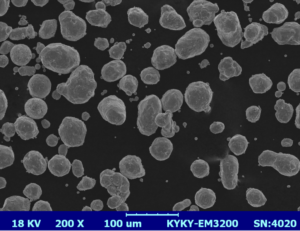
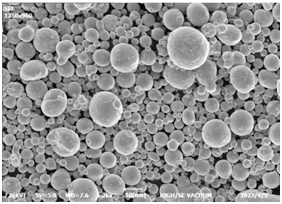
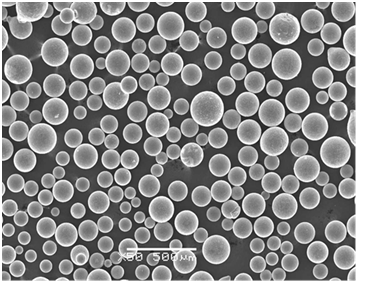
| SEM morphology inspection | Direct visibility of shape, satellites, and irregular particles | Surface-focused unless paired with other methods | Roundness, satellite count, absence of agglomerates |
| Oxygen / nitrogen analysis | Confirms gas-content cleanliness | Does not by itself predict feeder behavior | Compliance with internal impurity specification |
GA, PREP, and VIGA for CM247LC Spherical Powder
Gas atomization is often the most practical route for industrial-scale CM247LC supply, especially when the target is a DED-ready coarse cut. With suitable control of melt chemistry, gas atmosphere, and sieving, GA can deliver a feedstock with good flowability and acceptable morphology for nozzle-fed deposition.
PREP is attractive when very high sphericity and cleanliness are prioritized. VIGA-type production adds value through tighter atmosphere and melt control upstream of atomization. For a crack-sensitive superalloy, these route differences can matter because the process window may already be narrow.
Quality Assurance Priorities for DED Powder
Incoming inspection for CM247LC should normally include chemistry, PSD, oxygen, and morphology at minimum. For critical work, users may also track apparent density, tap density, Hall flow, retained samples, and long-run feeder calibration performance. Those measures do not guarantee process success, but they greatly improve the ability to separate material variation from machine variation.
This is where lot-to-lot consistency becomes especially important. A DED program can only be scaled if the powder behaves similarly from one shipment to the next.
Powder Quality and Repair Repeatability
Repair applications tend to expose powder inconsistency faster than basic coupon trials. Local geometry changes, thermal mass differences, and substrate history all influence the deposition result, so any extra variability from the powder makes parameter control harder. Users therefore benefit from a release package that supports both laboratory validation and real repair work.
Why Choose Truer as Your Supplier
For CM247LC powder for directed energy deposition, supplier selection is mostly a question of technical fit. Buyers usually need a source that understands spherical superalloy powder production, DED-oriented size targeting, and the practical differences between repair powder, cladding powder, and general AM powder. A supplier with powder-making process knowledge can usually communicate more clearly about what size range, morphology, and documentation are appropriate for the intended deposition route.
Shanghai Truer Technology is relevant because its additive manufacturing activities connect powder-making equipment, spherical metal powders, and downstream AM applications. The Truer company background outlines the company’s work with PREP equipment, gas atomization, SEBM-related technologies, and multiple categories of metal AM powders. In a DED program, that process-to-powder understanding is often useful because the purchase decision is tied to feeder behavior, deposition strategy, and post-process requirements rather than to alloy name alone.
Ordering Guide and Support
An effective order for CM247LC powder for directed energy deposition begins with application data, not just with a grade request. The buyer should define the deposition system, target PSD, intended use case, shielding environment, substrate alloy, and documentation requirements. That information helps determine whether the powder should be optimized for narrow-track repair, larger cladding beads, near-net-shape building, or hybrid manufacturing trials.
For complex superalloys, sample evaluation is usually the most efficient path. Small-lot testing allows the user to confirm feeding behavior, bead geometry, dilution response, and early microstructure before moving into larger procurement volumes.
| Format d'emballage | Typical MOQ Tier | Typical Lead Time | Sample Policy |
|---|---|---|---|
| 500 g bottle | Feasibility screening | 1–2 weeks typical if sample stock is available | Paid sample or project evaluation sample |
| 1 kg bottle | Initial feeder setup and single-track trials | 1–3 weeks typical | Often used for parameter scouting |
| 5 kg sealed can | Extended wall builds and repair coupons | 2 à 4 semaines en général | Usually supplied with baseline test data |
| 10 kg sealed can | Pilot qualification work | 3–5 weeks typical | Retained sample can be arranged |
| 25 kg lot packaging | Repeat engineering or pre-production supply | 4–8 weeks typical | Larger orders generally follow sample approval |
Information to Include in a Technical Inquiry
The most useful inquiry includes alloy name, target particle size range, process type, deposition purpose, substrate material, expected annual volume, and required inspection items. If the powder must match a repair procedure already under development, it is also helpful to state the existing feed rate range, laser power window, and any heat-treatment constraints.
That level of detail speeds up technical review and reduces the chance of testing the wrong powder cut. It also makes it easier to align powder certificates with the specific needs of the application.
Samples, Documentation, and Technical Communication
Because CM247LC is a specialized superalloy, buyers often qualify it in stages: sample evaluation, feeder test, deposition trial, metallography, then larger-lot ordering. This sequence is efficient because it limits risk before expensive substrate material or extended machine time is committed. For quotations, sample requests, or specification discussion, the most direct route is the powder inquiry contact page.
Notre entreprise
Shanghai Truer Technology Co., Ltd. was established in 2009 and created its additive manufacturing business in 2019. The company is dedicated to integrating 3D printing powder-making equipment and services with high-quality 3D printing powders to support engineering applications of additive manufacturing. Its core technologies include Selective Electron Beam Melting equipment, Plasma Rotating Electrode Process powder-making equipment, and gas atomization relevant to spherical metal powder production. The company’s powder portfolio includes TiNi, TiTa, TiAl, TiNbZr, CoCrMo, as well as nickel-based, cobalt-based, titanium-based, copper-based, aluminum-based, and stainless steel spherical metal powders. It operates within a joint innovation center for metal 3D printing with laboratories and industry experts, and serves processes including SLM, SEBM, directed energy deposition, laser cladding, powder metallurgy, MIM, HIP, cold and hot spraying, welding, and coating for industries such as 3C electronics, hand tools, remote control cars, medical, aerospace, and nuclear power.
FAQ
Q1. What particle size is typically used for CM247LC powder for directed energy deposition?
For many laser DED systems, 45–105 µm and 53–150 µm are common starting ranges because they balance flowability, stream focus, and melt response. The correct range depends on nozzle design, target bead width, and powder feed rate. A narrower repair track may require a finer cut than broad-bead cladding.
Q2. Is CM247LC powder for directed energy deposition mainly used for repair or for new part production?
It is used in both workflows, but repair and localized feature build-up are especially common because DED is well suited to adding material only where it is needed. New-part or near-net-shape manufacturing is also possible when the component is large or when hybrid machining plus deposition is more practical than powder bed processing. The choice depends on geometry, economics, and qualification strategy.
Q3. Does CM247LC powder for directed energy deposition need heat treatment after deposition?
In most engineering applications, yes. Post-deposition heat treatment is usually required to manage residual stress, stabilize the microstructure, and support the intended precipitation response. The exact cycle depends on the substrate, deposition thermal history, and final property target.
Q4. How does CM247LC compare with Inconel 718 for directed energy deposition?
CM247LC is generally selected for higher-temperature service and stronger creep resistance, while 718 is usually easier to process and qualify. If the application can be met by 718, it may offer a broader deposition window and lower development effort. If the service environment approaches turbine hot-section conditions, CM247LC may be the more appropriate alloy.
Q5. What quality documents should a buyer request with CM247LC powder for directed energy deposition?
Typical requests include chemistry, particle size distribution, oxygen content, and basic flow or density data, along with lot identification and packaging traceability. For critical deposition work, SEM morphology review and retained sample arrangements are also valuable. The most useful documents are the ones that reflect DED feeding performance, not only generic powder certification.
Q6. Can CM247LC powder for directed energy deposition be reused after overspray collection?
Potentially, but reuse should be controlled carefully because oxidation, contamination, and PSD drift can change how the powder feeds and melts. Many users inspect reclaimed material and limit or condition any blend-back ratio rather than returning powder directly to production. For a crack-sensitive superalloy, reuse policy should be based on measured powder condition rather than assumption.