Research on the Properties of CuCrZr/CuAlCrFeNi2.5 Composite
Background
Copper (Cu)-based materials are widely used in the fields of power, transportation and new energy due to their excellent electrical conductivity. However, pure copper has a relatively low strength (less than 100 MPa), and traditional strengthening methods (such as solid solution strengthening) often cause severe lattice distortion, which leads to significant electron scattering and thus greatly reduces the electrical conductivity.
Copper alloy, such as Cu-Cr-Zr and Cu-Ni-Si, although they can enhance strength by solid solution/precipitation strengthening, it is difficult to achieve extremely high levels of strength.
Copper alloy with ceramic particle reinforcement has high hardness, but its wettability with the metal matrix is poor, resulting in weak interface bonding and significant loss of conductivity.
CuCrZr/CuAlCrFeNi2.5 composites possess extremely high strength, excellent thermal stability and good metal compatibility. CuAlCrFeNi2.5 was designed as the reinforcing phase, and the copper element contained in it helps to form a good metallurgical bond with the matrix.
Experimental processes
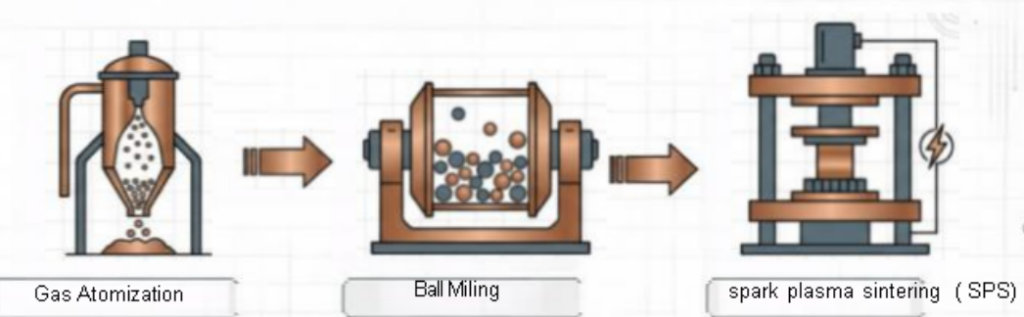
The preparation process of the composite material combines technologies of gas atomization, mechanical ball milling and discharge plasma sintering.
Raw material:
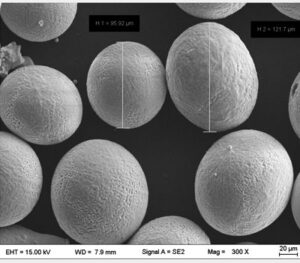
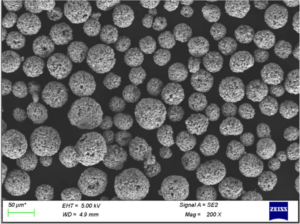
Matrix: TRUER CuCrZr alloy powder with particle size distribution 15-53μm.
Chemical composition of CuCrZr powder:
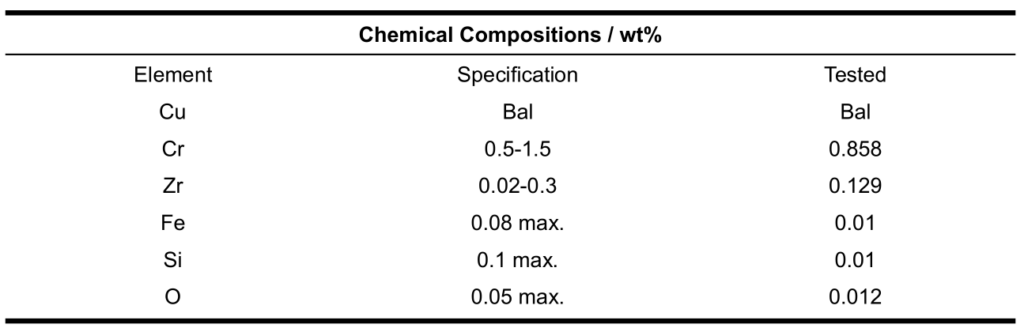
TRUER Lot No. : 20250628-Y4
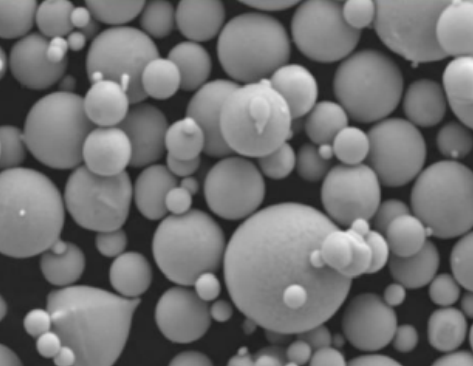
20 wt.% CuAlCrFeNi2.5 powder, with particle size 0-25μm, has a dual-phase structure of FCC and BCC.
SEM photo of CuCrZr/CuAlCrFeNi2.5 powders:
Ball milling process:
Rotation speed 250 rpm, ball-to-material ratio: 10:1, duration: 5 hours. Ball milling causes the matrix to undergo plastic deformation and encapsulate the reinforcing phase particles.
Discharge Plasma Sintering (SPS):
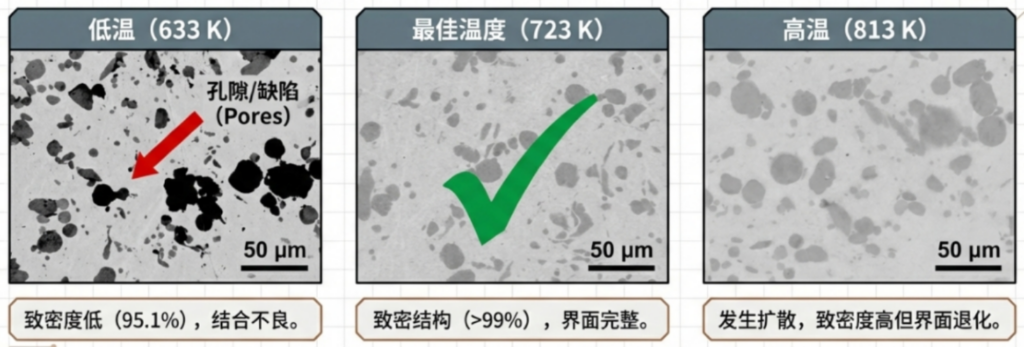
The pressure is maintained at 600 MPa, and the sintering temperature range is from 633 K to 843 K (with a gradient of 30 K), with a holding time of 10 minutes. This technology is beneficial for maintaining an ultrafine crystal structure under low temperature and high pressure conditions.
Microstructure Analysis
The influence of sintering temperature on density
As the sintering temperature increases, the density of the composite material significantly improves.
| Sintering Temp. (K) | Densité (g/cm3) | Relative density (%) |
| 633 | 8.08 | 95.1% |
| 693 | 8.36 | 98.4% |
| 723 | 8.43 | 99.2% |
| 843 | 8.47 | 99.7% |
Note: At 723 K, the relative density exceeds 99%, indicating the entry into the dense sintering stage.
Phase transformation and grain evolution
Phase composition: The XRD analysis confirmed that the matrix was Cu, and the reinforcing phase contained B2 phase and FCC phase. As the temperature increased, the Al-Ni precipitation enhanced the diffraction peaks of the B2 phase.
Grain size: Although the increase in temperature leads to grain growth, due to the inhibitory effect of precipitation particles and the rapid process of SPS, the grains still remain at the nanometer/micrometer scale. At 633 K, the average grain size is 210 nm, and it increases to 840 nm at 843 K.
Mechanical properties and strengthening mechanisms
The yield strength (YS) and compressive strength (UCS) of the composite material show a trend of increasing first and then decreasing with temperature with the increase of the sintering temperature.
Fracture behaviour
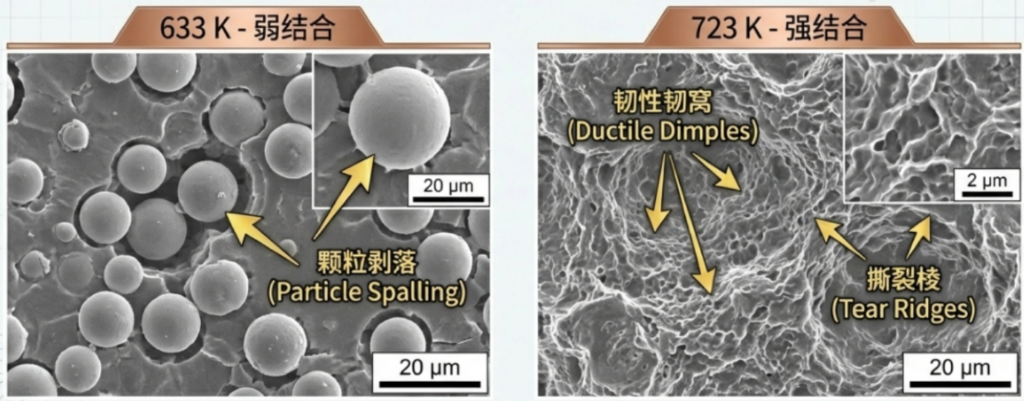
It exhibits a mixed fracture characteristic of toughness and brittleness, with good interface bonding, maintaining the balance between strength and plasticity at 723 K.
The cracks originate directly within the Cu alloy phase rather than at the interface, indicating an extremely strong interface bonding force.
Conclusion
This study demonstrates that by optimizing the sintering temperature (723 K) and combining the structural engineering of multi-component alloys, copper-based composite materials with extremely high strength (850 MPa yield strength) and excellent electrical conductivity (40% IACS) can be fabricated. The design of CuCrZr/CuAlCrFeNi2.5 Composites provides important scientific basis for the development of next-generation high-performance electrical contact materials.