إجابة سريعة
Gas atomized spherical 6061 aluminum powder is an aluminum-magnesium-silicon alloy feedstock produced as near-spherical particles for additive manufacturing, powder metallurgy, and related thermal processes. It is chosen when engineers need a lighter metal powder with good corrosion resistance, balanced mechanical properties, and broad industrial familiarity. Compared with heavier nickel or steel powders, 6061 offers a practical combination of low density, machinability after printing or consolidation, and suitability for prototypes, tooling, and functional industrial parts where extreme high-temperature performance is not the main requirement.
What Is gas atomized spherical 6061 aluminum powder?
Gas atomized spherical 6061 aluminum powder is a particulate form of the widely used 6061 wrought aluminum alloy, adapted for powder-based manufacturing routes. In composition terms, 6061 belongs to the Al-Mg-Si family, often classified as a heat-treatable 6xxx series aluminum alloy. In powder form, it is valued not simply because it is 6061, but because gas atomization converts the alloy into free-flowing, mostly spherical particles that can be processed in layer-wise or consolidated manufacturing systems.
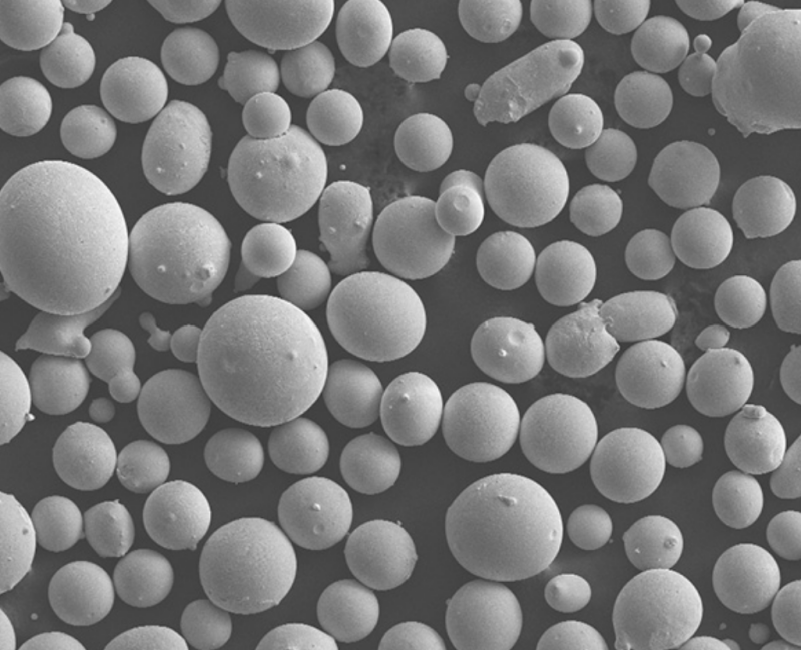
The “gas atomized” part of the name matters. During atomization, a stream of molten alloy is disintegrated by high-velocity gas into droplets that solidify rapidly into powder. This route is commonly used when manufacturers need controlled particle size distribution, relatively smooth particle surfaces, and stronger flow behavior than irregular water-atomized powder can usually provide.
The term “spherical” also has technical significance. Powder with higher sphericity generally spreads more consistently, packs more efficiently, and behaves more predictably in hoppers, recoaters, and feeding systems. In additive manufacturing, that powder behavior can be just as important as nominal chemistry because feedstock uniformity strongly affects layer formation and final-part density.
As an alloy family, 6061 has a different position from cast-friendly aluminum AM grades such as AlSi10Mg. It is not usually chosen because it is the easiest aluminum alloy to print in every machine. Instead, it attracts interest because the base alloy is familiar across machining, structural fabrication, transport equipment, consumer products, and general engineering. That makes gas atomized spherical 6061 aluminum powder especially relevant in programs where downstream machining, joining, corrosion performance, and alloy recognition matter alongside printability.
Historically, 6061 became one of the most common engineering aluminums because it balances strength, formability, corrosion resistance, and availability. Translating that alloy into a spherical powder form allows designers to use similar material logic in additive routes, metal injection molding, spray processes, and powder metallurgy. It effectively bridges traditional aluminum design practice and newer manufacturing methods.
In standards language, the powder should be understood as a feedstock, not just an alloy number. The framework of ISO/ASTM additive manufacturing terminology is useful here because it distinguishes the raw material input from the built part and from the process category itself. That distinction helps purchasing teams avoid the mistake of specifying only “6061” when they actually need a defined powder size range, impurity level, and morphology window for a specific AM process.
Chemical Composition and Material Grade
The chemistry of 6061 aluminum is based on aluminum with controlled additions of magnesium and silicon, supported by smaller amounts of copper and chromium. Those additions allow the alloy to be heat treated and help explain its broad use in structural and industrial applications. In powder applications, the chemistry window must be paired with limits on contaminants and interstitial-related surface oxidation because fine aluminum particles have a high surface-area-to-volume ratio.
Magnesium and silicon are the most functionally important alloying elements in standard 6061. Together they support the precipitation behavior associated with heat-treatable 6xxx alloys. Copper contributes to strength, while chromium helps control grain structure and corrosion-related behavior in the broader alloy system.
For powder buyers, grade language can become confusing because 6061 is more commonly discussed in wrought product forms such as plate, bar, and extrusions than in metal AM feedstock language. That means a buyer may find chemistry references in aluminum alloy standards, while the powder-specific requirements are handled in separate purchasing specifications, internal quality plans, or process qualification documents. In other words, the alloy grade tells only part of the story.
The table below combines representative composition ranges with common grade-reference language. Values are typical industry ranges for 6061 chemistry and should be confirmed against the supplier’s certificate of analysis and the end-use specification.
| Element / Grade Reference | Typical or Common Range (wt%) | ASTM Cross-Reference | AMS Cross-Reference | GB Cross-Reference | ISO / DIN Context |
|---|---|---|---|---|---|
| الألومنيوم (Al) | الرصيد | Chemistry aligned with 6061 alloy family | Commonly referenced in aerospace material systems | Typical equivalent family used in Chinese designation mapping | Often associated with AlMg1SiCu-type designation context |
| المغنيسيوم (Mg) | 0.80–1.20 | Standard 6061 range | Same chemistry family | Similar 6061-equivalent chemistry practice | Same grade context |
| السيليكون (Si) | 0.40–0.80 | Standard 6061 range | Same | Same | Same |
| النحاس (النحاس) | 0.15–0.40 | Standard 6061 range | Same | Same | Same |
| الكروم (Cr) | 0.04–0.35 | Standard 6061 range | Same | Same | Same |
| الحديد (Fe) | ≤ 0.70 | Residual limit typical | Same | Same | Same |
| الزنك (Zn) | ≤ 0.25 | Residual limit typical | Same | Same | Same |
| المنجنيز (Mn) | ≤ 0.15 | Residual limit typical | Same | Same | Same |
| التيتانيوم (Ti) | ≤ 0.15 | Residual / grain-refining limit | Same | Same | Same |
| Other elements, each / total | Small residual limits typical | Buyer-defined for powder use | Buyer-defined | Buyer-defined | Buyer-defined |
For many technical buyers, the more important question is whether the lot is chemistry-correct and powder-appropriate at the same time. A chemically acceptable 6061 melt can still be a poor AM feedstock if particle morphology is irregular, oxygen is elevated, or fines content is unsuitable for the intended recoating system. That is why powder data sheets, certificates, and retained samples often matter more than the alloy number alone.
When cross-referencing standards, it is helpful to separate alloy designation standards from testing or procurement standards. Buyers who work across international supply chains often review ASTM aluminum alloy standards resources in parallel with internal print-process requirements. This approach reduces the common risk of assuming that a familiar wrought alloy standard automatically defines the correct powder specification for additive manufacturing.
المواصفات الفنية
Technical specifications for gas atomized spherical 6061 aluminum powder cover more than chemistry. Powder performance depends on particle size distribution, apparent density, tap density, flow behavior, oxide condition, and morphology. Because aluminum powders are comparatively light and reactive at fine sizes, users also pay close attention to packaging, inert handling, and lot-to-lot repeatability.
Particle Size Distribution for 6061 Spherical Powder
The ideal particle size distribution depends on the process route. Finer cuts such as (15\text{–}53\ \mu m) are often considered for powder bed systems and fine-feed applications, while coarser cuts like (45\text{–}105\ \mu m) or (53\text{–}150\ \mu m) are more typical for directed energy deposition, thermal spraying, and some powder metallurgy routes. A supplier should specify whether the reported PSD is measured by laser diffraction, sieve analysis, or a combined method.
Flow, Packing, and Surface Condition
Flowability is critical because good alloy chemistry cannot compensate for unstable powder delivery. Apparent density gives insight into the loose packing condition, tap density reflects consolidation under vibration, and Hall flow offers a basic comparative measure of how easily the powder moves through a standard funnel. For aluminum powder, these properties are strongly influenced by sphericity and the amount of fines.
Oxygen Control and Safe Handling
Surface oxide is unavoidable on aluminum, but excessive oxygen or degraded surface condition can make processing less stable. Fine spherical aluminum powder also requires disciplined handling for safety, storage, and contamination control. For that reason, serious users evaluate not only the lab values but also how the powder is packaged, transferred, and reopened in production.
| Specification Item | Fine AM Grade | Standard AM / PM Grade | Coarse DED / Spray Grade | الملاحظات |
|---|---|---|---|---|
| توزيع حجم الجسيمات | 15–45 µm typical | 15–53 µm typical | 45–105 µm or 53–150 µm typical | Final choice depends on process window |
| الكثافة الظاهرة | 1.20–1.45 g/cm³ typical | 1.25–1.50 g/cm³ typical | 1.35–1.60 g/cm³ typical | Lower than steel or nickel due to alloy density |
| كثافة الحنفية | 1.45–1.75 g/cm³ typical | 1.50–1.80 g/cm³ typical | 1.60–1.90 g/cm³ typical | يشير إلى كفاءة التعبئة والتغليف |
| تدفق القاعة | 16–28 s/50 g typical | 14–24 s/50 g typical | 12–22 s/50 g typical | Fine cuts may flow more slowly |
| محتوى الأكسجين | Supplier-controlled, low and process-specific | Supplier-controlled, low and process-specific | Supplier-controlled | Acceptance range depends on use case |
| الكروية | High, near-spherical | High, near-spherical | High, near-spherical | Usually verified by image analysis |
These values should be treated as typical commercial ranges, not universal guarantees. Aluminum powder properties often shift slightly with PSD, sieve cut, atomization conditions, and measurement method. For that reason, comparing supplier data sheets line by line without checking test methods can produce misleading conclusions.
End users should also ask whether the reported data refer to as-atomized powder, post-sieved powder, or the exact packaged lot being sold. That distinction matters because coarse particle removal, de-dusting, or secondary classification can materially improve flow and morphology performance. In qualification-driven programs, the question is less “what is a good number?” and more “can the supplier reproduce the same number lot after lot?”
In many practical programs, 6061 aluminum powder is selected not because it maximizes one property, but because it offers lightweight structural potential with manageable secondary processing. Parts may still be machined, heat treated, joined, or surface finished after printing or consolidation, and 6061’s familiarity in those downstream steps is often a major advantage.
Applications Across Industries
Gas atomized spherical 6061 aluminum powder serves multiple sectors where low density, moderate strength, corrosion resistance, and post-process machinability matter more than extreme hot-section capability. It is especially attractive for lightweight structures, functional prototypes, tooling, and industrial components that benefit from near-net-shape production.
In additive manufacturing, 6061 is often considered for development programs, customized fixtures, housings, brackets, and ducting-like geometries. In powder metallurgy and MIM-adjacent development, it can also support near-net-shape parts where wrought machining from billet would create excessive waste or cost. Thermal spraying and cladding applications may use coarser size fractions when aluminum-based coating or repair strategies are being explored.
The alloy’s role becomes clearer when compared with neighboring material families. Relative to many steels, it offers a major density reduction. Relative to titanium, it is usually more economical and more familiar in general industrial fabrication. Relative to cast-style aluminum powders, it may be chosen when end users want closer alignment with conventional 6061 alloy ecosystems rather than a silicon-rich casting composition.
That comparison matters in multi-material programs. Teams evaluating 6061 may also review the broader aluminum alloy powder catalog for other lightweight options, or compare against copper alloy powder options when thermal conductivity becomes more important than structural efficiency.
| الصناعة | Typical Part | Performance Driver | AM / PM Process |
|---|---|---|---|
| الفضاء | Brackets, housings, duct-like parts, fixtures | Weight reduction and machinability | LPBF, DED, PM |
| Automotive / Motorsport | Prototype mounts, lightweight fixtures, enclosures | Fast iteration with low mass | LPBF, PM, MIM development |
| Electronics / 3C | Structural frames, heat-dissipating housings, custom tooling | Light weight and manufacturability | LPBF, PM |
| معدات صناعية | Jigs, grippers, machine accessories, covers | Corrosion resistance and cost control | LPBF, PM, cold spray |
| Consumer / Recreation | RC car components, sporting hardware, custom parts | Low density and geometric freedom | LPBF, PM |
| Research / Education | Test coupons, parameter studies, prototype assemblies | Material familiarity and accessible alloy logic | LPBF, PM |
Aerospace use of 6061 powder is usually concentrated in non-hot-section structures, tooling, and development hardware rather than the highest-temperature engine environments. Industrial users are often more interested in fixtures, housings, and lightweight moving components where every gram removed can improve ergonomics or system response. In electronics-related hardware, the alloy’s balance of low density and acceptable corrosion behavior can be attractive when complex shapes are needed in moderate production quantities.
Material selection should still be application-specific. If the part requires outstanding wear resistance, steels or cobalt alloys may be more suitable. If the priority is the highest corrosion resistance in marine exposure, another aluminum or even a stainless option may be more appropriate. If the need is extreme heat resistance, 6061 is typically not the correct choice.
Manufacturing and Quality Assurance
Gas atomized spherical 6061 aluminum powder is defined as much by its manufacturing route as by its nominal alloy number. The atomization environment, gas selection, melt cleanliness, and sieving practice all influence final powder behavior. For aluminum, controlled atmosphere handling is particularly important because of oxide formation and the safety considerations associated with fine metal powders.
GA vs. PREP vs. VIGA for Aluminum AM Powder
Gas atomization is the most relevant commercial route for 6061 spherical powder because it is scalable and well suited to aluminum feedstock production. PREP is more commonly associated with highly spherical reactive-alloy powders and specialty applications, while VIGA terminology is frequently encountered where vacuum melting and inert atomization discipline are emphasized. For a common structural aluminum alloy such as 6061, GA is usually the center of the conversation.
Powder QA Tests That Matter Most
A robust quality program includes chemistry verification, PSD testing, morphology review, flow testing, density measurement, and controlled packaging. Depending on the end use, additional checks may include SEM imaging, moisture-sensitive handling protocols, and retained sample practices. The goal is to confirm that the powder will feed, spread, and consolidate predictably in the selected process.
Documentation, Sampling, and Acceptance Logic
The most reliable suppliers define how samples are taken, how sieving is controlled, and how test results are linked to a specific packaged lot. This matters because a polished data sheet can hide variability if the testing and packaging chain is poorly controlled. In practice, low-oxide spherical powder is not just a descriptive phrase; it is the result of disciplined melting, atomization, classification, and packaging.
| السمة | مسحوق GA Powder | VIGA Powder | المسحوق التحضيري | ما أهمية ذلك |
|---|---|---|---|---|
| شكل الجسيمات | Spherical, with some satellites possible | Spherical, often with tighter cleanliness control | Very spherical, low satellites typical | Affects flow and spreading |
| Commercial scalability | عالية | متوسطة إلى عالية | Lower for commodity-scale supply | Important for repeat orders |
| Atmosphere control | Inert gas atomization standard | Vacuum melt plus inert atomization discipline | High-purity route typical | Supports cleanliness |
| PSD flexibility | Broad and commercially adaptable | Broad and well controlled | Controlled, often premium-focused | Match to process needs |
| Cost position | Usually most practical | Mid to premium | Premium | Part economics matter |
| Best-fit scenario | General AM, PM, spray supply | Higher-control specialty lots | Critical morphology-focused supply | Route selection depends on risk |
Quality assurance for aluminum powder also includes safe packaging and handling discipline. Many buyers request sealed containers, low-moisture exposure, and clear lot identification for each package size. Storage conditions, container-opening instructions, and re-sealing practice become especially important when fine powder is used intermittently rather than consumed immediately.
Feedstock consistency is often the first condition for part consistency.
Organizations building more formal control plans often consult broader technical references to shape their internal procedures. NIST materials measurement guidance is useful for understanding method discipline and reproducibility, while ASM International aluminum materials resources provide technical context for alloy behavior, heat treatment, and processing. Those references do not replace supplier qualification, but they help frame a more rigorous incoming-inspection strategy.
Why Choose Truer as Your Supplier
Choosing a supplier for gas atomized spherical 6061 aluminum powder involves more than comparing price per kilogram. Buyers also need to know whether the supplier can align particle-size distribution, packaging, documentation, and process matching to the intended route, whether that route is LPBF, DED, powder metallurgy, spraying, or another powder-based method.
Truer is relevant because its additive manufacturing activities combine powder-making equipment knowledge with metal powder supply. Its process background includes gas atomization, PREP equipment, and familiarity with end-use technologies such as SLM, SEBM, DED, laser cladding, PM, MIM, and HIP. That matters when a buyer needs technical discussion about feedstock behavior rather than only a list of alloy names.
A second practical point is breadth across related materials. Engineers selecting 6061 often benchmark it against other lightweight systems, against steels for stiffness and wear, or against copper for thermal management. A wider overview of Truer’s manufacturing scope and application coverage appears in its additive manufacturing company overview, which helps place the aluminum powder offering in context.
For sourcing teams, the key supplier questions remain concrete. Can the supplier provide a PSD tailored to the intended process? Can each lot be supplied with chemistry, density, flow, and morphology data? Can shipment, sample policy, and packaging format support both development work and production-scale procurement? Those questions are more useful than generic claims, especially for repeatable powder performance in industrial AM workflows.
Ordering Guide and Support
The ordering process for gas atomized spherical 6061 aluminum powder should start with a clear application brief. Buyers get better quotations when they specify the process route, preferred particle-size range, quantity, documentation needs, and whether the powder is intended for feasibility trials, qualification builds, or routine manufacturing. Because aluminum powders are process-sensitive, it also helps to mention machine type, target layer thickness, and any packaging constraints.
Small test orders are often the right starting point, but they should be planned carefully. A low-cost sample is useful only if it reflects the same powder family and documentation method that would be used for larger follow-on orders. Otherwise, development work may succeed on one lot and fail to translate into stable purchasing.
What to Include in an RFQ for 6061 Aluminum Powder
A strong inquiry usually states the end process, target PSD, required certificate content, expected annual consumption, and destination region. If the powder will be reused, blended, or requalified internally, that should also be mentioned because it may affect the recommended size cut or packaging format. Buyers who define these details early usually get more relevant technical support.
| Packaging Format | Typical MOQ Tier | Typical Lead Time | Sample Policy |
|---|---|---|---|
| 500 g bottle | Lab screening quantity | 1–3 weeks typical if available | Small paid sample often possible |
| 1 kg bottle | Feasibility and parameter testing | 1–3 weeks typical | Traceable sample lot commonly preferred |
| 5 kg bottle | Extended trials or pilot work | 2–4 weeks typical | Often supplied with standard data package |
| 10 kg bottle | Pilot production quantity | 2–5 weeks typical | Suitable for machine and post-process validation |
| 25 kg drum | Regular production or framework orders | 3–6 weeks typical | Lot reservation may be arranged for repeat programs |
Lead time is shaped by stock status, whether custom sieving is needed, and whether extra testing is requested. Additional requirements such as SEM morphology images, inert-gas packing, or special export packaging can extend delivery schedules even when the base alloy is available.
It is also worth aligning the sample policy with the qualification plan. A research group may need only a bottle for spread and coupon trials, while a production team may need a reserved lot, duplicate certificates, and change-control procedures before approving the material. Project-specific requests can be submitted through Truer’s technical powder contact page so the required packaging, test data, and application details can be clarified before ordering.
شركتنا
Shanghai Truer Technology Co., Ltd. was established in 2009 and created its additive manufacturing business in 2019. The company integrates 3D printing powder-making equipment and services with metal powders for engineering applications of additive manufacturing. Its core technologies include Selective Electron Beam Melting equipment, Plasma Rotating Electrode Process powder-making equipment, and gas atomization. The company’s powder portfolio includes TiNi, TiTa, TiAl, TiNbZr, CoCrMo, and nickel-based, cobalt-based, titanium-based, copper-based, aluminum-based, and stainless steel spherical metal powders for SLM, SEBM, DED, laser cladding, powder metallurgy, MIM, HIP, cold and hot spraying, welding, and coating across industries including 3C electronics, hand tools, remote control cars, medical, aerospace, and nuclear power.
التعليمات
Q1. Is gas atomized spherical 6061 aluminum powder suitable for metal 3D printing?
Yes, it can be suitable for additive manufacturing when the powder size distribution, morphology, and oxide condition are matched to the machine and process window. However, 6061 is not identical in print behavior to more established cast-style aluminum AM grades, so parameter development and qualification are especially important. Buyers should treat machine compatibility as a technical validation issue, not an assumption.
Q2. What particle size is commonly used for gas atomized spherical 6061 aluminum powder?
For finer AM applications, (15\text{–}45\ \mu m) and (15\text{–}53\ \mu m) are common commercial ranges. Coarser cuts such as (45\text{–}105\ \mu m) or (53\text{–}150\ \mu m) are more typical for DED, cladding, spraying, or broader powder metallurgy use. The correct range depends on the feeding mechanism and the process objective.
Q3. Why is spherical morphology important in 6061 aluminum powder?
Spherical particles usually flow more consistently and pack more efficiently than irregular particles. In recoating and feeding systems, that can improve layer uniformity and reduce variability during processing. Good sphericity also tends to support more repeatable bulk density and handling behavior.
Q4. How does gas atomized spherical 6061 aluminum powder compare with AlSi10Mg powder?
6061 is often considered when users want an alloy that aligns more closely with the conventional 6xxx engineering ecosystem, especially for downstream machining and general structural familiarity. AlSi10Mg is often more established in powder bed fusion because its silicon-rich composition supports strong castability-related print behavior. The choice depends on whether printability, alloy familiarity, or end-use property balance is the leading priority.
Q5. Can gas atomized spherical 6061 aluminum powder be used outside additive manufacturing?
Yes. Depending on the size cut and specification, it may also be used in powder metallurgy, thermal spraying, cold spray-related development, and other powder-based fabrication routes. The same base alloy can serve different applications when the PSD and packaging are tailored accordingly.
Q6. What documents should buyers request when sourcing gas atomized spherical 6061 aluminum powder?
At minimum, buyers should ask for a certificate of analysis covering chemistry, particle size distribution, flow, density, and lot identification. For stricter programs, they may also request morphology images, packaging details, retained sample policy, and information on how the powder was sampled and tested. Those documents help connect the alloy designation to actual process readiness.