إجابة سريعة
Inconel 939 alloy powder is a nickel-based superalloy powder designed for high-temperature service, especially where oxidation resistance, hot corrosion resistance, and long-term mechanical stability are critical. It is chosen for 3D printing applications when parts must operate in hotter, more aggressive environments than standard nickel alloys can reliably tolerate. In practical additive manufacturing, it is most relevant for turbine-related components, combustion hardware, repair builds, and heat-stressed industrial parts that require dense deposition, stable powder flow, and strong elevated-temperature performance.
What Is Inconel 939 alloy powder?
Inconel 939 alloy powder is the powder form of a precipitation-strengthened nickel-based superalloy commonly used in severe thermal environments. The alloy is best known in gas turbine and hot-section engineering because it combines creep resistance, oxidation resistance, and hot-corrosion performance in a chemistry built for sustained exposure to heat. When converted into powder, it becomes suitable for additive manufacturing, repair deposition, and several advanced powder-processing routes.
The material sits within the broader family of nickel superalloys rather than conventional corrosion-resistant nickel alloys. That distinction matters. Superalloys are designed around property retention at temperature, not just room-temperature strength or chemical resistance in mild process media. Inconel 939 therefore enters the conversation when service conditions are dominated by thermal stress, combustion products, and prolonged high-heat exposure.
In powder form, the alloy becomes useful for processes such as laser powder bed fusion, directed energy deposition, laser cladding, hot isostatic pressing feedstock preparation, and selected powder metallurgy programs. A concise definition of additive manufacturing process classes can be found in [ISO/ASTM 52900 terminology], which helps explain why feedstock morphology, chemistry, and contamination control are so important in powder-based workflows.
Why this superalloy exists
Inconel 939 was developed for environments where general-purpose nickel alloys may lose strength or degrade too quickly. Chromium improves oxidation and hot-corrosion resistance, cobalt helps stabilize the matrix, tungsten strengthens the alloy at high temperature, and aluminum plus titanium enable a strong gamma-prime precipitation response. The result is an alloy engineered not for simplicity, but for thermal durability.
That design intent carries directly into the powder market. Manufacturers and repair teams use Inconel 939 alloy powder when the service environment justifies a more demanding material and a tighter process window. It is rarely selected because it is the easiest nickel alloy to print; it is selected because the final part must survive conditions that easier alloys may not tolerate for long.
How Inconel 939 differs from more common AM powders
Compared with alloys such as Inconel 625, Inconel 939 is more specialized and more temperature-driven. It offers a stronger high-temperature property profile, but it also tends to require more disciplined control over build parameters, heat treatment, and residual-stress management. That tradeoff is typical of higher-performance superalloys.
This makes alloy selection fundamentally application-led. If the part mainly needs corrosion resistance at moderate temperature, other nickel powders may be more practical. If it must hold strength in a combustion-adjacent or turbine-relevant thermal regime, high-temperature superalloy powder such as Inconel 939 becomes much more compelling.
Why powder form matters
The powder format opens manufacturing routes that are difficult or uneconomic with wrought or cast supply alone. Complex internal features, localized repairs, near-net-shape deposition, and accelerated design iteration all become possible when the alloy is available in a controlled powder specification. For industries dealing with expensive hardware and harsh environments, that flexibility can be as important as the alloy chemistry itself.
Chemical Composition and Material Grade
The performance of Inconel 939 alloy powder is rooted in chemistry. Small changes in aluminum, titanium, cobalt, tantalum, tungsten, carbon, boron, and zirconium can shift how the alloy precipitates, how it behaves during solidification, and how it performs after heat treatment. For additive manufacturing, composition is therefore not just a material identity issue; it is part of the process-control framework.
Typical composition and grade cross-reference
| Element / Grade Reference | Typical wt.% | Functional Role | Cross-Reference Note |
|---|---|---|---|
| النيكل (ني) | الرصيد | Matrix phase | Base metal of the alloy system |
| الكروم (Cr) | 22.0–23.0 | Oxidation and hot-corrosion resistance | Major environmental-resistance element |
| الكوبالت (Co) | 18.0–19.0 | Matrix stability and hot strength | Important for elevated-temperature balance |
| التنجستن (W) | 1.8–2.3 | Solid-solution strengthening | Supports hot strength and creep resistance |
| الموليبدينوم (Mo) | 0.4–0.9 | Secondary strengthening | Lower than some nickel superalloys |
| التنتالوم (Ta) | 1.2–1.8 | Gamma-prime support | Helps high-temperature capability |
| الألومنيوم (Al) | 1.7–2.0 | Gamma-prime former | Critical precipitation-strengthening element |
| التيتانيوم (Ti) | 3.3–3.9 | Gamma-prime former | Major contributor to hardening response |
| النيوبيوم (Nb) | 0.6–1.2 | Secondary strengthening | Controlled addition |
| الكربون (C) | 0.10–0.18 | Carbide formation | Influences grain-boundary behavior |
| البورون (B) | 0.005–0.02 | Grain-boundary strengthening | Small but significant addition |
| الزركونيوم (Zr) | 0.03–0.08 | Grain-boundary conditioning | Tight control preferred |
| الحديد (Fe) | ≤1.0 typical | العنصر المتبقي | Usually kept low |
| السيليكون (Si) | ≤0.5 typical | العنصر المتبقي | Controlled impurity |
| المنجنيز (Mn) | ≤0.5 typical | العنصر المتبقي | Controlled impurity |
| ASTM / AMS / GB / ISO / DIN | — | Commonly supplied to producer or customer specification | No single globally dominant AM powder designation applies to every sale |
Many powder buyers expect a one-line universal standard cross-reference, but the procurement reality is more nuanced. Inconel 939 is a recognized alloy family, yet the powder form is often ordered to supplier technical specification, customer drawing, or project-specific AM qualification criteria rather than one universally applied powder standard. That is common in advanced metal AM.
What the chemistry means in practice
The chemistry of Inconel 939 alloy powder supports a strong precipitation response after suitable thermal processing. Aluminum and titanium form the basis of gamma-prime strengthening, which is one reason the alloy retains useful mechanical properties in hotter service. Chromium protects against oxidation and hot corrosion, while cobalt and tungsten help preserve performance under elevated thermal load.
Because the alloy is compositionally complex, chemistry control is directly tied to powder value. A nominally correct alloy name is not enough if the actual composition window drifts. In AM programs, especially those involving critical thermal hardware, buyers usually review the certificate of analysis alongside morphology, gas content, and size distribution rather than treating chemistry as a standalone pass-fail item.
Distinguishing the alloy from adjacent nickel grades
Some engineers first encounter Inconel 939 while comparing it against 625, 718, or repair-focused deposition alloys. Alloy 939 generally occupies a more heat-intensive niche than 625, while differing from 718 in strengthening balance and intended service profile. Its value proposition is clearest when the environment includes high heat plus oxidizing or corrosive combustion conditions.
For that reason, comparing across a broader [nickel superalloy powder selection] can be helpful during specification. It clarifies whether the program truly needs alloy 939 or whether another nickel grade better matches the operating temperature, repair strategy, or machine capability.
المواصفات الفنية
Technical specifications determine whether Inconel 939 alloy powder performs consistently in production. AM users do not buy chemistry alone; they buy a controlled combination of particle-size distribution, morphology, flowability, density behavior, gas content, and packaging stability. Each of these parameters affects how the powder spreads, feeds, melts, and consolidates.
Typical technical specification for Inconel 939 alloy powder
| المعلمة | 15–53 µm | 45–105 µm | 53–150 µm | Typical Comment |
|---|---|---|---|---|
| التطبيق النموذجي | LPBF / fine-feature AM | DED / laser cladding | DED / larger deposition | Process dependent |
| D10 | 15–20 µm | 45–55 µm | 53–65 µm | Laser diffraction typical |
| D50 | 28–35 µm | 68–80 µm | 88–105 µm | Median size typical |
| D90 | 48–53 µm | 100–105 µm | 145–150 µm | Upper cut control |
| الكثافة الظاهرة | 4.5–5.1 g/cm³ | 4.7–5.3 g/cm³ | 4.8–5.4 g/cm³ | Morphology dependent |
| كثافة الحنفية | 5.0–5.8 g/cm³ | 5.2–5.9 g/cm³ | 5.3–6.0 g/cm³ | Packing behavior typical |
| تدفق القاعة | 13–20 s/50 g | 11–18 s/50 g | 10–17 s/50 g | Typical of well-made spherical powder |
| محتوى الأكسجين | ≤0.03 wt.% typical | ≤0.03 wt.% typical | ≤0.04 wt.% typical | Final limit by agreement |
| المحتوى النيتروجيني | ≤0.02 wt.% typical | ≤0.02 wt.% typical | ≤0.02 wt.% typical | Low pickup preferred |
| الكروية | ≥0.93 typical | ≥0.93 typical | ≥0.93 typical | Image-analysis basis |
| Satellite content | Low typical | Low typical | Low typical | Important for stable behavior |
| Moisture condition | Dry sealed pack | Dry sealed pack | Dry sealed pack | Storage discipline required |
The fine 15–53 µm range is usually associated with laser powder bed fusion because it supports more uniform recoating and finer detail. Coarser fractions such as 45–105 µm or 53–150 µm are more often matched to directed energy deposition or laser cladding, where feeder behavior and melt-pool capture matter more than thin powder-bed layers.
Particle size and process fit
Particle-size distribution is not a cosmetic variable. A powder that is too fine may show handling difficulties, dusting, and altered flow. A powder that is too coarse for the chosen process may spread poorly, fail to pack consistently, or produce unstable deposition.
This is why powder should be specified by process route first. LPBF, DED, cladding, and PM do not consume the same PSD in the same way, even when the alloy name stays constant. For Inconel 939 alloy powder, process matching is particularly important because the alloy itself already demands disciplined thermal control.
Morphology, flowability, and density behavior
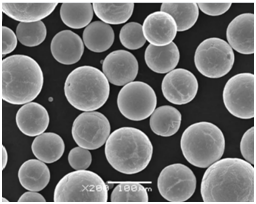
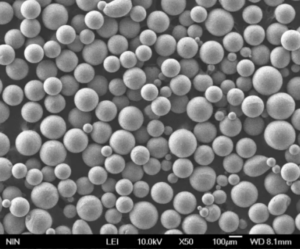
spherical powder morphology supports predictable flow and better packing. In LPBF, it contributes to smoother layers and more stable recoating. In DED, it supports more consistent feeder transport and can reduce delivery fluctuations that affect track geometry.
Apparent density and tap density help buyers understand how the powder behaves in storage, handling, and loading. Hall flow gives a practical view of whether the material moves in a repeatable way under standard test conditions. None of these numbers alone define build quality, but together they indicate whether the powder is likely to behave like a true AM feedstock rather than a merely acceptable metal powder.
Gas content and contamination control
Gas content is particularly important in nickel superalloys. Oxygen, nitrogen, and moisture pickup can affect melting behavior, inclusion risk, and final part quality. That is why inert production, controlled sieving, proper storage, and sealed packaging are standard requirements rather than optional refinements.
From a procurement perspective, technical specifications should also define test methods where necessary. One company’s “low oxygen” claim may not align perfectly with another’s acceptance framework. For critical projects, the purchase document should state not only the target number but also the method or reporting basis used to verify it.
Applications Across Industries
Inconel 939 alloy powder is used where service temperature and environmental severity justify a superalloy solution. It is not the first choice for every nickel AM project, but it becomes highly relevant when parts must tolerate hot gas, cyclic thermal exposure, and long-term structural demand. The alloy’s strongest use cases are therefore concentrated in thermal engineering rather than general fabrication.
Typical industry applications for Inconel 939 alloy powder
| الصناعة | Typical Part | AM / PM Process | Why the Alloy Is Selected |
|---|---|---|---|
| الفضاء | Combustor components, shrouds, hot-section features | LPBF, DED, repair cladding | Elevated-temperature strength and oxidation resistance |
| التوربينات الغازية الصناعية | Vanes, segment repairs, transition hardware | DED, laser cladding | Hot corrosion and creep resistance |
| توليد الطاقة | Burner hardware, thermal shields, heat-exposed zones | DED, PM | Stable behavior in hot gas paths |
| Maintenance and repair | Tip rebuilds, localized restoration, feature recovery | DED, cladding | Material compatibility for expensive parts |
| Energy equipment | Heat-resistant structural zones | AM development, PM | Better high-heat retention than general alloys |
| Research and qualification labs | Coupons, process studies, alloy comparisons | LPBF, DED | Useful for superalloy AM window development |
Aerospace and industrial turbine sectors are the clearest application base because those industries regularly deal with the exact failure modes the alloy was designed to resist. Components in or near combustion zones face a combination of heat, oxidation, and mechanical demand that quickly separates ordinary materials from genuine superalloys. That is where Inconel 939 alloy powder earns its relevance.
Additive manufacturing in hot-section design
AM enables part geometries that are hard to produce by subtractive methods alone. Internal cooling concepts, local reinforcements, repair zones, and near-net-shape features all become more accessible in powder-based workflows. When combined with a superalloy like Inconel 939, this design flexibility can support both performance development and hardware life-extension.
In practice, not every finished part is fully printed from scratch. Some projects use the powder for repair, dimensional restoration, or localized build-up on existing components. That can be especially valuable when the underlying hardware is expensive, geometrically complex, or difficult to replace quickly.
In high-temperature AM, alloy selection should start with the service environment and only then move to machine settings.
Repair and MRO relevance
Repair and maintenance programs are among the most practical uses of Inconel 939 alloy powder. Directed energy deposition and laser cladding can restore worn surfaces, rebuild local features, or add material where a full replacement would be slow or costly. In these cases, alloy compatibility and high-temperature behavior often matter more than design freedom.
This is why powder specifications for repair applications may differ from those for LPBF prototyping. Coarser PSD windows, feeder-focused flow targets, and repair-specific QA documentation can all become more important than fine powder-bed behavior.
When another alloy family may be better
There are many harsh environments where Inconel 939 is not the best choice. If wear is the dominant problem rather than sustained heat, [cobalt wear-resistant powder grades] may be more appropriate. If low density is a higher priority than maximum hot-section performance, a [titanium alloy powder portfolio] may better match the application.
Likewise, certain tooling, thermal conductivity, or cost-sensitive programs may point toward other metal powder families altogether. Material selection should therefore remain application-specific rather than automatically defaulting to the highest-performance nickel superalloy available.
Manufacturing and Quality Assurance
The route used to make Inconel 939 alloy powder strongly affects how it performs later in the machine. Powder production is not just a bulk melting exercise; it is a sequence of metallurgical and particle-engineering decisions that shape morphology, cleanliness, size classification, and lot consistency. For a demanding superalloy, that production discipline is essential.
Production route comparison for AM superalloy powder
| Production Route | Typical Particle Shape | Cleanliness Level | Main Advantage | Main Limitation |
|---|---|---|---|---|
| GA (Gas Atomization) | Spherical to near-spherical | Good with inert control | Scalable, widely used, practical supply route | Satellite population varies by setup |
| تجهيز | كروي للغاية | عالية جداً | Excellent roundness and low contamination | Higher cost and different yield profile |
| فيجا | كروي | جيد جداً | Strong chemistry control with vacuum induction melting | Equipment-intensive route |
| Plasma-based specialty routes | Spherical refined fractions | عالية | Useful for premium feedstock tailoring | Availability may be narrower |
Gas atomization is widely used because it provides a practical balance of throughput, cost, and morphology. With proper inert-gas control and post-atomization classification, it can produce spherical AM feedstock suitable for a broad range of powder applications. PREP is often discussed for especially high sphericity and cleanliness, while VIGA is valued for strong melt control in complex alloy systems.
What quality assurance should cover
For Inconel 939 alloy powder, quality assurance usually includes chemistry, PSD, morphology, apparent density, tap density, flow rate, and gas-content checks. Visual or image-based morphology review is especially useful because it can reveal satellites, irregular particles, or classification issues that simple size data may not fully capture. High-quality release data should describe the powder as a processing material, not merely as a chemical composition.
An external framework for terminology and materials thinking can also be useful when drafting specifications. Buyers often consult the [ASTM materials standards platform] for test-related language, while broader metallurgical guidance can be contextualized through [ASM International materials resources]. These references do not replace internal qualification, but they help create common technical vocabulary between supplier and user.
Why lot consistency matters
lot-to-lot traceability is essential when the powder is intended for production AM, repair of critical hardware, or formal process qualification. If chemistry or morphology shifts from lot to lot, machine parameters that once worked well may begin to produce porosity, cracking, or dimensional inconsistency. In complex superalloys, even modest variation can create expensive downstream troubleshooting.
Lot consistency also affects powder reuse policies. Users who recycle build leftovers need a clear baseline from the virgin lot before evaluating oxygen pickup, PSD drift, or contamination introduced by handling. Without that reference point, it is difficult to make defensible decisions about reused powder in critical builds.
Acceptance criteria should reflect application risk
Not every project needs the same QA package. Laboratory coupon work may tolerate a lighter release framework than turbine repair or high-value industrial hardware. The key is to define requirements in proportion to service risk and qualification stage.
For early development, rapid access to a representative powder may be more important than exhaustive documentation. For later production or critical repair work, tighter release criteria and traceability become increasingly important. The most effective purchasing strategy matches QA depth to application consequence rather than treating all orders identically.
Why Choose Truer as Your Supplier
Selecting a supplier for Inconel 939 alloy powder involves more than confirming that the alloy name is available. Buyers usually need a source that understands powder production, particle-size tailoring, and the differences between LPBF, DED, laser cladding, and broader powder-metallurgy use. With high-temperature nickel powders, process context matters because a chemically correct powder may still be a poor operational fit if morphology, size range, or documentation do not align with the intended route.
Truer is relevant in this context because its activity includes both powder-related technologies and additive manufacturing applications. That matters when discussing whether a fine spherical cut is intended for powder-bed systems or whether a coarser fraction is more suitable for feeder-based deposition. A short [company background and capabilities] page outlines the organization’s scope across powders, equipment, and AM-related services.
Another practical consideration is portfolio breadth. Many engineers evaluating alloy 939 also compare it against other nickel, cobalt, titanium, copper, aluminum, or stainless materials before locking in a final specification. A supplier working across multiple spherical powder families can support those comparisons more realistically than a source limited to one narrow catalog segment.
Ordering Guide and Support
Ordering Inconel 939 alloy powder efficiently starts with a clear technical brief. The buyer should identify the intended process, target particle-size range, anticipated quantity, and whether the powder is for development, qualification, repair, or recurring production. Without that context, quotations may look comparable while actually describing powders meant for different operating windows.
Typical packaging and order framework
| Packaging Format | MOQ Tier | Typical Lead Time | Sample Policy |
|---|---|---|---|
| 500 g bottle | Laboratory screening | 1–2 weeks if stock exists | Paid sample commonly available |
| 1 kg bottle | Initial AM parameter trials | 1–3 weeks typical | Same-lot data may be included |
| 5 kg sealed can | Development build campaigns | 2–4 weeks typical | Additional test items by request |
| 10 kg drum | Pilot qualification | 3–5 weeks typical | Reserved sample may be negotiated |
| 25 kg drum | Production planning or repair use | 3–6 weeks typical | COA and traceability per order |
| Custom inert packaging | Export or special storage programs | By agreement | Project-specific terms |
A staged qualification approach is usually the most efficient. First, confirm that the powder feeds or spreads correctly on the target equipment. Next, evaluate density, cracking tendency, and heat-treatment response using representative coupons. Only after those steps should the final PSD, release package, and repeat-order framework be locked in.
Information that helps a supplier quote accurately
A technically useful inquiry typically includes machine type, process route, preferred size cut, annual demand estimate, and any required limits on oxygen or impurity levels. It should also mention whether documentation needs include chemistry only, full physical characterization, or lot traceability for qualification. These details help avoid delays and reduce the risk of receiving a powder optimized for the wrong route.
Where direct technical discussion is needed, the most practical step is to use the [powder inquiry contact page]. For superalloys like Inconel 939, early alignment on PSD, morphology expectations, and certification format often saves far more time than it costs.
شركتنا
Shanghai Truer Technology Co., Ltd. was established in 2009 and created its additive manufacturing business in 2019. The company integrates 3D printing powder-making equipment and services with metal powders for engineering applications of additive manufacturing. Its core technologies include Selective Electron Beam Melting equipment and Plasma Rotating Electrode Process powder-making equipment, with gas atomization also relevant to powder production. The powder portfolio includes TiNi, TiTa, TiAl, TiNbZr, CoCrMo, along with nickel-based, cobalt-based, titanium-based, copper-based, aluminum-based, and stainless steel spherical metal powders. The company also participates in a joint innovation center for metal 3D printing with laboratories and experts, and serves end processes including SLM, SEBM, DED, laser cladding, PM, MIM, HIP, cold or hot spraying, and welding or coating for industries such as 3C electronics, hand tools, remote-control cars, medical, aerospace, and nuclear power.
التعليمات
Q1. Is Inconel 939 alloy powder mainly used for additive manufacturing or repair?
It is used for both, but repair and high-temperature deposition work are especially common. Full AM builds, near-net-shape development, and localized restoration all benefit from the alloy when thermal performance is the main design driver.
Q2. How does Inconel 939 alloy powder compare with Inconel 625 powder?
Inconel 939 is generally selected for hotter and more mechanically demanding service environments. Inconel 625 is often easier to process and more general-purpose, while alloy 939 is chosen when stronger elevated-temperature capability is needed.
Q3. What particle size is typical for Inconel 939 alloy powder in LPBF?
A fine range such as 15–53 µm is commonly evaluated for laser powder bed fusion. The best range still depends on recoater behavior, layer thickness, machine settings, and the user’s qualification strategy.
Q4. Why is oxygen control important for Inconel 939 alloy powder?
Oxygen affects surface condition, melting behavior, and the overall cleanliness of the feedstock. In a high-performance superalloy, excess oxygen can complicate process stability and reduce confidence in final part quality, especially after powder recycling.
Q5. Can Inconel 939 alloy powder be reused after a build?
It can be reused in some AM workflows, but only under a controlled recycling procedure. Users generally monitor sieve fraction, contamination, and gas pickup before returning powder to critical applications.
Q6. Is Inconel 939 alloy powder suitable for medical implants?
It is not typically chosen for implant-focused applications. The alloy’s main value lies in high-temperature aerospace, energy, and industrial service rather than in the biocompatibility-driven selection criteria used for implant materials.