إجابة سريعة
GRCop42 copper chromium niobium powder is a precipitation-strengthened copper alloy powder developed for demanding thermal and structural environments, especially in propulsion and heat-flux-intensive hardware. It is a strong choice for additive manufacturing when a part needs higher hot strength, creep resistance, and durability than pure copper while still retaining high thermal conductivity. In practice, it is most relevant for rocket combustion devices, heat-transfer components, and other metal AM parts where conductivity alone is not enough and elevated-temperature mechanical stability is equally important.
What Is GRCop42 copper chromium niobium powder?
GRCop42 is a copper-chromium-niobium alloy associated with NASA-originated high-performance copper materials for propulsion service. The name is commonly understood as a copper alloy containing approximately 4 wt.% chromium and 2 wt.% niobium, with copper making up the balance. In powder form, it is used as a feedstock for additive manufacturing, thermal spray, and other powder-based routes where high thermal conductivity and elevated-temperature strength must coexist.
This alloy sits in a specialized corner of the copper-alloy landscape. Standard high-conductivity copper is excellent at moving heat, but it softens rapidly when exposed to sustained high temperature. Many designers therefore need a material that keeps more of copper’s heat-transfer advantage without giving up dimensional stability, rupture resistance, or structural margin in hot-wall service. That is the design gap GRCop42 was created to address.
The metallurgical basis is important. GRCop42 is a Cu-Cr-Nb precipitation-strengthened system rather than a simple solid-solution alloy. During proper thermal processing, chromium- and niobium-bearing precipitates help stabilize the microstructure and improve strength retention at elevated temperature. That makes the alloy especially attractive in service conditions involving hot gases, steep thermal gradients, repeated heating cycles, or localized high heat flux.
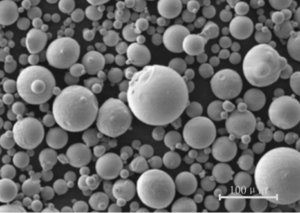
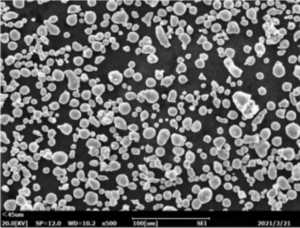
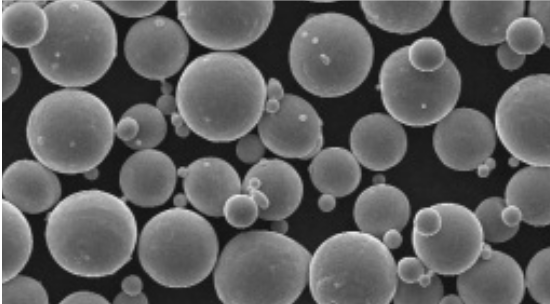
For AM users, the powder version matters as much as the nominal chemistry. Copper alloys are more difficult to print than steels or nickel superalloys because high reflectivity and high thermal conductivity can make laser energy coupling and melt-pool stability less forgiving. A well-made spherical GRCop42 powder reduces one part of that challenge by improving flowability, packing behavior, and layer consistency.
GRCop42 is often discussed in the context of propulsion hardware, but its relevance is broader than space launch. Any industry working on compact heat exchangers, heat sinks, tooling inserts, plasma-facing components, or thermal-management hardware may find the alloy useful when pure copper lacks strength and nickel-based alloys carry too much thermal penalty. In that sense, it occupies a distinct performance niche rather than competing directly with commodity copper powders.
A useful starting point for readers comparing process language is the general additive manufacturing process overview, which clarifies the production categories in which GRCop42 powder is typically used.
Chemical Composition and Material Grade
GRCop42 copper chromium niobium powder chemistry
The standard shorthand for GRCop42 is simple: copper as the balance, chromium at about 4 wt.%, and niobium at about 2 wt.%. That chemistry is central to the alloy’s identity because it supports a fine precipitate structure that strengthens the copper matrix without turning the alloy into a low-conductivity refractory system.
In procurement, the buyer should distinguish between nominal alloy chemistry and delivered powder chemistry. A nominal target such as Cu-4Cr-2Nb still requires lot-by-lot verification for chromium, niobium, oxygen, and residual impurities. Even small deviations can influence printability, precipitation response, and the resulting balance between conductivity and strength.
Unlike widely traded wrought copper grades, GRCop42 is not usually purchased through a single mature global standards framework in the way 316L or Ti-6Al-4V often is. In practice, it is more often supplied against a customer specification, aerospace development drawing, or internal AM material control plan.
Composition and grade cross-reference
| Material Designation | Typical Composition (wt.%) | ASTM Cross-Reference | AMS Cross-Reference | GB Cross-Reference | ISO Cross-Reference | DIN / EN Cross-Reference |
|---|---|---|---|---|---|---|
| GRCop42 nominal alloy | Cu balance, Cr 3.5–4.5, Nb 1.5–2.5 | No dedicated universal ASTM alloy grade commonly used for AM procurement | No direct AMS commodity equivalent | Usually customer drawing or enterprise standard | No direct ISO alloy grade equivalence | No direct DIN / EN equivalent commonly assigned |
| CuCrNb 4-2 AM powder | Cu balance, Cr 4.0 typical, Nb 2.0 typical | Supplier specification with chemistry verification | Internal aerospace spec when applicable | Supplier specification | Internal quality plan | Supplier specification |
| Low-oxygen GRCop42 powder | Cu balance, Cr/Nb per target, O tightly controlled | Chemistry and gas analysis per PO | No direct AMS number typically cited | Enterprise standard | Internal control document | Internal control document |
| DED-grade GRCop42 feedstock | Cu balance, Cr 3.5–4.5, Nb 1.5–2.5, PSD adjusted for process | Supplier specification | Program-specific | Supplier specification | Program-specific | Supplier specification |
The absence of a one-line global grade code does not make the alloy unusual in advanced AM. It simply means the chemistry window, testing method, and acceptance criteria must be written explicitly into the order. For engineers accustomed to buying established copper grades, this is one of the main procedural differences.
Why chromium and niobium matter
Chromium contributes strengthening and supports precipitate formation, while niobium helps create thermally stable phases that improve elevated-temperature performance. In combination, the two elements let copper keep more structural integrity under heat than pure copper typically can. This is why GRCop42 is often treated as a high-conductivity rocket alloy rather than just another copper feedstock.
The copper matrix still does the thermal heavy lifting. That is the foundation of the alloy’s value: it moves heat efficiently while the Cr-Nb phase architecture helps resist softening. For thermal-mechanical applications, that pairing is more important than ultimate room-temperature strength alone.
Grade selection in real AM projects
In actual purchasing practice, “GRCop42 powder” is rarely enough information by itself. A serious RFQ should specify whether the powder is intended for laser powder bed fusion, directed energy deposition, laser cladding, or thermal spray, because each route may call for a different particle-size distribution and different oxygen ceiling. It should also define whether the part is a research coupon, a prototype combustion liner, or a repeat production component.
المواصفات الفنية
Typical properties of GRCop42 copper chromium niobium powder
The powder specification for GRCop42 must address two separate issues: how the powder behaves as a feedstock and how the alloy behaves after consolidation. The first concern covers particle morphology, size range, oxygen, and flow; the second concerns density, conductivity, and mechanical response in the printed or deposited part.
| درجة المسحوق | Typical PSD | الكثافة الظاهرة | كثافة الحنفية | Hall Flow | محتوى الأكسجين | الكروية |
|---|---|---|---|---|---|---|
| Fine LPBF grade | 15–45 µm | 4.8–5.4 g/cm³ | 5.6–6.3 g/cm³ | 18–28 s/50 g | 200–600 ppm typical | ≥0.90 typical |
| Standard LPBF / SLM grade | 15–53 µm | 4.9–5.5 g/cm³ | 5.8–6.5 g/cm³ | 17–26 s/50 g | 150–500 ppm typical | ≥0.92 typical |
| DED / laser cladding grade | 45–105 µm | 5.0–5.8 g/cm³ | 5.9–6.7 g/cm³ | 15–24 s/50 g | 150–450 ppm typical | ≥0.93 typical |
| Coarse deposition grade | 53–150 µm | 5.1–5.9 g/cm³ | 6.0–6.8 g/cm³ | 14–22 s/50 g | 150–450 ppm typical | ≥0.93 typical |
These values are typical commercial targets, not universal specification limits. Acceptance should be tied to process route, build strategy, and final property requirements rather than to a generic catalog number alone.
GRCop42 copper chromium niobium powder size selection
For laser powder bed fusion, finer size ranges such as 15–45 µm or 15–53 µm are common because they promote uniform spreading and thinner layer deposition. For directed energy deposition and laser cladding, coarser fractions are generally preferred because consistent powder feeding and stable catch efficiency matter more than very fine recoating behavior.
Particle size also influences laser interaction. Finer powder can improve local energy absorption but may increase oxygen pickup risk and handling sensitivity. Coarser powder can be easier to handle in some deposition systems, yet may require more aggressive energy input or different nozzle dynamics.
Feedstock behavior versus part performance
With copper alloys, it is easy to focus only on conductivity, but powder behavior deserves equal attention. Poor flow can produce uneven layers, while excessive satellite content can lower apparent density and complicate spreading. For this reason, spherical AM powder quality is not merely a handling preference; it is directly tied to melt consistency and defect control.
Conductivity, strength, and thermal exposure
After consolidation and suitable thermal processing, GRCop42 is valued for thermal conductivity with elevated-temperature strength. It does not match pure copper in conductivity, but it usually outperforms much stronger high-temperature alloys in heat transport. That tradeoff is precisely why it is selected for chamber liners, injectors, and heat-loaded structures.
Thermal service must be considered in context. A propulsion component may experience localized hot gas exposure, steep internal coolant gradients, or repeated start-stop cycling, while an industrial thermal-management part may see lower peak temperature but longer dwell time. The target property window therefore depends on the duty cycle, not just on the alloy name.
Process language and standards context
Because different AM routes create different thermal histories, it helps to align documentation with recognized process terminology. A neutral benchmark for process vocabulary is the ISO standards platform for additive manufacturing terminology, which is commonly consulted when building internal technical specifications and supplier agreements.
Applications Across Industries
Where GRCop42 copper chromium niobium powder is used
GRCop42 is best known for rocket propulsion hardware, but its real significance is broader: it is used anywhere the engineer is trying to move a large amount of heat without losing structural margin under temperature. That combination is rare, and it explains why the material remains technically interesting even outside aerospace.
| الصناعة | Typical Part | Primary Requirement | AM / PM Process |
|---|---|---|---|
| Space propulsion | Combustion chamber liners, thrust chamber sections | High heat flux handling, hot strength, cyclic durability | LPBF, DED, HIP-assisted AM |
| Aerospace R&D | Injectors, heat shields, thermal test coupons | Conductivity with structural integrity | LPBF, DED |
| Industrial thermal management | High-duty heat sinks, compact heat exchangers | Rapid heat transfer under load | LPBF, PM |
| Advanced tooling | Conformal-cooled inserts, localized hot spots in dies | Heat extraction plus service stability | LPBF, laser cladding |
| Energy and plasma systems | Nozzles, thermal-facing components, cooling features | Thermal fatigue and oxidation exposure | DED, spray-based routes |
| Research institutions | Benchmark coupons, lattice structures, graded thermal parts | Property mapping and process optimization | LPBF, DED, PM |
Rocket hardware and combustion devices
Rocket chamber liners and related components are the most visible use case for GRCop42. In those parts, the material must manage severe heat flux while maintaining dimensional stability and resisting softening. Pure copper transfers heat well, but that alone is not enough in a chamber wall that must survive pressure, temperature, and thermal cycling at the same time.
The alloy’s ability to sit between pure heat conduction and usable hot strength is what makes it valuable. That is especially true in AM, where complex internal cooling passages and near-net-shape geometries can unlock designs that are difficult to machine conventionally.
Thermal management and compact cooling designs
Outside propulsion, GRCop42 can be relevant for demanding cooling hardware. Additive manufacturing allows complex fin networks, lattice-supported surfaces, and internal channels that increase surface area and fluid contact. When those geometries are paired with a copper alloy that retains more stability at temperature, designers gain extra operating margin.
This is the context in which buyers may also compare the alloy with broader copper alloy powder options. The decision is usually not whether copper is useful, but which copper-alloy family best fits the heat load, service temperature, and manufacturing route.
Tooling, dies, and localized heat extraction
Certain tooling applications create intense thermal spikes in localized zones rather than across an entire part. In those cases, it can be inefficient to build the whole tool from a high-performance copper alloy. Instead, engineers may apply GRCop42 selectively through AM inserts or deposited features, using the alloy only where heat extraction and hot stability are most needed.
Material selection versus alternative AM powders
GRCop42 is not a universal replacement for nickel-, cobalt-, or stainless-based powders. If peak structural strength, oxidation at extreme temperature, or general corrosion resistance dominates the requirement, designers may still choose a different family. That is why comparative screening often includes nickel superalloy powder grades and other established AM feedstocks before the final material is locked.
Manufacturing and Quality Assurance
Making spherical GRCop42 powder for AM
High-quality GRCop42 feedstock typically starts with tightly controlled melting and atomization. Because copper alloys oxidize readily and because chromium and niobium must remain inside a narrow chemistry window, the production route has a direct effect on both powder consistency and final AM behavior.
Gas atomization is a common route for copper alloy powder because it can produce spherical particles at industrially relevant scale. Vacuum-based melting or atomization approaches may offer tighter control over contamination and chemistry retention, especially for premium AM lots. PREP is well known in some high-end spherical powder markets, although for copper systems it is less universal than for certain reactive titanium materials.
| QA Test | Typical Instrument / Method | What It Verifies | Typical Acceptance Direction |
|---|---|---|---|
| التركيب الكيميائي | ICP-OES, XRF, wet chemistry as needed | Cu/Cr/Nb ratio and residual elements | Within ordered alloy window |
| توزيع حجم الجسيمات | Laser diffraction with sieve cross-check | D10, D50, D90 and cut-range compliance | Matches ordered PSD range |
| Morphology and satellites | SEM and image analysis | Sphericity, agglomeration, surface condition | Predominantly spherical, low satellites |
| Oxygen and gas content | ONH analyzer | Surface cleanliness and oxidation control | Within specified low-oxygen target |
| Flow and density | Hall flowmeter, apparent and tap density tests | Recoating or powder-feed consistency | Stable versus qualified baseline |
| Printed coupon verification | Density, metallography, hardness, conductivity checks | Real printability and property response | Meets process qualification criteria |
Why powder QA matters more for copper alloys
Copper alloys can be less forgiving in AM than steels because energy input, reflectivity, and heat extraction all interact strongly during melting. A lot with the correct nominal chemistry may still perform poorly if morphology, oxide level, or PSD drift outside the optimized process window. That is why QA for GRCop42 should always extend beyond the certificate of composition.
Coupon validation is especially useful. Printed density cubes, thin-wall features, and representative thermal sections can reveal lack-of-fusion risk, surface roughness behavior, and conductivity response under realistic processing conditions. For aerospace development, the part geometry itself often becomes part of the materials test plan.
AM process qualification and repeatability
Because GRCop42 is typically used in high-consequence hardware, qualification needs to address not only feedstock but also process repeatability. This includes machine type, laser strategy, powder reuse policy, atmosphere control, support design, and post-build thermal treatment. In many projects, application-specific qualification matters more than catalog-property claims.
التوثيق وإمكانية التتبع
A serious powder package should include chemistry, PSD, gas analysis, morphology data, lot number, and packaging traceability. For customers building internal material databases, it is also helpful to capture coupon results linked to the same powder lot. That link between powder data and build data becomes crucial when future lots are introduced or process windows are refined.
Comparing GRCop42 with neighboring powder families
Material screening often involves looking at more than one alloy family. Stainless grades may offer lower cost and easier printability, while other copper grades may offer higher conductivity with lower hot strength. For organizations doing broad materials comparison, a published stainless AM powder range can provide a useful baseline for understanding where a specialized Cu-Cr-Nb alloy sits on the performance map.
In thermal hardware, the best material is often the one that balances heat flow and shape retention, not the one that maximizes either property alone.
Why Choose Truer as Your Supplier
For a material such as GRCop42, supplier evaluation should focus on process understanding rather than on simple stock availability. Copper-alloy AM powders require control of chemistry, morphology, and oxygen, but they also require awareness of how those variables affect laser interaction, deposition behavior, and post-build properties.
That context makes Truer relevant because the company’s stated capabilities span gas atomization, PREP-related powder-making equipment, selective electron beam melting equipment, and application support across SLM, SEBM, DED, laser cladding, PM, MIM, HIP, spraying, welding, and coating. For a buyer working with Cu-Cr-Nb alloys, that breadth is useful because the material may move from laboratory trials to different downstream routes before a final process is selected.
It is also practical that GRCop42 sits within a wider portfolio of metal powder families rather than in isolation. In real engineering programs, the selected alloy may change after thermal modeling, manufacturability review, or coupon testing. A neutral view of supplier capability can therefore be informed by the company’s background in additive manufacturing systems as well as by its coverage of adjacent alloy categories.
Ordering Guide and Support
What to specify when buying GRCop42 copper chromium niobium powder
A well-written RFQ for GRCop42 should define chemistry, particle-size range, oxygen limit, intended AM or PM process, packaging format, and inspection requirements. It should also state whether the powder is for exploratory research, machine parameter development, prototype hardware, or controlled repeat production.
| Packaging Format | Typical MOQ Tier | Typical Lead Time | Sample Policy |
|---|---|---|---|
| 100 g evaluation vial | Screening and feasibility trials | 1–2 weeks if stock or retained lot exists | Paid sample, basic PSD and chemistry data |
| 500 g laboratory bottle | Parameter development builds | 2–3 weeks typical | Sample lot with standard inspection summary |
| 1 kg sealed canister | Extended coupon program | 2–4 weeks typical | Retained reference sample available on request |
| 5 kg technical batch | Pilot hardware or multi-build testing | 3–5 weeks typical | Full lot traceability subject to PO terms |
| 10–25 kg production lot | Repeated builds or DED program support | 4–6 weeks typical | Documentation package aligned to contract requirements |
Sampling, trials, and lot approval
For a first order, it is usually better to start with a structured validation plan rather than to rely on one successful print. The plan should include powder inspection, parameter screening, density checks, conductivity testing, and at least one geometry representative of the intended application. If the component is thermal-critical, hot exposure or cyclic thermal testing should be built into the trial stage.
Questions buyers should ask before issuing a PO
The buyer should confirm whether the chemistry is guaranteed on a weight-percent basis, what impurity elements are tracked, how oxygen is measured, and whether reused powder data are available. It is also worth asking whether the supplier can support alternative PSD cuts for LPBF versus DED, since the same nominal alloy may perform very differently across processes.
Technical support and communication
Because GRCop42 projects often involve close coordination between materials engineers and manufacturing teams, communication quality matters. The most practical route is direct technical exchange through the supplier’s industrial inquiry contact page, where project requirements can be translated into powder specifications and inspection expectations before the order is finalized.
شركتنا
Shanghai Truer Technology Co., Ltd. was established in 2009 and created its additive manufacturing business in 2019. The company focuses on integrating 3D printing powder-making equipment and services with metal powders for engineering applications. Its disclosed technical scope includes selective electron beam melting equipment, plasma rotating electrode process powder-making equipment, and gas atomization-related capabilities, together with support for SLM, SEBM, DED, laser cladding, powder metallurgy, MIM, HIP, cold or hot spraying, welding, and coating. The powder portfolio includes TiNi, TiTa, TiAl, TiNbZr, CoCrMo, and spherical powders across nickel-based, cobalt-based, titanium-based, copper-based, aluminum-based, and stainless steel material families. The company also participates in a joint innovation center for metal 3D printing with laboratories and external experts, serving industries such as 3C electronics, hand tools, remote control cars, medical, aerospace, and nuclear power.
التعليمات
Q1. Is GRCop42 copper chromium niobium powder mainly for rocket engines?
Rocket propulsion is the best-known application, especially for combustion chambers, liners, and injectors. However, the alloy can also be relevant for heat exchangers, thermal-management hardware, tooling inserts, and other components that must move heat efficiently while retaining strength at temperature.
Q2. How does GRCop42 differ from pure copper powder in additive manufacturing?
Pure copper offers higher conductivity, but it generally has much lower elevated-temperature strength and poorer resistance to thermal softening. GRCop42 is chosen when the design needs a more balanced property set, especially under repeated thermal load or hot-gas exposure.
Q3. Can GRCop42 copper chromium niobium powder be used in laser powder bed fusion?
Yes, it is commonly considered for LPBF when the powder is spherical, the oxygen level is controlled, and the machine parameters are adapted for copper-alloy processing. Because copper reflects laser energy strongly and conducts heat rapidly, parameter development is usually more demanding than it is for stainless steel or many nickel alloys.
Q4. What particle size is typical for GRCop42 AM powder?
For LPBF, 15–45 µm and 15–53 µm are common target ranges because they support stable layering and detailed geometries. For DED or cladding, coarser cuts such as 45–105 µm or 53–150 µm are more typical because powder feeding behavior becomes the primary concern.
Q5. Does GRCop42 have a universal ASTM or AMS grade number?
In most commercial AM purchasing scenarios, no single globally used ASTM or AMS alloy designation is relied upon in the same way as for some mainstream structural alloys. Buyers usually specify the material by nominal Cu-Cr-Nb chemistry, powder requirements, and application-specific acceptance criteria.
Q6. What should be included in a GRCop42 powder specification?
A strong specification should include chromium and niobium targets, allowable chemistry tolerance, particle-size range, oxygen limit, morphology requirements, packaging method, and lot traceability. For production use, it should also reference the intended process route and the coupon or component tests required for qualification.