إجابة سريعة
Grade 5 titanium powder is the powder form of Ti-6Al-4V, the most widely used alpha-beta titanium alloy in advanced manufacturing. For 3D printing, it is chosen because it combines low density, strong mechanical performance, corrosion resistance, and broad process compatibility across laser and electron beam powder bed fusion. In practice, it is often the default choice for aerospace, medical, and high-performance industrial parts when engineers need a mature titanium alloy with a well-established standards landscape and a large body of processing knowledge.
What Is Grade 5 titanium powder?
Grade 5 titanium powder is the particulate feedstock form of Ti-6Al-4V, also known as Ti64, UNS R56400, and in many Asian supply chains, TC4. In material terms, it is an alpha-beta titanium alloy containing nominally 6% aluminum and 4% vanadium, with titanium as the balance. The alloy is widely recognized for its combination of low density, useful room-temperature strength, corrosion resistance, and heat-treatment versatility, which is why it has become one of the most common titanium alloys in engineering use.
Why Grade 5 Titanium Became the Reference Alloy
Ti-6Al-4V became important because it offered a practical middle ground between commercially pure titanium and more specialized titanium systems. Commercially pure grades provide good corrosion resistance but lower strength, while more exotic titanium alloys can be harder to source, qualify, or process. Grade 5 became the reference alloy because it delivered a strong structural property set without losing the low-density advantage that makes titanium attractive in the first place.
Grade 5 Titanium Powder in Additive Manufacturing
In additive manufacturing, the powder form is not merely a crushed version of wrought stock. It is a controlled feedstock produced to meet targets for particle size distribution, flowability, cleanliness, and morphology so that it spreads predictably and melts consistently in powder-bed or directed-energy processes. Process language around these routes is standardized in ISO/ASTM 52900 terminology, which defines additive manufacturing fundamentals and vocabulary used across powder bed fusion, directed energy deposition, and related methods.
What Distinguishes Grade 5 From Other Titanium Powders
The main differentiator is balance. Grade 5 is not as ductile as commercially pure titanium and not as low-interstitial as Grade 23 ELI, but it provides high specific strength and proven usability across multiple process windows. That combination explains why it appears so often in aerospace brackets, structural implants, motorsport hardware, heat-resistant housings, and other parts where strength-to-weight ratio matters more than absolute low cost.
Powder Form Matters as Much as Alloy Name
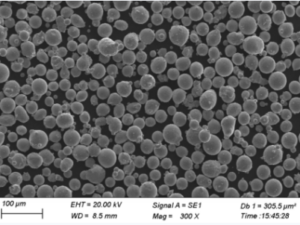
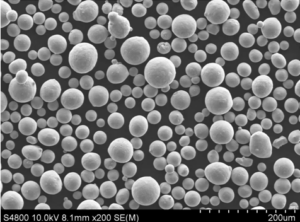
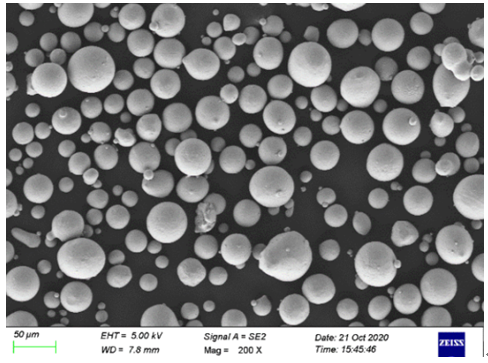
Two suppliers may both offer “Grade 5 titanium powder,” yet the powders can behave differently in production if their oxygen content, satellite level, sphericity, or size distribution are not the same. For powder-bed fusion in particular, the feedstock has to support even recoating, stable melting, and repeatable chemistry across fresh and reused batches. That is why powder qualification often focuses as much on morphology and interstitial control as on the nominal alloy designation itself.
Chemical Composition and Material Grade
Grade 5 titanium powder is usually specified through the Ti-6Al-4V chemistry framework rather than through one single powder-only standard. In practical procurement, buyers often see the alloy referenced by titanium grade, UNS number, AM standard, medical standard, or regional designation. That makes cross-referencing important, especially when a program moves between aerospace, industrial, and medical supply chains.
Typical Grade 5 Titanium Powder Composition and Cross-Reference
| Material / Reference | Ti (wt%) | Al (wt%) | V (wt%) | Fe (wt%) | O (wt%) | Typical Cross-Reference |
|---|---|---|---|---|---|---|
| Grade 5 / Ti-6Al-4V standard | بال. | 5.5–6.75 | 3.5–4.5 | ≤0.30 | ≤0.20 | ASTM Grade 5, UNS R56400, Ti64 |
| AM Grade 5 feedstock | بال. | 5.5–6.75 | 3.5–4.5 | ≤0.30 | typically ≤0.20 | ASTM F2924 powder bed fusion standard reference family |
| Medical ELI comparison grade | بال. | 5.5–6.5 typical | 3.5–4.5 typical | ≤0.25 typical | lower than Grade 5 | ASTM F3001 ELI titanium standard reference family |
| Regional designation family | بال. | ~6 nominal | ~4 nominal | controlled | controlled | TC4, Ti-6Al-4V, DIN 3.7164/3.7165 family, ISO 5832-3 comparison context |
The ranges above reflect common industry chemistry expectations for Ti-6Al-4V and related AM or medical references, but not every specification uses identical impurity limits. In real purchase documents, the acceptable range for oxygen, iron, nitrogen, and carbon may be tightened based on the end use, the process route, and whether the part is intended for medical or flight-related qualification. (asm.matweb.com)
Grade 5 Versus Grade 23 ELI
Grade 5 and Grade 23 are closely related but not interchangeable. Grade 23 is the extra-low-interstitial version of Ti-6Al-4V and is often selected when improved ductility, fracture toughness, or implant-related performance is required. Grade 5 remains the broader industrial and aerospace workhorse, while Grade 23 is more common when lower oxygen and tighter biocompatibility-focused control are priorities.
Why Oxygen Limits Matter in Grade 5 Titanium Powder
Oxygen acts as a strengthener in titanium, but it also pushes the alloy toward lower ductility when it climbs too high. In powder form, oxygen is especially important because fine particles have more surface area and can pick up oxygen during production, handling, reuse, or storage. As a result, the practical chemistry of Grade 5 titanium powder is not only about aluminum and vanadium; it is also about how well the supplier controls surface condition and interstitial pickup.
Grade Naming in Global Supply Chains
In English-language procurement, “Grade 5 titanium powder” is the most familiar industrial phrase, but engineers may also see Ti64, Ti-6Al-4V, ASTM Grade 5, UNS R56400, or TC4. Those terms generally point to the same base alloy family, yet the actual powder specification still needs confirmation through the certificate of analysis, particle-size class, and process suitability. Naming shorthand helps commercial communication, but qualification always depends on the detailed technical sheet.
المواصفات الفنية
Technical specifications for Grade 5 titanium powder are process-driven. A powder for laser powder bed fusion is normally finer than one intended for directed energy deposition, and both differ from powder selected for MIM, HIP canning, or thermal spray. Engineers therefore evaluate the alloy through size, shape, flow, density, and impurity control rather than by chemistry alone.
Typical Grade 5 Titanium Powder Specifications
| Powder Class | Typical PSD Range | الكثافة الظاهرة | كثافة الحنفية | Hall Flow | محتوى الأكسجين | الكروية |
|---|---|---|---|---|---|---|
| Fine LPBF grade | 15–45 µm | 2.2–2.8 g/cm³ typical | 2.8–3.5 g/cm³ typical | 25–40 s/50 g typical | ≤0.20 wt% typical | High, typically ≥0.90 |
| Standard LPBF / EBM grade | 15–53 µm | 2.3–2.9 g/cm³ typical | 3.0–3.7 g/cm³ typical | 22–38 s/50 g typical | ≤0.20 wt% typical | High, low satellite level typical |
| DED grade | 45–105 µm | 2.5–3.1 g/cm³ typical | 3.2–3.9 g/cm³ typical | 18–30 s/50 g typical | ≤0.18 wt% typical | Spherical, free-flowing typical |
| Coarser PM / spray grade | 53–150 µm | 2.6–3.3 g/cm³ typical | 3.3–4.1 g/cm³ typical | 16–28 s/50 g typical | ≤0.18 wt% typical | Spherical to near-spherical typical |
These values are representative market ranges rather than one universal specification. Depending on atomization method, sieving cut, and reuse strategy, a supplier may report slightly different density or flow values, and some users supplement Hall flow with spreadability or rheology data when qualifying for demanding AM processes.
Spherical Grade 5 Titanium Powder for LPBF and EBM
For powder-bed systems, spherical Grade 5 titanium powder is usually preferred because it spreads more consistently and packs more uniformly than angular material. Better packing supports stable layers, which in turn helps melt-pool consistency, dimensional control, and porosity management. This is especially relevant in fine-feature components or tall builds where layer-to-layer variation accumulates over time.
Flowability, Spreadability, and Recoating
Dry-powder flow is important, but it does not tell the entire story. A titanium powder may show an acceptable Hall flow number yet still perform differently on the machine if satellites, fines, or surface oxidation affect layer spreading. That is why process engineers increasingly consider spreadability and layer behavior, not just static powder metrics, when screening Grade 5 titanium powder.
Reuse Sensitivity and Interstitial Drift
Powder reuse is common in industrial AM, but titanium demands discipline. Unmelted Ti-6Al-4V powder can oxidize during repeated exposure to the build environment, and oxygen variation may occur alongside shifts in particle size distribution if fines accumulate differently across cycles. For that reason, reuse rules are usually validated internally instead of assumed from first-pass powder data alone.
Post-Processing Matters
The printed part is rarely the end of the story. Heat treatment, stress relief, HIP, machining, blasting, and surface finishing all affect the final performance of Grade 5 titanium parts. When engineers evaluate powder, they are therefore assessing how the feedstock behaves through the entire chain from powder handling to final property acceptance, not only during the build itself.
Applications Across Industries
Grade 5 titanium powder is used across industries that value low weight, corrosion resistance, and strong mechanical performance relative to mass. It is not a low-cost alloy, so it is usually reserved for parts where geometry, operating environment, or weight reduction justifies titanium’s economics. Additive manufacturing extends that use case further by enabling near-net-shape and topology-optimized components that are difficult to machine conventionally.
Typical Applications for Grade 5 Titanium Powder
| الصناعة | Typical Part | AM / PM Process | Why It Is Used |
|---|---|---|---|
| الفضاء | Brackets, airframe fittings, ducts, structural nodes | LPBF, EBM, HIP-assisted routes | High strength-to-weight ratio and mature qualification path |
| الطبية | Surgical tools, spinal cages, implant-adjacent instruments | LPBF, EBM | Corrosion resistance and titanium familiarity in healthcare |
| Motorsport / automotive | Lightweight mounts, turbo hardware, performance connectors | LPBF, DED | Weight savings and heat-resistant structural capability |
| Industrial / energy | Heat-resistant housings, compressor parts, corrosion-exposed fixtures | LPBF, DED, cladding | Corrosion resistance with structural efficiency |
Aerospace Use of Grade 5 Titanium Powder
Aerospace remains the most visible application sector because every mass-saving opportunity matters. Ti-6Al-4V is widely used where designers want complex geometry with strong structural capability, and additive manufacturing has expanded that role into integrated brackets, manifolds, and topology-optimized support structures. The alloy’s established presence in standards and material databases also lowers adoption friction compared with less mature titanium systems.
Medical and Implant-Adjacent Applications
In medical manufacturing, Grade 5 titanium powder is often discussed alongside Grade 23 ELI rather than in isolation. Grade 23 is generally the more common reference for implant-critical AM, but Grade 5 still appears in instruments, tools, and some device-related components where the lower-interstitial ELI route is not mandatory. The distinction matters because the clinical or regulatory expectation often drives the choice more than the nominal chemistry alone.
Industrial Parts and Corrosion-Exposed Hardware
Outside aerospace and medical, the alloy shows up in industrial sectors where stainless steel may be too heavy or insufficient at elevated specific performance targets. Designers use Grade 5 titanium powder for chemical-processing fixtures, marine-adjacent hardware, motorsport parts, and compact structural components that benefit from titanium’s corrosion resistance and lower density. In those cases, AM is attractive when geometry is complicated enough to offset material cost.
The most valuable titanium powder is not the cheapest kilogram; it is the powder that prints predictably and meets the final property target with the fewest corrective steps.
How It Compares With Alternative Metal Powders
Material selection is comparative by nature. If corrosion resistance is the main driver but weight is less critical, engineers may compare against stainless steel powder grades. If the application runs hotter for longer, they may assess nickel-based superalloy powders. For light-metal choices that prioritize lower cost over peak strength, an aluminum alloy powder range may be more relevant. Grade 5 titanium powder tends to win when the design case centers on strength-to-weight ratio and corrosion-resistant structural performance rather than raw economy.
Manufacturing and Quality Assurance
The manufacturing route strongly influences powder behavior. Grade 5 titanium powder for additive manufacturing is commonly produced by gas atomization or plasma-based routes that aim to create clean, spherical particles with controlled size distributions. The target is not just correct chemistry, but a reproducible powder that can survive packaging, transport, storage, sieving, and machine handling without losing performance.
Typical QA Framework for Grade 5 Titanium Powder
| QA Test | Instrument / Method | Typical Acceptance Focus | ما أهمية ذلك |
|---|---|---|---|
| التركيب الكيميائي | ICP-OES, combustion analysis | Ti-6Al-4V major elements and interstitials within agreed limits | Confirms grade identity and chemistry control |
| توزيع حجم الجسيمات | Laser diffraction, sieve cross-check | D10 / D50 / D90 aligned to ordered process window | Affects recoating, deposition, and density |
| فحص الشكل | SEM and image analysis | High sphericity, limited satellites, low agglomeration | Supports consistent powder spreading |
| Oxygen / nitrogen / hydrogen | Inert gas fusion methods | Tight interstitial control, especially for reused lots | Influences ductility and repeatability |
| Apparent / tap density and flow | Hall flowmeter, density funnel tests | Stable lot-to-lot handling behavior | Screens for feeding and packing consistency |
The acceptance focus in the table is typical rather than universal. High-end aerospace or medical programs often add internal controls for reuse ratio, retained sample requirements, contamination checks, and machine-specific validation coupons before the powder is formally released to production.
Gas Atomization, PREP, and Powder Quality
Gas atomization is a mainstream route for producing titanium AM powder because it offers scalable production and good control over particle shape. PREP is also important in titanium because it can produce highly spherical powder with low contamination potential when properly run. In procurement, the route matters because it influences morphology, satellite content, flow behavior, and ultimately the consistency of the build process.
Why Oxygen Control Is Non-Negotiable
For titanium, oxygen control is one of the defining quality variables. Oxygen pickup can happen during atomization, classification, storage, recycling, or machine handling, and each stage can affect final ductility or consistency if not controlled. For that reason, powder management procedures are not a secondary detail; they are part of the material specification in practice.
Lot Consistency and Requalification
A single successful batch does not guarantee long-term process stability. Serious users track lot-to-lot consistency, retained samples, packaging condition, and powder history after machine returns. As AM programs mature, powder-to-part traceability becomes as important as the alloy name on the purchase order, especially when parts must pass mechanical, metallographic, or regulatory review.
Finished-Part Standards Matter Too
Feedstock quality has to align with finished-part requirements. For powder-bed fusion Ti-6Al-4V, published standards and related documents exist because aerospace and medical users need consistent language for chemistry, process, post-processing, and acceptance. That standards ecosystem is one reason Grade 5 titanium powder remains easier to justify than more experimental titanium grades.
Why Choose Truer as Your Supplier
For Grade 5 titanium powder, supplier selection is really a question of process capability, documentation discipline, and understanding of end-use routes. A supplier must be able to speak credibly about particle-size classification, powder morphology, packaging, traceability, and the differences between SLM, SEBM, DED, PM, and related downstream processes.
Within that context, Truer’s published capabilities are relevant because the company works with powder-making equipment and spherical metal powder supply across multiple AM-related alloy systems and end processes. Buyers comparing titanium feedstocks against adjacent material families can also use Truer’s broader titanium alloy powder portfolio to frame Grade 5 within a wider additive-manufacturing materials strategy.
Ordering Guide and Support
Ordering Grade 5 titanium powder effectively starts with the process route, not just the alloy name. A request for LPBF on a fine-feature machine, for example, should not use the same powder window as a request for DED repair work or cold-spray evaluation. The best purchase documents identify the intended process, PSD range, oxygen limit, packaging needs, and whether reused powder will be blended into the operating plan.
Typical Ordering Framework
| التعبئة والتغليف | MOQ Tier | المهلة الزمنية | Sample Policy |
|---|---|---|---|
| 100–250 g sealed bottle | Lab screening | 1–2 weeks typical | Paid sample for chemistry and initial morphology review |
| 500 g to 1 kg inert-packed can | Parameter development | 2–3 weeks typical | Suitable for coupon builds and flow checks |
| 5 kg vacuum or argon-protected pack | Pilot production | 3–5 weeks typical | Common for machine qualification lots |
| 20 kg+ industrial lot packaging | Repeating demand | 4–8 weeks typical | Batch approval and retained sample policy typically agreed in advance |
These commercial ranges are illustrative and depend on atomization route, PSD cut, certification detail, and total annual volume. In practice, lead time is affected less by the generic alloy and more by how tightly the buyer defines size distribution, documentation, and acceptance testing.
What to Include in the RFQ
A strong RFQ should specify the process route, target PSD, oxygen maximum, morphology expectation, and whether the powder will be used fresh only or in a reuse loop. It should also state whether the project targets general industrial use, aerospace-style qualification, or medical device development, because those paths often demand different documentation and impurity-control thresholds. The more precise the RFQ, the faster a supplier can match the powder to the actual application.
Sample Trials and Support
Sample qualification usually begins with chemistry and PSD, but it should quickly move into real build trials. Engineers typically check layer quality, density, surface finish, microstructure, and tensile or hardness response after the intended heat treatment. Teams that need to discuss powder cuts, packaging formats, or sample availability can use the technical contact channel as part of RFQ preparation.
شركتنا
Shanghai Truer Technology Co., Ltd. was established in 2009 and created its additive manufacturing business in 2019. The company focuses on integrating 3D printing powder-making equipment and services with 3D printing powders for engineering applications. Its core technologies include Selective Electron Beam Melting equipment, Plasma Rotating Electrode Process powder-making equipment, and gas atomization-related capability. The powder portfolio includes TiNi, TiTa, TiAl, TiNbZr, CoCrMo, and spherical nickel-based, cobalt-based, titanium-based, copper-based, aluminum-based, and stainless steel powders for use in SLM, SEBM, DED, laser cladding, powder metallurgy, MIM, HIP, cold or hot spraying, welding, and coating across industries including 3C electronics, hand tools, remote control cars, medical, aerospace, and nuclear power. Additional company background is available in the Truer company overview.
التعليمات
Q1. Is Grade 5 titanium powder the same as Ti-6Al-4V powder?
Yes. In most industrial contexts, Grade 5 titanium powder and Ti-6Al-4V powder refer to the same base alloy family, also identified as UNS R56400. However, different suppliers may offer different PSD ranges, oxygen levels, and process-specific forms of that alloy, so the powder is not interchangeable on name alone.
Q2. What is the difference between Grade 5 and Grade 23 titanium powder?
Grade 23 is the extra-low-interstitial version of Ti-6Al-4V and is generally specified when lower oxygen and improved ductility or fracture performance are required. Grade 5 remains the broader industrial standard, while Grade 23 is especially common in medical and some high-reliability applications.
Q3. What particle size is typical for Grade 5 titanium powder in LPBF?
A common LPBF window is 15–45 µm or 15–53 µm, though exact preferences depend on the machine platform and build strategy. Some producers use narrower cuts for fine features, while broader ranges may be acceptable for larger parts or less demanding geometries.
Q4. Can Grade 5 titanium powder be reused in additive manufacturing?
Yes, but reuse should be governed by a documented powder-management plan. Titanium powder can experience oxygen pickup and particle-distribution shifts during repeated handling and exposure, so reuse limits are typically validated by each manufacturer rather than assumed universally.
Q5. Is Grade 5 titanium powder suitable for medical implants?
It can be used in medical contexts, but implant-critical applications often favor Grade 23 ELI because of its lower interstitial content and the standards framework built around that condition. The correct choice depends on the device type, regulatory pathway, and the performance profile required by the end user.
Q6. What documents should buyers request with each lot of Grade 5 titanium powder?
At minimum, buyers should request chemistry, particle size distribution, and oxygen data. For more demanding programs, it is also sensible to ask for morphology evidence, apparent and tap density, packaging condition, retained-sample policy, and lot traceability so that the powder can be linked clearly to downstream build and test results.
Learn more:
- F2924 Standard Specification for Additive Manufacturing Titanium-6 Aluminum-4 Vanadium with Powder Bed Fusion
- ASM Material Data Sheet
- ISO/ASTM 52900:2021 – Additive manufacturing — General principles — Fundamentals and vocabulary
- Additive Manufacturing Powder Metrology Laboratory | NIST
- F3001 Standard Specification for Additive Manufacturing Titanium-6 Aluminum-4 Vanadium ELI (Extra Low Interstitial) with Powder Bed Fusion
- Additive manufacturing titanium powder oxygen variation within a single powder bed due to differences in powder size and oxygen content | NIST
- Ti-6Al-4V