Respuesta rápida
Pure copper powder for additive manufacturing is a high-purity copper feedstock, typically produced as spherical particles for powder-bed fusion, directed energy deposition, and related AM processes. It is chosen when designers need maximum thermal and electrical conductivity together with geometry freedom that conventional machining, brazing, or stamping cannot easily deliver. In practical terms, it is best suited to heat exchangers, induction components, RF hardware, cooling inserts, and electrical parts where internal channels, lattice features, or part consolidation create measurable performance gains.
What Is pure copper powder for additive manufacturing?
Pure copper powder for additive manufacturing is a powder-engineered form of elemental copper designed specifically for layerwise manufacturing processes. Unlike generic copper powder used in conventional powder metallurgy, AM-grade material is controlled not only for chemistry, but also for particle size distribution, particle morphology, surface condition, flow behavior, and oxygen content. Those characteristics matter because the powder is both the raw material and a process medium: it must spread predictably, absorb energy consistently, and consolidate into dense parts.
In the broader taxonomy of metal AM feedstocks, pure copper belongs to the nonferrous, high-conductivity materials family. It sits apart from copper alloys such as CuCrZr because its primary value is not strength or precipitation hardening, but conductivity. That distinction affects design decisions. Engineers normally select pure copper when the function of the part depends on rapid heat transfer or current carrying, and they move to alloys only when added strength, hardness, or softening resistance outweighs the conductivity penalty.
The term itself can describe several closely related powder classes. Some products are based on electrolytic tough pitch chemistry, others on oxygen-free or low-oxygen copper concepts, and some are tailored as application-specific AM feedstocks with tighter impurity and particle-shape controls than their wrought-material analogs. The industry definitions behind additive manufacturing are framed by ISO/ASTM additive manufacturing terminology, but copper powder procurement usually goes well beyond terminology into machine-specific qualification.
Historically, copper was viewed as a difficult AM material because it reflects much of the incident laser energy and conducts heat away from the melt pool very quickly. Those physical traits are useful in service, but they complicate processing. As laser systems improved, especially with better wavelength strategies and more stable energy delivery, pure copper became increasingly viable for serial applications rather than just demonstration builds.
Another reason pure copper exists as a specialized AM powder is geometric economics. Many copper components are functionally simple but geometrically constrained by internal cooling, part count, or space claim. Additive manufacturing changes that cost equation. Features such as conformal channels, gyroid heat-transfer cores, compact manifold routing, and localized mass reduction become practical without joining several machined subcomponents.
For copper AM, the powder is not just a consumable; it is a process variable that directly influences absorptivity, spreading, porosity, and final conductivity.
How pure copper AM powder differs from standard copper powder
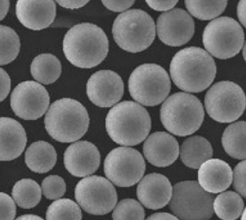
The difference is usually not visible in a one-line chemistry description. Standard copper powder for press-and-sinter applications may have acceptable purity but still be unsuitable for powder-bed fusion because the particles are irregular, the size range is too broad, or the oxide condition is too high. AM-grade copper is therefore a tighter specification class rather than a simple commodity form.
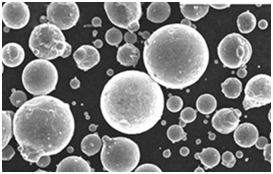
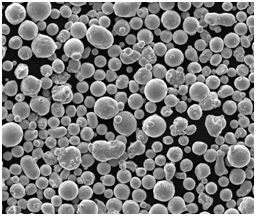
Shape is one major differentiator. Spherical particles reduce interparticle friction and improve powder recoating, which helps build uniform layers. That is why gas atomization and other spherical-powder routes dominate the AM market for copper, while water-atomized grades remain more common in conventional PM.
Why engineers specify pure copper instead of copper alloys
The answer is usually functional performance. When a part exists primarily to move heat or conduct current, pure copper often outperforms CuCrZr, bronze, brass, or nickel-containing alternatives. Those alternatives may print more easily or offer higher strength, but they generally do so by giving up some conductivity.
This trade-off explains why pure copper is common in thermal management and electrical systems, while alloyed powders are more common in mixed-load structural service. In early-stage design reviews, engineers often compare pure copper against materials from a wider copper alloy powder range to determine whether conductivity or mechanical robustness is the dominant requirement.
Composición química y calidad del material
The chemistry of pure copper powder for additive manufacturing is usually specified around a high-copper base with strict limits on metallic and nonmetallic impurities. In practice, the most consequential “composition” issues are often trace elements and oxygen rather than the headline copper percentage. Sulfur, lead, bismuth, iron, phosphorus, and oxide content can affect conductivity, process stability, or downstream joining behavior even when they appear only in small amounts.
For this reason, many procurement teams use wrought copper grades only as reference points, then add powder-specific controls. The powder specification may call out not only copper content, but also oxygen maximums, particle size windows, morphology targets, and permitted residuals from melting and atomization practice.
| Powder Type / Reference Concept | Cu (wt%) | Key Residual / Alloy Limits (typical) | Oxygen Condition | Grade Cross-Reference / Equivalent |
|---|---|---|---|---|
| AM pure copper, ETP-type reference | ≥ 99.7 | Trace Ag acceptable; Fe, Pb, S, Bi controlled | Low to moderate, process-specific | Similar chemistry concept to ASTM/UNS C11000, GB T2, DIN E-Cu57, ISO/EN ETP copper references |
| AM pure copper, oxygen-free reference | ≥ 99.95 | Total impurities tightly controlled | Very low oxygen target | Similar chemistry concept to ASTM/UNS C10100 or C10200, GB TU1/TU2, DIN OF-Cu |
| AM pure copper, low-oxygen custom grade | ≥ 99.9 | Residuals per purchaser specification | Low oxygen, defined by application | Cross-reference often project-specific rather than a direct wrought standard match |
| AM pure copper, electron-beam or specialty feedstock | ≥ 99.9 | Low volatile and low tramp elements | Tight oxygen and cleanliness control | Internal supplier specification mapped to ASTM / GB / DIN chemistry baselines |
| PM / spray pure copper feedstock | ≥ 99.5 to 99.9 | Residuals depend on route and application | Application-dependent | May align with broader industrial copper powder grades rather than strict AM-only specifications |
Purity targets for pure copper powder for additive manufacturing
For conductivity-driven applications, copper content alone is not enough. A supplier may report 99.9% copper, but if the remaining 0.1% includes unfavorable oxygen or tramp elements, performance can still be compromised. That is why advanced users focus on both total purity and the impurity profile.
In AM, the oxygen issue is particularly important. Oxide films can influence laser coupling, melt-pool behavior, and the conductivity of the finished part. In some cases, powder that looks chemically acceptable on a bulk basis still underperforms because oxide distribution and surface condition were not tightly controlled.
Grade selection by end-use environment
Oxygen-free reference chemistries are usually favored for high-end electrical and vacuum-sensitive applications. They also make sense where post-processing includes brazing or joining steps that benefit from cleaner copper.
ETP-type compositions may be adequate for certain industrial thermal components when the complete build-and-post-process route has already been validated. Custom low-oxygen grades are increasingly common because AM users want the flexibility to define their own acceptance criteria rather than inherit a wrought standard without modification.
Standards language versus powder reality
There is no single universal AM standard for pure copper that covers every machine, every size cut, and every application. Instead, manufacturers often combine recognized copper grade concepts with test frameworks borrowed from powder metallurgy and additive manufacturing. That hybrid approach is common in real procurement practice because the powder must satisfy both metallurgical and process requirements.
Especificaciones técnicas
Technical specifications for pure copper powder for additive manufacturing usually include particle size distribution, apparent density, tap density, Hall flow, oxygen content, and sphericity. These metrics are not independent. A very fine powder may improve surface detail but can also increase oxidation sensitivity and alter spreadability. Likewise, a coarser powder may feed well in DED but be unsuitable for thin-layer powder-bed processing.
The most common AM size cuts are chosen to match layer thickness, recoater design, and energy input strategy. For copper, the interaction between PSD and process window can be especially sensitive because melt-pool stability depends on both packing efficiency and energy absorption. Users therefore tend to qualify copper powder at the machine-and-parameter level rather than assume one specification will work universally.
| Typical Use Class | PSD Range (µm) | Densidad aparente (g/cm³) | Tap Density (g/cm³) | Hall Flow (s/50 g) | Contenido de oxígeno | Sphericity / Morphology |
|---|---|---|---|---|---|---|
| Fine AM powder for laser powder bed fusion | 15–53 | 4.5–5.2 | 5.0–5.8 | 16–24 | typically low, purchaser-defined | Highly spherical, low satellite content |
| Standard AM copper powder | 20–63 | 4.6–5.3 | 5.1–5.9 | 15–23 | typically low, purchaser-defined | Spherical with controlled fines |
| DED / cladding copper powder | 45–105 | 4.7–5.4 | 5.2–6.0 | 14–22 | application-specific | Esférico a casi esférico |
| Coarser PM / spray copper powder | 53–150 | 4.8–5.5 | 5.3–6.1 | 13–21 | application-specific | Spherical, broader PSD acceptable |
| Custom user-defined fraction | per drawing | per specification | per specification | per specification | per specification | per specification |
Particle size distribution in copper AM powder
For laser powder-bed fusion, 15–53 µm and 20–63 µm are common because they offer a workable balance between layer quality and powder handling. Finer cuts can support thinner layers and improved feature resolution, but they may also raise storage, safety, and oxidation concerns. Coarser fractions are more typical in processes where powder feeding, not recoating, governs performance.
The exact distribution shape matters as much as the nominal top and bottom cut. Too many ultrafine particles can disturb flow and increase oxygen pickup. Too many coarse particles can reduce layer uniformity or interfere with thin recoating strategies.
Interpreting density and flow data
Apparent and tap density provide indirect information about packing behavior. Higher values usually indicate a more efficient powder bed, but the interpretation depends on shape, surface texture, and PSD. These tests are useful screening tools, not stand-alone proof of printability.
Hall flow is widely used because it is quick and familiar. However, copper powder can exhibit acceptable Hall flow yet still behave poorly during recoating if there is excessive satellite content or an unfavorable fines tail. For that reason, buyers often combine Hall flow with image-based morphology analysis and laser diffraction or sieve data.
Surface condition and oxygen control
For high-conductivity applications, oxygen control is one of the most consequential technical parameters. Low oxygen does not guarantee success, but excessive oxide can undermine the very reason pure copper was selected in the first place. This is why some customers specify powder storage, packaging atmosphere, and resealing practice as part of the technical requirement.
Many companies align specification language with broader ASTM materials standards resources and internal AM qualification protocols. In engineering discussions, reference property data from NIST materials science resources also helps frame why conductivity retention and impurity control matter in copper systems.
Aplicaciones en distintos sectores
Pure copper powder for additive manufacturing is most compelling where conductivity and geometric complexity have to coexist. Traditional copper fabrication is excellent for bars, sheets, tubes, and many machined parts, but it becomes less efficient when the design requires internal passages, monolithic manifolds, localized heat transfer control, or low-volume customization.
The strongest adoption driver is thermal management. Copper’s ability to transport heat makes it attractive for parts exposed to high local flux, rapid thermal cycling, or compact packaging constraints. The same logic applies to electrical designs in which current path efficiency and assembly simplification create value.
| Industria | Typical Part | Primary Functional Requirement | AM / PM Process |
|---|---|---|---|
| Aerospace and space | Combustion liners, thermal straps, RF waveguide components | High heat flux dissipation and conductivity | L-PBF, DED, specialty AM routes |
| Electronics and 3C | Heat spreaders, compact cooling plates, connector-adjacent thermal parts | Fast thermal transfer in tight packaging | L-PBF, binder jet with sintering, PM |
| Tooling and molds | Conformal-cooled inserts, localized heat extraction blocks | Reduced cycle time and controlled thermal gradients | L-PBF, DED, HIP-assisted routes |
| Energía y potencia | Cooling blocks, busbar support features, induction hardware | Current carrying and heat removal | L-PBF, PM, cladding |
| Automoción y deportes de motor | Inverter cooling structures, e-motor thermal components | Weight-efficient thermal management | L-PBF, DED |
| Medical and scientific equipment | Custom thermal stages, specialty instrument components | Stable heat transfer and low-volume precision manufacture | L-PBF, PM |
Thermal management applications with pure copper powder for additive manufacturing
In cooling hardware, additive manufacturing opens a design space that wrought copper cannot always reach economically. Internal channels can follow heat sources more closely, cross sections can vary along the flow path, and manifold functions can be integrated into one build. This reduces brazed joints and can shorten the thermal path between source and coolant.
These advantages are particularly relevant in electronics, aerospace, and power systems. When the designer can tune the cooling geometry instead of merely selecting a thicker block of copper, material performance and structural design begin to work together rather than compete.
Electrical and electromagnetic components
Pure copper also serves in specialized electrical parts where the geometry is too intricate for conventional fabrication. Examples include compact conductors, induction features, RF-adjacent components, and housings that combine mechanical and conductive functions. AM is not always the lowest-cost route, but it can be the best route when assembly reduction or performance integration drives the business case.
Comparing copper with other AM metals
Copper is rarely evaluated in isolation. Aluminum may be chosen where lower density matters more than peak conductivity, stainless steel where corrosion resistance or structural stiffness dominates, and nickel alloys where high temperature service is decisive. That is why engineering teams often review lightweight aluminum powder grades y stainless steel powder options alongside copper during concept selection.
Fabricación y control de calidad
Most pure copper AM powder is produced by gas atomization, where a copper melt is disintegrated into droplets by high-pressure inert gas and then rapidly solidified. The resulting particles are classified to the required size range and subjected to release testing. The route is industrially attractive because it offers a good balance of throughput, morphology control, and commercial scalability.
That said, copper places unusual demands on the process. Oxygen pickup can occur at several stages, including melting, atomization, collection, classification, and packaging. Process discipline therefore matters just as much as equipment capability. Even a well-designed atomizer can yield inconsistent copper powder if gas purity, handling atmosphere, or powder transfer practice is not tightly controlled.
| Powder-Making Route | Typical Strengths | Typical Limitations | Best-Fit Use Cases | Relative Cost / Throughput |
|---|---|---|---|---|
| Gas Atomization (GA) | Good scalability, spherical powder, flexible PSD control for copper and copper alloys | Oxidation and satellite control require disciplined processing | Mainstream AM, PM, cladding, spray copper feedstock | Balanced cost and high industrial throughput |
| DEBERES | Very clean and highly spherical powder with low contamination risk | Higher cost and less common for commercial pure copper economics | Premium specialty powders and demanding clean-feedstock programs | Higher cost, lower general throughput |
| VIGA | Strong atmosphere control with integrated melting and atomization | Higher capital complexity and process-specific economics | High-purity specialty powder production | Medium to high cost |
| Atomización del agua | Low cost and high productivity for conventional PM routes | Irregular shape, higher oxidation, poor AM recoating behavior | Press-and-sinter copper parts rather than advanced powder-bed AM | Lower cost, very high throughput |
| Plasma-related routes | Very spherical particles and high cleanliness in selected systems | Typically expensive for pure copper business cases | Niche high-specification programs | Coste elevado |
Quality assurance for spherical copper powder
A copper powder QA plan typically begins with raw material verification and ends with sealed lot release. Between those points, the producer may check chemistry, oxygen, particle size distribution, apparent density, tap density, Hall flow, morphology, and contamination. The exact sequence varies, but the principle is consistent: powder qualification is multivariable.
For AM users, morphology evidence is increasingly important. A certificate showing acceptable chemistry does not reveal satellites, agglomerates, or elongated particles that may harm recoating. That is why image-based analysis, SEM review, or optical particle characterization often complements standard bulk tests.
Acceptance criteria are process-dependent
There is no universal pass/fail window that suits every copper application. A laser powder-bed process for fine thermal features may need a narrower PSD and lower oxide state than a coarser DED repair process. Qualification should therefore be tied to machine platform, layer thickness, shielding gas strategy, and target part properties.
This process-specific mindset is one reason copper projects often involve several evaluation stages rather than a single incoming inspection. A technically sound supplier should understand that a powder is only “good” relative to the process it is meant to support.
¿Por qué elegir a Truer como proveedor?
Supplier selection for pure copper powder for additive manufacturing is usually based on control, traceability, and process understanding rather than on catalog language alone. Buyers want to know whether the powder source understands how chemistry, PSD, sphericity, oxygen, packaging, and downstream process choice fit together in real production settings.
Truer’s relevance in this context comes from its connection to both powder-making technologies and end-use additive manufacturing processes. Because the company works with gas atomization, PREP-related equipment, and metal AM applications, it is positioned to discuss copper powder not just as a material certificate, but as a feedstock for SLM, SEBM, DED, laser cladding, PM, and related manufacturing routes.
For technical buyers, the main differentiator is often lot-to-lot consistency supported by application-aware documentation. Copper parts can be sensitive to small changes in powder behavior, especially during early machine parameter development. That makes supply continuity, particle-size stability, and practical communication more important than a simple headline purity claim.
Projects involving several metals may also benefit from a broader supplier base under one qualification path. When design teams compare copper against titanium, cobalt, or nickel systems for different part families, a linked titanium alloy powder portfolio or adjacent powder offering can simplify vendor management while keeping technical review consistent.
Guía de pedidos y asistencia
The most effective way to order pure copper powder for additive manufacturing is to define the application first and the grade second. Buyers should indicate the intended process, machine platform, target PSD, oxygen expectations, packaging preference, and whether the final part is conductivity-critical. Without those details, two technically “pure” copper powders can differ enough to produce very different results on the shop floor.
Most copper AM programs also benefit from staged qualification. A small sample can establish baseline parameter behavior, a pilot lot can confirm repeatability across builds, and a production lot can then be frozen around the validated window. This approach reduces the risk of overcommitting before the powder and process are aligned.
| Packaging Format | Typical MOQ Tier | Typical Lead Time | Sample Policy | Notas |
|---|---|---|---|---|
| 500 g bottle | R&D evaluation | 1–2 weeks if material is available | Small paid or approved qualification sample | Suitable for initial parameter screening |
| Botella de 1 kg | Early prototype builds | 1-3 semanas | Common first-stage evaluation size | Often used for coupons and conductivity checks |
| 5 kg sealed unit | Pilot production | 2-4 semanas | Usually supplied after initial screening | Useful for repeatability studies |
| 10–25 kg drum | Pre-production / production | 3–6 weeks depending on specification | Generally follows qualification approval | Preferred for controlled lot release |
| Custom industrial pack | Volume programs | Project-based | Not normally used for early sampling | May include inert packing and custom labeling |
What to include in an RFQ
A strong RFQ should specify chemistry target, particle size range, process route, estimated annual usage, and documentation needs. If the part is for aerospace, medical, nuclear, or regulated electronics service, those compliance expectations should be identified at the quoting stage rather than after sampling.
It is also useful to state whether the application prioritizes conductivity, dimensional accuracy, surface finish, or deposition rate. Those priorities help determine whether a finer or coarser copper powder cut is the better fit.
Sample evaluation and technical support
For new builds, sample quantities are most useful when paired with a clear evaluation plan: coupon density, conductivity, microstructure, and post-process testing. That creates a practical basis for scaling from trial lots to recurring supply.
When a project includes custom PSD targets, unusual packaging, or process-specific acceptance windows, a direct discussion through the technical contact channel can shorten qualification time and reduce specification drift.
Nuestra compañía
Shanghai Truer Technology Co., Ltd. was established in 2009 and created its additive manufacturing business in 2019. The company focuses on integrating 3D printing powder-making equipment and services with metal powders for additive manufacturing applications. Its core technologies include Selective Electron Beam Melting equipment, Plasma Rotating Electrode Process powder-making equipment, and gas atomization. The powder portfolio includes TiNi, TiTa, TiAl, TiNbZr, CoCrMo, and spherical nickel-based, cobalt-based, titanium-based, copper-based, aluminum-based, and stainless steel powders for processes including SLM, SEBM, DED, laser cladding, PM, MIM, HIP, cold or hot spraying, welding, and coating. Additional background is available in the company overview page.
Preguntas más frecuentes
Q1. Is pure copper powder for additive manufacturing difficult to print?
Yes, relative to many common AM alloys, pure copper is considered more demanding because of its high reflectivity and thermal conductivity. Those properties can narrow the process window and make energy absorption less forgiving. With suitable powder quality, machine settings, and atmosphere control, however, stable production is achievable.
Q2. What particle size is best for pure copper powder for additive manufacturing?
For laser powder-bed fusion, 15–53 µm and 20–63 µm are common starting ranges. The best choice depends on layer thickness, recoater design, laser strategy, and part geometry. Coarser cuts are often preferred for DED or cladding rather than fine powder-bed applications.
Q3. Why is low oxygen important in pure copper AM powder?
Low oxygen helps preserve conductivity and can improve process consistency. Excess oxide may affect melt behavior, surface chemistry, and final part performance, especially in demanding thermal or electrical service. That is why many buyers specify oxygen separately from overall copper purity.
Q4. Is pure copper powder better than CuCrZr for additive manufacturing?
It is better when conductivity is the primary design objective. CuCrZr and similar alloys may provide higher strength and easier overall processability, but they usually do so with lower thermal and electrical conductivity than pure copper. The correct choice depends on whether the part is mainly functional, structural, or both.
Q5. Can pure copper powder for additive manufacturing be reused after printing?
In many operations, yes, but reuse should be governed by a documented powder management protocol. Screening, blend-back ratio, oxygen trend monitoring, and morphology checks are important because copper powder properties can shift with repeated exposure and handling. Reuse policy should always be validated against part requirements.
Q6. What should I ask a supplier before buying pure copper AM powder?
Ask for chemistry, oxygen level, PSD data, apparent and tap density, Hall flow, morphology information, packaging details, and lot traceability. It is also wise to ask how the powder was qualified for the intended process and whether sample-to-production consistency is documented. Those details are usually more useful than a single purity number on its own.