Additive Manufacturing with Invar 36 Alloy
Introducción
Invar 36 (4J36)(FeNi36) alloy is classified as a low expansion alloy and a precision alloy. Due to its extremely low coefficient of thermal expansion (CET) under conditions of temperature change, this type of alloy is an indispensable material in precision equipment.
Comparison of the thermal expansion coefficients of Invar alloy and other alloys (average value from 20℃ to 200℃)
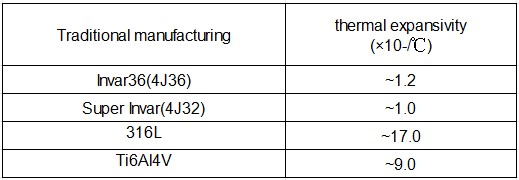
Traditional manufacturing of FeNi36 (Invar 36) alloy
The traditional manufacturing methods of Invar 36 alloy mainly include casting, forging, powder metallurgy, welding and rolling.
In terms of component manufacturing, the traditional manufacturing method encounters technical difficulties.
– High tendency to undergo work hardening: During the cutting process, the compression and friction exerted by the cutting tool on the Invar alloy cause intense plastic deformation of the surface metal, resulting in a rapid increase in hardness. This significantly aggravates tool wear, reduces processing efficiency, and may lead to a deterioration in the surface quality of the workpiece.
– Thermal stress sensitivity: This type of alloy has an extremely low thermal conductivity. The heat generated during cutting is difficult to conduct and diffuse rapidly, and localized high temperatures can cause significant thermal stress. This thermal stress is highly likely to lead to uncontrollable deformation of precision parts, making it difficult to maintain the micron-level dimensional accuracy.
– High cutting force and rapid tool wear: Due to the high plasticity and toughness of Invar 36 alloy, the chips are not easily broken and tend to adhere to the rake face of the tool, forming chip lumps. This not only increases the cutting force but also aggravates the adhesion wear and diffusion wear of the tool, requiring the use of high-performance hard alloy coated tools.
Chemical composition of Invar 36 powder (wt%)
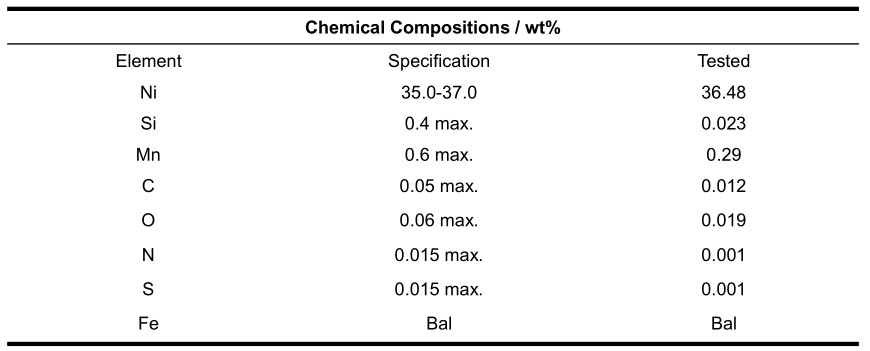
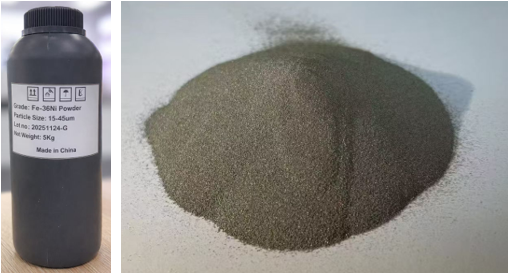
TRUER Lot No. : 20251124-G
When the temperature rises, the expansion caused by the atomic vibration of Invar alloy is counteracted by its magnetic property. This effect is optimal when the Ni content is 36%. Another important role of Ni in Invar alloy is to act as an austenite stabilizing element, keeping the Invar alloy in the austenite phase within the working temperature range and avoiding size changes caused by phase transformation.
In some studies aimed at enhancing the tensile properties of Invar alloys, trace amounts of elements such as Mo, Ti, V, Cr, and Nb were introduced, such as TRUER FeNi42Mo. Although the alloys were strengthened and the working temperature range was expanded, it led to an increase in the thermal expansion coefficient.
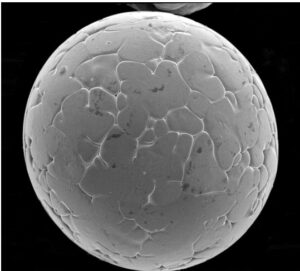
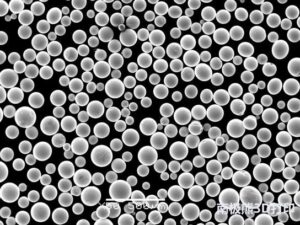
SEM photo of Invar 36 powder
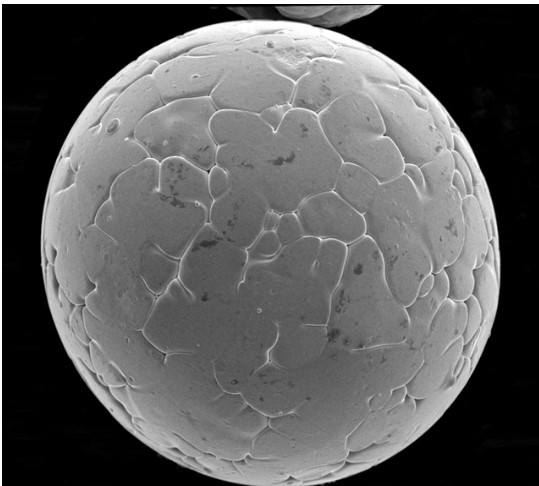
Obtaining finer grains has a positive effect on enhancing the performance of Invar alloy. However, in terms of composition modification, it is difficult to avoid the trade-off between gains and losses.
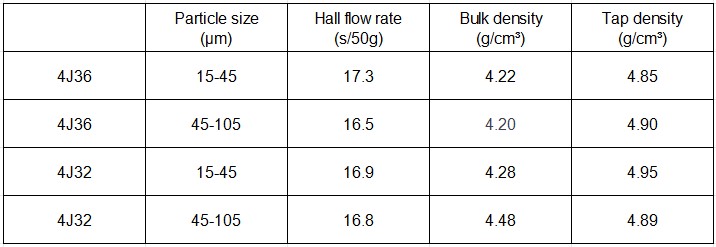
Physical properties of Invar 36 powder
Additive manufacturing for invar 36 powder
The main methods of additive manufacturing with Invar 36 powder include Selective Laser Sintering (SLS), Laser Powder Bed Fusion (LPBF), Directed Energy Deposition (DED), Cold Spray Additive Manufacturing (CSAM), and Adhesive Jetting (BJT), etc.
Compared with traditional manufacturing, additive manufacturing offers more control and flexibility over the microstructure. Additionally, additive manufacturing can produce complex components, lattice structures, gradient materials, and composite materials. The Invar 36 alloy manufactured by LPBF, even without heat treatment, achieves a lower thermal expansion coefficient and higher tensile strength than that produced by traditional manufacturing.
Performance of LPBF manufactured samples (in the transverse direction)

Invar alloys fabricated by LPBF exhibits remarkable tensile properties and high-cycle fatigue performance at room temperature, as well as a CTE that is comparable to or even lower than that of the forged samples.
Within the standard composition range, the yield strength of the superalloy fabricated by additive manufacturing is mainly influenced by the grain size, while the thermal expansion coefficient is mainly affected by the porosity, composition and residual stress.
Optimizing the energy density and controlling the thermal gradient are of great significance for refining the grain structure and reducing the porosity.
The residual stress produced by LPBF manufacturing can have a positive effect on the reduction of CTE. This is the reason why LPBF manufacturing of Invar alloys does not require stress elimination annealing or other heat treatments.